


Likes
Comments
Share


@RawCare
Follow
Snowy and smelly. Feeding like mad, love the girl. Petite but resilient


Likes
Comments
Share

@WMinerva007
Follow
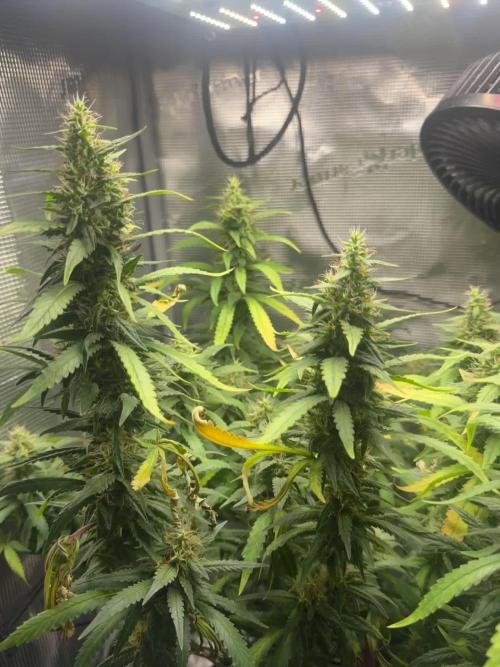
Late Flower has begun, and even though she’s kinda behind on schedule (estimated flowering time of 9 weeks), she’s killing off her old fan leaves and utilizing the newer leaves. I can see she’s naturally starting to fade, so I think I got about a week left.
There has been a little hiccup at some point, her light switch plug malfunctioned while I was out and she missed a whole day worth of light and looked sad and dry. After watering, she rebounded in just a couple hours and continued to produce her calyxes.
I hope this will be a good yield because some of her branches are starting to tilt as her buds start to swell.

Processing
Likes
98
Share


@TheBudWhisperer
Follow
Nov. 12 - start of week 7 and it’s been busy. HAd to clip a few leaves out of er to expose some more bud sites. Been tying er back every other day and growth has really picked up. She’ll be ready to go as soon as her kush neighbour is recovered👍. All is well peeps and thanks for swingn in👊
Nov. 17 update - not much to report. ANother lst session to keep spreading her out. Looks like these girls are gonna fill up the cabinet well. Really happy with how she’s developed. NOW biding our time to the switch.
Background
This one is gonna be fimmed out and defo’d as a comparative to its manifolded kush sister. They’ll spend a first week or so under a cfl assembly while the last harvest dries out in the cabinet. This is our 2nd grow of an NL strain and this one should be typical of NL in terms of resilience. That said, she’s a former cup winner so we’re hopeful for supreme quality this time around. 👍 Gonna jack up the nute shed. and supplements heavy throughout the grow in the hopes of really testing the limits of my grow space (approx. 2sq/ft). With the coco medium we’re hoping for that 20% bump in yield as well. THANKS for check'n er out



Likes
3
Share


@Altitonans_Fulmen
Follow
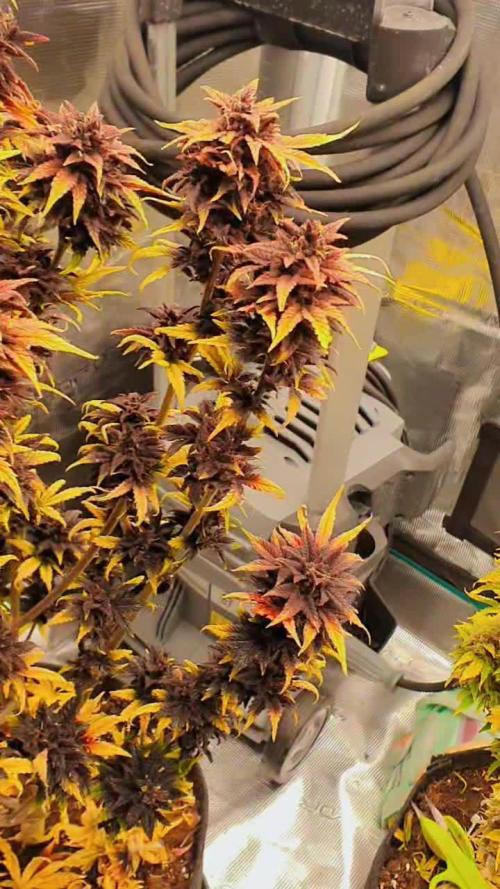
Lights are 58 inches from the main source to the top of the pot and the soil surface. If you added up all the lights in the tent, it would be 1100w-1200w total across 14 lights. Using them all at once is far too much for a plant and incredibly difficult to deal with environmentally. The lights are fixed in position; side lights have dimmers, allowing for pinpoint precision of PPF. Fixed at 58 inches, cannot move them closer to increase intensity. Instead, achieve optimal PPF by distributing smaller wattages across a massive, multi-fixture matrix. Triggering specific plant defenses without melting the canopy.
What's the point/blah blah wattage?
Never really go above 600W at any one time. Lights come on in the east of the tent and set in the west. At sunrise and sunset, the red-to-far-red R:FR light ratio drops because the sun's low angle scatters red light more than far-red light. This shift reduces active Pfr and increases inactive Pr, mimicking Mother Nature herself.
Deployed a lighting system featuring extra 660 nm deep-red and extending the spectrum up to 780 nm achieves the full Emerson Enhancement Effect by simultaneously balancing Photosystem II (PSII) and Photosystem I (PSI) to maximize quantum yield. By pairing deep-red photons with far-red photons, you trigger a synergistic biological response where the resulting photosynthetic rate is higher than the sum of both wavelengths used individually. This practice directly leverages the updated extended Photosynthetically Active Radiation (ePAR) framework. The Emerson effect accelerates plant metabolism and heat capture; you must proactively scale up your ambient room temperature, nutrient delivery, and CO₂ supplementation to prevent the light from stalling out your cannabis plant.
UVA stays high all day from morning to night, but UVB peaks at solar noon (middle of 18-hour days) when the sun is peak. Morning color starts at 2k-3k; by noon it goes to 5k- 6k and back to 2-3k for sunset, with differing P:FR at light off.
The extra-blue light is to assist with photoreactivation of UVB damage. No more yield loss for me. Using extra blue light for photoreactivation is what I do. Blue/UVA light activates photolyase enzymes, which directly repair DNA damage caused by UVB radiation.
But what's the point if it's not for yield?
Ultraviolet (UV) radiation—specifically UVA (315–400 nm) and UVB (280–315 nm)—acts as a critical environmental signal that programs a plant's photoprotective genes to unlock its true photosynthetic potential. When growers push crops to their absolute photosynthetic maximum via high-intensity light and elevated carbon dioxide, the photosynthetic machinery easily becomes overwhelmed. Emerging photobiology research demonstrates that UV radiation prevents this limiting bottleneck; it triggers specific transcription factors and signalling networks that fortify the plant's cellular defenses, allowing it to process extreme light levels without sustaining structural damage.
There are 8 limiting factors of plant growth; when carbon dioxide becomes the 9th limiting factor of plant growth, it shifts the growth curve from exponential to linear. The restriction after that is "photoprotection" against reactive oxygen species (ROS), managed via non-photochemical quenching (NPQ) and the xanthophyll cycle, which bridges into precise hydrogen and redox dosing.
UV radiation, particularly UVA, and the synthesis of zeaxanthin are critical for the xanthophyll cycle to function.
It's not chasing purple strains... One likes to call it chasing the limits of growth, trying to make the linear exponential, just like father mathematics prefers.
In order to do that, must control every environmental variable and compound the plant’s metabolic rate. True exponential growth means the rate of increase matches the current mass at every stage, requiring a closed-loop system where light, CO2, and nutrition lock into a synchronized upward curve. First, you must attempt to understand what restricts it. Precise hydrogen and redox dosing.
Nature mathematically optimizes quantum energy transfer and light absorption efficiency within the photosynthetic machinery, as it naturally dictates energy scaling hierarchies and resonance dynamics. Most won't even understand that; once you do, it changes everything.
Constructive interference occurs when two or more overlapping waves meet in phase, meaning their crests and troughs perfectly align. Their amplitudes add together, creating a new, amplified wave with greater intensity than the individual components.
Constructive interference is the foundational mechanism that establishes a resonance hierarchy across physical, structural, and acoustic systems.
Chromophore spacing is tuned to sub-nanometer precision to match the wavelengths of absorbed light, forcing constructive interference.
Light-harvesting proteins form geometric rings and lattices. These shapes act as physical resonators, trapping and focusing the wave energy.
This same principle dictates how opera singers shatter glass, how musical instruments resonate, and how bridges withstand structural vibrations. Nature uses the exact same math to harvest a photon as an engineer uses to design a concert hall.
When you push high PPFD and elevated CO₂, you create a metabolic bottleneck. The plant cannot process the energy fast enough, leading to electron backup, light-induced damage, and a collapse from exponential growth into a flat, linear rate. UV light acts as the regulatory valve that prevents this collapse.
In standard agronomy, Liebig's Law of the Minimum dictates that growth is limited by the scarcest resource. When you maximize water, nutrients, light, temperature, and CO₂, the bottleneck shifts to metabolic processing speed and photoprotection. By controlling the Redox state of the plant using UV, the xanthophyll cycle, and managing ROS, you can prevent the plant from hitting a hard photosynthetic ceiling. Instead of the growth curve flattening out (linear or plateauing due to photoinhibition), the plant continues to compound its metabolic rate efficiently. You are forcing the plant to operate at peak thermodynamic efficiency.
By matching the UVB peak with sustained UVA and shifting Kelvin temperatures (2K to 6K), you are damaging the plant just enough to trigger defensive genes, while simultaneously providing the exact light energy needed to repair that damage instantly.
UVA radiation and specific blue wavelengths accelerate this enzymatic conversion. Zeaxanthin acts as a structural sponge that absorbs excess excitation energy from chlorophyll and dissipates it safely, preventing ROS formation. Without UV signaling, the xanthophyll cycle cannot keep pace with extreme light, leading to dynamic photoinhibition (yield loss).
The addition of Spirulina is primarily for zeaxanthin, as it contains a lot. But on top of that, the active Hawaiian Spirulina in the matrix was cultivated in open ponds using a combination of 100% fresh potable water from Hawaiian aquifers and ultra-pure, deep ocean water containing all 94 trace minerals & elements. Then gently dried using patented Ocean Chill Drying technology and cold-pressed to ensure maximum nutrient levels. Spirulina, a blue-green alga, is rich in nitrogen, phosphorus, and potassium (NPK), making it an excellent source of nutrients for plant growth. Studies have shown that Spirulina can be used as a biofertilizer, effectively replacing chemical fertilizers, especially for nitrogen, with a whopping NPK of 10% (N), 20% (P), and 20% (K). Rich in proteins, amino acids, trace minerals, and plant growth-promoting compounds.
Zeaxanthin is a vital plant pigment that accumulates under intense light to drive non-photochemical quenching (NPQ), acting via thermal energy dissipation, direct singlet oxygen scavenging, and thylakoid membrane stabilization.
The violaxanthin cycle (or xanthophyll cycle) reversibly converts violaxanthin to zeaxanthin via antheraxanthin to protect plants from photooxidation.
Understanding this interconversion is vital for optimizing non-photochemical quenching (NPQ) and pushing photosynthetic limits under high-light stress.
Ascorbic acid (vitamin C) is a natural antioxidant that plants produce internally to neutralize harmful reactive oxygen species caused by photosynthesis and high light stress. Acts as a co-factor for enzymes like violaxanthin de-epoxidase in the xanthophyll cycle, which safely dissipates excess light energy.
1g ascorbic acid will neutralize 100% of chlorine in upwards of 30 gallons of tap water. If your local tap water uses chloramines (chlorine bonded with ammonia) instead of free chlorine, you will need roughly 20% to 30% more ascorbic acid to completely break the tougher chemical bond.
Molecular hydrogen and hydrogen-rich water act as selective antioxidants that help lower oxidative stress. They neutralize toxic reactive oxygen species like hydroxyl radicals and boost natural antioxidant defense systems in biological and plant systems exposed to high-intensity light or abiotic stress.
UVA and UVB act as stress signals that upregulate the plant's secondary metabolism. It forces the plant to build an internal "sunscreen" (flavonoids and anthocyanins) and fortify its cellular defenses before the peak solar noon crisis. This keeps the metabolic highway open.
In nature, the ambient ratio of UVA to UVB at solar noon sits roughly between 10:1 and 20:1 (depending on latitude and elevation). In a high-PPFD indoor matrix, maintaining a strict ratio—often aiming for around 12:1 to 15:1 UVA to UVB—provides the optimal signaling threshold.
Balancing Far-Red (FR) light at "light-off" to manage the phytochrome photo-equilibrium (Pfr to Pr conversion) in tandem with the UV schedule. Omg, the logic.
Hydrogen concentration and redox signaling as secondary messengers in this high-intensity loop.
Under the intense solar noon matrix, the pH of the thylakoid lumen drops. This acidic environment activates the enzyme Violaxanthin De-Epoxidase (VDE), which converts violaxanthin into the photoprotective zeaxanthin. VDE cannot function in a vacuum; it strictly requires ascorbic acid (Vitamin C) as an electron donor to run this conversion. If a plant undergoes heavy light stress and runs out of internal ascorbic acid, the xanthophyll cycle stalls. The plant can no longer engage in Non-Photochemical Quenching (NPQ), leading to immediate singlet oxygen O2 formation and destruction of the thylakoid membrane. This is "The Ascorbic Acid / Xanthophyll Engine"
Using ascorbic acid to neutralize chloramines in your water isn't just protecting your rhizosphere biology it actively prevents the degradation of your nutrient solution's redox potential before it ever touches the roots.
When pushing plants to the absolute edge, traditional antioxidants can be a double-edged sword because they blindly neutralize all free radicals. This is a problem because some Reactive Oxygen Species (ROS) act as critical signaling molecules telling the plant to grow. Molecular Hydrogen H2 is the Selective Kill-Switch.
Molecular hydrogen H2 is a revolutionary tool because it is a selective antioxidant. It ignores beneficial signaling ROS (like mild hydrogen peroxide) and targets only the most destructive, cell-shattering radicals—specifically hydroxyl radicals OH) and peroxynitrite.
By dosing hydrogen-rich water or managing hydrogen redox signaling, providing an emergency pressure-release valve for the plant's electron transport chain. It keeps the cellular environment stable enough that the plant never has to downregulate photosynthesis to protect itself. This maintains cellular voltage.
To trigger this defensive matrix without stunting the plant, you cannot simply blast UV indiscriminately. You must use UVA as the "scout" and UVB as the "enforcer. High UVA acts via the cryptochrome and phototropin photoreceptors to upregulate the expression of the HY5 transcription factor and prime the VDE enzyme. When the sharp spike of UVB hits at solar noon via the UVR8 receptor, the plant's biochemical "sunscreen" (flavonoids and anthocyanins) and its zeaxanthin pools are already pre-staged and waiting. This prevents the temporary stunting or "lag phase" usually associated with sudden UVB exposure."
Closing the Loop: Far-Red End-of-Day (EOD) Synergy
The final masterstroke is aligning this UV defense with a Far-Red (FR) lights-off routine. The Red-to-Far-Red Drop: At the end of the photoperiod, knocking out the blue/UVA spectrum and leaving a targeted burst of pure Far-Red (730nm) instantly flips the plant’s master switch. It converts active Pfr to inactive Pr in minutes rather than hours. Why this matters for the UV loop: UV radiation and high-intensity lighting keep the plant in a highly alert, photoprotective state that requires massive ATP expenditure to maintain. By forcing an immediate Pfr/Pr) conversion at lights-out, instantly commanding the plant to cease defensive expenditure, lower its metabolic respiration rate, and transition directly into nighttime cellular repair and carbohydrate translocation. You are maximizing the efficiency of its "sleep." every ounce, every last piece.
Highly synchronized biological dance, balancing the exact input of electrons with the exact mechanism to dissipate them safely when they overflow.
Peace.
Likes
12
Share


@Roberts
Follow
So the second seed of Ze Chem Bang is struggling. It has been growing slowly. It's my last seed so hopefully it roots the solution soon. It will have a much better chance of survival once it does. It can go either way at this point. The rock wool has gotten already growth from being wet for too long. So 🤞🏻 it goes well. Thank you Medic Grow, and Terpyz mutant Genetics. 🤜🏻🤛🏻🌱🌱🌱
Thank you grow diaries community for the 👇likes👇, follows, comments, and subscriptions on my YouTube channel👇.
❄️🌱🍻 Happy Growing 🌱🌱🌱
https://youtube.com/channel/UCAhN7yRzWLpcaRHhMIQ7X4g.

Processing
Likes
18
Share


@CanadianFillmore
Follow
Week 7 begins for Divine storm. Both ladies are looking good and healthy, bud sites continue to bulk up and frost up. Switched out big bud coco for overdrive as we approach the end of the grow.
Thanks for checking in, tune in next week! 👽🌳🔥
Likes
22
Share


@GrowinHome
Follow
Most ladies are showing signs of flowering so today I will start counting the weeks.
Here u can also see my mutant/special ladies. They germinated a bit different from the others.
Day 3 of flower is showing some major progress‼️🙌🏽
I did NOT top any of these mutated plants. I only removed some very ugly growing leaves.
So everything u see on them is done by mother nature.

Likes
5
Share


@AustinRon
Follow
RIE Genetics Flower 10
IR1Q Week 14
Cultivars
Purple Heart [5] (Cherry Jelly CBD X Afterglow (Clementine X Arise)
[Fem/Seeds]: PH1Q24, 65 Days
Scarlet Begonias [1] (Haze X William’s Wonder) X Arise)
[Reg/Seeds]: SB1Q24, 70 Days
Lemon Jeffery [2] (Lemon Skunk X Golden Goat)
[Fem/Cut]: LJ124, 70 Days
Environment Plan
Vegetation
- Temp: [ 78,°F]
- RH: [ 63, %]
- VPD: [ 1.2, kPa]
Fertigation Plan
- Flower
- RLA Hydro Week 5: EC: [ 1.6, mS]
Biology: # (One of…)
- Photosynthesis Plus: [ 6, ml, gal]
- King Crab: [ 0.5, ml, gal]
- Mammoth-P: [ 0.6, ml, gal]
Line & Res Maintenance:
- SLF-100 Enzymatic Cleaner: [ 5, ml, gal]
Foliar Feeds
- RLA Foliar Schedule
Start of Week: [ Sun 19 May, 2024, IRIE1Q24 64:F:10:1]
End of Week:
[ Sat 25 May, 2024, IRIE1Q24 70:F:10:7]
Notes:
- Flushing Purple Heart prior to Harvest
- [x] Chop
__
Sun May 19, 2024
IRIE 1Q24 64:F:10:1
PURPLE HEART HARVEST
- 5 Plants - Not Weighed, Branched and Hung
- Temp: TBD
- RH:67%
- AIRFLOW SPEED (1-10): 4
- Harvest Date: 2024.05.29, 9 Weeks Complete
- Bring Fan Speed down to 2 on Tuesday
- Didn’t Weigh Wet - Will weigh Trimmed Flower
Runoff
- [x] RunoffAmt: [ 1.7, ml]
- [x] RunoffEC: [ 1900, mS]
We’ve FINALLY got runoff within 0.3 mS of Input!
__
Mon May 20, 2024
IRIE 1Q24 65:F:10:2
Update Grow Journals Flower Weeks 8 & 9, Harvest (9) Purple Heart
Runoff
- [ ] RunoffAmt: [ , ml]
- [ ] RunoffEC: [ , mS]
Flooded tent, no numbers. Easy cleanup, just a little overflow
__
Tue May 21, 2024
IRIE 1Q24 66:F:10:3
- Dry Chamber to AIRFLOW SPEED: 2
Runoff
- [x] RunoffAmt: [ 3800, ml]
- [x] RunoffEC: [ 2.0, mS]
Drilled 9 holes on remaining drip rings for FED irrigation, not drip. l
__
Wed May 22, 2024
IRIE 1Q24 67:F:10:4
- Dry Chamber Airflow Speed to 1
Runoff
- [ ] RunoffAmt: [ , ml]
- [ ] RunoffEC: [ , mS]
__
Thu May 23, 2024
IRIE 1Q24 68:F:10:5
Runoff
- [ ] RunoffAmt: [3800 , ml]
- [x] RunoffEC: [ 1.7, mS]
Reduced 10 0
min per irrigation
1900 ml less over 40 min
80/min gal
__
Fri May 24, 2024
IRIE 1Q24 69:F:10:6
Runoff
- [x] RunoffAmt: [ 1900, ml]
- [x] RunoffEC: [ 1.6, mS]
__
Sat May 25, 2024
IRIE 1Q24 70:F:10:7
Runoff
- [ ] RunoffEC: [ , mS]
- [x] RunoffAmt: [ 0, ml]
Irrigation Line Blocked - cleared - restored operation.


Likes
8
Share


Likes
17
Share


@HowtoBubatz
Follow
Today marks the second week of flowering, and I’m really excited about how well my cannabis plant is doing! Over the past few days, it’s really stretched out and has grown quite a bit taller.
The leaves are looking lush and vibrant, with a deep green color that shows how healthy the plant is.
I was a bit worried last week because the leaves were slightly droopy, but after adjusting the water and getting the levels just right, it’s looking much better now.
It feels like the plant has responded really well to the care I’ve been giving it.
I’m looking forward to seeing how it continues to develop in the next weeks.
The buds are starting to form, and I can’t wait to see them fill out. This is such an exciting process, and I’m really hopeful that everything will keep going smoothly from here on.
Fingers crossed for a successful grow!💚🌱

Likes
121
Share

@Schnabeldino
Follow
📅 Week 11 | 🗓️ Day 71–77
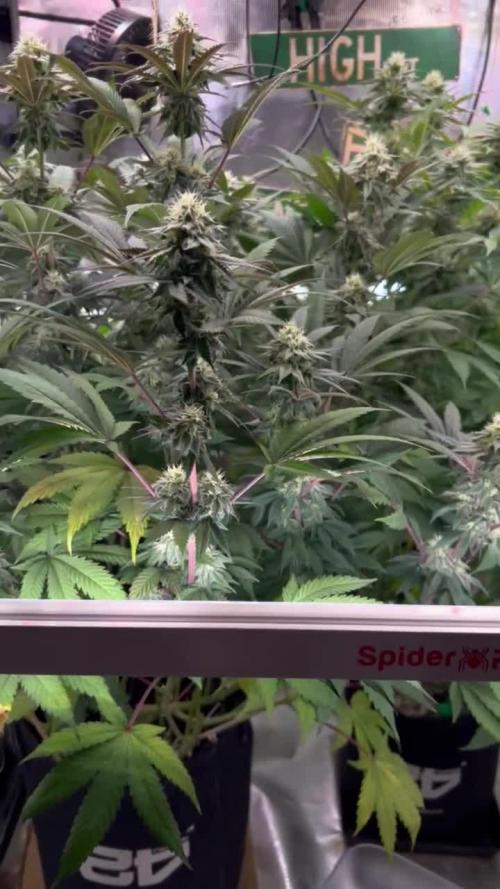
Day 77 – 3-4 week of flower 🌸 Lemon Cherry Runtz 🍋🍒
🔸Lemon Cherry Runtz is really kicking into gear this week. Buds are swelling up nicely, calyxes are plump, and the white pistils are shooting out like little antennas in every direction. Resin production is in full swing – the tops are already frosty, sparkling under the light, and the colas are stacking beautifully along the main stems.
🔸Leaves are looking strong and healthy – deep green with some subtle purple hues showing on the edges. No clawing, no deficiencies, and no signs of overfeeding, maybe she could use a little more nutrition.. Sugar leaves are already coated with trichomes, which is always a good sign that the plant is cruising in the right direction.
🔸This week I kept it simple: only water. I also cranked the SANlight up to 100% to push temps up a bit, and it worked out great. Daytime VPD now sits right around 1.4–1.6 kPa, which is the sweet spot. Climate is steady, airflow keeps everything dry, and the buds are staying fresh and compact.
📈 Current Conditions (Day 77)
🌡️ Day = 24.7 °C
🌡️ Night = 18 °C
💨 Humidity = 56.1 %
🌬️ VPD = 1.4 – 1.6 kPa
🔦 PPFD = ~1000 µmol (12/12)
🛠️ Setup (unchanged)
💡 2 x SANlight Evo 4-120 @100%
⛺ 120 x 120 x 180 Spiderfarmer tent
🍯 Pots: 18L fabric pots
🌱 Soil: Bio-Bizz Light Mix
💊 Nutrients: BIO Tabs
🌱 “Easy, organic, only-water method. Save 15% with GDBT420. biotabs.nl/en/shop/”
Likes
11
Share


@Organic473
Follow
Bud weight continues in week 4 of flowering…I don’t know if it’s the location or the strain but these buds are really big for 4 weeks….can’t wait for harvest in 35 days.

Likes
Comments
Share


@FuzzFarming
Follow
Esta semana tomé poco registro.
Descarté la planta mas atrasada y transplanté una a su maceta definitiva.
Fue transplantada en su día 19, estuvo una semana en maceta de 3.5L, la otra será transplantada en un par de días

Likes
30
Share


@ktkoi
Follow
Day 53: I have a feeling that a bigger pot is necessary for FIMmed plants. Defoliated Lemon a little bit (used her leaves for a morning shake 😁). Some of her leaves are turning lime green, not sure what that's about. Overall excited about their day to day growth from now.
Day 55: Followed some advice and tried to add some Cal in the form of chamomile tea. Ended up trimming the already deficient leaves will see what happens later on. Could also be light burn from the plants getting taller. Lemon Pie is showing the purple phenotype which I love!


Likes
44
Share


@RakonGrow
Follow
150-200PPFD 20/4
Mein Grow Stuff
Messen :
+ Messgerät - X-Sense WLAN Hygrometer 1 Basis SBS50 + 4 Sensoren
+ + Basis
+ + 4x WLAN Sensoren RH und Temp
+ Amtra Digital PH Tester
+ Amtra Digital TDC&EC Tester
+ Photone App (android Samsung S21 5G werkscallibriert (geprüft mit lichtreferenz))
+ GEHE ph-Wert 500 Testkit
+ + Testflüssigkeit
+ + Pimpette
+ + Probenröhrchen
+ + Propfen
+ Pimpette 10ml
Zelt :
+ Keimung und Vegetative Phase
+ + Growbox - DiamondBox Silver Line SL60 (60x60x160cm) (hohe luftfeuchtigkeit)
+ Blütenphase
+ + Spider Farmer 70x140x200cm Indoor Grow Tent
Licht :
+ SpiderFarmer SF1000 (100Watt) Dim (hohe luftfeuchtigkeit) (Vegetativ)
+ Sanlight EVO 1.5 3-60 mit Bluethoot Dimmer (niedrige luftfeuchtigkeit) (Blüte)
Abluft / Filter / Rohr:
+ 2x Abluftset - PrimaKlima PKEC-125-TC Set
+ + PKEC-125-TC Abluft
+ + PrimaKlima Aktivkohlefilter K2601 Flat (bis 70%rH) + Staubschutz
+ + Luftschlauch Aluflexrohr (Ummantelt), 3 Meter, ø 127mm
+ + Verbindungschelle 50mm (Metall mit Schaumstoff mit Aufhängemöglichkeit)
+ + 1x Universal-Schlauchschelle, 60-165mm
Samen :
+ 3x Royal Dwarf Automatic (RQS) (buy from Zamnesia Seeds)
Töpfe :
+ Nothers GZjiyu 6 Stk Pflanzsack Pack 2 Galonen = 8 Liter Stofftöpfe
Medium :
+ BioBiz LightMix
+ + Urgeisteinsmehl für Ergänzungsstoffe
+ Vulkangranulat (Aquabedarf , drenage)
Ventilator :
+ pro Zelt
+ + 2x Ventilator - Spider Farmer Grow Ventilator (EC 10Watt)
PH Korrektur:
+ 500ml Plagron PH-
+ 1000ml Canna PH+
Dünger :
+ Dünger - Canna Terra Kit
+ + 1000 ml Terra Vega
+ + 1000 ml Terra Flores
+ + 500 ml Rhizotonic
+ + 500 ml PK13/14 (wird nicht genutzt , da unnötig)
+ + 1000 ml Cal-Mag Agent (fals ich den mal brauche)
Entfeuchter :
+ Entfeuchter - MeacoDry ABC 10Liter
Zubehör :
+ 1L Nanoprotect Isopropanol 99,9% (Reinigungsmittel)
+ 1x Topfuntersetzer 30x30cm
+ Grießkanne 5 Liter
+ Pflanzendrath 1mm x 5m
+ Sprüflasche 0.7L
+ Drucksprühflasche 2L
+ Messbecher
+ + 1L
+ + 0.5L
+ + 0.25L
+ Eimer 10L
+ Gartengießkanne
+ + 5L
+ + 10L
+ Plastikabdeckung mit löchern fürs Sämlingstadium (ehemals Kuchenabdeckung)
+ Luftschlauch Aluflexrohr, 3 Meter, ø 127mm
+ GrowPRO Schere Curved
+ Gardo Gartenschere GDGSB 180
+ GrowPRO Pflanzendraht für Low Stress Training, 5 mm, 4,9 Meter
+ Dosierspritze, 5ml
+ 2x Universal-Schlauchschelle, 60-165mm
+ LIMITADA 15 Stücke Pflanzenbieger Verstellbar
+ 6er Steckdose
+ 2x Zeitschaltuhr (mechanisch)
+ Müllsack (umbau zur Trockenkammer)
+ Pappe
+ 2 x Gafa-Tape (Rolle)
+ Klettband 3m
+ Airpump Kit
+ + Air-Pump
+ + Luftschlauch silicon
+ + Air-Stone
Trychome analyse :
+ Samsung S21 5G optical Zoom
+ DIGIMICRO Mobil
+ + x300 optical zoom
+ + HD Video
+ + 12MP photo
+ GrowPRO Mikroskop 40x mit LED
CureBox :
+ CASO VacuBoxx E-Set Vakuumbehälter-Set aus Borosilikatglas mit Tritan Deckel
+ + 145x60x105
+ + 170x65x125
+ + 200x80x150
+ + 220x80x165 (about 40-50g dry buds space)
+ + manual vacuumpumpe
+ + adapter für automatische vaccumpumpen
VideoSystem:
+ GoPro Hero3+ Black
+ + Zeitraffer : 1 Bild pro Minute , gerendert in H.265 60fps .
+ + 12MP Bilder
+ + 1 Sekunde Film entspricht 1 Stunde Real .
+ + Ohne Dunkelzeiten.
+ Bild/Videoprogramme
+ + Photoshop (Bildsequenze render Video, Ausschnitt und Beschriftung)
+ + XMedia Recode (H.265 Neucodierung)
Likes
8
Share


@y11dos
Follow
Plants started to show signs of overfeeding, so i decided to flush with ph neutral water with only alg-a-mic and a bit of calmag. Does anyone know how long it usually takes for the plant to bounce back and recover from overfeeding?
Processing
Likes
1
Share


@Teddy01500
Follow
Bonjour à tous, ces derniers jours ce sont bien passé pour mes petit bébés elles grandissent doucement mais sûrement.C’est la première fois que je travail avec cette gamme de produits (je vous est mis des photos des produits 😉) pour l’instant j’en suis satisfait après, il faut voir le résultat final ce qui est moins facile 😂. Mes petit bébés commence leurs 5ème semaine (je me suis trompé d’une semaine 😕 désolé 😉) trop pressé!!! 😂 de mettre de nouvelles photos 😜. Je vous dis à là semaine prochaine vivement 😉 bonne journée à tous. Je vous remercie 😉.
