Likes
Comments
Share
Hit my 20-25% initial dry back. They’re getting 3% or 30 mL every 15 minutes until rolloff between the first one to two hours and then will monitor The dry back Trying to aim for 10% by tomorrow morning So every morning I’m hoping to hit a 10% dry back and working on wrapping them up with 3% Until I get a decent amount of runoff nothing crazy 10-20% of my ramp up total feedings
Likes
21
Share
@Adriplnks
Follow
A finales de semana empezaron a salir unas manchas en las hojas superiores, también han avanzado muy poco. Creo que es una carencia de potasio así que en el siguiente riego aumentaré las dosis del sbc.
Likes
8
Share
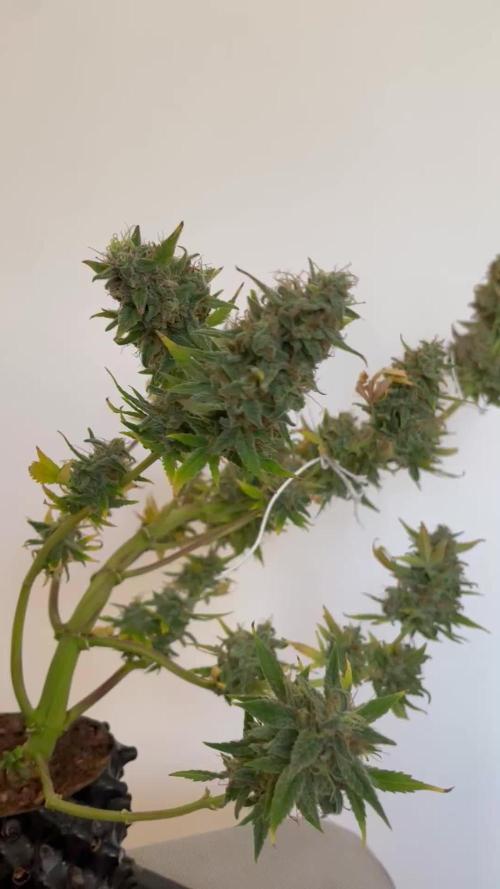
Hello everyone, fellow growers! welcome to peaky's gardens I had so much fun growing this little girl in a small pot and with a frame around which I twisted my plant I wanted to test her resistance and my experience
Likes
49
Share
@AsNoriu
Follow
Day 92. Yellowing not spreading , girls drink and pray all journey long, so conclusion - molasses was the issue. Still watering with ph 6.2-6.4 lower than my beloved 6.5. Hopefully i will feed them 2-3 times more and then flush. Only one Cheese left without brown pistils so i am max 4 weeks away from harvest by all look. Was thinking to do defoliation session , but i trimed them so hard on first during flower, plus bugs, later sulphur deficiency, so they are not fit in my mind for any stress. Skunks looks more mature, lower buds still packing on both strains. One Skunk (lowest amount of big colas) is one of fast runners, all in crystals already, looks like Christmas tree after good snow ;)) Happy Growing !!!
Likes
29
Share
Meine Woche ist finde ich gut verlaufen sie findet sich langsam zurecht in dem größeren Topf. Ich hatte zwischendurch das Gefühl dass sie nicht richtig an wurzeln dürfen dass sie nicht richtig trinkt aber scheinbar funktioniert es doch alles ich habe auch hier wieder die neue Lampe mit bei und ich denke deswegen hängen die Blätter ein wenig weil es jetzt eine Umstellung ist und diese Lampe sehr viel mehr power hat als die vorherige heute habe ich auch wieder Enhancer benutzt die untersten Blätter werden langsam schon gelb weiß jemand was ihr fehlt.
Likes
36
Share
@PapaBlob
Follow
13/01 😶 bien quoi ? 16/01 Bien.. foxtailing alors. Bon c'est pas ci mal. Elle passera à l'extraction pour me faire du liquide vapote. 😉 18/01 Aujourd'hui j'ai fait, des photos rapidement ,et l'arrosage encore plus rapidement car il fait -2c°. Etre en dessous de zéro c'est pas habituel par ici,. Alors J'ai refermé la tente vite fait, et suis rentré me mettre au chaud. 🙏🖖
Likes
18
Share
easy enough week. added dehumidifiers in both tents as i really have them packed and its best we take care of that now than run into diffs later. nutrients all good, much the same. harvested bday cake auto 45g wet weight. maybe was hard on her at the start but whatever.. looks good, hopefully tastes as good. 3rd week in and these girls are massive.. like really impressive. no hype.
Likes
6
Share
@Chubbs
Follow
These girls are growing amazing. I did some defoliation and lollipopped them this week. Hopefully with more air flow at the canopy level and lollipopping, the tops and main colas can focus all the energy on growing some beautiful flowers. All in all Happy Growing.
Likes
2
Share
Just added another 100 watt light, ahe is loving that. Definitely loving the first photo grow!!
Likes
37
Share
welcome to Day 71 2/26/2021 well I am very happy she is putting on some weight and is still looking healthy. we are getting near the end of the grow now and i have a new sponsorship coming up in my next grow so stay tuned. happy growing and as always keep your stick on the ice Update with some macro shots
Likes
41
Share
Likes
15
Share
@tokesly
Follow
Realized just how intense manual feeding for coco is. Takes up to 3 hours to mix the nutrients, water, and wait to empty the saucers. And I'm just doing this once a day, imagine the experienced growers feeding 3+ times a day. Definitely would be ideal to have a drip/drain system installed in the future. Pheno 2 got so lanky and heavy it fell over! A scrog and bamboo sticks would've helped a ton. Placed a peony cage to support the branches but it's hard to get it angled properly with the branches grown out. Boosted the PK again this week and halved the Bloom Nutes.
Likes
56
Share
What's in the soil? What's not in the soil would be an easier question to answer. 16-18 DLI @ the minute. +++ as she grows. Probably not recommended, but to get to where it needs to be, I need to start now. Vegetative @1400ppm 0.8–1.2 kPa 80–86°F (26.7–30°C) 65–75%, LST Day 10, Fim'd Day 11 CEC (Cation Exchange Capacity): This is a measure of a soil's ability to hold and exchange positively charged nutrients, like calcium, magnesium, and potassium. Soils with high CEC (more clay and organic matter) have more negative charges that attract and hold these essential nutrients, preventing them from leaching away. Biochar is highly efficient at increasing cation exchange capacity (CEC) compared to many other amendments. Biochar's high CEC potential stems from its negatively charged functional groups, and studies show it can increase CEC by over 90%. Amendments like compost also increase CEC but are often more prone to rapid biodegradation, which can make biochar's effect more long-lasting. biochar acts as a long-lasting Cation Exchange Capacity (CEC) enhancer because its porous, carbon-rich structure provides sites for nutrients to bind to, effectively improving nutrient retention in soil without relying on the short-term benefits of fresh organic matter like compost or manure. Biochar's stability means these benefits last much longer than those from traditional organic amendments, making it a sustainable way to improve soil fertility, water retention, and structure over time. Needs to be charged first, similar to Coco, or it will immobilize cations, but at a much higher ratio. a high cation exchange capacity (CEC) results in a high buffer protection, meaning the soil can better resist changes in pH and nutrient availability. This is because a high CEC soil has more negatively charged sites to hold onto essential positively charged nutrients, like calcium and magnesium, and to buffer against acid ions, such as hydrogen. EC (Electrical Conductivity): This measures the amount of soluble salts in the soil. High EC levels indicate a high concentration of dissolved salts and can be a sign of potential salinity issues that can harm plants. The stored cations associated with a medium's cation exchange capacity (CEC) do not directly contribute to a real-time electrical conductivity (EC) reading. A real-time EC measurement reflects only the concentration of free, dissolved salt ions in the water solution within the medium. 98% of a plants nutrients comes directly from the water solution. 2% come directly from soil particles. CEC is a mediums storage capacity for cations. These stored cations do not contribute to a mediums EC directly. Electrical Conductivity (EC) does not measure salt ions adsorbed (stored) onto a Cation Exchange Capacity (CEC) site, as EC measures the conductivity of ions in solution within a soil or water sample, not those held on soil particles. A medium releases stored cations to water by ion exchange, where a new, more desirable ion from the water solution temporarily displaces the stored cation from the medium's surface, a process also seen in plants absorbing nutrients via mass flow. For example, in water softeners, sodium ions are released from resin beads to bond with the medium's surface, displacing calcium and magnesium ions which then enter the water. This same principle applies when plants take up nutrients from the soil solution: the cations are released from the soil particles into the water in response to a concentration equilibrium, and then moved to the root surface via mass flow. An example of ion exchange within the context of Cation Exchange Capacity (CEC) is a soil particle with a negative charge attracting and holding positively charged nutrient ions, like potassium (K+) or calcium (Ca2+), and then exchanging them for other positive ions present in the soil solution. For instance, a negatively charged clay particle in soil can hold a K+ ion and later release it to a plant's roots when a different cation, such as calcium (Ca2+), is abundant and replaces the potassium. This process of holding and swapping positively charged ions is fundamental to soil fertility, as it provides plants with essential nutrients. Negative charges on soil particles: Soil particles, particularly clay and organic matter, have negatively charged surfaces due to their chemical structure. Attraction of cations: These negative charges attract and hold positively charged ions, or cations, such as: Potassium (K+) Calcium (Ca2+) Magnesium (Mg2+) Sodium (Na+) Ammonium (NH4+) Plant roots excrete hydrogen ions (H+) through the action of proton pumps embedded in the root cell membranes, which use ATP (energy) to actively transport H+ ions from inside the root cell into the surrounding soil. This process lowers the pH of the soil, which helps to make certain mineral nutrients, such as iron, more available for uptake by the plant. Mechanism of H+ Excretion Proton Pumps: Root cells contain specialized proteins called proton pumps (H+-ATPases) in their cell membranes. Active Transport: These proton pumps use energy from ATP to actively move H+ ions from the cytoplasm of the root cell into the soil, against their concentration gradient. Role in pH Regulation: This active excretion of H+ is a major way plants regulate their internal cytoplasmic pH. Nutrient Availability: The resulting decrease in soil pH makes certain essential mineral nutrients, like iron, more soluble and available for the root cells to absorb. Ion Exchange: The H+ ions also displace positively charged mineral cations from the soil particles, making them available for uptake. Iron Uptake: In response to iron deficiency stress, plants enhance H+ excretion and reductant release to lower the pH and convert Fe3+ to the more available form Fe2+. The altered pH can influence the activity and composition of beneficial microbes in the soil. The H+ gradient created by the proton pumps can also be used for other vital cell functions, such as ATP synthesis and the transport of other solutes. The hydrogen ions (H+) excreted during photosynthesis come from the splitting of water molecules. This splitting, called photolysis, occurs in Photosystem II to replace the electrons used in the light-dependent reactions. The released hydrogen ions are then pumped into the thylakoid lumen, creating a proton gradient that drives ATP synthesis. Plants release hydrogen ions (H+) from their roots into the soil, a process that occurs in conjunction with nutrient uptake and photosynthesis. These H+ ions compete with mineral cations for the negatively charged sites on soil particles, a phenomenon known as cation exchange. By displacing beneficial mineral cations, the excreted H+ ions make these nutrients available for the plant to absorb, which can also lower the soil pH and indirectly affect its Cation Exchange Capacity (CEC) by altering the pool of exchangeable cations in the soil solution. Plants use proton (H+) exudation, driven by the H+-ATPase enzyme, to release H+ ions into the soil, creating a more acidic rhizosphere, which enhances nutrient availability and influences nutrient cycling processes. This acidification mobilizes insoluble nutrients like iron (Fe) by breaking them down, while also facilitating the activity of beneficial microbes involved in the nutrient cycle. Therefore, H+ exudation is a critical plant strategy for nutrient acquisition and management, allowing plants to improve their access to essential elements from the soil. A lack of water splitting during photosynthesis can affect iron uptake because the resulting energy imbalance disrupts the plant's ability to produce ATP and NADPH, which are crucial for overall photosynthetic energy conversion and can trigger a deficiency in iron homeostasis pathways. While photosynthesis uses hydrogen ions produced from water splitting for the Calvin cycle, not to create a hydrogen gas deficiency, the overall process is sensitive to nutrient availability, and iron is essential for chloroplast function. In photosynthesis, water is split to provide electrons to replace those lost in Photosystem II, which is triggered by light absorption. These electrons then travel along a transport chain to generate ATP (energy currency) and NADPH (reducing power). Carbon Fixation: The generated ATP and NADPH are then used to convert carbon dioxide into carbohydrates in the Calvin cycle. Impaired water splitting (via water in or out) breaks the chain reaction of photosynthesis. This leads to an imbalance in ATP and NADPH levels, which disrupts the Calvin cycle and overall energy production in the plant. Plants require a sufficient supply of essential mineral elements like iron for photosynthesis. Iron is vital for chlorophyll formation and plays a crucial role in electron transport within the chloroplasts. The complex relationship between nutrient status and photosynthesis is evident when iron deficiency can be reverted by depleting other micronutrients like manganese. This highlights how nutrient homeostasis influences photosynthetic function. A lack of adequate energy and reducing power from photosynthesis, which is directly linked to water splitting, can trigger complex adaptive responses in the plant's iron uptake and distribution systems. Plants possess receptors called transceptors that can directly detect specific nutrient concentrations in the soil or within the plant's tissues. These receptors trigger signaling pathways, sometimes involving calcium influx or changes in protein complex activity, that then influence nutrient uptake by the roots. Plants use this information to make long-term adjustments, such as Increasing root biomass to explore more soil for nutrients. Modifying metabolic pathways to make better use of available resources. Adjusting the rate of nutrient transport into the roots. That's why I keep a high EC. Abundance resonates Abundance.
Likes
34
Share
Still getting abit attacked by slugs, got to go down tomorrow with some copper tape and slug pellets. Lost few inner nodes and the 2 tops 1 is lagging behind the other. But gave a big feed so hoping will help and once these slug deterrents down they won’t endure anymore stress. That’s all this week. Happy growing🌱
Processing
Likes
23
Share
@GrowGuy97
Follow
Everything seems to be going great for them to all be random bag seeds! Temp is staying a little higher than I would like trying to figure out some ways to cool it down may just order some new lights!
Likes
3
Share
Sugar high came out very nice. Has a very gluey terp almost like super glue. For an f1 this genetic grows like a weed lol but seriously Sugar high by Mephisto genetics should be taken seriously!!!
Likes
2
Share
Hallo zusammen 🤙. Sie wächst sehr schön und macht keine Probleme.
Likes
12
Share
Hello guys 😍👽 This week is the most exciting time of my cultivation. After we grew 10 og creams, today in the third week of flowering, all the seeds showed that they are feminized😍😍 My project has given the right result But more important than this is the final product, which we compare with the father (og kush) and the mother (cake n cream) and the traits it inherited😍😍 Thanks for your comment🙏😍👽 "farah4weed"
Likes
13
Share
Eccoci qui... Tutto va per il meglio, questa settimana non ho applicato stress alla piccola, ma ho guardato l'evoluzione che ha avuto dando i nutrienti. Ora ha un odore davvero intenso ed uno strat di resina pauroso, vediamo come si riprende dalla defogliazione che ho fatto settimana scorsa. Seguiranno aggiornamenti, grazie a tutti per il supporto🔥🌲❤️