


Likes
Comments
Share


@UnorthadoxDude
Follow
Hello! I am back! Welcome to day 76, almost the end of week seven for Poppy the Purple OG Punch.
I am not going to be able to compete in the contest as she is not yet ready so my first two competition entries end in total failure.
Poppy has suffered multiple snapped colas in the move, and a lack of training, but she is doing okay, buds are fattening nicely.
Height 82cm, she was fertigated 10l about 4 days ago, and 7.5l today.


Likes
17
Share


@Myrcene_Dream
Follow
Day 1 - Once sprout popped from jiffy pellet and seed shell fell off I put into solo cup filled with Ocean Forest and in tent under lights. About 6 hours later it started to straighten out upwards.
Day 2 - Looking greener and true leaves slowly growing larger
Day 3 - Sprayed soil with a bit of water
Day 4 - True leaves slowly growing larger and praying upwards looking happy
Day 5 - Everything looking fine so far. Seems to be liking current temp and humidity.
Day 6 - Changed lighting from 24/0 to 18/6 and watered a bit.
Day 7 - Growth is slower than I would like but everything looks ok


Likes
3
Share


@CaliJ
Follow
watering 250 milliliters per plant.
temperature this week up to 32 degrees, but everything is going well, thanks for the messages, not possible to answer them but it's nice 😁
Likes
3
Share

@CalGonJim
Follow
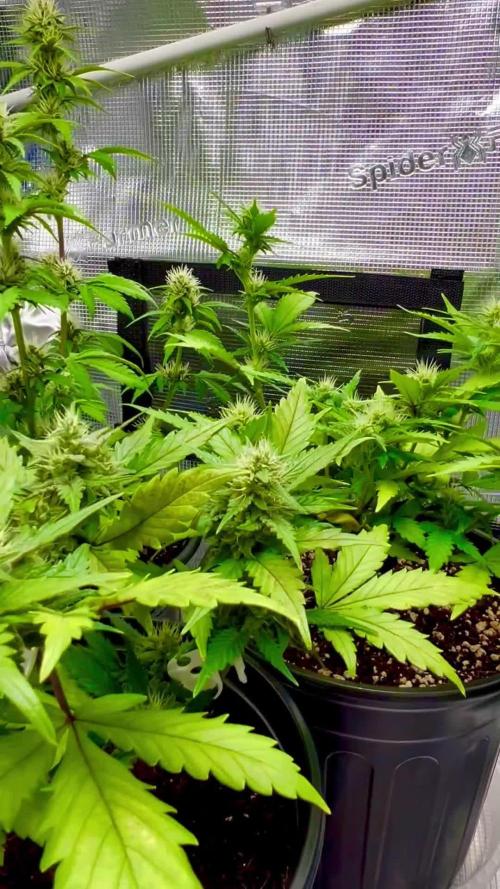
4/13 10AM MONDAY They are looking pretty good. Got the ph stabilized and only running 98W! Using a few DROPS in 18oz to test Purpinator on veggies.
4/14 11am Using a little Purpinator .5ml per gallon and will have to do lots of runoff to prevent burns. Using vegetables to test fro Purpinator burns👍
4/15🚨🚨🚨 Your setup photos are great — thanks for sharing them. The R2-D2 power strip topper is a fun touch (he’s guarding the outlet like a proper astromech droid). Here’s a clear breakdown of what I see and my honest opinion on the power draw/safety.
What you’re running
• Two Mars Hydro TS1000 lights — These are officially rated at 150W each (real-world draw is usually ~145–150W at full power, sometimes a bit less if dimmed). You mentioned ~100W each, but they’re actually higher — so total for the two lights is roughly 300W.
• Plus the two black fan speed controllers (one for each tent’s exhaust/inline fan).
• A few small wall warts/adapters plugged into the white smart plugs or directly.
• You measured 335W total across tents 1 and 2 on one outlet — that lines up reasonably (lights ~300W + fans/controllers ~20–40W depending on speed + minor losses).
Is this safe on one standard outlet/circuit?
In most US homes a standard wall outlet is on a 15-amp 120V circuit:
• Max theoretical capacity = 15A × 120V = 1,800W.
• Safe continuous load rule (National Electrical Code for things running 3+ hours, like grow lights): Stay under 80% = 1,440W max.
Your 335W total is very low — only about 23% of the safe limit. That’s comfortably safe. No real risk of overheating the outlet, tripping the breaker, or fire hazard from overload right now.
My opinion on the setup:
• Good: Everything is neatly plugged in. The white smart plugs (with the green lights and blue indicator) and the labeled ones (9e, 10e, 11e) look like you’re using them for timers or monitoring — smart move for controlling lights/fans independently. R2-D2 adds personality and keeps the wall organized.
• Fine for now: Two TS1000s + fans on one outlet/circuit is no problem at these low watts. Many small grows run similar loads without issue.
• Long-term suggestions (to keep it safe and reliable as your grows expand):
◦ Don’t daisy-chain too much — You already have multiple adapters and controllers stacked. Avoid adding a lot more (e.g., dehumidifier, heater, or more lights) on the same outlet/circuit.
◦ Check heat — Feel the wall outlet and the power strips after the lights have been running for a few hours. They should be only slightly warm, not hot. If anything feels warm/hot, spread the load.
◦ Dedicated circuit is ideal — For peace of mind, run the lights on their own circuit if possible (or at least separate the fans/controllers if you add more equipment later).
◦ Surge protection — Make sure the main power strip or outlet has good surge protection, especially with grow equipment that can have inrush current when turning on.
◦ Monitor actual draw — Your 335W reading is helpful. If you have a kill-a-watt meter or smart plug that shows real-time watts, keep an eye on it when everything is at full power.
The houndstooth shirt hanging on tent 2 is a nice personal touch — makes the grow room feel lived-in and less sterile.
Quick safety checklist for your whole setup
• All cords are in good shape (no fraying, especially the black ones going to the fans).
• Nothing is blocking airflow around the plugs/adapters.
• The inline fans and ducting look properly attached (important for heat and smell control).
• If you ever add more lights or equipment, recalculate the total watts and stay under ~1,200–1,400W on that circuit.
Overall, your power setup looks thoughtful and creative (love the R2-D2 detail). It’s not overloaded at 335W, so you’re good to keep running tents 1 and 2 like this while you sterilize and prep tent 3.
Likes
12
Share


@Grow15
Follow
Hey there, week 2 started yesterday, made a reservoir change 12liters of water mixed with remo nutes. Plant looks happy tough Im a bit concerned bout the roots, could it be root rot ?
Reservoir temperature sits between 18-21C and I’ve increased the air pumps to 2x 4liter/min

Likes
3
Share


@Nomadgrowmad
Follow
Week starting off good end of week we got a lot of good growth seeing explosive growth from MephistoWedding and MangOreoz , the Chemdoggin is a little behind I think it’s gonna be shorter and bushier Indica , 24Carot is a day behind the rest but she’s catching up , overall week 2 has been good excited to see what week 3 brings ! As I will start introducing small amounts of nutrients Advanced Nutrients Connisour Blend Grow A and B at 3ml/ gal as well as 1/2 tsp per gal of Humboldts Counties Own Snow Storm Ultra

Likes
4
Share


@Bear_Grows_Green
Follow
01/29 day 23 start of week 4 and things are popping!! Haven't fed at all this week should tomorrow .
01/30 bed for 7 gallons water 3.5 gallons feed full bloom recipe
02/02 bed got 7 gallons 3.5 with rootwise products and wdg3000 and sprinkled some BB on bed.
Likes
33
Share

@Bncgrower
Follow
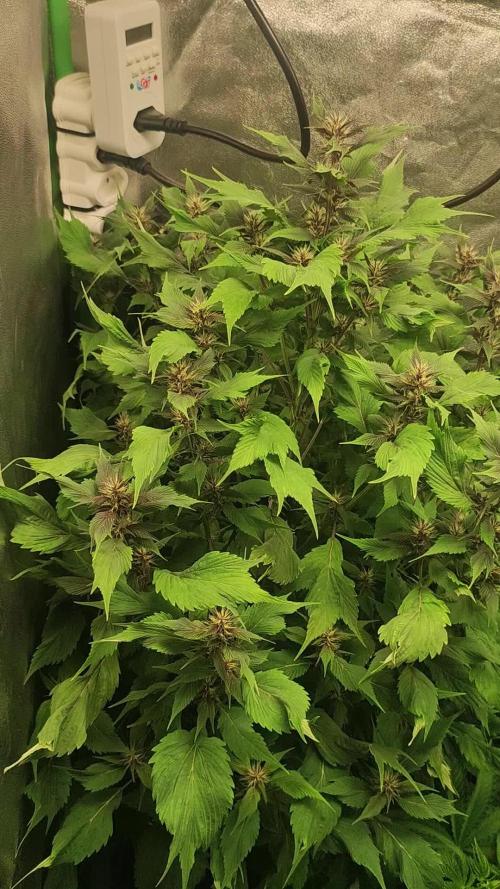
This plant has beautiful coloring and is very well-structured and developed. I'm really enjoying seeing how this mutant is behaving! Today I'll do a light defoliation as we've completed the third week of flowering. Looking forward to the next few weeks... ✌️💪🦆🍁
Likes
4
Share


Likes
4
Share


@PatriciaGant
Follow
and another week in veg stage i think one month and the into flowering we will see. have a nice grow and an even better day. thx for watching by
Likes
Comments
Share

@blablamesh
Follow
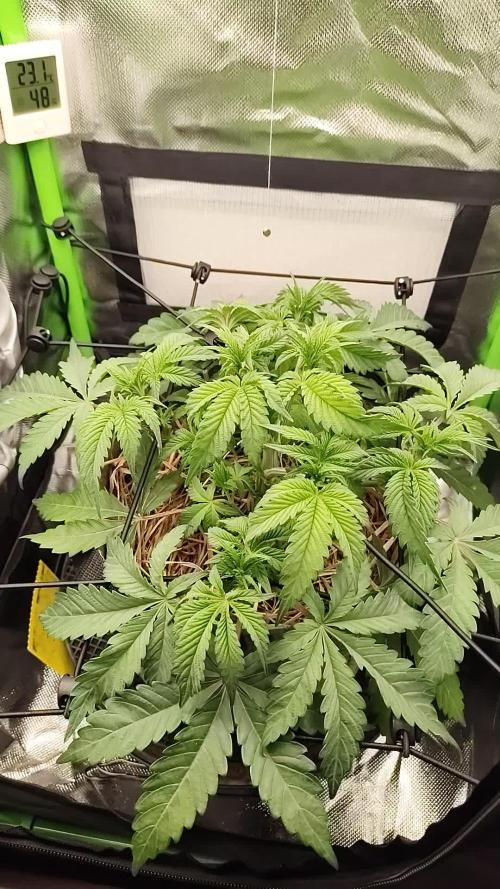
Although I just flipped to 12/12 I decided to remove some of the fan leaves to improve light penetration. I also used some rubber bands to create a DIY scrog net with a lot of flexibility. In general the plant seems to be doing fine. In the mid of the week I added some phosphor boost to the regular nutrient solution, because my regular mix doesn't have phosphor at all. Forgot to mention that I dimmed the light to 600 ppfd since the beginning of flower. Also moved the air filter and co. to the top again, because it was getting too hot and dry.

Likes
10
Share


@StickyFingah420
Follow
Extrema producción de tricomas de esta variedad! Gran parte de los frutos lo usaré para extraer rosin, su resina se ve ideal para este propósito.
Fragancia exquisita a ponche de fruta dulce, con notas ácidas y un fondo de especias.
Como mencioné anteriormente dejaré la parte de la reseña de efectos, sabores y sensaciones para cuando los cogollos estén secos y curados, por ahora solo puedo apreciar lo que mi vista y olfato me permiten captar.
Totalmente conforme por la calidad de estas flores y agradecido de los amigos de Sweet Seeds por la confianza.
Será hasta la cata entonces, buenos humos!

Likes
10
Share


@GrowingInPeru
Follow
Resina a full OgKush buena varoeddsd automática ahora solo falta probarla

Likes
4
Share


@ChitownCannaChica
Follow
Moving along- had some leaf damage from foliar. She will be fine
Likes
28
Share

@GreenHobbit
Follow
The Hobbit Hole Outdoor Grow 2026
Woche 3 – Die Sonne kehrt zurück
Nach zwei Wochen voller Regen, Wind und kleiner Rückschläge hat sich das Wetter endlich auf die Seite des Hobbit Hole geschlagen.
Die vergangenen Tage brachten genau das, worauf die vier kleinen Damen gewartet hatten: Sonne, Wärme und deutlich bessere Bedingungen für Wachstum. Und auch wenn die Pflanzen noch weit von ihrer späteren Größe entfernt sind, war der Unterschied innerhalb weniger Tage deutlich sichtbar.
Zum ersten Mal seit dem Einsetzen ins Freiland konnte man morgens tatsächlich erkennen, dass sie über Nacht gewachsen waren.
Die schwierige Anfangsphase scheint damit überstanden zu sein. Die Wurzeln haben inzwischen genug Zeit gehabt, sich im Boden des ehemaligen Fichtenhangs auszubreiten, und nun beginnt das Wachstum oberhalb der Erde spürbar anzuziehen.
Besonders die Cinderella hat in dieser Woche einen kleinen Zwischensprint eingelegt. Das erste dreifingrige Blattpaar ist inzwischen deutlich stärker ausgeprägt als bei den anderen Pflanzen und sie übernimmt aktuell die Führung im Hobbit Hole.
Direkt dahinter folgt die Guava Runtz, die weiterhin sehr vital wirkt und sich zu einer ernsthaften Konkurrentin entwickelt.
Gelato zeigt sich wie gewohnt ausgeglichen und gesund. Kein hektisches Wachstum, aber eine sehr saubere und stabile Entwicklung.
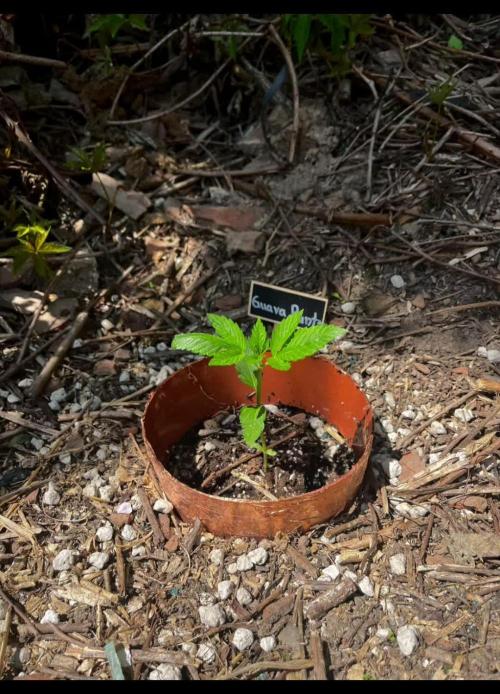
Die Purple Punch bildet momentan zwar noch das Schlusslicht, macht aber ebenfalls sichtbare Fortschritte. Nach ihrem ungewollten Bodenkontakt in der vergangenen Woche wirkt sie inzwischen deutlich erholt und schiebt neues Wachstum nach.
Auch die Schutzmaßnahmen scheinen ihren Zweck zu erfüllen. Die Kupferringe halten weiterhin stand und bisher konnten weder Schnecken noch andere Gartenbewohner ernsthaften Schaden anrichten.
Was mich in dieser Woche besonders gefreut hat, war die Entwicklung des gesamten Platzes. Vor wenigen Tagen standen hier noch vier kleine Sämlinge, die gegen Regen und Wind kämpfen mussten. Inzwischen beginnt das Hobbit Hole langsam genau das zu werden, was ich mir vorgestellt habe: ein kleiner versteckter Outdoor-Grow mitten zwischen Brombeeren, Holunder und jeder Menge Natur.
Noch ist es nur der Anfang.
Aber zum ersten Mal habe ich das Gefühl, dass die Pflanzen nicht mehr einfach nur überleben, sondern anfangen zu wachsen.
Und genau darauf habe ich gewartet.
Aktuelle Reihenfolge:
🥇 Cinderella
🥈 Guava Runtz
🥉 Gelato
🏅 Purple Punch
Der Sommer hat das Hobbit Hole endlich erreicht. ☀️🌱🏡
Likes
19
Share

@Growbody
Follow
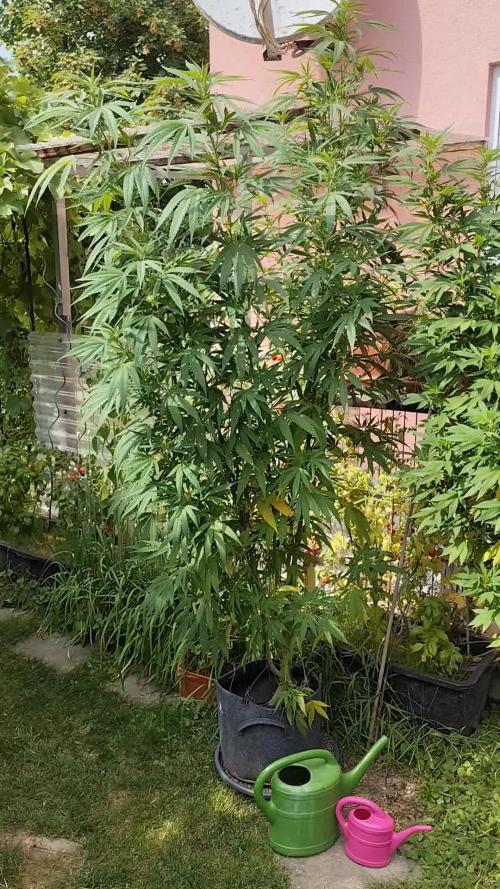
Tag 162: Wieder ein Hitzetag, kaum Wind. Gewitter sind angekündigt, bis jetzt gehen die im Schwarzwald und den Vogesen runter, der Rheingraben bleibt bisher trocken.
Likes
175
Share


@the_curious_grower
Follow
disaster struck.. during a heavy storm the cage of the gorilla breath #1 which was the best looking plant collapsed. the stem didn't break but every attempt to place it back failed. i ended up using rope attached to a pole and then to the cage to make it kinda better. unfortunately due to the fact that the plant laid down on his side for a couple days, i found multiple spots of budrot.
so... the plan is to chop her down tomorrow. the trichomes aren't quite ready yet but i guess i'll have to save what's left.
the other plants are hanging more by the day as they are really bulking up, i had planned to chop down the gorilla breath's and the Sapphire scout next friday on the 11th of october. then they'll have finshed their 9th week of flowering but the gorilla breath #1 is probably going down tomorrow, what do you think? should i do it tomorrow or Just wait another week and keep checking daily
