


Likes
Comments
Share


Likes
43
Share


@Johnny2Fire4U
Follow
Flipped to flower let's go now... halfway there and I'm so pumped!!! Gave them 72 hours of darkness. Now it time to watch them do what they do!!

Likes
40
Share


@Bread_n_Buds
Follow
Disclaimer: if you want to have a big flash like a big trip focus on the trichomes, really crazy colors.
I still have to recover from the beauty of the Purple Urkle harvested last week that must amaze me again:
even this time we are embarrassed by the beauty of the colors of this plant, this time it is a plant with shades of purple that if you go to see then in micro are fantastic very light trichomes on lilac and all shades of purple.
We have nice big buds this time, of that type with a large calyx but really beautiful and elegant.
** Remember that for all the varieties we have at least two plants, one left to grow straight and one worked with the techniques (come back during the week to see). Today we talk about the harvest of the phenotype with shades of purple.
Technique used // In this case we did topping repeatedly x16 and cleaned the sparse branches.
Better with the techniques or normal? This time we have two very different phenotypes, one plant with medium internodal distance for beauty and color better than the other, this one beautiful flowers and beautiful quantity.
Flower quality // From one to 10 stars 10. The plant has resinated very well on all sides, it is super mature, very mature pistils, mature trichomes, the flowers are very purple and of a very good general quality. There is also a fair quantity this time. We washed the flowers according to the procedure suggested by zamnesia.
Check the article in your language // https://www.zamnesia.io/it/guida-growing-cannabis/333-lavaggio-delle-ceme
Fertilizers// I am very happy with how I managed to unload the plant that at a certain point before going to flush was fed for a few days only with additives and then went to flush and we are very very well discolored, I predict a very tasty flower, grown organic and flushed successfully, the flavor and taste will be epic.
All the fertilizers and additives of Plagron in the green / 100% organic version have fully satisfied me. Choose your soil based on your style and calculate the sheet on the website www.plagron.com -
Bro if you are stubborn use additives listen every now and then....and then come and tell me.
The fertilizers instead are found in convenient all-inclusive packages on the Zamnesia website.
Purple dl CALI flavour ...
---- https://www.zamnesia.io/en/11168-zamnesia-seeds-purple-urkle.html
Zamnesia Description // A direct descendant of a Mendocino Purps phenotype, Purple Urkle is a high-performance cultivar from Zamnesia Seeds. This feminized, indica-dominant strain is sure to win over any cannabis grower. With a THC content of 20%, Purple Urkle has a lot to offer from seed to harvest and beyond. Suitable for growing indoors, outdoors or in a greenhouse, Purple Urkle is a very resilient strain. Growers will be impressed by how easy this cultivar is to manage. Purple Urkle can reach 120cm indoors and 160cm outdoors, but if you want more control over the height, LST can be used. Purple Urkle has fantastic flavours and aromas that intensify during the flowering phase. Regardless of the method of consumption, Purple Urkle offers pungent and fruity flavors that lean toward notes of grapes, berries and plums. The effects of this strain are soothing and relaxing, with uplifting sensations that make the experience suitable for any occasion, both social and solitary.
Music and frequencies // For about 4/6 hours a day my plants listen to 432 Hz frequencies created specifically for their well-being and sometimes a bit of black music to give them those vibrations that only music can give. www.radionula.com
All the best that mother nature has to offer is at —— www.zamnesia.com

Likes
6
Share

@All_our_small_plants
Follow
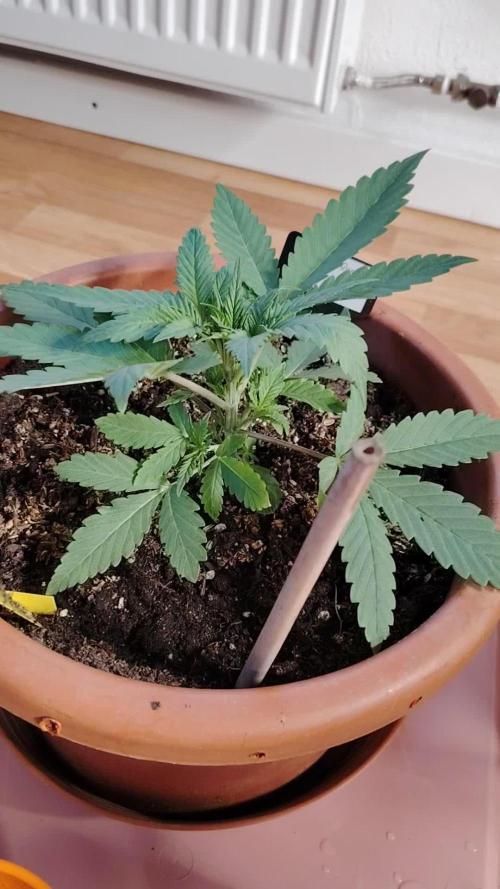
Bewässerung: 1000 ml jede 2 tage in der dritten Woche
pH-Wert: 6
EC-Wert: 0,6
Temperatur: 28ºC
Luftfeuchtigkeit 80%
Schädlingsbekämpfung:
PPFD: 200 µmol/m²/s
DLI
Düngemittel: mineralischer Dünger NPK 7-3-5
Besonderheiten: wir versuchen bei diesem Grow Effektive Mikroorganismen aus. Die Opfer Linsen sind wieder da 😜
-Tag 15 Eleven Roses hat heute wieder etwas Dünger bekommen, sie wächst am besten von allen vier neuen 😍
-Tag 16 Sie will unbedingt Kinder haben XD deswegen haben wir heute den ersten Klon geschnitten, den Kopf, und sie sind jetzt zusammen umgezogen in unser kleines Zelt wo wir die Luftfeuchtigkeit besser kontrollieren können. Wir haben Clonex Gel benutzt. Drückt uns die Daumen 😃
-Tag 17 wir haben die Mutti heute wieder mit den Mikroorganismen gegossen und die stinken schon sehr stark, irgendwie nach Erbrochenem 😖
--Tag 2 das Kind sieht lebendig aus
-Tag 19 die Luftfeuchtigkeit ist sehr hoch deshalb brauchen wir die Mutti nicht zu gießen, die Erde trocknet gar nichts
--Tag 4 das Kind hat ein paar schwarze Flecken und etwas gelitten am den größere Blätter aber sieht immer noch lebendig aus 😳
-Tag 21 Mutti braucht immer noch kein Wasser
--Tag 6 Im zwei tage sollte das Kind wurzeln entwickeln haben, wir sind gespant 😕


Likes
13
Share


@BB_UK
Follow
Was supposed to update my diaries yesterday but literally forgot lol #edibles but they’re flowering nicely and stretching as they go! They’re truly loving life under the ts1000 can’t wait to see what the next week brings!
Processing
Likes
25
Share


@herewegrow
Follow
Day 8 - I topped off each of the solo cups with a little more soil. Might just be my lighting but the leaves are looking kinda light in color to me. Other than that everything seems to be going well.
Day 9 - Leaf color looks fine now, probably just the white balance in the photos. I picked up some free worm tea from my local hydro shop today and gave most of it to my outdoor garden (no cannabis) and a small portion to the ladies in the tent. It's looking like they're almost large enough to transplant but I still haven't set up my larger tent yet. Soon!
Day 12 - Finished setting up my new tent and transplanted the ladies. Tent is 100x100x200cm and I now have 2 300w 2nd Gen Roleadro LEDs. Going to see if this Cellmax Rootbooster makes any difference in the transplant. I'd noticed the 3BOG was looking kinda droopy lately. It was also the only transplant that didn't go smoothly so hopefully it will make it through all this stress. Not sure what was causing the drooping originally though, all plants have been cared for the same until now.
Day 14 - Noticing some light curling on the leaves. I'm thinking it's just the low humidity but I moved the lights up a few inches just to be safe. I haven't given them a full watering yet in the new 3 gallon pots so maybe the humidity will rise once they get some water. (Humidity up to 34% a few hours after watering)

Likes
133
Share


@PapaNugs
Follow
Another stellar week here. Not much to note this week since there wasn't any lollipopping or much defoliation. Girl is now on auto pilot. Just watering every couple days. Got the self watering pot underneath.
Lights at 100% power.
Here are the lights details:
Medic Grow Mini Sun-2 150W LED
Model: MN150-022
Spectrum mode: V1
Efficacy: 2.8 umol/J
Thanks for stopping by!
You can find the light on Grow Diaries:
https://growdiaries.com/grow-lights/medic-grow/mini-sun-2-150-watts
You can find the light on Medic Grow's website:
https://medicgrow.com/

Likes
1
Share

@Borberad
Follow
Woche 10
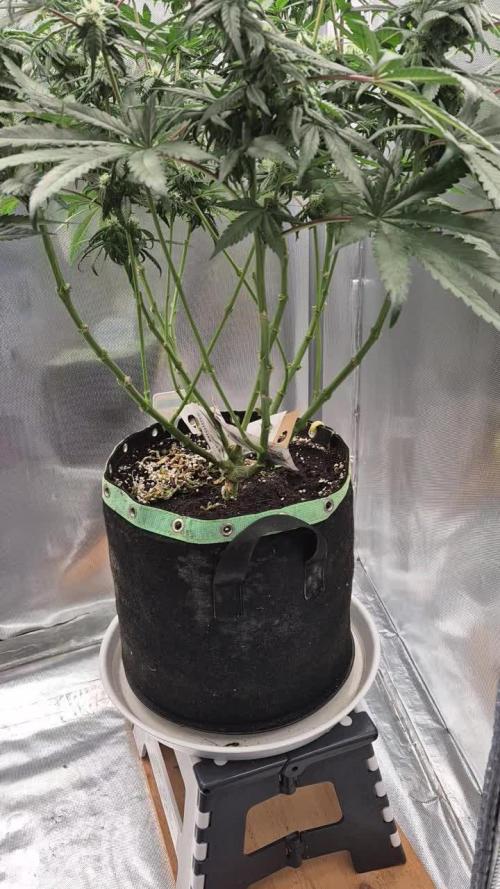
Schöne stinkige Blüten am Blümchen welche so langsam immer dicker werden. Trichome sind, wie zu dieser Zeit bei 56 bis 63 Tagen agegebener Blüte zu erwarten, noch Glasklar. Da das Blümchen zwischenzeitlich Adlerklauen bekam, wurde die Wassermenge, sowie Düngerkonzentration reduziert.
* Zustand der Pflanze: Kräftiger Blütestretch, erste Blütenstände sichtbar.
* Wichtige Ereignisse: Anhebung des DLI.
* Düngung & Messwerte:
* Gießwasser: pH ca. 6,5. Leitwert 0.9
* Drain: Wir stellen sicher, dass der pH-Wert nicht unter 5,5 und nicht über 6,8 liegt und der Leitwert die +/- 500 S Abweichung einhält.
* Anpassungen: Das Blümchen hat sich bisher mäßig nur mäßig gestreckt um auf die Hohe ihrer Mitbewohnerin zu kommen wurde sie daher auf einen Hocker gestellt. (Zum Glück haben wir kein SCROG-Netz gespannt)
Likes
26
Share


@CapeGrows
Follow
This week I did a final bit of defoliation just to channel the energy to the buds. I upped the EC to 2.1. I got a well priced pkm boost powder from my local hydro shop, wich I added to get the EC levels a bit higher. I will start flushing at the end of this week with a flushing solution. I have also been making use of a dehumidifier to reach optimal RH.


Likes
1
Share

@TTerpz
Follow
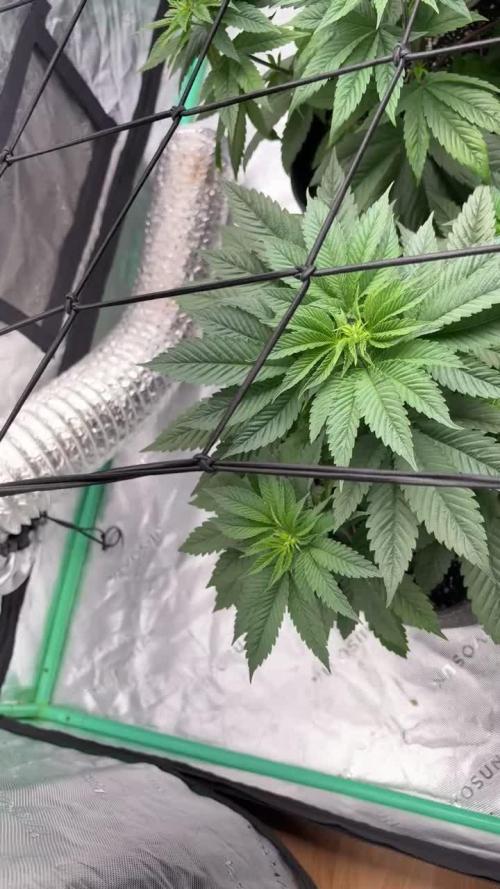
Start of week 5
8/20/25
Flushed with sledge hammer : 8/21/25
Watered: 8/23/25
Likes
3
Share


@OrganicPower
Follow
Week 8 flower, watering until the end. No more top dressing or fish shit. Just the same de chlorinated tap water, not ph’d or filtered that I’ve been using since the beginning. Comes out the tap with a ph of 7 and less than 15ppm tds. The soil takes care of everything.


Processing
Likes
15
Share


@MG2009
Follow
01/28/2020
Switching to flower schedule today 12-12, doing a little defoiliating, and stem cracking then get ready to watch the show. I was looking for a female Unicorn, it looks like it's a male Unicorn
He has all the attributes of his sisters that I like defoiliating doesn't bother him, quickly recovers from LST Stinks way more than any of the females that I have grown, out my hands get sticky just picking the fan leaves, I've got 2 clones starting for future use. Question is do I finish my diary on a male( Unicorn ) plant hmmm🤔 will anyone appreciate it? Will he carry on these attributes in his offspring?
I guess I'll flower him out and see if he lives up to my hopes.
I Will harvest his pollen and test his offspring to see how he contributes to the next generation.
If all goes well I got a good breeder.
Likes
3
Share


Likes
7
Share


@SintrexGrow
Follow
Step 1: 24 hrs in a glass of water
Step 2: planted in a root riot
Step 3: placed the root riot plug in a germination box on a heating mat until it germinated.

Likes
21
Share


@NSABND
Follow
Hi there start of week 11 today 😏
today (Day 78) the weather is cold and very high humidity because of rain 😲😩😕
Day 79 same shit weather then yesterday with very high humidity and rain 😵😲😵😲😵
Day 80 autumn has arrived 😱😨😰 cold with rain and high humidity 😲😵😭
Day 82 there are no Updates sorry 😵
Likes
39
Share


@Hazecat_420
Follow
Se realizó una defoliación en la parte más baja y en las 2 hojas más grandes de la parte superior para que pudiera entrar de mejor manera la luz a los brotes más pequeños. Se aplicó Voodo Juice para las raíces y Top Bloom para la floración, ya todas tomaron de buena manera el cambio del fotoperiodo. Seguimos 👽 ...
Likes
77
Share


@Roberts
Follow
FBT 2309 is growing really good. I just changed her to ph water yesterday, to start her flush week. She is loaded with trichromes, and has a very nice aroma. Which is a sweet berry fruity smell. Everything is looking great. Next update will be the harvest. Thank you Fast Buds, Gen1:11, and Medic Grow. 🤜🏻🤛🏻🌱🌱🌱
Thank you grow diaries community for the 👇likes👇, follows, comments, and subscriptions on my YouTube channel👇. ❄️🌱🍻
Happy Growing 🌱🌱🌱
https://youtube.com/channel/UCAhN7yRzWLpcaRHhMIQ7X4g
If anyone needs to purchase fastbuds here is a link for my affiliate program
https://myfastbuds.com/?a_aid=60910eaff2419


