Likes
Comments
Share
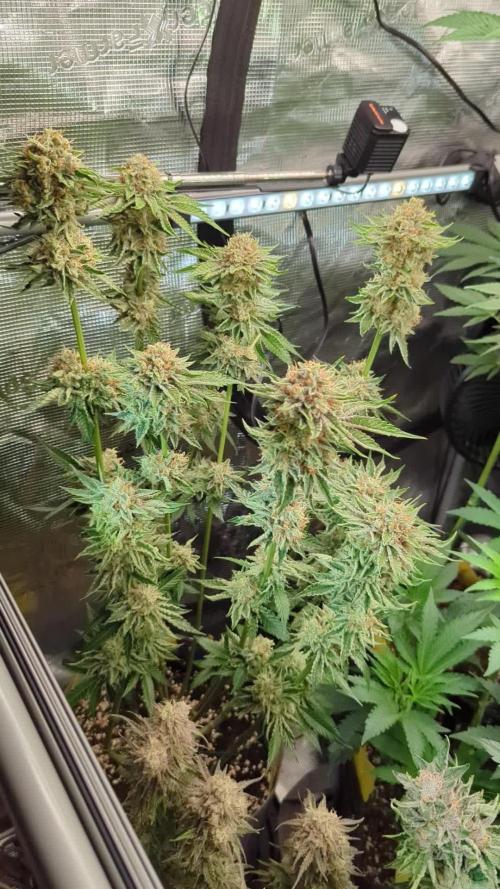
Week 10 for GMO auto by atlasseed Both the indoor & outdoor auto (outdoor was mostly indoor expect last 2/3 weeks i think?) Anyway they are both drying, my wife & I had a tester smoke of the outdoor plant & both had uncontrollable laughing fits.. genuine laugher it was a refreshing high yet my face hurt after😂 The indoor smaller plant definitely crushed it in the looks department way chunkier, the way the outdoor one finished in 42+ sun probably has a lot to do with the looks deference. Will update on smoke report etc when everything is dried. Lets find out if she's getting growth again or not😇.
Processing
Likes
5
Share
Pineapple Chunk was definitely being a nice crop.. very healthy and vibrant
Likes
1
Share
Likes
31
Share
Tarde en subir el resumen de esta semana porque ya pensaba subir las fotos de la planta cortada, pero por el tono de los tricomas esta si es la Ăşltima semana, ya el 18/11/22 subire fotos de la planta cortada lista para curar. Mas de esta semana no pasarĂĄ, luego esperare para subir el resumen de la genĂŠtica. Volviendo al tema de la planta esta semana solo fue regada con agua, asique el lavado de raĂ­ces se cumpliĂł a la perfecciĂłn.
Likes
49
Share
@Roberts
Follow
FBT 2401 is doing great. She got her first lst a few days ago. Looks like the diluted solution worked well. She has started making good progress. Thank you Fast Buds. 🤜🏻🤛🏻🌱🌱🌱
Likes
30
Share
@Xpie77
Follow
💚Please Like This Diary and Leave a Comment!💚 Mac is growing nicely and good smell to. Just a little bit of juice, not to much. Seeds Genetics information: MAC is a highly sought after Cali cannabis strain. This strain was created by crossing Alien Cookies with Colombian X Starfighter. The plants develop beautiful colored buds that are covered in abundance with resin trichomes. The flowers have an average THC content of 20-24% THC. This makes this strain a real Cali winner! The yield is also top with an average of 450-550 gr/m² within a flowering period of 8 to 9 weeks. It is a true balanced indica/sativa hybrid strain. Smoking this weed gives you a euphoric high with a delicious spicy diesel aroma with a hint of citrus. Its uplifting and joyful effects even helped MAC win a High Times Cup, cementing its top status as a Cali strain. Flowering time: 8 – 9 weeks Genetics: Alien Cookies x Colombian x Starfighter 50% sativa, 50% indica Plant height outside: 100 – 180 cm Outdoor harvest month: from June to October Yield indoors: 450 – 550 gr/m² Yield outdoors: 200 – 800 gr / plant THC: 24% 💸💸💸Wanna buy MAC Seeds? 💸💸💸 https://seedsgenetics.nl/product/mac-gefeminiseerd/
Likes
117
Share
@StarLorr
Follow
Welcome to my autø Møøn Røck 1 Diary. In this Diary: Seeds: Sponsored by Ðivine Seeðs Media: Pro~Mix HP *•ns Nutrients: Remo Supercharged Kit *•ns *•not sponsored ___________________________ Feeding: Tue 05Nov: 2L Remo/Recharge pH'd 6.5 Fri 08Nov: 2L Remo/Recharge pH'd 6.5 ___________________________ Trichomes are all white and some amber. Will be flushing on the next feeding. ___________________________ Thanks for stopping by, likes and comments are appreciated!👊🏻😎 Keep on growin! Keep on tokin!!! 😙💨💨💨💨💨
Likes
52
Share
Its time to prepare for war. *Blows bagpipe* FISH SH!T THE ORGANIC SOIL CONDITIONER (used twice before and always noticed instantly) Fish Shit is a living product! It provides a complex Microbial profile that includes thousands of different species of bacteria, fungi, and protozoa. This profile is closer to a natural ecosystem than anything you will find on the market. Fish Shit helps release essential oils and terpenes which contribute to the building of a myriad of flavonoids. Flavanoids play a key role in the development of the most potent aromas and tasteful flavors of a plant and its fruit. Fish Shit contains beneficial microorganisms that help plants maximize nutrient uptake. It does this by transforming nutrients into more usable forms and keeping these nutrients in the soil longer. During photosynthesis plants naturally produce exudates (chemicals that are secreted through their roots). Through these exudates, plants can attract the types of good bacteria that are beneficial to them at different points in their growing cycle. These good bacteria cover the roots and act as a barrier to the invasion of disease-causing organisms that may harm the plant. What Are Enzymes? Before we dive headfirst into how, exactly, enzymes can benefit cannabis plants, it helps to understand a little about what these microscopic proteins do. Essentially, enzymes facilitate chemical reactions. They do so by binding with a substrate and forming or breaking molecular bonds. In this context, the substrate is the molecule upon which an enzyme acts to boost the efficiency of a reaction. •substrate /sŭb′strāt″/ •noun •The material or substance on which an enzyme acts. A surface on which an organism grows or is attached. An underlying layer; a substratum. Enzymes are proteins with complex 3D shapes that feature regions called active sites. When the substrate binds to these active sites, it forms an enzyme-substrate complex that causes a chemical reaction to take place, temporarily changing the structure of the enzyme and ultimately causing molecules to either come together or break apart. As a result, molecular products are released, and the enzyme returns to its original shape. Specific enzymes are capable of binding with certain substrates, as the substrate fits into the active site more or less via a lock-and-key principle. Although, new research suggests a more accurate theory of "induced fit", in which enzymes and substrates undergo structural changes to facilitate the reaction. If you take the human body as an example, we have an abundance of enzymes in our saliva and digestive system. These molecules bind with substrates in these regions (food particles), working to break down the food we eat into usable parts before converting them to energy. Enzymes in cannabis work in a similar way to the example highlighted above. Typically, enzymes occur in soil naturally, but if your soil mix is lacking organic material, or you're growing hydroponically, then adding enzymes directly to the substrate is crucial. By using them in cannabis growing, enzymes not only help break down essential nutrients into smaller, more readily available pieces, but they also support the digestion of dead root cells, clearing a direct path for nutrients. Overall, enzymes make it easier for your cannabis plants to absorb all the elements they need to reach their full potential. For growers, a plant that reaches its full potential means a bucketload of juicy buds come harvest. This is essential if you want to reuse a pot with old systems left over like mine. Common plant enzymes include: •Cellulase •Xylanase •Beta-glucosidase •Hemicellulase •Amidase Amino acids are a crucial, yet basic unit of protein, and they contain an amino group and a carboxylic group. They play an extensive role in the gene expression process, which includes an adjustment of protein functions that facilitate messenger RNA Nitrogen, phosphorus, and potassium are the three main pillars of nutrient solutions and fertilizers, but there are countless other nutrients that your cannabis plants need to produce the best possible harvest. Amino acids are one of them. You may have noticed that amino acids get a lot of attention from bodybuilders and other athletes. That’s because they play a key role in the synthesis of protein, which, as you probably know, is super important for sports recovery and muscle growth. Amino acids are the building blocks of protein and the foundation of both plant and animal life. But what do amino acids do for cannabis? WHY IS PROTEIN IMPORTANT FOR CANNABIS? Just like proteins are important for the human body, they are equally important for the growth and development of plants. For example, proteins help plants: •Facilitate the growth of intracellular plant structures •Promote energy generation •Stimulate metabolic processes •Facilitate the absorption and transportation of nutrients So, where do plants get these vital proteins from? Well, unlike humans, plants can’t source proteins or amino acids from other organisms. Instead, they need to create their own amino acids, and then use these to build protein. That's why gardeners, much like athletes, go wild for amino acid supplements. Amino acids help plants by… • Increasing their production of chlorophyll, which ultimately improves their ability to photosynthesize • Serving as an easily absorbable form of nitrogen • Stimulating the synthesis of key vitamins • Improving their resistance to pests and diseases • Boosting the strength of their cells Amino acids also serve as the precursors to auxins, a group of plant hormones produced in the meristems—the apex of the stems where new leaves and stems are born. Auxins play a key role in the plant, activating genes for plant growth and development by triggering a multitude of vital plant functions. In other words, they determine what its size and architecture will look like. Auxins influence the development of branches, flowers, and roots, and even help to regulate the photoperiod response of the plant. Some amino acids, like cysteine, also work together with antioxidants like glutathione to help cannabis plants deal with oxidative stress, which can be caused by high-intensity lighting, some nutrient solutions, and high levels of CO₂. Unlike humans, plants can synthesize all the amino acids they need to survive and develop properly. Unfortunately, however, amino acid synthesis is a really high-energy process, and plants may struggle to produce enough amino acids when exposed to stress. WHAT FACTORS AFFECT A PLANT’S ABILITY TO SYNTHESISE AMINO ACIDS? Any kind of stress can affect a plant’s ability to produce enough amino acids. This includes: • Drought • Temperature extremes • Poor soil health • Pests • Diseases • Poor lighting • Lack of space • Poor root health WHAT DOES ALL OF THIS MEAN FOR WEED PLANTS? If you want to push your plants to their extreme in terms of floral growth and resin production, you should look into amino acid fertilizers. By making amino acids readily available to your plants, they’ll be able to use crucial energy to grow and bloom, rather than focusing on synthesizing amino acids themselves. Game of Inches, this is another Plants can absorb amino acids via their roots and leaves. They can also benefit from amino acids during both their vegetative and flowering phases. The fastest way for plants to absorb amino acids is via their leaves. The foliar application of amino acids is believed to improve the transportation of nutrients, increase transpiration, and boost photosynthesis. Hence, I recommend feeding your plants with foliar amino acid fertilizers. When doing so, however, carefully measure the amount of fertilizer you use, as—like with any nutrient—overfeeding can damage your plants. FOLIAR FEED AND SOIL SOAK • 1 crushed queen anne carrot • Add 2 tbsp of NPK Raw powdered water-soluble cane molasses • 20ml h2o2 • 1 crushed radish • 0.25 tsp NPK Enzymes • 0.25 tsp NPK Amino Acids • 50ml coconut water ( nature's own amniotic fluid packed with amino, enzymes ) + The sound of songbirds. Onto the predators 1250 -Green Lacewings Lacewings are extremely voracious predatory insects that feed on several pests. In adulthood, it feeds on pollen and nectar. In the larval stage, it feeds on aphids, thrips, and mealybugs at all stages of growth. It can also attack spider mites in moderate quantities. It is initially an aphid predator, but very effectively controls thrips and mealybugs infestations. It is so voracious that in the absence of prey, it will feed on its congeners. Lacewings are cannibalistic if there is no food available for them. It is therefore important to introduce them into an infestation situation, and not just preventively. •congener /kŏn′jə-nər/ •noun •A member of the same kind, class, or group. •An organism belonging to the same taxonomic genus as another organism. •A thing of the same kind as. or nearly allied to, another; specifically, in botany and zoology, a plant or an animal belonging to the same genus as another or to one nearly allied. Ideal temperature 20°C – 26°C Ideal humidity 60% – 70% Predatory stage life cycle 21 days Introduction rate 4 weeks Storage Refrigerator Use Immediately Are there any specific instructions on how to use this predator? Lacewings are available on small paper cards that you can hang to plant stems. On the cards are dozens of eggs ready to hatch. There are also sterile eggs they can feed on once they have hatched before they are ready to disperse in the foliage. It is important to use them quickly upon receipt to avoid cannibalism. If you don't use them right away, you can store the cards in the refrigerator for 24 to 48 hours to prevent the eggs from hatching too quickly. Avoid storing them for longer than this or you risk losing eggs. 1250 eggs are divided into 7.5 cards, 2500 eggs on 15 cards, and 5000 on 30 cards. The application rate is one card per square meter of growing surface. Is this predator best used for preventive or curative treatments? Lacewings are used as a curative solution. Anything else I should know? Lacewing eggs hatch approximately 24-72 hours after the cards are exposed to room temperature. When they emerge, the lacewings are just 1.5-2 mm long. They are very small so they are difficult to see. Once hatched, they will stay on the cards for a few hours and then disperse in the foliage. You quickly lose sight of them if you have not witnessed the hatching. They then live in the foliage for about 3 weeks. Often, you will see them towards the end of their larval cycle. After feeding for 3 weeks, they will triple and even quadruple in size. At that point, they are easier to see. But they remain very discreet insects, it is not abnormal not to see them. Egg carcasses left behind on the cards do not disappear after the hatching has happened. It's normal to see eggs still on the cards. Visually it is very similar before and after hatching. Also, on the boxes, there are sterile ephestia eggs which are used to feed the lacewings once hatched. Not all lacewing eggs are viable either. Only a certain percentage of lacewing eggs will hatch. Once hatched, the eggs are white. You can observe this using a magnifying glass. With, 5000 Stratiolaelaps Scimitus It is used to prevent or control thrips pupae, fungus gnats larvae, and root mealybugs in the soil. It can also be used for red mites in bird farms or hen houses. The adult is about 1 mm long and is medium brown with a beige triangle on its back. Another fun fact about them is they can survive without prey. They can eat algae and plant debris. This is why they can reproduce and stay in plants for long periods. Ideal temperature 15°C – 23°C Predatory stage life cycle 18 days Introduction rate 2 weeks Storage Room temperature Use Within one week Are there any specific instructions on how to use this predator? Sprinkle directly on the growing media. They can live in all types of substrates like potting soil, coconut fiber, rock wool, cedar mulch, etc. Stratiolaelaps establish easily so they are permanently fighting pests. One introduction is generally enough unless you have an infestation. In this case, introduce them at least twice at a 2-week interval for best results. If you grow your plants in a 100% mineral substrate, it will have to be released more often since there is less organic matter than in traditional soil. Do I need to take any specific precautions? Stratiolaelaps breed in the top layer of the soil. So it is important not to disturb them in the first days following their introduction. They don't like temperatures below 8 ° C. So be sure not to introduce them in a water-saturated or cold environment. Release them 24-48 hours after your last watering. They are very sensitive to chemical acaricides and diatomaceous earth. These methods are incompatible with their use.
Likes
18
Share
@Hashy
Follow
Growdiaries Grow 20 Welcome to my 20th grow on growdiaries, I'm doing 4 plants in this grow. This grow will consist of. #1 FFNA2410 Fastbuds test (?days flower) #2 FFNA2411 Fastbuds test (?days flower) #3 FFNA2412 Fastbuds test (?days flower) #4 Acapulco Gold MSNL (56-70days flower) This diary is focusing on: #3 FFNA2412 Fastbuds tester. I have little to no information about this strain until its been released for sale. The only information I do have is it is a fastflowering photoperiod. I have grown fadtbuds fastflowering photos before and they were 🔥 so 🤞these will also be great. Equipment on Smart plugs. 1. Light= Viparspectra Xs2000 2. Extractor= Ac infinity 4 inch 3. Oscillating fans/cameras= on 4 ext. 4. Humidifier= ram 5L/Dehumidifier= 2L 5. Feed= water pump. 6. Radiator= KW Germination. Tent settings. Extractor controller settings High temp= 23c Low temp= c Temp step=0c High Rh= 70% Low Rh= % Rh step=0% Speed max=5 Speed min=1 Smart controller settings (during lights on). Lights on=24/0 Radiator on=<c Radiator off=>c Humidifier on=<60% Humidifier off=>65% Dehumidifier on=>% Dehumidifier off=<% VPD aim=0.4-0.8 DLI aim=14-16 EC aim=0.4 PH aim=6.0 🗓️ Sun 17/12/23 #3 📋 Chose the seed and placed it in a shot glass of water at 10.40pm. 🗓️ Mon 18/12/23 #3 📋 At 7.00am tapped seed and it sunk so put it in wet paper towel. 10.00pm filled 0.6L pots with biobizz light mix and wet with 100ml water (5ml/L roots). 🗓️ Tue 19/12/23 #3 📋 7.00am tap root breaking through shell so put in soil. 5.30pm started running tent. Light 24/0 Light distance 87cm Light power=73w=30% Dli=14.5 🗓️ Wed 20/12/23 #3 📋 5.00pm looks like no soil movement, sprayed soil. 🗓️ Thur 21/12/23 #3 (Day 0) 📋 7.00am looks like movement. 7.00pm has broken ground and leaves are open. So that's the end of germination for this one. From getting the seed wet to breaking ground took 5 days. She will stay in the small pot now until the root system has developed enough to transplant. Back soon. Take it easy.
Likes
6
Share
Likes
5
Share
This week brought some challenges—I discovered thrips on the leaves of my plant. Thankfully, the infestation isn’t too severe yet, and I acted quickly to address the issue: 1. Sprayed the plant with plain water to knock off any pests. 2. Removed the top layer of soil. 3. Applied BioBizz Leaf Coat as a protective measure. I really hope this will help. After reading up on these nasty pests, I learned that they can completely devastate the leaves if left unchecked. Unfortunately, I have only myself to blame for their appearance. Due to the cold weather, I’ve been using a heater in the room with my growbox, which has caused the humidity to drop significantly. It sometimes dips as low as 30%, and it rarely goes above 50%. Most of the time, the humidity hovers around 35-40%, which is an ideal breeding ground for thrips. To answer the obvious question—yes, I do have a humidifier. However, my growbox has a very powerful exhaust fan (315 m³/h for an 80x80 space), so the air is refreshed too quickly for the humidifier to make a lasting difference. Aside from fighting thrips, I also made some adjustments to my grow this week. On Day 20, I did a little LST. Honestly, I wasn’t planning on using any training techniques in this grow, but I decided to give it a try anyway. One thing I can say for sure—I want to skip LST in my next grow. It’s quite inconvenient to water the plant when the leaves are practically touching the soil. Additionally, I defoliated the first two sets of leaves. I felt this was necessary to improve airflow around the plant and reduce the risk of pests spreading further. Watering: Day 17: 400 ml Day 20: 500 ml I’m keeping a close eye on the plant and hope to overcome these challenges successfully.
Likes
8
Share
Day 22 Yo I'm expecting big growth next week, tucked some huge fan leaves under the new nodes, as advised from a question. Temperature sweet 25.5°C all day. Need more humidity though cause it drops at 30%. Day 23 Started using LST. Trying to spread the new branches so they all get the light they need. Temperature 25°C/22°C night. Humidity 40%. Day 24 Bro has reached 25cm high, so I started bending the top branch. Temperature 25°C/22°C night. Humidity 40%. Day 25 Temperature 26°C day/22°C night. Humidity 50°C. Day 26 Temperature 25°C day/22°C night. Humidity 40%. Day 27 Still tucking her leaves, so she gets an even canopy. Counting 11 branches. Temperature 27°C day/24° night. Humidity 50%. Day 28 Temperatures 28°C day/24 night. Humidity 40%.
Likes
27
Share
5/23/2023 Week 7- Day 1 of Flower (Day 110 overall) (Day 49 of Flower) There was a couple of small super small sucker buds on the lower stocks that needed to be cleaned off but that was it. Just watching them Flower!! 5/24/2023 Week 7- Day 2 of Flower (Day 111 overall) Tucked a few fan leaves below lower buds but didn't see any blatant offenders that needed to be removed. I typically do start my checks in Week 8 but since this is a new strain I decided to go ahead and do a Trichome check just to see what was what.. Just as I thought nothing but clear glassy Trichomes. I will check again in one week.... 5/25/2023 Week 7- Day 3 of Flower (Day 112 overall) Just letting them grow today!! Smell is getting stronger I would say it is a hint of Pine and a heavier fruity smell. 5/26/2023 Week 7- Day 4 of Flower (Day 113 overall) I did Nothing but took some pics and I enjoyed it!!!! It is nice to be able to just sit back and watch them on auto pilot.. :-) Tomorrow Water Change Day!! 5/27/2023 Week 7- Day 5 of Flower (Day 114 overall) I admit it.. I had to defoliate a little bit.. I looked in while changing the water today and there were just a couple blatant offenders blocking the light from lower bud sites and those leaves they just had to go. Other than that I changed the water and this week is where I drop everything and start preparing them for this last phase of the grow. Loving a few of these buds they are starting to beef out very nicely. I added 36 gallons Mammoth Silica = .5Mil/Gal= 18Mil Root DRIP = 1Mil/Gal= 36Mil CalMag= .5Mil/Gal= 18Mil FloraMicro = 3.8Mil/Gal= 137Mil FloraGro= 2.8Mil/Gal= 100Mil FLoraBloom= 4.6Mil/Gal= 166Mil LiquidKoolBloom= 2.5Mil/Gal= 90Mil TPS SIGNAL= 4.0Mil/Gal= 144Mil ORCA = .5Mil/Gal= 18Mil Water Temp= 70.1 Tent Temp= 76 Humidity =64 ** I have two dehumidifiers running on Ink bird controllers to try and keep the humidity down, In late in flower I like to keep the humidity above 45 but below 60. 5/28/2023 Week 7- Day 6 of Flower (Day 115 overall) Opened the back of the tent today and boy did she need some defoliation love in the back. Other than that I took off a few little sucker buds trying to form. I did start to setup my Dry space as well as did a Trichome Check today and the brown tips are coming in nicely. 5/29/2023 Week 7- Day 7 of Flower (Day 116 overall) Found a few baby sucker buds trying to form so I removed them. Other than that I am enjoying watching her mature. I also started my Reverse of the Clone I took 6 weeks ago in Apr from #3. I am uploading footage of the reversing process for your viewing pleasure.
Likes
39
Share
@NuttyYeti
Follow
It has been a journey but I'm happy it's over. Would have liked it to go another week or 2 but I'm happy with what I got. She smells like cotton candy and I can't wait for a taste. ☺️🤤
Likes
19
Share
@Adam420
Follow
Good news: managed to transplant a tree out the ground into a neutral space. Took 5 days to bounce back. Tallest plant is growing with no stress Bad news: male plant found. My 2nd tallest and favorite plant looks to be male and will be cutting it
Likes
1
Share
@mheat
Follow
She gettin fat!!! I upped her bloom a bit...She loves it! Wish she could have gotten more light and less stretch.
Likes
12
Share
@DawgBoi
Follow
In the middle of week 5 and things are still running well. I will try and get more pictures as the plant really starts the flowering push.I haven't done any thing new other then add some supports to certain stems that might need it later in the flowering stage.
Likes
34
Share
The RainBow Sherbet really have everything in its place, they are beautiful plants, one was planted a few days later because a little sister damaged by the placenta was replaced, but we are talking about 4 (5 days of difference between the two, nothing special, I will not have to do hrvest on the same day. Growing projects for autoflowering plants ----- As for autoflowering plants, I really love preserving the Main Cola. So I will try to make the plants grow well or badly without damaging the main cola. Nowadays, topping autoflowering plants is very accepted but it is not my favorite thing to transform a baby born to finish in 10 weeks into a baby who finishes in 14, I say at this point I do photoperiodic. But in times of people who only grow autoflowering everything is permitted for goodness sake if you want to do it, do it, I will not be the one to stop you. Also because the results are excellent, nothing to really discuss about anything except time. All this to tell us that I recommend for example fimming on plants that tend to grow tall to give power to the side branches, LST as much as you want, I don't like too much, I need space. HST and splitting are with experience. These are my tips not the absolute truth please do not mistake me for a great sage holder of the truth I speak as I see it. The first week went only with Power Roots 1 Ml/l and Pure Zym 1 ml/l from now on we will start with ALga Grow. The plants were transplanted shortly after germination because the biodegradable pots were very small. The soil is Plagron Pro Mix 100% organic renewed with 30% new soil and 20% Perlite added. (Pro mix does not have perlite but is airy, we added it anyway) Plagron fertilizers are available at Zamnesia in convenient Pack formats for all growing styles. I used this one with a simple search you can find the other products. ---- https://www.zamnesia.io/it/12119-plagron-top-grow-box-100-naturale.html Try a seed of this variety that drives us crazy... ---- https://www.zamnesia.io/en/11230-zamnesia-seeds-rainbow-sherbet-automatic.html Description Zamnesia // A cross between Pink Guava, Sunset Sherbet and a hint of ruderalis, Rainbow Sherbet Auto offers a wide range of flavors, effects and more. This 70% indica-dominant strain reaches considerable THC levels (24%) and is suitable for both experienced growers and those taking their first steps in the world of cannabis cultivation. Growbox and Air System - Secret Jardin DS120w + fans + exhaust fans and DF16 filters kit ---- https://www.secretjardin.com All the best that mother nature has to offer is at ----www.zamnesia.com Collaboration request: I am available for collaborations with companies of lights and various growing equipment (please no seed and nut companies) I would like to renovate my 120x120 space that has slightly outdated lights and would like to try some controllers. If you have any proposals available.