




Likes
4
Share


@MRSGROW
Follow
Hola amigos partiendo con la sexta semana, todas las nenas muestras claros signos de floración, se realizó la última defoliacion
Likes
16
Share


@Moose82
Follow
Week was good. Hope y'all like what I got done on my door. Things are starting to grow fast

Likes
45
Share


@Ultraviolet
Follow
"Mens Dei"
What can be made to expand, airy and loose, can also be made to contract, dense and tight.
Trichomes do not discriminate, although we like to think of trichomes' primary purpose as being to get us high; they are there to provide photoprotection (sunscreen). Trichomes apply themselves based on area dimensions; the more area = the more trichomes in order to protect. Different from density: Trichomes, the resinous glands on plants, are often produced in response to stress, including high light intensity. This increased production can lead to denser trichome coverage on the plant, stress, stress, stress, stress is the signal. There is a certain beauty in watching the large water-filled buds once swollen to the brim slowly shrink during drying, as the surface areas contract, the trichomes just cluster up to form denser and denser coatings, already dense from high light intensities, UVB exposure, and IPS, and every other stressor I could tweak. Trichomes, the resinous glands on cannabis plants, are often produced in response to various forms of stress. These stresses can be environmental, like excess light(HIL) or UV-B radiation, temperature fluctuations, or drought, or mechanical, such as wind, pruning, or even the weight of the plant's own buds. The plant reacts to these stressors by increasing trichome production as a defensive mechanism to protect itself and its valuable compounds like THC and CBD. In essence, cannabis plants perceive stress as a threat and respond by producing more trichomes as a way to protect themselves and their valuable compounds. Several studies have shown this. Not so much a "master" grower as a master of stress.
Psssst.
Trichomes fill with "antioxidants," including THC.
Ant"ox"idants,
The production of antioxidants in plants is intricately linked to their oxidative apparatus.
The plant has limited oxidative capacity/apparatus. During daytime photosynthesis, a large percentage of that oxidative capacity is tied up in protecting the plant.
During the night, plants alter their metabolic pathways. This leads to a far more focused production of specific antioxidants, like THC. Plants also produce antioxidants during the day to scavenge ROS made from photosynthesis. The differential ROS production by blue and IR light can have significant biological consequences. For example, high levels of ROS induced by blue light can lead to cell damage and death, while lower levels of ROS produced by IR light may be involved in beneficial cellular signaling pathways. Long nights under the IR (very low ROS), the boost in cellular respiration, and the boost in energy production. In a perfect world, I'd give the plant a shock treatment of 60DLI in 4 hours and give her the other 20 hours to perform cellular respiration under IR. The stress of those 4 hours would be rigorous and full of stress abound, 1800-2000ppm CO2 is easy for a couple of hours during daylight, it's maintaining it that's hard, but 4 hours is very doable with nothing but a little extra "carbon sugar" in your medium every other night during the first 4 weeks of flower.
In my opinion, you only need to jack CO2 for those first 4 weeks of flower to see maximal output, after that it's all about trichome preservation, everything else comes second. Without the temps to assist with metabolism, CO2 is reduced to normal levels along with temps 4-5th week of flower.
Buds are primarily composed of water. Developing flower buds, like other plant tissues, require a significant amount of water for growth and turgor pressure, which helps maintain their structure and firmness.
Turgor pressure in plant cells is primarily generated by osmosis, but transpiration plays a crucial role in maintaining it.
The optimal internal leaf surface temperature for photosynthesis at 1800-2000ppm CO2 is likely in the upper range of 97°F, meaning ambient would need to sit at 102°F-ish or thereabout for full metabolic utilization. That's putting your transpirational pulling force x5 x6 maybe x7 of what it would be if she were cruising at 68F.
"My buds won't fatten, what can I do!!"
Crank it. If your purpose was to blow up a balloon as fast as you can, as much as you can, would you use 2x force or x5 Force to do so? Bad analogy, but you get the idea. Kiss.
Optimize photosynthesis & VPD by day, cellular respiration by night.
TECHNICALLY:
"While transpiration and cellular respiration are both ongoing plant processes, they are not neatly separated into day and night. Both processes occur both day and night, though at different rates and with different emphasis. Transpiration, the release of water vapor from plant surfaces, is primarily driven by sunlight and photosynthesis during the day, but it also continues at a lower rate at night. Cellular respiration, which provides energy for the plant, occurs continuously, both day and night. "
A leaf can perform cellular respiration and photosynthesis simultaneously. During daylight hours, plant cells utilize both processes: photosynthesis to produce glucose and oxygen, and cellular respiration to break down glucose and release energy for the cell's needs. The products of photosynthesis (glucose and oxygen) are used as reactants in cellular respiration, while the products of cellular respiration (carbon dioxide and water) can be used in photosynthesis.
The limiting factor is the oxidative capacity; the less a leaf is utilizing photosynthesis, the less oxidative capacity it uses, and the more it can perform cellular respiration.
Even if a leaf is not in an optimal photosynthetic position, it can still utilize respiration to its full capacity during daylight hours. Kinda too much info to explain when some asks if they should defoliate or not, yeah add calmag or some shit.
BUT Only 10% ATP can be processed through photosynthesis and carbon capture.
90% of ATP is processed when the plant's oxidative capacity becomes available (NIGHTTIME). Cellular respiration relies on the process of oxidation to generate energy. Specifically, the final stage of cellular respiration, called oxidative phosphorylation, utilizes oxygen as the final electron acceptor to produce a substantial amount of ATP, the cell's primary energy currency.
Factors such as oxygen concentration, glucose availability and temperature will all impact the amount of aerobic respiration an organism will perform.
See you next grow, *twiddles thumbs*


Likes
11
Share


@Madman2020
Follow
Vegetative Steering
71f/60%
6:30 220 P1
6:49 440 P1
7:08 660 P1
7:27 880 P1
7:46 1100 P1
8:09 1320 P2
10:45 1540 P2
11:04 1760 P2
03:00 1320 P3
Day 14
Plant training shows most here. I do not like the look of a doubled topped plant.(will continue to do one top per 6 week Veg)
Day 15
Secret sauce microbes 1ml per.
Day 16
Tricantonol Spray(150ppm)
Did that spray fix the sick plants? I think so
15 of 16 plants have preflowers.
the 7 week veg plants are my favorite.
7 weeks is good if i will be topping twice
The third fan was crucial to humidity control
Day 17
Sprayed 6 plants(pictured right) with Jas
wondering if these 6 will have stunted growth.
Either they will have a stress response and halt root growth to early OR they grow normal but are a but frostier
These 6 will be sprayed a second time during week 4 BEFORE the bud sites are medium sized.
The other 6 will be sprayed once wk4 qnd once wk 5
Likes
9
Share


@Mychakrapong
Follow
during the flowering stage I used bio water from yellow ripe fruit that I made myself that check ppm before water the plants

Likes
4
Share

@Bear_Grows_Green
Follow
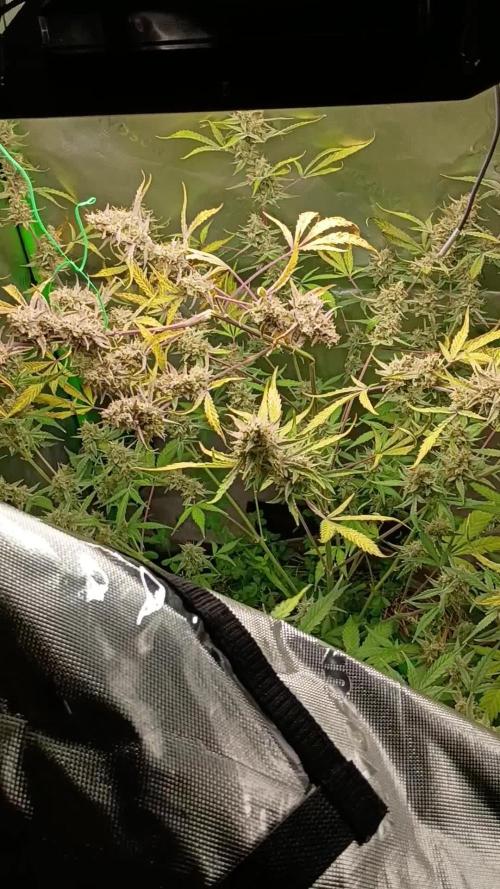
12/18 start of a new week. Smelling super strong now Trichs still a lot of clear no amber yet.
12/19 watered in gallon with coconut and q


Likes
46
Share


@Mrs_Larimar
Follow
Sunday Feb. 14th
The Plants are still alive and looking quite good
Its hard to keep them happy in 10 g Soil
They are watered twice a Day with Feedingsolution
AND sPRAYED WITH fAST pLANTS SPRAY AS fOLIAR fEED
I can see little Flowers
i think next Update we can see it much better.


Likes
3
Share


@HeavensHarvest89
Follow
week 8 was another growful week no issues to report.. No matter what I do to this thing she just continues to thrive.. i was worried some of the aggressive defoliation I was doing would stress her out but she has showed no signs even after the training accident she didn't slow her growth down a bit
Likes
17
Share

@Chucky324
Follow
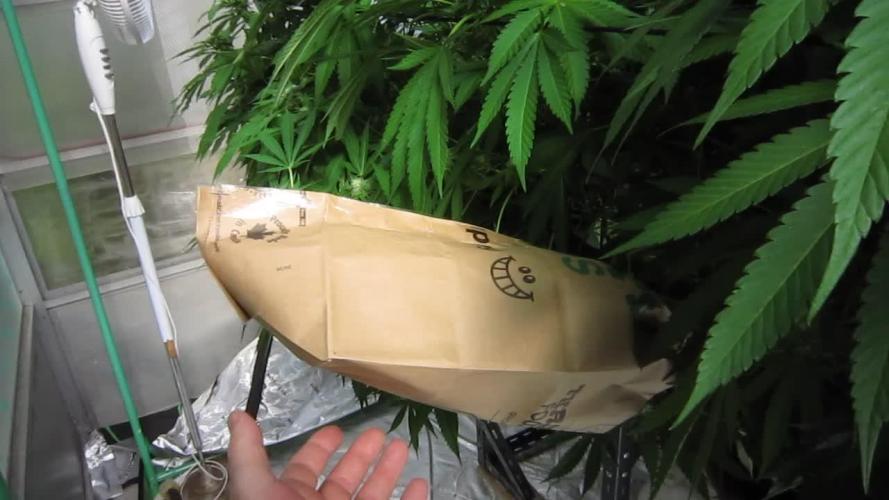
Hello. This is the end of week 4 and the beginning of week 5 of flowering.
Got some pollenating done this week.
Took pollen from male plant #1 and put it in some paper bags and slipped the bags over the female flowering branches.
Tied the bags at the end and gave the bags some small taps to get the pollen airborne in the bags, without coming out and getting more buds seeded.
I came in through the day and tapped the bags 3 times in total.
Once when I put the bags on, and once at around 3 pm. and once when I closed up the tent at 8 pm.
I took the bags off when I opened the tent in the morning. So the bags were on flowering branches for about 23 hours in total.
I pollenated plants #2, #3, #4, and the best smelling one is plant #5. Plant #5 also has good shaped buds.
Want to try some free seeds from me? Privet message me...
I didn't like the smell of plant #1, a little sour, and I didn't like the shape of the buds either, and plant #6 doesn't have much smell?
The rest of the greenhouse is doing good and growing well. As you can see.
OK. Be Great.
Chuck.


Likes
49
Share


@MadeInGermany
Follow
Hi Guys:)
Today is the update of the Sour Diesel 🌱.
It looks very healthy and vital 👌.
It has grown very nicely this week.
Tomorrow there will be a few more pictures, because unfortunately I only came to the videos today.
It's a hell of a lot of work that comes with growing and still working in everyday life 😅. What you don't do for your passion 😍 👍
I wish you all a good start into the new week, let it grow and stay healthy 🤗 🙏 🏻 🌱 🍀

Likes
2
Share


@Greenbean15
Follow
Send help... the Pineapple Express has taken over the tent... she’s massive at 44-45” tall currently... stretch slowed down but she’s past the light at this point and even light angled doesn’t hit the very top of the main colas just yet. (Back left of tent)
White widow looking great for the lollipopping method I used on her(front left of the tent)
White widow 2 growing well, got a nice dose of ferts this week based on her light coloration(front middle)
Berry white growing slowly still, tent is more suited for sativa dominant strains but this one gives the tent a bit more variety. (Middle back of tent)
Purple trainwreck 2 growing like a beast this go round, she’s taking up half the tent almost by herself and filling in a 1.5x2 foot area in nicely. (Far right of tent)
Purple trainwreck 1 bulking up extremely well, buds are nice and sticky, density is great so far on these buds. Hoping for another 14-20 days. Started her flush after giving her one more dose of nutes last week. Spotted first ambers on the trichomes... she’s only on day 45 of flower but the trichomes are already beginning to turn amber. I still suspect this strain to be semi-auto(has rudelaris genetics somewhere) and additional growing of this plant has simply increased this theory. The plant did have pistils when put into flower(18/6 lighting) but was a clone of a previous plant. She did reveg in 18/6 lighting and was cut from a flowering plant. I believe she had already transitioned into flowering since the plant had started opening pistils up again before being placed in 12/12. I believe she was a week or two into flower at the start of 12/12.

Likes
64
Share

@MadeInGermany
Follow
Hi folks :-)
This week it has developed very nicely 👍
The shoots are starting to grow again, and will soon be ready to be tied down again 👍
I wish you all a nice weekend and let it grow 🍀🌱🙏🏻

Likes
4
Share


@Jaschkoo0
Follow
I will grow this plant again in a few days but this time without overfeeding.