Likes
19
Share
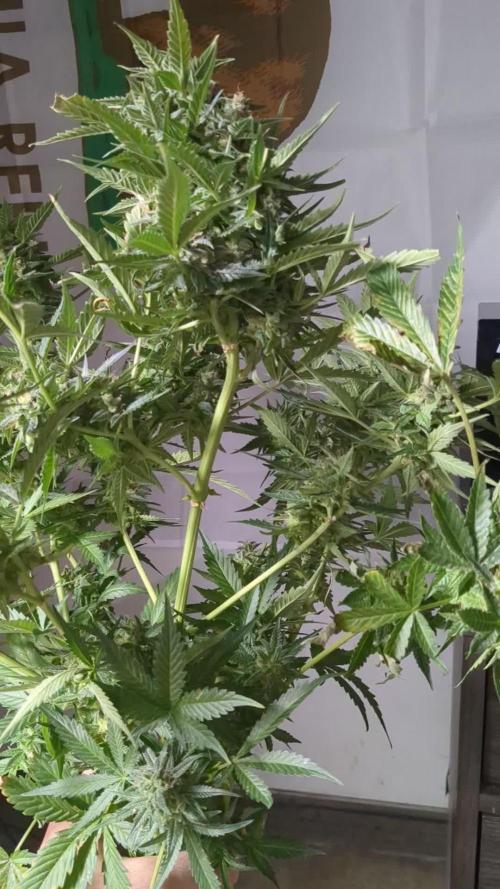
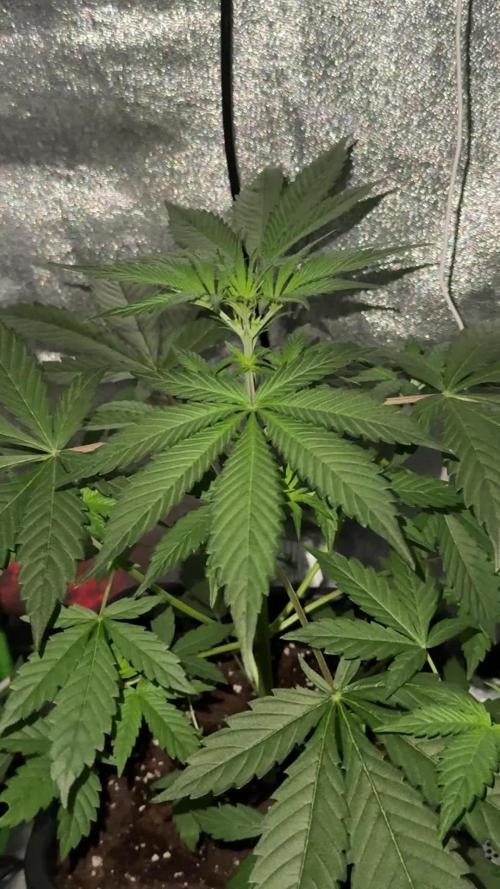
Day 8-19/12/21 all the chemdawg are looking great!!! Day 10-21/12/21 all chemdawg are looking great!!!! Day 13-24/12/21 still looking healthy!!!
Likes
6
Share
@NewbieOne
Follow
Unsure if this will produce bigger buds before harvest, watching the trichomes now to see when the right time will be. I anticipate her being ready by Christmas, will cut when trichomes are mostly cloudy
Likes
14
Share
Day 56: Like I said in the 2 weeks before this one, I was on vacation and a friend took care of my plants. This is the last week he helped out, I will be taking care of them again in the upcomming week. Well what can I say about this week; - Weather/climate was still bad. Lots of rain and cold temps. - They kind of failed with Low stress training, they went up and stretched without proper bending. - One plant has already mature looking buds but still on the small size. Two/three of them are going well and one is falling behind flowering wise. - They look nicely green tought. Until next week.
Likes
52
Share
Lacewings seemed to have mostly killed themselves by flying into hot light fixtures. I may have left the UV on which was smart of me :) Done very little to combat if anything but make a sea of carcasses, on the bright side its good nutrition for the soil. Made a concoction of ethanol 70%, equal parts water, and cayenne pepper with a couple of squirts of dish soap. Took around an hour of good scrubbing the entire canopy. Worked a lot more effectively and way cheaper. Scorched earth right now, but it seems to have wiped them out almost entirely very pleased. Attempted a "Fudge I Missed" for the topping. So just time to wait and see how it goes. Question? If I attached a plant to two separate pots but it was connected by rootzone, one has a pH of 7.5 ish the other has 4.5. Would the Intelligence of the plant able to dictate each pot separately to uptake the nutrients best suited to pH or would it still try to draw nitrogen from a pot with a pH where nitrogen struggles to uptake? Food for stoner thought experiments! Another was on my mind. What happens when a plant gets too much light? Well, it burns and curls up leaves. That's the heat radiation, let's remove excess heat, now what? I've always read it's just bad, or not good, but when I look for an explanation on a deeper level it's just bad and you shouldn't do it. So I did. How much can a cannabis plant absorb, 40 moles in a day, ok I'll give it 60 moles. 80 nothing bad ever happened. The answer, finally. Oh great........more questions........ Reactive oxygen species (ROS) are molecules capable of independent existence, containing at least one oxygen atom and one or more unpaired electrons. "Sunlight is the essential source of energy for most photosynthetic organisms, yet sunlight in excess of the organism’s photosynthetic capacity can generate reactive oxygen species (ROS) that lead to cellular damage. To avoid damage, plants respond to high light (HL) by activating photophysical pathways that safely convert excess energy to heat, which is known as nonphotochemical quenching (NPQ) (Rochaix, 2014). While NPQ allows for healthy growth, it also limits the overall photosynthetic efficiency under many conditions. If NPQ were optimized for biomass, yields would improve dramatically, potentially by up to 30% (Kromdijk et al., 2016; Zhu et al., 2010). However, critical information to guide optimization is still lacking, including the molecular origin of NPQ and the mechanism of regulation." What I found most interesting was research pointing out that pH is linked to this defense mechanism. The organism can better facilitate "quenching" when oversaturated with light in a low pH. Now I Know during photosynthesis plants naturally produce exudates (chemicals that are secreted through their roots). Do they have the ability to alter pH themselves using these excretions? Or is that done by the beneficial bacteria? If I can prevent reactive oxygen species from causing damage by "too much light". The extra water needed to keep this level of burn cooled though, I must learn to crawl before I can run. Reactive oxygen species (ROS) are key signaling molecules that enable cells to rapidly respond to different stimuli. In plants, ROS plays a crucial role in abiotic and biotic stress sensing, integration of different environmental signals, and activation of stress-response networks, thus contributing to the establishment of defense mechanisms and plant resilience. Recent advances in the study of ROS signaling in plants include the identification of ROS receptors and key regulatory hubs that connect ROS signaling with other important stress-response signal transduction pathways and hormones, as well as new roles for ROS in organelle-to-organelle and cell-to-cell signaling. Our understanding of how ROS are regulated in cells by balancing production, scavenging, and transport has also increased. In this Review, we discuss these promising developments and how they might be used to increase plant resilience to environmental stress. Temperature stress is one of the major abiotic stresses that adversely affect agricultural productivity worldwide. Temperatures beyond a plant's physiological optimum can trigger significant physiological and biochemical perturbations, reducing plant growth and tolerance to stress. Improving a plant's tolerance to these temperature fluctuations requires a deep understanding of its responses to environmental change. To adapt to temperature fluctuations, plants tailor their acclimatory signal transduction events, specifically, cellular redox state, that are governed by plant hormones, reactive oxygen species (ROS) regulatory systems, and other molecular components. The role of ROS in plants as important signaling molecules during stress acclimation has recently been established. Here, hormone-triggered ROS produced by NADPH oxidases, feedback regulation, and integrated signaling events during temperature stress activate stress-response pathways and induce acclimation or defense mechanisms. At the other extreme, excess ROS accumulation, following temperature-induced oxidative stress, can have negative consequences on plant growth and stress acclimation. The excessive ROS is regulated by the ROS scavenging system, which subsequently promotes plant tolerance. All these signaling events, including crosstalk between hormones and ROS, modify the plant's transcriptomic, metabolomic, and biochemical states and promote plant acclimation, tolerance, and survival. Here, we provide a comprehensive review of the ROS, hormones, and their joint role in shaping a plant's responses to high and low temperatures, and we conclude by outlining hormone/ROS-regulated plant-responsive strategies for developing stress-tolerant crops to combat temperature changes. Onward upward for now. Next! Adenosine triphosphate (ATP) is an energy-carrying molecule known as "the energy currency of life" or "the fuel of life," because it's the universal energy source for all living cells.1 Every living organism consists of cells that rely on ATP for their energy needs. ATP is made by converting the food we eat into energy. It's an essential building block for all life forms. Without ATP, cells wouldn't have the fuel or power to perform functions necessary to stay alive, and they would eventually die. All forms of life rely on ATP to do the things they must do to survive.2 ATP is made of a nitrogen base (adenine) and a sugar molecule (ribose), which create adenosine, plus three phosphate molecules. If adenosine only has one phosphate molecule, it’s called adenosine monophosphate (AMP). If it has two phosphates, it’s called adenosine diphosphate (ADP). Although adenosine is a fundamental part of ATP, when it comes to providing energy to a cell and fueling cellular processes, the phosphate molecules are what really matter. The most energy-loaded composition for adenosine is ATP, which has three phosphates.3 ATP was first discovered in the 1920s. In 1929, Karl Lohmann—a German chemist studying muscle contractions—isolated what we now call adenosine triphosphate in a laboratory. At the time, Lohmann called ATP by a different name. It wasn't until a decade later, in 1939, that Nobel Prize–-winner Fritz Lipmann established that ATP is the universal carrier of energy in all living cells and coined the term "energy-rich phosphate bonds."45 Lipmann focused on phosphate bonds as the key to ATP being the universal energy source for all living cells, because adenosine triphosphate releases energy when one of its three phosphate bonds breaks off to form ADP. ATP is a high-energy molecule with three phosphate bonds; ADP is low-energy with only two phosphate bonds. The Twos and Threes of ATP and ADP Adenosine triphosphate (ATP) becomes adenosine diphosphate (ADP) when one of its three phosphate molecules breaks free and releases energy (“tri” means “three,” while “di” means “two”). Conversely, ADP becomes ATP when a phosphate molecule is added. As part of an ongoing energy cycle, ADP is constantly recycled back into ATP.3 Much like a rechargeable battery with a fluctuating state of charge, ATP represents a fully charged battery, and ADP represents a "low-power mode." Every time a fully charged ATP molecule loses a phosphate bond, it becomes ADP; energy is released via the process of ATP becoming ADP. On the flip side, when a phosphate bond is added, ADP becomes ATP. When ADP becomes ATP, what was previously a low-charged energy adenosine molecule (ADP) becomes fully charged ATP. This energy-creation and energy-depletion cycle happens time and time again, much like your smartphone battery can be recharged countless times during its lifespan. The human body uses molecules held in the fats, proteins, and carbohydrates we eat or drink as sources of energy to make ATP. This happens through a process called hydrolysis . After food is digested, it's synthesized into glucose, which is a form of sugar. Glucose is the main source of fuel that our cells' mitochondria use to convert caloric energy from food into ATP, which is an energy form that can be used by cells. ATP is made via a process called cellular respiration that occurs in the mitochondria of a cell. Mitochondria are tiny subunits within a cell that specialize in extracting energy from the foods we eat and converting it into ATP. Mitochondria can convert glucose into ATP via two different types of cellular respiration: Aerobic (with oxygen) Anaerobic (without oxygen) Aerobic cellular respiration transforms glucose into ATP in a three-step process, as follows: Step 1: Glycolysis Step 2: The Krebs cycle (also called the citric acid cycle) Step 3: Electron transport chain During glycolysis, glucose (i.e., sugar) from food sources is broken down into pyruvate molecules. This is followed by the Krebs cycle, which is an aerobic process that uses oxygen to finish breaking down sugar and harnesses energy into electron carriers that fuel the synthesis of ATP. Lastly, the electron transport chain (ETC) pumps positively charged protons that drive ATP production throughout the mitochondria’s inner membrane.2 ATP can also be produced without oxygen (i.e., anaerobic), which is something plants, algae, and some bacteria do by converting the energy held in sunlight into energy that can be used by a cell via photosynthesis. Anaerobic exercise means that your body is working out "without oxygen." Anaerobic glycolysis occurs in human cells when there isn't enough oxygen available during an anaerobic workout. If no oxygen is present during cellular respiration, pyruvate can't enter the Krebs cycle and is oxidized into lactic acid. In the absence of oxygen, lactic acid fermentation makes ATP anaerobically. The burning sensation you feel in your muscles when you're huffing and puffing during anaerobic high-intensity interval training (HIIT) that maxes out your aerobic capacity or during a strenuous weight-lifting workout is lactic acid, which is used to make ATP via anaerobic glycolysis. During aerobic exercise, mitochondria have enough oxygen to make ATP aerobically. However, when you're out of breath and your cells don’t have enough oxygen to perform cellular respiration aerobically, the process can still happen anaerobically, but it creates a temporary burning sensation in your skeletal muscles. Why ATP Is So Important? ATP is essential for life and makes it possible for us to do the things we do. Without ATP, cells wouldn't be able to use the energy held in food to fuel cellular processes, and an organism couldn't stay alive. As a real-world example, when a car runs out of gas and is parked on the side of the road, the only thing that will make the car drivable again is putting some gasoline back in the tank. For all living cells, ATP is like the gas in a car's fuel tank. Without ATP, cells wouldn't have a source of usable energy, and the organism would die. Eating a well-balanced diet and staying hydrated should give your body all the resources it needs to produce plenty of ATP. Although some athletes may slightly improve their performance by taking supplements or ergonomic aids designed to increase ATP production, it's debatable that oral adenosine triphosphate supplementation actually increases energy. An average cell in the human body uses about 10 million ATP molecules per second and can recycle all of its ATP in less than a minute. Over 24 hours, the human body turns over its weight in ATP. You can last weeks without food. You can last days without water. You can last minutes without oxygen. You can last 16 seconds at most without ATP. Food amounts to one-third of ATP production within the human body.
Likes
38
Share
@PapaNugs
Follow
A more difficult week. I've been battling the water consumption on two of the girls. I ordered and hooked up the Blumats auto watering system. I followed the instructions to a T but they don't work on those settings for this type of plant. They must be recommending for succulents cause the girls dried out right away with the settings. So I've been slowing dialing it in the get the proper amount to release. This Gorilla Cookie is my problem child right now. She is so delicate. Underwatered all the time. Then when you water a bunch she's overwatered. It's a dumb situation. I've never ran into this. I just think she outgrew her pot too soon and could benefit from synthetic nutrients. She's not gonna get them so tough luck. Dimmed to 80% Here are the lights details: Medic Grow Mini Sun-2 150W LED Model: MN150-022 Spectrum mode: V1 Efficacy: 2.8 umol/J Thanks for stopping by! You can find the light on Grow Diaries: https://growdiaries.com/grow-lights/medic-grow/mini-sun-2-150-watts You can find the light on Medic Grow's website: https://medicgrow.com/
Likes
Comments
Share
@Flauros
Follow
13.10 Day 53 CalMag - 100ppm 0.5ml/l Bloom - 120 ppm Pk 13/14 - 400 ppm 1ml/l Input: 840 ppm Output: 1010 ppm
Likes
9
Share
@Grileon
Follow
Started giving nutrients, up to 300-350 ppm. Having temperature problems, it's too hot outside 34-36 degrees Celsius. This causes problems inside the box, mostly for water inside hydroponics. Have to use frozen bottles of water two times per day.
Likes
17
Share
@DBQush
Follow
Dear diary, Week 10 total and week 1 of flower is behind us. Will just be making sure all tops are exposed and somewhat in the right place as I let them stretch for about 21 days before some defoliation. 🌸🌸🌸🌸🌸🌸🌸🌸🌸🌸 ⏰ Day 67: Feeding was given in the evening with a solution of 1.87ms and pH of 5.6. During this feeding, I guided most of the tops into their designated positions within the net, ensuring they are adequately spread out to receive optimal light. I also checked the runoff, which measured 2.3ms, but considering the extra dissolved salts from full draining and collection that would be higher that it really is, I will aim to bring it back to the desired range of 1.65-1.7ms to be sure. ⏰ Day 68: In the evening, the plants were fed with a solution of 1.64ms at a pH of 5.8. ⏰ Day 69: Evening feeding consisted of a solution with 1.66ms strength and a pH of 5.9. I also took the opportunity to confirm that the lights were positioned at a 48cm distance from the canopy. Additionally, I'm testing the exhaust system by venting it outside the room. Currently, the relative humidity (RH) ranges from 53-55% during lights-off and 58-60% during lights-on, while the temperatures remain around 18°C with lights off and 23.5°C with lights on. These conditions fall within the desired vPD (vapor pressure deficit) range of 0.95-1.2. ⏰ Day 70: Feeding was carried out in the evening using a solution with a strength of 1.66ms and a pH of 5.9. To enhance air circulation, I added a fan at the top of the tent. Furthermore, I checked the light intensity, which measured around 760-780ppfd. ⏰ Day 71: During the evening feeding, the plants received a solution with a strength of 1.64ms and a pH of 6.4. The RH levels range from 55-65% as the girls get more bushy, while temperatures vary between 23-18°C, depending on whether the lights are on or off. ⏰ Day 72: Evening feeding included a solution with 1.64ms strength and a pH of 6.4. ⏰ Day 73: The plants were fed with a solution having a strength of 1.66ms and a pH of 6.0. As indicated by the feeding schedule, the A+B mix was increased to 3.5ml/l. I also ensured that the lights were positioned approximately 50cm above the canopy and set to 90% intensity to provide additional heat.
Likes
6
Share
to view this lamp or any other marshydro product go to: https://instagram.com/marshydro_aliexpress?igshid=YmMyMTA2M2Y=
Likes
2
Share
Yes I my peoples cheers and love Here we flush them to a future crop
Likes
3
Share
@123Grow
Follow
1. LABS - I suggest using distilled water for the entire process ( no chlorine or chloramine). I also suggest the type of rice product shown ( 1/2 cup), it has red, brown, white, and black rice blended together. You get the benefits of each type. 2. Take the rice that was used in making the rice rinse for labs and boil it in 3 cups of water for 30 mins. Strain the rice out. Add 1 TBSP molasses per 300 mls. Use 300 mls of the above mixture during your watering cycles. It contains starches, b vitamins, aminos, trace minerals, calcium, magnesium, iron, phosphorus, potassium, and some nitrogen. The ppm’s are not higher than 200 ( if using distilled water). This is ONLY used if your plants are healthy. If your plants are sick…this will NOT help them. It will make stuff worse!!! The Hulk-Berry got a new home. 1 tsp 7-3-1, 1/2 tsp 0-12-0, 1/2 tsp Langbeinite, 1 TBSP 2-2-2, 3 TBSP 4-3-3, worm castings, recharge (1/32 tsp) into the soil ( Mother Earth). The 3 RuntZ are coming back from slow growth at the outset. I added LABS, Lentil SST, Photosynthesis Plus to the media. I did a foliar spray with recharge. 24-36 hours later the leaves exploded with growth and height. I added ZERO nutrients!!! I only used natural inputs and bacteria to get the root zone back in order. 11-3. Things are all in check! The LABS, SST’s and Rice wash have gotten the 3 RuntZ back on track. The Hulkberry is in full swing. I think I can get to 3 feet by flower time with the Hulkberry 11-5 All is well today!!! Everyone is very happy after the cal-mag, Photosynthesis Plus, kelp bath
Likes
43
Share
@Sabac
Follow
Última semana de mis plantitas Hoy corto 12 de 16 Fue un cultivo sin problemas. Y creo que viene buena producción Recomiendo 100% los fertilizantes hesi buenísimos. 5 cultivos con ellos y 0 problemas. El sustrato Biobizz light mix excelente Las semillas de barneys farm uff pura crema. Eva seeds recomendables y las sweed seeds buenisimas semillas para seguir cultivando. Los Led yxo para ser de un perfil bajo qué no a toda la gente les gusta cumplen la. Función 480w de pura potencia en un espacio de 120x120 los recomiendo para gente que tenga un presupuesto bajo. Ahora voy por unos sobre 600w aunque los reforzaría estos con unos led de 100w . Bueno feliz con los resultados. Esta semana mostraré los resultados de las plantas cortadas. Se vienen más cultivos Salu2
Likes
59
Share
@Jsammy09
Follow
8/12 (Day 56) - Well it’s a week and things are looking ok I suppose. Everything is staying in check and I’m feeding full strength and the plants seem to be handling it well. Drinking 4-5 gallons a day. I think the stretch is pretty much done so hopefully we can get some big juicy nugs to develop. These ladies are sooooo stick. I defoliate and 10 seconds later it’s like my hand is covered in stick glue, and the smell…sooo sweet. Like a tropical candy. Going to be doing probably one last big defoliation on these girls in the next day or two. I’m always plucking here and there to be honest. But seems to be ok. Thanks for looking! 8/13 (Day 57)- Did some very light defoliation on three of the plants, then the back right plant I ended up removing a ton of the lower growths and leaves. It needed it pretty bad I feel. She is a little behind the other plants but looking good none the less. Just going to continue to monitor and feed regulary. 8/14 (Day 58)- Started the morning with the flush and change of water and nutrients. Everything is looking good, going to leave them alone for a few days let the one plant recover and grow. All conditions are steady and constant. 8/15 (Day 59)- Just continuing to monitor and check for issues, feeding around a gallon or more every 4-5 hours. I am noticing more and more frosty goodness as the girls continue to develop! As always tips and recommendations welcomed and appreciated.
Likes
7
Share
@kapai
Follow
Everything looking nominal. One girl is looking a little weak but that may have been my doing. All others look more or less the same. Nutrient schedule the same. Did a res clean and replace. Using reverse osmosis water. PPM’s hovering around 280-300. Water temp 20ish °c
Likes
2
Share
@ARAWAK972
Follow
Salut à tous, germination dans la terre directement avec le substrat Seedmix, en godet biodégradables, pendant 10 jours puis rempotage en pot géotextiles de 4 litres et substrat Zero mix Guano Diffusion. Terreau enrichi avec Lombricompost, Alguacymor, engrais guano, en 3-4 semaines les racines avaient entièrement colonisé le substrat sauf pour les Shogun et Cookies Gelato qui prennent leur temps ( rempotage 1 semaine plus tard ) Rempotage en pot de 15 litres pour les Fat Banana Auto et Royal Gorilla Auto, en pot de 4L pour la Critical et Royal Critical Auto, Royal Gorilla en pot de 50L mais avec environ 35 litres de substrat. Terreau enrichi comme ci-dessus avec guano de floraison et ajout de guano de croissance, passage en floraison fin de 4 ème semaine, ajout d'oligoélément Trace Mix Canna, MC4, 1/4 dose de Top-Max et sel d'epsom. Pour l'instant tout se passe bien, mon eau est très dure alors je la prépare la veille avec des bâtons de charbon macérant le temps u'il faut pour absorber un maximum de vacherie. Bref, hyper content de ses graines de chez ROYAL QUEEN SEEDS, la Fat Banana Auto ... AWAH!!!
Likes
5
Share
@DrShotzUK
Follow
All round a very good plant to grow , one of them stretched but I lollypopped and topped it late into flower due to outgrowing my tent and she took it well, producing absolutely top quality buds covered in milky thricomes and glistening all over the nuggs. Absolutely frosted. The smell at this point was around 7.8 smelling strong of orange and citrus , the main cola nice and dense, with lots of other colas branching off. Easy strain to grow to this point although I did have a calcium deficiency but it was fairly rectified.
Likes
10
Share
Looks good from my house lol any input would be greatly appreciated guys thanks in advance! I have a couple that I’m worried about will post more video soon sorry. Good luck buds!🌳☘️