The Grow Awards 2026 šŸ†
Likes
Comments
Share
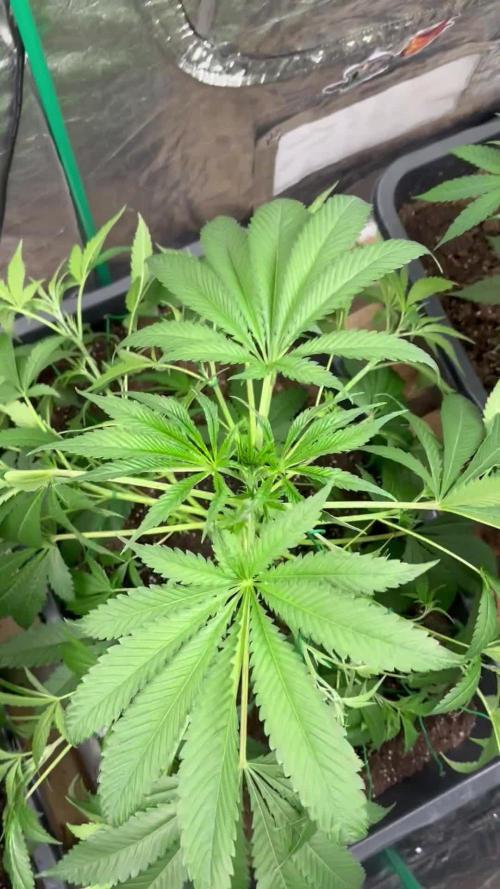
These ladies did'nt stretched much so far in week 2 but that could be due to the light intensity and distance I had it at in week 1 of the stretch period. This strain is really starting to show signs of that Gassy, Sweet, Creamy smelly that I was looking for and so far these ladies have been a breeze to grow.
Likes
52
Share
Once again she passes my expectations, late to the show with trichome production. I'm surprised there is purple on the bud, maybe Purpinator does work. I thought I could see hints under the grow lights and thought my eyes were deceiving me, I was just being hopeful. But nah 2 of the 3(under the UV) have developed a beautiful tone of purple. I was never going to bother with a deep freeze but maybe the whole bud will change given conditions, that would be something, fingers crossed. šŸ¤” was a little skeptical that reducing temps humidity would change density, but it does, buds are solid something I've not been able to achieve before. Rule of thumb is never to surpass 60% RH in the flowering phase and try to progressively reduce it down to 40% in the last 2–3 weeks before harvest. The plant will react as it seeks to protect its flowers, responding by producing denser buds and a higher concentration of resin. Cannabis plants are sensitive to sudden temperature changes, especially in the flowering stage. Extreme heat or cold can impact bud density and overall yields. In nature as a defense mechanism from cold, the plant sensing sudden dips in temperature will attempt to remove the pockets of air within the bud, it achieves this by compacting itself in doing so to better protect itself from cold snaps which are normally indicators in nature that worse weather is on the way. Terpene levels are the highest just before the sun comes out. Ideally, you want as many terpenes present in your plants as possible when you harvest. Cannabis plants soak up the sun during the day and produce resin and other goodies at night. The plant is at its emptiest from "harvest undesirables" so to speak right before the lights on. Boiling cannabis roots during harvesting slows down the drying process. When you boil cannabis roots, it shocks the plant, closing the stomata on the leaves. This prevents massive moisture loss through the leaves, leaving only the floral clusters actively losing moisture at a reduced pace. I've always run a strict 60/60 and it took almost twice as long to dry to a snap than previous grows where I didn't boil for what it's worth. Chlorophyll is good for the plant but not for you. When you harvest the buds, even after you flush them, if you flush them, they’re still filled with chlorophyll. Freshly cut buds are greener than dried buds because they still contain loads of chlorophyll. However, when rushed through the drying process, the buds dry but retain some chlorophyll, and when you smoke it, you will taste it. Chlorophyll-filled buds are smokable, but they aren’t clean. Slow drying gives the buds enough time and favorable conditions to lose the chlorophyll and sugars, giving you a smoother smoke. How the plant disposes of the chlorophyll and sugars by a process of chemically breaking them down and attaching the decomposed matter once small enough to water molecules which then evaporate back into the ether. Time must be given to the process to break down the chlorophyll and sugars. Think of it like optimizing the environment for decay. All the nutrients it could ever need are in abundance, it eats nutrients based on its demand for growth, which is dictated primarily by available light. Plant growth and geographic distribution (where the plant can grow) are greatly affected by the environment. If any environmental factor is less than ideal, it limits a plant's growth and/or distribution. For example, only plants adapted to limited amounts of water can live in deserts. Either directly or indirectly, most plant problems are caused by environmental stress. In some cases, poor environmental conditions (e.g., too little water) damage a plant directly. In other cases, environmental stress weakens a plant and makes it more susceptible to disease or insect attack. Environmental factors that affect plant growth include light, temperature, water, humidity, and nutrition. It's important to understand how these factors affect plant growth and development. With a basic understanding of these factors, you may be able to manipulate plants to meet your needs, whether for increased leaf, flower, or fruit production. By recognizing the roles of these factors, you'll also be better able to diagnose plant problems caused by environmental stress. Water and humidity *Most growing plants contain about 90 percent water. Water plays many roles in plants. It is:* A primary component in photosynthesis and respiration Responsible for turgor pressure in cells (Like the air in an inflated balloon, water is responsible for the fullness and firmness of plant tissue. Turgor is needed to maintain cell shape and ensure cell growth.) A solvent for minerals and carbohydrates moving through the plant Responsible for cooling leaves as it evaporates from leaf tissue during transpiration A regulator of stomatal opening and closing, thus controlling transpiration and, to some degree, photosynthesis The source of pressure to move roots through the soil The medium in which most biochemical reactions take place Relative humidity is the ratio of water vapor in the air to the amount of water the air could hold at the current temperature and pressure. Warm air can hold more water vapor than cold air. Relative humidity (RH) is expressed by the following equation: RH = water in air Ć· water air could hold (at constant temperature and pressure) The relative humidity is given as a percent. For example, if a pound of air at 75°F could hold 4 grams of water vapor, and there are only 3 grams of water in the air, then the relative humidity (RH) is: 3 Ć· 4 = 0.75 = 75% Water vapor moves from an area of high relative humidity to one of low relative humidity. The greater the difference in humidity, the faster water moves. This factor is important because the rate of water movement directly affects a plant's transpiration rate. The relative humidity in the air spaces between leaf cells approaches 100 percent. When a stoma opens, water vapor inside the leaf rushes out into the surrounding air (Figure 2), and a bubble of high humidity forms around the stoma. By saturating this small area of air, the bubble reduces the difference in relative humidity between the air spaces within the leaf and the air adjacent to the leaf. As a result, transpiration slows down. If the wind blows the humidity bubble away, however, transpiration increases. Thus, transpiration usually is at its peak on hot, dry, windy days. On the other hand, transpiration generally is quite slow when temperatures are cool, humidity is high, and there is no wind. Hot, dry conditions generally occur during the summer, which partially explains why plants wilt quickly in the summer. If a constant supply of water is not available to be absorbed by the roots and moved to the leaves, turgor pressure is lost and leaves go limp. Plant Nutrition Plant nutrition often is confused with fertilization. Plant nutrition refers to a plant's need for and use of basic chemical elements. Fertilization is the term used when these materials are added to the environment around a plant. A lot must happen before a chemical element in a fertilizer can be used by a plant. Plants need 17 elements for normal growth. Three of them--carbon, hydrogen, and oxygen--are found in air and water. The rest are found in the soil. Six soil elements are called macronutrients because they are used in relatively large amounts by plants. They are nitrogen, potassium, magnesium, calcium, phosphorus, and sulfur. Eight other soil elements are used in much smaller amounts and are called micronutrients or trace elements. They are iron, zinc, molybdenum, manganese, boron, copper, cobalt, and chlorine. They make up less than 1% of total but are none the less vital. Most of the nutrients a plant needs are dissolved in water and then absorbed by its roots. In fact, 98 percent are absorbed from the soil-water solution, and only about 2 percent are actually extracted from soil particles. Fertilizers Fertilizers are materials containing plant nutrients that are added to the environment around a plant. Generally, they are added to the water or soil, but some can be sprayed on leaves. This method is called foliar fertilization. It should be done carefully with a dilute solution because a high fertilizer concentration can injure leaf cells. The nutrient, however, does need to pass through the thin layer of wax (cutin) on the leaf surface. It is to be noted applying a immobile nutrient via foliar application it will remain immobile within the leaf it was absorbed through. Fertilizers are not plant food! Plants produce their own food from water, carbon dioxide, and solar energy through photosynthesis. This food (sugars and carbohydrates) is combined with plant nutrients to produce proteins, enzymes, vitamins, and other elements essential to growth. Nutrient absorption Anything that reduces or stops sugar production in leaves can lower nutrient absorption. Thus, if a plant is under stress because of low light or extreme temperatures, nutrient deficiency may develop. A plant's developmental stage or rate of growth also may affect the amount of nutrients absorbed. Many plants have a rest (dormant) period during part of the year. During this time, few nutrients are absorbed. Plants also may absorb different nutrients as flower buds begin to develop than they do during periods of rapid vegetative growth. 432 Hz is said to be mathematically consistent with the patterns of the universe. Studies reveal that 432 Hz tuning vibrates with the universe’s golden mean PHI and unifies the properties of light, time, space, matter, gravity and magnetism with biology, the DNA code and consciousness. When our atoms and DNA start to resonate in harmony with the spiraling pattern of nature, our sense of connection to nature is said to be magnified. Another interesting factor to consider is that the A=432 Hz tuning correlates with the color spectrum while the A=440 Hz is off. Audiophiles have also stated that A = 432 Hz music seems to be non-local and can fill an entire room, whereas A=440 Hz can be perceived as directional or linear in sound propagation. Once you adopt the idea that sound (or vibration in general) can have an equalizing and harmonizing effect (as well as a disturbing effect), the science of harmony can be applied to bring greater harmony into ones life or a tune to specific energies. There is a form of absolute and of relative harmony. Absolute harmony can for example be determined by the tuning of an instrument. The ancients tuned their instruments at an A of 432 Hz instead of 440 Hz - and for a good reason. There are plenty of music examples on the internet that you can listen to in order to establish the difference for yourself. Attuning the instrument to 432 Hz results in a more relaxing sound, while 440 Hz slightly tenses up to body. This is because 440 Hz is out of tune with both macro and micro cosmos. On the contrary, 432 Hz is in tune. To give an example of how this is manifested micro cosmically: our breath (0,3 Hz) and our pulse (1,2 Hz) relate to the frequency of the lower octave of an A of 432 Hz (108 Hz) as 1:360 and 1:90. It is interesting to note that 432 Hz was the standard pitch of many old instruments, and that it was only recently (19th and 20th century) the standard pitch was increased. This was done in order to be able to play for bigger audiences. Bigger audiences (more bodies) absorb more of the lower frequencies, so the higher pitch was more likely to ā€œcut throughā€. One of the oldest instruments of the world is the bell ensemble of Yi Zeng (dated 423 BC), tuned to a standard F4 of 345 Hz which gives an A= 432 Hz. The frequency of 345 Hz is that of the platonic year! Similarly many old organs are tuned in an A=432 as well; for example: St. Peter’s Capella Gregoriana, St. Peter’s Capella Giulia, S. Maria Maggiore in Rome. Maria Renold’s book ā€œIntervals Scales Tones and the Concert Pitch C=128 Hzā€ claims conclusive evidence that 440 Hz and raising concert pitch above scientific ā€œCā€ Prime=128 Hz (Concert A=432 Hz) disassociates the connection of consciousness to the body and creates anti-social conditions in humanity. The difference between concert pitch A=440 Hz and Concert A=432 Hz is only 8 cycles per second, but it is a perceptible difference of awareness in the human consciousness experience of the dream we share called existence.
Processing
Likes
14
Share
@goeser
Follow
08.11.2020 | Finally it looks like the ladies are starting to grow _________ 10.11.2020 Maybe a bit to ā€žearlyā€œ but because they are autos i prefer them to be as early as possible in the big pots. 11Liter pots. ______________ 14.11.2020 girls starting to grow nice. also started with biobizz bio grow 2ml/l.
Likes
18
Share
So I had some internet issues so I couldn't upload. But now everything is alright. This last week I only gave her water 2 times. first time I gave her 500 ml water and the second time only 250 ml water only. And I took more fan leafs off her as you can see I only had to hang her up without trimming or anything. After she is dried I am going to weigh her and see how much I got. ***************************************************************************************************** As for grow report : Blue kush is really easy to grow just make sure the temps optimal. The buds grow really dense thats 1 of the parts I like about this strain. She takes normal feeding. Very strong genetics. And she can take a few mistakes so this strain is perfect for beginners and in medium or expert hands she can get really nice with the colors and smell and taste. Next week i will post the weight and the dried product.
Likes
8
Share
Done abit of lst this week on a few of the big ones First timer not really got a clue what to do so trying trial and error One half the back of tent got a trellise over them the other half have had the fam leaves tucked under and the ones you see under the smaller light have been tied down about 90 degree angle Also a few showing signs of maybe nutrient deficiency of some sort could anybody give a hand as to what this is also something I’ve noticed over the last week a lot of the leaves look almost chewed off complete fan leaves gone only the stem left this is a indoor grow first time I can’t seem to see anything in the tent or any signs of snails or slugs and I’ve put it down to water landing on the leafs and burning them away completely (pot head conspiracy ) any help would be much appreciated please
Likes
23
Share
@Zuppler
Follow
šŸ¦**Grow Report by Zuppler - Week 3 Flowering Phase** šŸ¦ Yo yo, what’s poppin’? It’s Zuppler back with that grow update straight from the heart of the city, ya feel me? We’re in Week 3 of the flowering phase, and let me tell you, the ladies are lookin’ fresh as hell right now. Everything's running smooth, no stress. The buds are starting to show up like diamonds in the rough, you know what I’m sayin’? The girls are growing like real queens, standing strong and firm, like they know they’re about to take over the spotlight soon. Nodes are tight, no stretchin’, everything stayin' solid like a real OG. Lights are on that 12/12 cycle, and the nutes are mixin’ in just right – no overfeedin’, no deficiencies, just smooth sailin’, bruh. Water game is on point too – pH is dialed in, no dry-out drama. Roots are doing their thing, and the ladies are sucking up that H2O like they’re thirsty in the desert. We’re usinā€˜ that clean and pure Osmosewasser. So far, everything’s rollin’ as planned. I’m hyped to see how these next few weeks turn out – buds gettin’ fatter, stickier, and that smell’s gonna get even crazier. Stay tuned, yo – Zuppler out. Peace!
Processing
Likes
18
Share
*****Disclaimer ****** Mrs Wildeweed is not the photographer here yet. She will sneak in for some shots here and there, and take over once the show really begins. Blame me not her for the shoddy camera work. Disclaimer over. . . . Now to the good stuff!!! This is the first diary of the 2.0 account. This is something I’ve been wanting to do for sometime. Show off the behind the scenes stuff that leads to boss lady’s pictures. Now we will see how we get to those shots. And what a way to start! Wickedstixgenetics Herercane. A custom breed brought to us by the former machine that was green! We’ve seen the fire that comes from his grows so I’m really pumped to take this project on. We have his full line and will be running them all right here and on insta. Since this was a Greenmachine breed and venture, how could I NOT run this in dutch buckets. This man saved my hydro ass more than a few times, and he raves these buckets and maxi since the day we first said hello. So that’s how this will be done. This bucket set up is basically just a scaled down version of the one I built for when they get bigger. After seeing how much size his solo cups did and ours is doing in 16oz cups, I decided to do the veg in this set up using 24oz or so cups. Once they are ready for flowering I’ll transplant into the big table I’m still putting finishing touches on. So, here it is. The beginning of something wonderful. Please follow along. I promise we will have some good content rolling around here. Thanks for looking, and see ya next week!
Processing
Likes
12
Share
This is my second time growing this strain and i am much more please this time around. Came out with almost 3 times more than last time and the buds are a lot bigger. Have already ordered another seed because i think this may be my favorite strain!
Likes
8
Share
@Chi_Dou1
Follow
The seedlings responded really well to Root Juice from Biobizz,. Potted them all on day 5, and kept them under a 600w.led vegging light (Cobb Cree 3000w Led by Philizon) Days 1-6 Not much happening on the surface, miniature differences with each one, but been autos right now the seedlings will be rooting. Environment. Light cycle is now 19 on 5 off. Using the Philizon cob Cree 3000w full spectrum veg light. Light suspended 32" of the lip of the pot practically the top of the seedlings, I could have got it lower but I can't imagine much difference vegging. Night Temperature were previously between 19.5c to 23c. Temperature has been slightly altered to 22.4c to 25.6 following some guidance I read on; https://www.royalqueenseeds.com/blog-indoor-cannabis-growing-relative-humidity-and-temperatures-n243. Set up is currently been regulated by Inkbird climate remote heat n cooling. 1500w oil radiator ;) set at 900w 26/27c 22.02.20- Slight change to air exchange set for every 14 mins previously cycling every 40 to 43 mins( radiator was set too low, higher power temp, more responsive to temp changes.) This enables the radiator oil to reach its heat n switch off it's internal thermostat at the device, not the controller. I found I was able to continue radiating a couple of air cycles, before finally dropping below 25.7 which then triggers the radiator to kick in as it's been able to cool off for nearly 26mins) Temp cycle Set 27c Fan activates 27.5 stops at 27 but temp drops 1.5 Heater (controlled by Inkbird climate controller) activates 26.c stops at 27.c takes a further 6 mins to climb +.6c & then fans kicks in. Take 14 mins for cycle. Pot temp 22.4 c to 23.7c Misting Using Active Vera 1.5 ltr 3ml active vera, once a day, especially over the top soil I find helps raise the humidity (ranges 60 - 80%) Week 3 - 03/03/20 Rapid growth, I topped five of the fastest strongest plant out of the 8. Some moisture inch deep. No feed required. Humidity 50 to 65 Temp 26c to 27c Week 3 Day 3 - 5/3/20 Water feed. pH. 5.9 Biobizz: Bio.Grow 2ml/L (20ml) Bio Bloom 1ml/L (10ml) Top Max 1ml/L (10ml) Bio Heaven 2ml/L (20ml) Alg-A-Mic 2ml/L (20ml) Acti-Vera 2ml/L (20ml) Cal-Mag 1ml per gallon (2ml) Water mister lightly mist the flowers following feed as leaves began to droop from lack of water. 2ltrs pH.5.9 2ml Acti Vera 2ml Alg-A-Mic Used 200ml, will save n use rest over the next couple of days. Humidity following feed 75% Humidifier set at 60% Humidity Range 50 to 60 Room temp 25 to 27c av 26c Lights off temp 19.5c to 23c (pot) Pot temp Day Time 25c to 26c Plants responding really well to been topped, loads of new foliage in just 2 days. Started 1st course in blooming feeds. All have started pre flowering, with little white hairs appearing down the stem. Step are as thick as the gavita kettle power cord. Smell like fresh humid green, to the touch of the plant is exhibiting tangy fresh citrousy smells that have that widow rhino smell,.. mmm. Week 4 10/3/20 Day 29 11/3/20 Water feed. 10 ltrs 1.25 Lt p p pH. 5.9 Biobizz: Bio.Grow 2ml/L (20ml) Bio Bloom 2ml/L (20ml) Top Max 2ml/L (10ml) Bio Heaven 2ml/L (20ml) Alg-A-Mic 2ml/L (20ml) Acti-Vera 2ml/L (20ml) CalMag 1ml p gallon (2ml) Bat Guano Fert 2x scoops Some light LST training. Height 14.5 to 17" smallest to tallest. 17" is the CC that has not been topped As shown below. In pic 1 Sat 14/03/20 D32 (Seems I wasn't putting enough water through, so no previous run offs.) I noticed the begining signs of Nitrogen toxicity as some leaf's where begining to claw. I let the plants dry out a day further. I filled a reservoir 80 ltrs tap water, n let sit overnight pH to 6.3 Sunday W4 D33 15/03/20 Poured 8 litres into each pot gradually (2ltr bottle hand feed) - water didn't run off untill the 6ltr (3rd bottle), the next 2ltrs that followed ran out quicker & less sluggish. I checked in 6hrs later, plants appear to be well. I will keep you posted as we enter the beginning of week 5 (week6 on grow diaries as Day 1 was week 1,. Unable to amend) #sweetseeds
Likes
22
Share
@Vyzon1
Follow
Girls are on day 4 of being in their forever pots, 5 gal. I am a noob and over watered my plants, thus the curled leaves and I had a very small amount of mold on Dorothy's soil. Removed it with a spoon and did a good search for how often and where to water. Watered the whole soil, not just near the roots. I will be waiting until the soil is dry before watering going forward and I'm hoping the girls will get to 100 percent health. My grow tent comes tomorrow and they will be transferred into the tent with grow lights and a fan. Rn I have a basic house light on them which I'm thinking will stunt them initially. Hopefully the grow light brings the girls all the way to life I will update with them in the grow tent tomorrow. Also my 4th seed officially never grew a taproot, so RIP Sophia 😄Please leave any and all tips, as I am walking blind and depending on a few websites for my advice.
Likes
41
Share
This is my favorite plant of the 16oz dutch bucket grow. She has grow fast, healthy, and has a beautiful structure. She is putting on some nice tops. She is starting to show some drooping on the top leaves in the evening since being put under the quantum boards. But she perks back up in the morning so I think she will keep chugging along. I'm thinking I will easily exceed 2 oz on harvest if I can see her to the end. Got the nutrient pumping and the lights beaming. Not much else to do from here on out
Likes
4
Share
bud production is a little slow hoping she will get a move on but more pistols showing so plenty more development to be done
Likes
18
Share
@FatCobra
Follow
Had some issues with the big fan leaves on the lower nodes. They weren’t doing so great, turning brown and brittle so I cut them off today. Hopefully that helps, probably should have done it sooner but I was a little worried I was going to kill it or something. It’s still growing though, lots of new growth and a few branches growing potential bud sites so I think it’s ok. The reason the leaves were dying? Could have been the low humidity. Could have been underwatering (she’s sucking up the water really quickly, needs to be transplanted). Maybe I have the light too close, realized today it’s only 8 inches away, I was just eyeballing it. If you know the proper distance for this Mars Hydro TS1000 LED please comment below. I will be transplanting this week on Thursday when my new Air-pots come. Goals for this week: Figure out exactly how much I should be feeding this thing, it’s possible it needs cal-Mag added to the food? If you know about nutrients please comment below. I am using the General Organics GoBox. Hopefully cutting those leaves will lead to some new growth. I checked out the gross of some of you that have commented. You all are doing awesome I know there is a lot I can learn from this community and appreciate any help you can give. I don’t really have a lot of time for research these days with my work schedule and children and there is a lot of information out there it’s hard to sort out the good stuff. Thanks for stopping by, have a great week!
Likes
9
Share
@Plebsi710
Follow
Still 3 plant in the tent at the moment , 2 of them are harvested and drying right now :) another should be ready for harvest this week :) I do have a plant that seems to be late compared to the other , although she is now massive compared to her sisters
Likes
8
Share
@Krissci
Follow
One of the best plants I've grown so far. Trichomes are crazy Day 4 - most probably last sugar/pk feed before beginning flushing. Major defoliation to expose buds
Likes
14
Share
All feed is based in 5ļøāƒ£ litres for this update And our germ room.is our philzone 6ļøāƒ£0ļøāƒ£0ļøāƒ£w at 5ļøāƒ£0ļøāƒ£% pulls around 1ļøāƒ£1ļøāƒ£0ļøāƒ£ true watts will get a reading next run. Then in week 2ļøāƒ£ they go to tge big girl pit with tye super lumen
Likes
58
Share
Results are starting to come in now, going to be Cake all the way to the end. Time to grab your popcorn and stay tuned in šŸ¤”šŸŽŖ Short Phenos is Pure Michigan lean, obvious now with the purple starting to form from bud sites. Tall girl is Sugar Cane Pheno what a stake, huh!? GHL out šŸš€
Likes
11
Share
@BudBeezy
Follow
Now that the plant is dry, I can go into a few more details. In my opinion, the harvest is a complete success for a beginner. During the harvest I realised how hard the flowers are. After drying, they became even harder, almost rock hard. The flowers are covered with many shiny trichomes. The harvest took quite a long time. I spent about 14 hours on it, which was also due to the super meticulous wet trim. The reason for the thorough wet trim was the mould. Every single flower was examined. I disassembled the large flowers before drying to be on the safe side. It's nice to have huge flowers, but in the end they are chopped up anyway. At the end of the 8 days of drying, the GG4 Sherbet FF rewarded me with finest ice-coated flowers. Thanks to the wet trim, I didn't have to do any more work. I was able to separate the buds directly from the branch and put them in the jars to mature. As the offcuts were also super potent due to the thorough wet trim, I processed them into butter.