


Likes
Comments
Share


Likes
226
Share


@HighTV
Follow
| 📅 Week 0 |
| 🎪 4ft x 4ft |
| 🍃 201 CFM |
11/06: Soaked 6 blocks of rockwool and the hydroton in 5.8 PH water to stabilize before contact with seedlings,
11/07: The germination of the seeds were started directly inside the rockwool that's lightly damp with 5.8 PH
| 📅 Week 1 | Days 1 - 7
| 💡 450w 📏48' |
| 🌡️️🌞 77 - 86 |
| 🌡️️🌑 70 - 77 |
11/09: After 2-3 days of germination 4 seedlings have sprouted and the last 2 have cracked their shells and are making the climb to the light! Were going to let them stretch a little to better fit into their final netpots.
11/10: Plants placed in temporary net pot for more space under dome. Added water + air-stone to increase humidity from under the net pot.
11/11: Added water the the seedling with a dropper at 5.8 PH. Lowered the light to stop the stretching.
11/12: Added 5.8 water to the seedlings/rockwool with a dropper.
11/13: Adjusted Light some more. Added 5.6 PH water to seedlings with a dropper.
11/14: Added 5.6 PH water to rockwool through a dropper. Removed humidity dome for temperature.
11/15: Hydroton for final netpots soaking in 5.8 PH water. Added 5.8 PH water to seedlings.
This Diary will be a little bit different. While the comments will include the whole tent and all the tasks done in it, the timelapse and vast majority of the pictures will only be about the focus plant for a better lapse experience. 😎

Likes
11
Share

@xipo86
Follow
Day 63
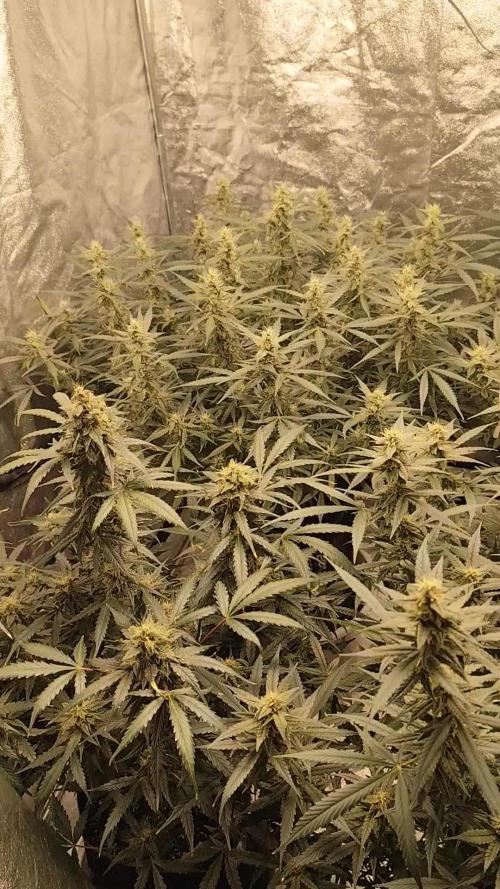
Going down a bit on top bloom was a good move due that darkening went down... and no more burned tips... so it's not at is max .. now i have room to play with... i like more this color...
And starting to add extra PK to the advanced one...
PM1 is clearly ahead... then GC2 , GC1 and PM2.... looks like will be a escalated chop at the end...
PM2 has already a sweet smell like fruitcandy... PM1 goes more to a diesel side...
GC1 & 2 very citrus... with pine.. mixed with sweet tones...
will see how developes...
See you next week Growmies..

Likes
17
Share


@DoctorCannas
Follow
Dear friends of growdiaries, welcome back.
The two automatic ladies grow up healthy and healthy .
Nutrients are doing a great job.
Unfortunately sharing the grow closet with 5 feminized, which are a jungle, is challenging and requires constant attention.
It was an experiment that I will not repeat, and due to the fact that in the balcony or in the garden the northern European climate would not have allowed a safe and lush growth, moreover, the neighbor bought himself a drone, what an asshole.
The distance from the lamp is 30 cm and I had to raise the pots almost to the tops of the other plants.
But the two young ladies are strong.
And my experience as a grower always finds suitable solutions.
See you next week.
Have fun and happy cultivation friends.
Doctor Cannas

Likes
8
Share


@NuttyYeti
Follow
She smells great! I wish she didn't get powdery mildew at the end but I couldn't risk it spreading to my other plants. Fortunately I caught it in time and the buds look good. The biggest one weighs 36 grams.

Likes
28
Share

@wolfvb
Follow
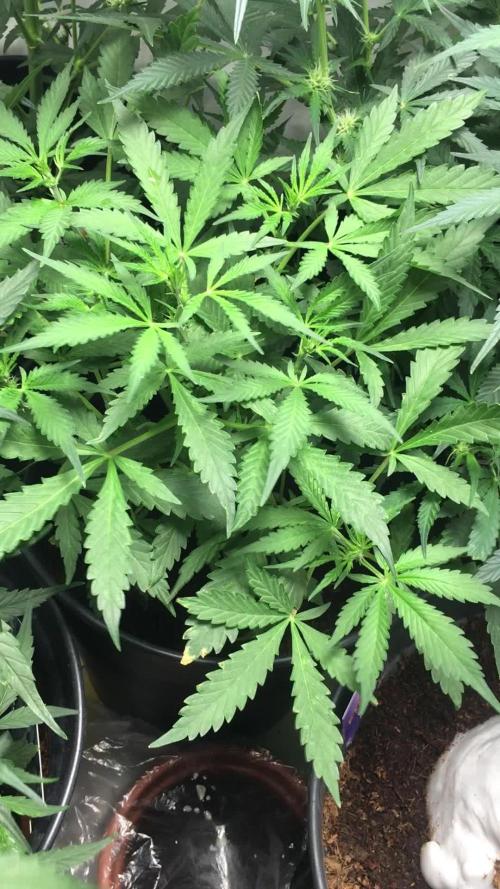
Week 5: babe this cake been baking for 30 days!
Loving this girl so far looking strong and healthy.
Will we have a new star ?

Likes
60
Share


@Roberts
Follow
Well for how I messed up the early weeks of this plants life I was rather surprised by final weight. Buds are hard and dense with hidden colors all about in light. Just started curing. Gonna be making another attempt at this strain soon. Thanks again fast buds. Your team is the best. 5 stars. ⭐⭐⭐⭐⭐
If looking to purchase seeds follow the link please here.
https://myfastbuds.com/?a_aid=60910eaff2419
Likes
Comments
Share


@Guerillafarm
Follow
D 24 Umtopfen:
Topf: 4L airpot, Substrat: Canna terra+ + Kokos fasern (trocken), Wurm Humus: 166,69g+ 50g on top. Bat guano: 15ml. Hornmehl: 15ml. Urgestein mehl: 25ml. Garten kalk: 15ml. Mykorrhiza: 4,20g
D24 0,7L Wasser mit Root juice 4ml.
D28 Lampe ist auf 40% Leistung total 40W
D 28 Die pflanze ist eher Fiming als Topping.

Likes
169
Share


@SlowpokeFuegobud
Follow
🍊 🐶 💜 🍊 🐶 💜 🍊 🐶 💜 🍊 🐶 💜🍊 🐶 💜 🍊 🐶 💜 🍊 🐶 💜 🍊 🐶 💜
Welcome to week 10, my fellow growmies!! 💚 💚 💚
DAY 66
Watered with 4ml bloom + pk+ humics + growzyme + bigfruits + 2ml calmag💧
DAY 68
Watered with 4ml bloom + humics + growzyme + bigfruits + 2ml calmag💧
DAY 70
Watered with 2ml bloom + 4ml humics, growzyme + bigfruits + 2ml calmag 💧
Thanks for stopping by, it's a true pleasure to have you as visitors!! 💚 💚 💚 😘
💜 🐘
______________________________________________________________
About Sour Tangie Dawg cannabis seeds
Sour Tangie Dawg is a sativa dominant cross between the famous Tangie and Chemdawg. Expect a combination of sweet & fruity mixed with a gassy, jet-fuel flavour. The amazing mix of citrus, tangerine, pine and gasoline produces uniquely rich, dank buds. The powerful sativa high is strong, uplifting and long lasting, great for creativity and socialising.
Chemdawg is the parent of OG Kush, all Diesel strain originate from Chemdawg. The Tangie is originally a Skunk hybrid strain but extremely fruity with the trademark Tangerine flavour. This strain is potent with THC-levels over 20% alongside very generous yields of top quality weed, very suited for hash and rosin producers. If you’re looking for a strain to produce the best tasting concentrates this Sour Tangie Dawg is a proven winner! She easy to grow and the perfect choice for SCROG growing due to her growth speed and stretch. We advise switching to 12/12 light when 75% of the net is filled. For outdoor growers the harvest period is early October. Indoors she’s finished after 9 weeks of flower - fast for a sativa dominant strain. We recommend growing in soil with organic nutrients for the best tasting weed.
Get some fantastic genetics here: https://supersativaseedclub.com/ 💜 🐘
___________________________________________________________________________
SETUP:
80x80x180 cm Zelsius
240W Full Spectrum LED IR UV dimmable
DW240H-A6-HS
Heatsink color red
LED Chips:
512pcs SAMSUNG LM301H + 24pcs Osram 660nm + 8pcs Osram IR 730nm + 8pcs UV 385nm
Color mix: 2700K + 4000K
2,8umol/J
Driver HLG-240H-C2100B
Coverage: veg 5x3ft / flower 4x2ft
Product size: 628x205x68mm
Green Buzz Nutrients
Shouts go out to my sponsors @GreenBuzzNutrients, thanks so much for your support! ❤️
If anyone would like to try their amazing organic products, use code GD42025 for generous 25% discount (for orders of minimum 75€) ✨
https://greenbuzznutrients.com/
Biobizz Lightmix
custom exhaust fan 320/270cm³/h
Carbon Active Granulate 240cm³/h
tab water pH 8 - EC 0,25 with Calmag to 0,5
Advanced Hydroponics pH minus Grow + Bloom to pH 6.2
🍊 🐶 💜 🍊 🐶 💜 🍊 🐶 💜 🍊 🐶 💜🍊 🐶 💜 🍊 🐶 💜 🍊 🐶 💜 🍊 🐶 💜
Likes
22
Share


@Slobasian
Follow
Love every plant each one is growing differently stacking different even the visual difference of one strain growin two different ways combined smells of diesel, pez candy and lemons


Likes
23
Share


@adam_pawloski87
Follow
This grow was pretty simple ! They went a total of 103 days from seed! Very trichomy dense buds with the smell of Berries vanilla and skunk ! This is a must try for you all Fastbuds has the greats!!!
Likes
92
Share


@THcHunteR23
Follow
Bravo Kannabia!! Vraiment!!!j’ai hâte de goûter ça sent tellement doux sucré 😍il
C’est juste incroyable 🤯🤯

Likes
18
Share


@MinorMonster
Follow
Heute ist sie genau 31 Tage alt, ich meine erste Anzeichen von Blüte zu sehen. Nächstes Giessen dann mit Hesi Boost und Blühkomplex 👍
Drückt mir die Daumen, und ja, ich weiß, das darf man alles mit Autoflowern nicht machen. Freut euch auf das Lollipopping in der Blüte 😂
Happy growing 🥦😎
Processing
Likes
9
Share


@GanjaThings
Follow
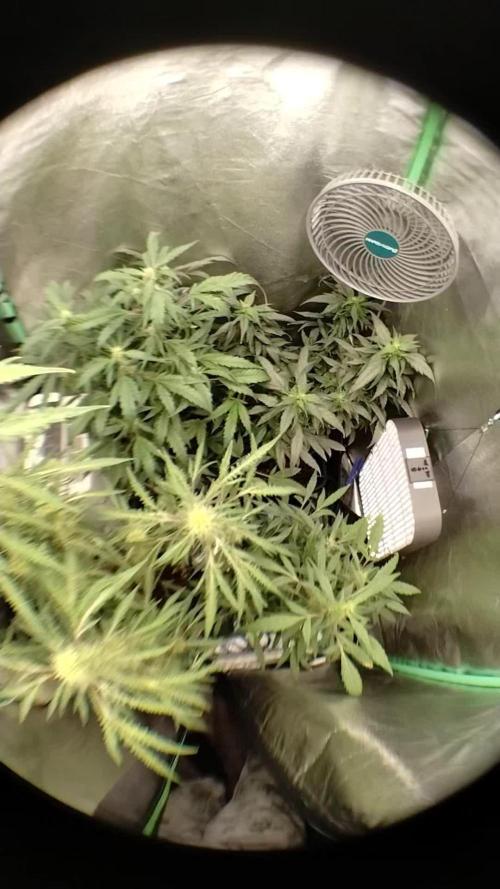
Continued growth, feeding every 3 days as soil dries out. Nice growth spurts noted and apical dominance broken via LST as limbs/new growth reach skyward. Minor fan leaf removal to permit light saturation and airflow to lower areas. Feeding 1/2 gallon per plant about every 3 days.


Likes
6
Share


@JustGrowWithIt420
Follow
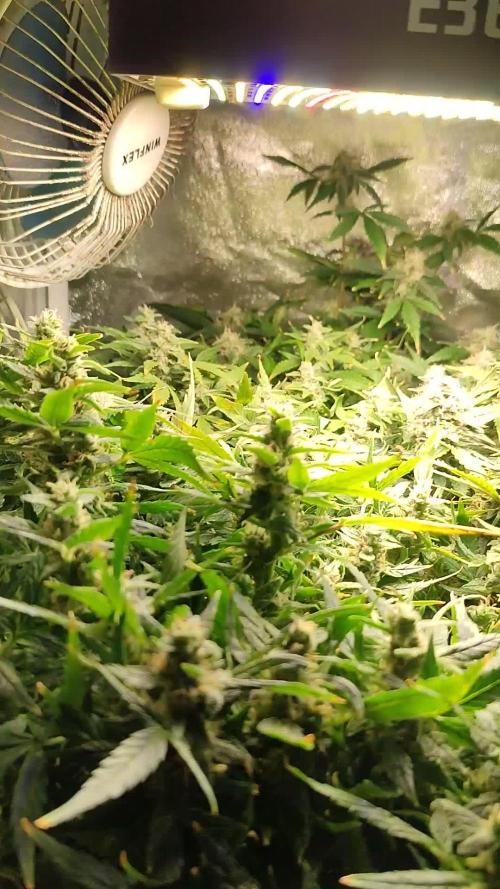
Was a little bit of a picky strain to grow but overall I am happy with the way everything turned out and the yields look phenomenal, would be nice to get 1 gram/watt, buds are dense, frosty and smell absolutely delicious! Will post pics of final product when she's done! 👊👌🔥


Processing
Likes
5
Share


@Christmas
Follow
The branching beast is doing well, but it's time again to bring her in a good shape.
Also I'll set the LST new cause of the fast growing one of the branches started splitting up.
So see ya next week when I maybe repot her in a bigger pot and cleaned her up!
Likes
4
Share


@DogDoctorOfficial
Follow
? 8×8 Adventure – Week 10
Blueberry Muffin – Pheno B
The Small Delight Continues to Surprise Us 💚🌸
Hello everyone, and welcome back to another week of the 8×8 Adventure! 🌱💚
And last but certainly not least...
Here comes our second Blueberry Muffin.
If you've been following both phenotypes, you already know that these two girls may share the same genetics, but they certainly didn't receive the same instruction manual. 😂
And this week, Pheno B continues to play the same card she's been playing since the beginning:
"I'm small. I'm slow. But look how beautiful I am."
And honestly...
She has a point.
Because compared with the rest of the room, this girl is slow as fuck. 😂
But she's also becoming an incredibly beautiful, compact and increasingly dense flowering plant.
So let's give this little delight the spotlight she deserves.
────────────────────────
🌸 Week 10 – The Small Delight
Pheno B continues to be one of the most compact plants in the entire room.
At approximately 75 cm, she isn't trying to compete with the taller girls.
She's not racing toward the ceiling.
She's not stretching dramatically.
She's simply building.
Slowly.
Quietly.
And beautifully.
That's actually one of the most fascinating things about having so many different genetics growing together.
Some plants seem determined to conquer the room.
Others seem perfectly happy occupying their little corner and making the most of it.
Blueberry Muffin Pheno B definitely belongs to the second group.
She's small.
She's compact.
She's increasingly dense.
And she's absolutely covered in developing flowers.
So maybe...
small isn't such a bad thing after all. ?🌸
────────────────────────
🌿 Compact Doesn't Mean Unproductive
This is something that's becoming increasingly obvious with her.
Her size doesn't tell the whole story.
She's not particularly tall, but she's building a very compact flowering structure.
The branches are carrying numerous flowering sites, the flowers are becoming more defined, and the plant is gradually developing that dense appearance we've been watching for.
She's basically concentrating everything into a smaller package.
And I really like that.
Because the purpose of this project was never to see which plant could become the tallest.
It was to see what the different genetics would do when given the same opportunity.
And Pheno B is showing us exactly what she wants to do.
She's telling us:
"I'm going to take my time."
"I'm going to stay compact."
"And I'm going to make it beautiful."
Fair enough, girl.
You do you. 😂💚
────────────────────────
🌸 The Flowers Keep Developing
The most important change isn't her height anyway.
It's what's happening at the flowering sites.
And those are looking fantastic.
The flowers continue to gain structure and definition, with fresh pistils covering the developing buds and the individual sites becoming increasingly substantial.
There's a very noticeable difference between looking at her now and looking back at the early flowering photographs.
She's no longer simply starting flower.
She's building it.
And because she's so compact, the flowers appear packed throughout her structure.
This is where that small size becomes particularly interesting.
Instead of putting a huge amount of energy into vertical expansion, she's gradually turning that compact architecture into a flowering structure.
She's still moving slowly compared with some of her sisters...
But she's definitely moving.
And that's what matters.
────────────────────────
💡 The LED Canopy – Feeding Her With Photons
This week I also want to give the lighting another proper spotlight, because across these individual diaries we're seeing something fascinating.
The Future of Grow LEDs continue providing the main artificial sun over the room.
And every day, millions upon millions of photons arrive at the canopy.
Those photons are the starting point for the energy that drives photosynthesis.
But what I particularly enjoy about this setup is that we're not thinking about the canopy as a completely flat surface.
The plants have depth.
They have upper leaves.
Inner growth.
Lower flowers.
Different angles.
Different orientations.
Different distances from the light.
And that's where the additional contribution from Lumiflora becomes particularly interesting.
By bringing light into areas that naturally receive less direct illumination, we're trying to make better use of the three-dimensional structure of the plants.
Not simply:
"More light."
But:
"More useful light reaching more of the plant."
And with a compact plant like Pheno B, that's particularly interesting.
Her flowers are packed into a relatively small structure.
So managing how photons interact with that structure becomes another part of the equation.
────────────────────────
☀️ The Plant Doesn't Know What Brand the Light Is
One thing I always find fascinating about lighting is that the plant doesn't care about the logo on the fixture.
She cares about photons.
Where they arrive.
How many arrive.
How consistently they arrive.
And whether the rest of the environment allows her to actually use them.
That's why lighting can't really be separated from everything else.
Light interacts with:
🌡️ Temperature
💧 Water availability
🥥 Root-zone conditions
💨 CO₂
🌿 Leaf health
⚗️ Nutrition
🌸 Developmental stage
Everything is connected.
And right now, we're giving Pheno B a strong and consistent artificial sun while maintaining the rest of the environment as steadily as possible.
She's responding in her own way.
Which, apparently, means:
very slowly. 😂
But beautifully.
────────────────────────
? Her Own Little Architecture
If I had to describe this phenotype in one sentence, I'd probably say:
She's becoming a little compact powerhouse.
Not a huge plant.
Not a dramatic plant.
Not the plant that's going to win a height competition.
But she's developing a very interesting architecture.
The flowers are sitting close together.
The branches are supporting a dense structure.
The foliage remains lush.
And the overall plant is becoming increasingly compact as flowering progresses.
That's her personality.
And I'm not trying to change it.
This is one of the things I enjoy most about phenotype work.
You can guide a plant.
You can manage it.
You can shape its environment.
But eventually...
the genetics introduce themselves.
And Pheno B has introduced herself quite clearly.
"I'm the small one."
😂?💚
────────────────────────
💧 Keeping the Roots and Irrigation Consistent
While the plant above the substrate is taking her sweet time, the root environment continues receiving the same consistent attention.
Current watering remains around:
💧 1.3 L per plant / 24 hours
The solution is approximately:
🌡️ 25°C
and the substrate is around:
🌡️ 26°C
The idea remains exactly the same as throughout this project:
Keep the root environment as consistent as possible and allow the plant to determine what she does with it.
We're not increasing inputs simply because we think a plant should be growing faster.
We're watching.
We're measuring.
We're responding.
And with Pheno B, that patience is particularly important.
Because if we tried to force her to behave like one of the faster phenotypes...
we'd be fighting the very characteristic that makes her interesting.
────────────────────────
🥥 Nutrition – Staying Steady
The feeding strategy also remains stable.
We're continuing with:
• Terra Bloom — 2.2 ml/L
• Pure Zym — 1 ml/L
• Power Buds — 1 ml/L
• Sugar Royal — 1 ml/L
• pH Plus / Lemon Kick — as required
Current readings are approximately:
⚗️ pH — 6.0
⚡ EC — 2.0 mS/cm
And once again...
She looks happy.
Beautiful green foliage.
Healthy flowering development.
No obvious reason to start changing everything simply because another week has passed.
The best feeding strategy isn't necessarily the one that changes the most.
Sometimes it's the one that gives the plant exactly what she's already responding well to.
So for now...
We stay the course.
────────────────────────
🌡️ Summer Is Still Summer
The environmental conditions remain very close to our previous week.
We're currently around:
• 🌡️ Day temperature: 29.9°C
• 🌙 Night temperature: 25°C
• 💧 RH: 60%
• 🥥 Substrate temperature: 26°C
• 💦 Solution temperature: 25°C
• ⚗️ pH: 6.0
• ⚡ EC: ~2.0 mS/cm
• 💨 CO₂: ~693 ppm
• 💡 Light schedule: 12/12
• 💧 Watering: ~1.3 L/plant/24h
• ? Pot size: 15 L
• 📏 Height: ~75 cm
Summer continues to make absolute temperature consistency a little challenging.
Some days are warmer.
Some days are cooler.
Sometimes we're fighting for that perfect number and the weather simply says:
"No." 😂☀️
So we're doing what we can.
The variables we can control are kept as stable as possible.
And rather than obsessing over a single degree here or there, we're looking at the whole environment and, most importantly...
the plant.
And the plant looks good.
────────────────────────
🌬️ Dense Is Beautiful – But We Still Watch the Canopy
As Pheno B becomes more compact and increasingly dense, canopy management remains something we're keeping an eye on.
The plant doesn't need dramatic intervention right now.
The major structural work has already been done.
At this stage, we're mostly observing how the flowers and foliage develop within that compact architecture.
The more dense the flowers become, the more important it becomes to maintain good airflow through the room and around the plants.
We're not trying to turn her into an empty skeleton.
Quite the opposite.
We're preserving that beautiful lush structure while making sure the environment around it remains manageable.
It's a balance.
And that's what we're watching.
────────────────────────
💡 Every Flower Has a Different Relationship With the Light
Another thing I love about photographing her at this stage is seeing how differently the flowers sit within the canopy.
Some are facing directly toward the LEDs.
Others are tucked between leaves.
Some receive additional light from the inner-canopy setup.
Others are naturally more shaded.
That's normal.
A plant isn't a perfectly engineered solar panel.
It's a three-dimensional living structure.
And our lighting strategy is simply trying to give that structure the best possible access to photons without unnecessarily disturbing the plant's natural architecture.
Future of Grow provides the main light.
Lumiflora helps bring additional illumination into the less-exposed areas.
And then...
the plant decides what to do with it.
That's the part we can't program.
And honestly?
That's the fun part.
────────────────────────
📸 The Camera Is Starting to Tell the Story
The photographs this week are another reminder that size really doesn't tell the whole story.
Look at those flowers.
Look at the structure.
Look at the density.
Look at the colour.
This girl may be slow...
but she certainly isn't boring.
😂?
And that's why these individual diaries are so valuable.
If we only photographed the entire room, Pheno B might disappear into the bigger picture.
But when we isolate her...
we can appreciate what she's actually doing.
A compact flowering plant slowly becoming denser.
Week after week.
She's writing her own story.
And I'm very happy to let her take her time.
────────────────────────
🧠 Slow Doesn't Mean Behind
This is probably my favourite observation this week.
Pheno B is slow compared with the rest of the room.
There's no question about it.
Some of her sisters are moving much faster.
But that doesn't mean she's behind.
She's simply developing according to her own rhythm.
There's a difference.
A plant doesn't know that another phenotype next door is growing faster.
She doesn't care.
She has her own genetic programme.
Her own structure.
Her own timing.
And our job is not to make every plant identical.
It's to understand them.
And this little Blueberry Muffin is teaching us patience.
Lots of patience. 😂
────────────────────────
🔮 Looking Ahead
From here, I'm keeping things simple.
No unnecessary changes.
No chasing height.
No trying to force her to become something she's not.
We're going to continue providing:
💡 Quality photons
💧 Consistent irrigation
🥥 Stable nutrition
🌡️ A controlled environment
🌬️ Good airflow
⏳ And plenty of time
Then we'll see where she takes us.
The flowers are continuing to develop.
The plant remains beautifully green.
Her structure is becoming increasingly compact and dense.
And if she wants to take her time...
well...
we have time.
────────────────────────
💚 Final Thoughts – Small, Slow & Beautiful
Every room has those plants that immediately demand attention.
The big ones.
The fast ones.
The dramatic ones.
And then there are plants like Blueberry Muffin Pheno B.
She quietly sits there.
She doesn't stretch like crazy.
She doesn't try to dominate the canopy.
She doesn't rush.
She simply keeps doing her thing.
Slowly.
Very slowly. 😂
But beautifully.
She's becoming an increasingly compact flowering plant, and I really like the direction she's heading.
The lighting is giving her plenty of photons.
The irrigation remains consistent.
The nutrition remains steady.
The environment is being kept as stable as summer allows.
And now...
we let her continue.
Because maybe the small delight doesn't need to become a giant.
Maybe she just needs to become the best version of herself.
And that's exactly what we're going to let her do.
?🌸💚
────────────────────────
🙏 Thank You
A huge thank you to Zamnesia for giving us the opportunity to explore these Blueberry Muffin genetics and discover just how different two phenotypes from the same cultivar can become.
Thank you to Plagron for supporting the garden throughout this flowering journey.
A massive thank you to Future of Grow for providing the main LED lighting and giving these girls the photons they need to keep building.
And thank you to Lumiflora for helping illuminate the deeper and less-exposed areas of the canopy and making this lighting experiment even more interesting.
Thank you to everyone following the 8×8 Adventure on GrowDiaries.
This project continues to remind me why I love documenting plants individually.
Same genetics.
Same room.
Same general conditions.
And yet...
completely different personalities.
Blueberry Muffin Pheno B may be the smallest and slowest girl in this particular race.
But she's beautiful.
She's becoming dense.
She's developing flowers.
And she's doing it her way.
So let's give our little delight the spotlight.
She deserves it.
Until next week...
Growers Love, happy growing, and take care everyone! 🌱💚?🌸


Processing
Likes
49
Share


@The_Projexx
Follow
Shes doing excellent forming up them flowers nicely now !! I will be starting this week on the flowering regiment of nutrients to make this plant go into overdrive !!! Let the show begin !!
A special thanks goes out to everyone who stops into the diaries , you guys are kick ass !!
-Happy Growing!