


Likes
Comments
Share


@LittleBigTrees
Follow
I've been feeding just water and allowing them to dry right back , I will harvest once the soil is dry again .

Likes
12
Share

@D33jW
Follow
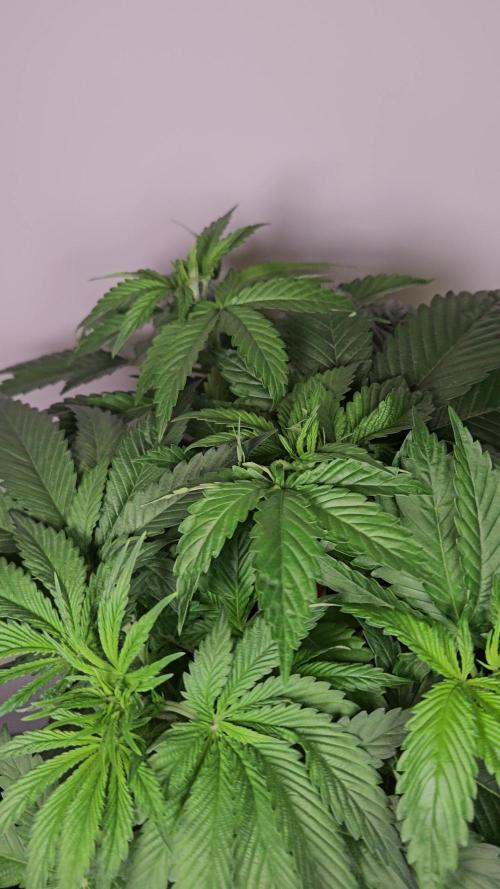
Day 27
I will switch the light to 12/12 so we will start flowering tomorrow.
All is going well she growing very nice and no issues so far.
We are work on large strong stems 💪
VPD is setup on 1.1 now.
Watering 500ml everyday.

Processing
Likes
49
Share


@MadeInGermany
Follow
Hey everyone 😊.
This week there was a bit of Pk 13/14 and the buds are starting to explode 😅.
Lots of shoots with nice, big buds 😍.
In the coming weeks, the nutrients will be reduced piece by piece.
Until then, I hope you enjoy the update and stay healthy 🙏🏻🍀
Strain : Sour Diesel
☝️🏼😍
Genetic:
Diesel x Northern Lights
👍
Vega Lights : 2 x Todogrow Led
Quantum Board 100 W
💡
Flower Lights : 2 x Todogrow Led
Cxb 3590 COB 3500 K 205 W
💡 ☝️
Soil : Canna Terra Professional +
☝️
Nutrients : Canna Terra Vega, Canna Terra Flores, Rizotonic, Cannazym, CANNA Boost, Pk 13/14,
Canna Cal/Mag, Canna Ph - Grow,
Canna Ph - Flores
☝️ 🌱
Water:
Osmosis water mixed with normal water (24 hours stale that the chlorine evaporates) to 0.2 EG. Add Cal / Mag to 0.4 Ec Ph with Organic Ph - to 6.0
💦 💧
Likes
14
Share


@mgmrmd
Follow
After 10 days I Change Them to flowering 12/23 🤞🙂 und IT will be 8.5 weeks vegi and 8weeks flowering
Likes
48
Share


@MG2009
Follow
Just water and tea from now on as needed I hope you can see tghe frost!😎,
I will be taken better photos in natural light when José, and Maria ( tropical storm's clear out of east coast next week,outside cleaning mould from plants😢

Likes
11
Share

@H0BBYGAERTNER
Follow
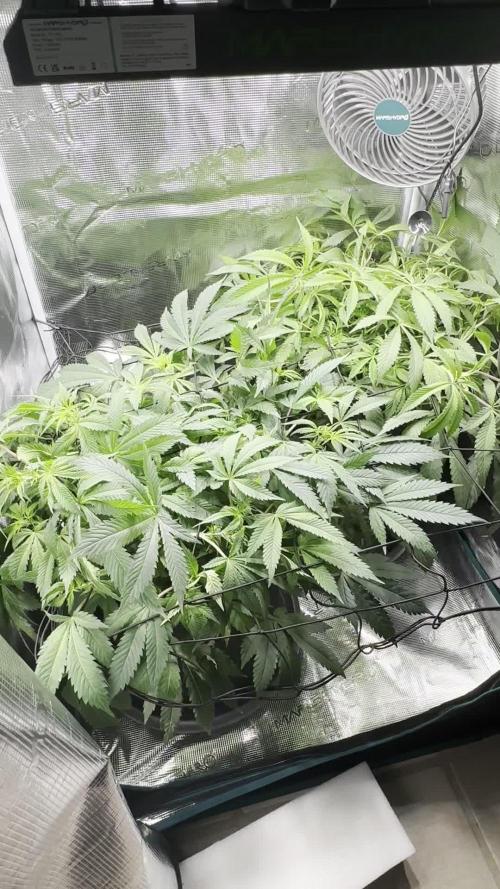
WEEK #12 - FIRST SIGNS OF BLOOM
The bushes are doing fine, it seems. Checking the photos of last week, the progress is huge. Slush is almost same size as Skywalker now, 40cm in diaemter and about 25cm tall. Though not as compact /dense. In fact the SMC seems to be a very delicate and "soft"/dropping plant, while the Skywalker is a bit more sturdy.
Really need to pull myself together to not remove mass (leaves) during stretch. 1-2 weeks to go, i think. Many leaves and high light intensity = thirsty much (and high humidity, but that shouldnt matter too much in this stage, err?). I think i will burn through all my fertilizer soon enough. But that's best for the plants surely.
Installed the ScrOG net, 70x70cm tent kinda limiting already, a few more centimeters woulg be nice for air circulation and general spread of the plants. Hope to branch them out a bit more the folling days. At the moment i'm a bit concerned, also regarding the net, as i have usually sometimes removed the plants for care. Well, have to see if that's a major problem or just annoying in the future.
Smell: not stronger than before (yet), very faint and not very distinct ("green").
Light: adjusted to appr. 35cm distance every other day, still 800 PPFD/µmol/m²/s - which could be a bit more in fact.
Wish i had a "fast forward" function, can't wait. 👻
- - -
Question(s):
2nd Fan under (instead above) canopy, after stretch seems reasonable? At the moment there's not enough space.



Likes
10
Share


@SgtDoofy
Follow
2/6:
Amnesia 3 is just about 6 inches tall now. Trainwreck is only a couple inches behind. Still keeping the temps between 73-82 and the humidity in the mid to low 70s. After thoroughly watering the very healthy, young tomato plant that coesxists in the tent, the tips of some of the leaves turned yellow. That makes me wonder if soaking the soil for the first time since transplant caused a bit of nutrient burn. I'm going to avoid any nutrients the first time I water Amnesia 3 and Trainwreck fully, to avoid the same potential issue. They're not looking too thirsty yet though.
2/8:
Amnesia 3 is tall enough and has a thick enough main stem to start slowly low stress training with a rubber coated gardening wire. I pre-drilled holes in my buckets for this occasion, and the wire fits well. Each day for the next week I'll gently pull the wire to slowly bend the main stem downwards, similar to how braces work on teeth: a long, slow procedure.
2/9:
Woke up to Trainwreck's leaf tips pointing downwards, so I took it as a sign to go ahead and give it its first watering. I siphoned up a bit of the runoff water, and it came back at a PH of 4! That's not good; however, after researching a bit, it's likely that I could have siphoned up a pocket of low PH nutrient-filled water, making my reading way off in terms of the PH of the whole slurry of runoff. If the leaves don't bounce back, I'm going to take that as a potential sign of Nitrogen toxicity and will monitor more closely. Will probably make plans for a flush if it progresses any worse than downward leaves. Nitrogen toxicity can cause fragile, dark green leaves that point down in a shape similar to a claw, among other symptoms.
2/12:
Watered Amnesia 3 for the first time since transplant. Getting taller and less bushy in some spots, so I may turn up the lights from 60 to 75% tomorrow, to see if I can increase some more growth. But before, I want to make sure this watering doesn't cause any nute burn from the soil.

Likes
51
Share


@Reyden
Follow
Il cultivo sta andando bene per fortuna le piante sono sane a parte qualche foglia secca in basso ma per quel poco che le ho seguite sono molto contento 🙃
Questa settimana ho aggiunto bio Bloom di Green house feeding ( nuova linea di fertilizzanti GHSC )
E sembrano andare alla grande con un ec 1900
Insieme uso fertilizzanti Atami soil bicomponente A/B che funziona benissimo ora che ho capito le dosi per ogni pianta 😝
Spero di riuscire ad aggiornare anche io resto ma sono molto impegnato e pieno di lavoro ragazzi quindi chiedo scusa ma state tranquilli che le piante saranno sempre al sicuro!!!! 😃💯🤩🌱✋😶🌫️


Likes
24
Share


@Firepharmer
Follow
Not much of a update this week been busy. Everything looks good monkey berries don’t seam to wanna fatten up a lot hopefully she put in on soon I won’t be surprised if she don’t tho just one of them strains. Slurricane ix is getting really phat and frosty . Add a bit of canna pk1314 this last week to 2 feedings , the stinky funk is really delicious at day 28


Likes
72
Share


@BodyByVio
Follow
Beginning of week 8 and seems like a long way to go. Most of the hairs still white. Hopefully the buds will fill in more! As right now I’m planning to take it 10+ weeks.
This week I will lower the CO2 slowly 50 PPM every day until I will reach 800PPM. Also I will lower the light intensity by 2% every day.
This week I lowered the day temp to 79 degrees and next week I’m playing to lower it every further to 76 degrees Fahrenheit. Water temp is at 68 degrees and probably from week 9 I will lower it to 66.
Beginning of week 8 TDS is at 550PPM.
I sent adding the Late bloom enhancer from Current Culture!
End of week 8 : lowered the TDS to 470ppm , she seems that it not eating so much nutrients anymore. She still drinking 3 gallons of water every single day.
Likes
12
Share


@PacoMendoza420
Follow
Secondo week of flower, Mimosas stretched pleasantly less than I expected and they already started to stack buds. Peyote critical seems to be stretching quite well and evenly and despite its indica dominant genetic it seems to be a little slower than the mimosas (sativa dominant)

Likes
3
Share


@Dico29
Follow
Messed up not trimming lower buds really fluffy but still, branches were lst to long and buds got heavy in branchs


Likes
Comments
Share

@majklsoft
Follow
Hey there growmies!
Gothic Remake just released, so there hasn’t really been time to keep a proper diary, folks 😂
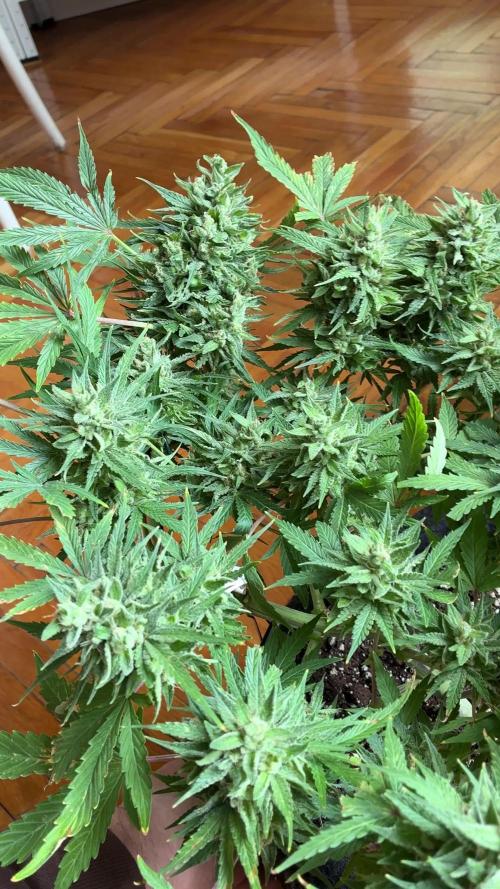
Anyway, a lot has changed around my little gal. I had to kick her out of the tent, so she now dwells by the window. I bought her a cheap 50W blue/red spectrum light — around 20 euros — and she seems to like it.
Observing the previous weeks, the recovery is something unbelievable. how she got green again.. nice job little lady
As you can see, the buds are a bit on the leafy side. I’m not sure if I messed something up along the way, or if it’s just genetics. From what I’ve researched, Mephisto’s Grape, which is in her genes, is often quite leafy.
She smells sour, grapey, and sometimes has hints of Hubba Bubba bubble gum.
The main bud is huge though — at least for 50W and my “skills” 🤓
I wish you all a super-trooper summer grow 🤞🏻🙏🌱🌱
Likes
5
Share


@Hix57
Follow
Le 42e jour ce passe très bien.
Les plantes sont au milieu de la prefloraison et ne vont pas tarder à arrêter leurs croissance pour se concentrer sur les bourgeons ainsi j'adapte l'alimentation au circonstances.
J'ai rattrapé l'erreur de pH même si cela reste précaire les plantes se portent dans l'ensemble très bien 🌱🙏

Likes
34
Share


@SalocinSpecial
Follow
D40 (31/12/2020): Second week of flower and everything is good! They are still stretching a lot. I'm not continuing LST with ties but just by tucking and banding stems and leaves. I will continue to slowly remove leaves and small bud site under canopy that will never receive enough light. The higher buds receive around 520 and 600 PPFD (40 000 to 46 000 lux) for a DLI (for 20 hours of continuous light) around 37,44 and 43,2 moles of photons which is perfect. This Glue Gelato phenotype is weird as it grows weird leaf structure since a couple of weeks. Probably since I discovers a nutrient lock in the soil with too much nutrients. Banana Kush is super healthy and look amazing! 😎
- temp: 25C
- no water
- RH: 56%
D41 (01/01/2021): They are stretching like crazy so it's a sign of good health! I fed with nutrients 3/4 of the recommended dose for transition week. I gave more then a gallon approx. 4L per plant. I did remove leaves today but no bending. I want to let them grow in height.
- temp: 25 C
- water: PH6.3, 820 PPM approx. 4L each plant
- run off: PH6.7, 1150PPM for BK ; PH6.8, 1120 PPM for GG
- RH: 54%
D42 (02/01/2021): Nothing special today. I try to turn the plant 180 degree each day to make sure fan is blowing air on every side of the pot and plant and to make sure light is distributed evenly. I also swap the two plants every 2-3 days to make sure again that the plants receive light equally. I continue removing leaves and small buds site under canopy.
- temp: 25 C
- no water
- RH: 54%
D43 (03/01/2021): The lights are now at 16 inch from the top buds and just 12h later I saw a big difference. They are now ready to receive intense light 😎. They receive approx. 650 to 780 PPFD and even 900 PPFD for the top buds (50 000 to 60 000 lux, and even 70 000 lux). I will check closely in the next days to make sure the buds and leaves are not burning. I fed only Max Minerals full recommended dose for transition week. I gave more then a gallon approx. 4L per plant. I placed a round stake in each pot for when the buds will be heavy.
- temp: 25 C
- water: PH6.3, 460 PPM approx. 4L each plant
- run off: PH6.8, 1550PPM for BK ; PH6.9, 1480 PPM for GG
- RH: 55%
D44 (04/01/2021): Nothing new today.
*** UPDATE ON BUGS: I did not see any more larvae since last week. It's the 3rd week since adding nematodes and after adding 2 pouch per plant, doing 2 insecticidal soap treatment and removing 1 inch of soil, I feel like I did control the infestation. I still see some mature fungus gnats on sticky traps but nothing alarming. Increasing air flow and reducing RH also helped a lot for those bugs.
- temp: 25 C
- no water
- RH: 55%
D45 (05/01/2021): Nothing special today. I let them grow without new LST. I did not removed leaves since a couple of days. They are growing in height and that's what I want. I might do a defoliation in beginning of week 7 (or week 3 of flowering). I want to reduce RH in the tent under 50%. When the lamps are off, I have a lot of difficulties to maintain a proper RH for flowering stage. During night, it is around 57% with the 4 inch AC Infinity inline fan blowing full speed. RH in the room where the tent is is around 35%-40%. With 5 plants in the tent (2 cannabis, 2 tomatoes and 1 mint) it will be more difficult to control RH in the next week with flower and fruit growing bigger. I ordered a small dehumidifier on Amazon to help me reduce the RH.
- temp: 25 C
- no water
- RH: 53%
D46 (06/01/2021): I fed today half of the recommended dose for transition week. The PPM of the run off from last fed was high so I want to cut a bit on nutrients. The run off of both plant is down under 900PPM which is what I wanted 👍
-temp: 25 C
- water: PH6.3, 480 PPM, approx. 3.5L each plant
- run off: PH6.9, 860PPM for BK ; PH6.9, 766PPM for GG
-RH: 52%

Likes
8
Share


@CrowMaster
Follow
Week 2 just finished de leafing everything gonna put net up this week….10k hps room 6-7 plants per light….apple fritter clones comes form a pack of Clearwater genetics I hunted last year

Likes
2
Share

@eldruida_lamota
Follow
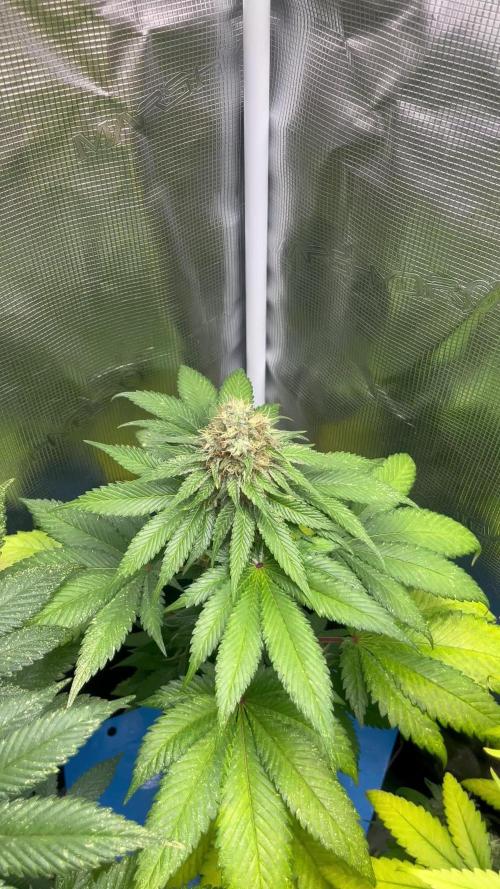
Vamos familia, actualizamos la sexta semana de floración de estas NoName de Seedstockers.
La temperatura que estuvo entre los 24-26 grados y humedad dentro de los rangos correctos.
En cuanto a las plantas pues estas últimas semanas cogimos un poco de trips y pues ahí ando combatiendo con planchas pegajosas de color azul, estiraron bien y ensancharon bastante también.
Las flores se están llenando de tricomas y van hinchando, aún con la plaga, por el momento todo correcto, aportamos mega pk y thor de Agrobeta.
Hasta aquí todo lo de esta semana , ya quedan pocas semanas iremos viendo como maduran, buenos humos.
- os dejo por aquí un CÓDIGO: Eldruida
Descuento para la tienda de MARS HYDRO.
https://www.mars-hydro.com
Hasta aquí todo, Buenos humos 💨💨💨
Likes
6
Share


@VeeDro203
Follow
Candy candy. One has a very strong cherry nose from the cherry pie cross. The sister has a more runts nose on it and sweet. Some cherry
The Wolf is giving a Chem smell. Items my nose like mint menthol. Vix or something. I like it!!
