


Likes
Comments
Share


@artems
Follow
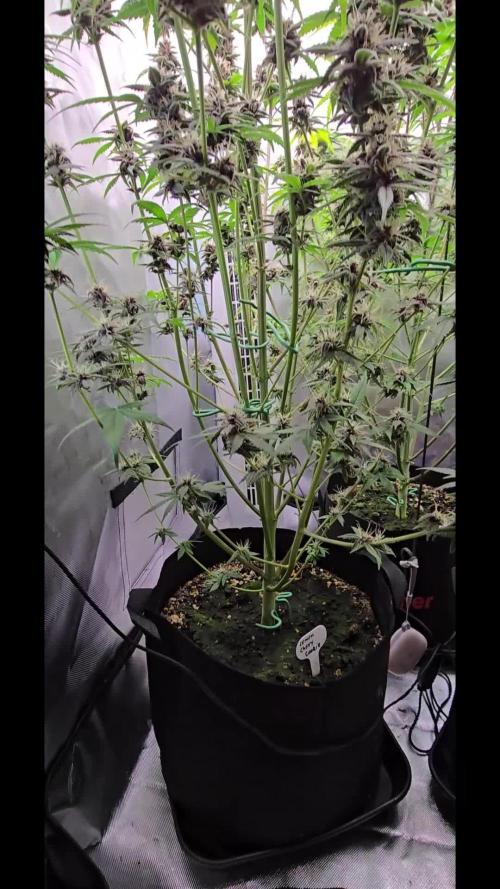
This week I stuck with plain water, cause you can see burns on the ends of the leafs and some yellow ones on the bottom. Now runoff is just around 1000ppm vs 2000ppm in the start of the week and I'm going to feed she in the beginning of next week.

Likes
7
Share

@NSABND
Follow
Day 57 😁👌all the queens are ok 🙏
Day 58 the queens got some fertilizer 💪😃👍
Day 59 what should i say... everything seems to fine 😃🙏👍
Day 60 the queens got some fertilizer 💪😃👍
Day 61 all queens are in good shape 😃🙏
Day 62 everything seems to be ok 🙏👌

Likes
10
Share


@Dr_Green_Thumb87
Follow
10/5/24
Flowering Day 65
Allover day 113
Trichomes mostly cloudy milky i will give her some more days until harvest.
Leafs turn pretty nice colors.
No more nutrients given except some water if needed.
10/7/24
Potential Bud Rot check passed
Since some leafs dry out the last days i wanted to be sure that the lady is doing well on the last couple of days.

Processing
Likes
8
Share


@Fizzybuds
Follow
We Have liftoff, They are officially potted! Regular soil and Perlite, going to find the sweet spot with the light, Being me Im trying a little Experiment with the pots, both fabric and 5/6 gal/25l but one taller and thinner than the rest, would be nice to see if there is any difference 😬, i've added the tiniest bit of bit of root juice just to spice things up a lil bit! Also a lil sneak peak of a Sweet seeds Dark Devil late flower 😉 lets doooo this!


Likes
16
Share


@ButterfliesLittleFarm
Follow
Hello Diary,
The third week of flowering has ended, Cherry Pie is progressing very nicely, which is clearly visible in the photos.
Cherry Pie has almost stopped growing, it has grown a scant 3 cm, which means that that is more or less the height.
72 cm is almost ideal considering the size of the grow box.
The main cola rises high above the other branches, it is completely covered with flowers.
As for the flowers, they are developing nicely, it is still early to make any predictions, but if it continues to develop like this, I will be very happy.
Cherry Pie has also started to smell more intensely, when I open the grow box, the smell is immediately noticeable.
The leaves are a healthy green color, there are no signs of a lack of anything.
Watering has become more frequent, they have become much thirstier.
I have continued to add CalMg and Bio Bloom Fertilizer with each watering.
All in all, I am very pleased with how Cherry Pie is progressing,
I try to provide them with the best possible conditions and the plants return the favor in their own way.
Here is what the past week looked like.
29/08/2024 - Day 36.
Watering.
I prepared 9 liters of water, added CalMg and Bio Bloom Fertiliser and lowered the pH to 6.0.
With that amount of water I watered all three plants on the "Farm".
01/09/2024 - Day 39.
Watering.
I repeated the same procedure as three days earlier.
03/09/2024 - Day 41.
Watering.
Same procedure.
04/09/2024 - Day 42.
End of the 6th week, or the third week of flowering. Photographing and measuring the height of the plants.
Cherry Pie - Day 42. - 72 cm.
That's all from me, see you soon.

Likes
2
Share

@Elguacho420
Follow
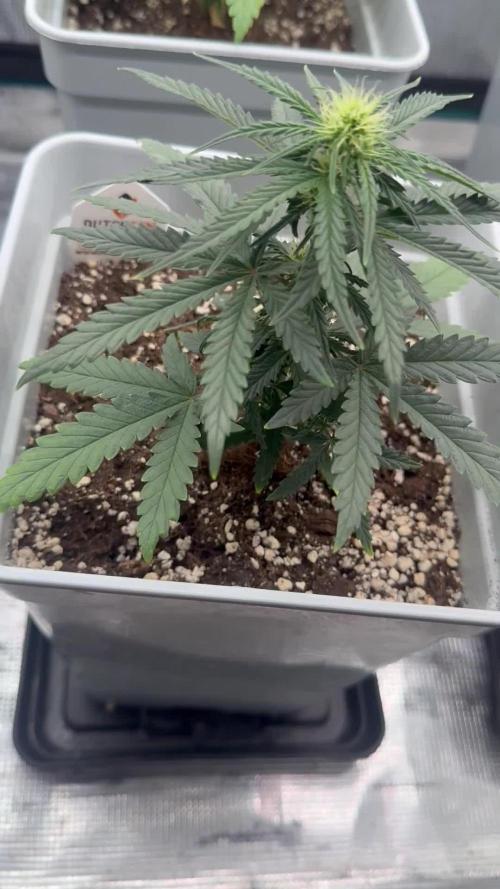
Buenos buenos días a todos, ya estamos de nuevo aquí para comentar una semana más como van nuestras plantas. 🍁🏻
Esta semana hemos visto una mejoría notable en cuanto a las anteriores semanas y eso nos pone felices.
Tras pasar un par de semanas administrando de nuevo los nutrientes que ya conocíamos , nos hemos dado cuenta de que estos son los que realmente nos funcionan ya sea por conocimiento o por seguridad nuestra de lo conocido, aún así seguimos pendientes de lo que nos quieren decir las plantas con sus diferentes signos
Los riegos por el momento son como la semana pasada 350 por planta y más o menos se riegan cada 3 días una con nutriente y la otra solo con agua, ambas dos equilibradas de PH al 6.0 como hemos hecho siempre.
Estamos contentos de poder seguir con nuestro cultivo aún que hemos sufrido algún inconveniente siempre seguimos activos y con ganas de aprender y mejorar.
Muchas gracias a todos por su atención , estamos contentos de pertenecer esta comunidad tan amable y llena de aprendizaje
Buenos humos a todos y nos vemos la próxima semana 💨🌱💀

Likes
16
Share


@Chocolopeison
Follow
Comenzando la semana 4 de floración y a las nenas le dimos una bienvenida para que comiencen de lleno esta fase de engorde.
Estos día bajamos a 2 riegos por día. Normalmente hacemos 3. Ya a mitad de semana volveremos a los 3 riegos.
A las nenas le sacamos prácticamente toda las hojas de abanico, ahora tenemos muchísima más penetración en la planta. Quizás tengamos problemas de altura pero ya estamos buscando la manera de resolverlo.


Likes
2
Share


@KannaGrowing
Follow
Estamos en la tercera semana de crecimiento vegetativo.
Nuestras plantas ya tienen unos 15 centímetros aproximadamente, y han superado la fase crítica.
Recordamos que hasta ahora solo estamos regando con agua, aún no hemos incorporado los fertilizantes.
Seguimos manteniendo la humedad relativa bastante alta, y la temperatura entre 22 y 24ºC.
Pero aumentamos la potencia al 50% de ambas luminarias.


Likes
31
Share


@bioaccessory
Follow
Hey!
The plant completely stopped growing at around 72cm. The bush turned out to be medium in size, but in this cycle I could not afford to spend a couple of weeks of veg. The main colas of the bush turned out to be asymmetrical, perhaps due to the fact that I broke one of the branches, or maybe not😏 I will continue to work with what I have.
The most interesting, in my opinion, segment of the cycle is coming - the ripening of the crop🌿👆
Glory to Ukraine! 🇺🇦

Likes
6
Share


@Organic473
Follow
I’ve been busy but so was her in growing up…a victim of the dogs but she pushed through…I had hope. Give thanks!
Likes
2
Share


@ReggaeShark_420
Follow
Im very happy with this girl. 26.8 for a plant got a bit hurt and struggled, the bud is sou beautifull.
Likes
11
Share


@Bread_n_Buds
Follow
The situation is getting interesting, flowering is coming in the final part for our Green Crack F1 Hybrid Auto.
First of all, we have another plant that is growing straight, you can see it in the photos in the Zamnesia pot that is doing very very well. It is behind in flowering compared to this one because it was planted later but it drinks two liters a day, it has huge sunbathing leaves, and it is starting to flower.
The plant worked with the main lining shows a typical characteristic according to my experience of the F1 Hybrid: these plants have a very fast flowering so they start to mature a little earlier in the sense that they put out flowers the red pistils while the flower is still swelling, it happened to me with all of them, I think even with the RQS ones in the past. From the observation of all the F1s I can notice that you can see some red and the flowers do not seem very big but after a while they reach a nice size. This one is in the swelling phase and in these days it is starting to change color from the top. Very beautiful, I hope they swell the buds properly and it will be perfect.
The shape is very very beautiful as is the structure of this plant indeed.
We are still using soil, fertilizers and all the additives recommended by Plagron 100% organic.
With her We have switched to the late flowering program that wants the additives Sugar Royal, Pure Zym for another week and adds the flowering stimulant Power Buds and the myth Green Sensation. Obviously the basic fertilizer is now Alga Bloom.
---- Decide on the right soil and calculate your fertilization program based on the soil on the official website. -- www.plagron.com
Try a seed of this strain that drives us crazy..
---- https://www.zamnesia.io/en/10677-zamnesia-seeds-green-crack-f1-automatic.html
Zamnesia Description // Forget what you think you know about cannabis. Green Crack F1 Automatic by Zamnesia Seeds is here to shake up the entire industry. Using F1 genetics, growing cannabis has never been easier. These plants offer uniform and abundant yields. Get ready to harvest high-quality buds, full of flavor and amazing effects.
All the best that mother nature has to offer is at ---- www.zamnesia.com
Likes
7
Share


@BushDoctor740
Follow
Day 42 and things are moving along awesome.Ive seen a huge stretch in the past week the strawberry pie is 3 feet tall.Watering more frequently these girls have been very thirsty and growing well.Top dressed with 4 tbs of Gaia green power bloom and watered with 1/2 tsp of Recharge.Increased light intensity to 60 percent power today as well.
Day 46 I cleaned out the tent and gave the girls a haircut to allow some airflow.Also decorated a lil for Christmas
Likes
37
Share


@Whitey307
Follow
Hi all back with another week all goin good hopefully. flushed both plants with small nutrients dose on advice as tips getting a bit yellow plus new growth .it looked like nutrient burn 🔥.plus when did runoff ec was 1.6 so dropped it all back and with a bit of look i caught it early but to be honest they look amazing and loving life so fingers crossed all going good. as it my first time ever tho seen them in flesh. they could be in a bad state and need chopping down and me thinking I'm doin a alright job 🤣🤣🤣that's why I put it up on here is well just incase im a cabbage wasting me time on 2 apple trees or something haha main reason is ta get as much help as I can.love this site any free time going through all your grows amazing 👏 plus to all that have help me so far honestly it well appreciated and if yous see anything or find anything I'm doin stupid from now please let me
Day 42:defoliated and gave a little hair cut ✂️ like lst hadn't a clue what i was doin and that work well I think so fingers crossed.
Marshydro ts1000 on 75 percent at 50 cm.move to 80 percent in few days see how they react.Good luck all and
Keep growing and blazing till we stoned


Processing
Likes
14
Share


@Chowswooster
Follow
Sloooooow going. My temps are fine if not ideal, humidity is steadily above 40%. Yet these plants still look weeks behind.
If you are reading this and my parameters and see any glaring mistakes please feel free to drop a comment. I am definitely new to organic growing andI just don't know what to do.
I started PHing organically this week. I ordered a water conditioner from Microbe life. It's not here yet, but soon. And if my video uploaded you'll see a product from Microbe Lift that will hopefully kill any fungus gnat larvae in the soil. Beyond that adding Armor Si back into my nutrient schedule is the only other thing I can think to snap these plants out of their funk. Good luck everybody else!
Likes
38
Share


@TheCannaProphet
Follow
--------------------------------------------
~DUTCH PASSION OUTLAW AMNESIA~
--------------------------------------------
Outlaw Amnesia is a top quality old-school Amnesia Haze dominant Sativa that will appeal to both beginners and connoisseur growers alike. She is 80/20 Sativa/Indica with around 20% THC and is a cross of our Super Haze with a very special clone of Amnesia. The high is powerful and fast with a clear uplifting sativa high and a strong Haze accent. The taste is fresh, sour, strong and old-school Hazy. Outlaw will stretch more than most, she can triple in height during bloom, and grows well with the SCROG method.
Although she can be harvested as early as 9 weeks, a full 12 week flower period may be required for best taste, yield and high. She grows well in all grow mediums with perhaps the best yields in hydro where yields of up to 500g/m2 are possible, classifying this as a high production variety.
*description credit to Dutch Passion
OUTLAW AMNESIA (DUTCH PASSION) FEMINIZED DATA SHEET
Breeder: Dutch Passion
Genetics: 20% Indica / 80% Sativa
Parents: Super Haze x Amnesia
Flowering Time: 11-12 weeks
THC: 20%
Yield (Indoor): 450-500 gr/m²
Height (Indoor): 50cm
Available as: Feminized seeds
Flowering Type: Photoperiod
Sex: Feminized
*Specified by breeder when grown under ideal circumstances
--------------------------------------------------------------------------------------------------------------------------------------------------------------------------------------------------------------------------------------------------------------------------------------------------------------------------------------------------------------------------------------------------------------------------------------------------------------------
THE SETUP:
~Planted into Jiffy Peat Pellets that were hydrated with de-chlorinated water with SuperThrive added then ph'd to 6.0 @ 80℉
~Grown 100% organic in 10g fabric pots with Mother Earth 70/30 Coco/Perlite medium amended with 2tbs/g of Down To Earth 4-4-4 / 2 cups/g of Earthworm Castings / 1tbs/g of Dr. Earth Flower Girl 3-9-4, 1tbs/g of Dr. Earth Bat Guano, 3/4 cup of Down To Earth Azomite and 1 tsp/g Down To Earth Fish Bone Meal.
~24hr light cycle during Germination / 19/5 light cycle for Vegetation and 12/12 for Flower
~Straight water ph'd @ 6.2-6.8 when needed and weekly Compost Tea's.
__________________________________________________________________________________________________________________________________________________________________________________________________________________________________________________________________________________________________________________________________________________________________________________________________________________________________________________
WEEKLY UPDATES:
9/13- With approx. 10 weeks of growth behind her now she's going into her 5th week of flower now and let me tell you the pictures don't do her justice... This is one phenomenal cultivar! 😍
She was given Compost Tea yesterday and today was still fairly heavy so I skipped watering and just removed a few leaves to maintain light penetration, turned her pot and sat and chatted with her awhile!
9/15- Well she really must have liked that last batch of Compost Tea as she looks exceptionally vibrant today!
She's continuing on her mission of stacking her flowers, which are developing beautifully and have a delicious earthy/hashy aroma to them right now.
I did not water yesterday, so today I watered with 1.5g of straight de-chlorinated water that was ph'd to 6.5 @ 72℉ and rotated her pot... Damn she is looking great! 🤩💖
9/17- Yesterday I top dressed her with 1/2 cup of Down To Earth Bio-Fish then watered it in with 1.5g of straight de-chlorinated water that was ph'd to 6.5 @ 72℉.
Her flowering is continuing beautifully and she's smelling stronger every day it seems! I'm staying on top of tucking leaves blocking light and turning her pot daily as well.
9/19- Five weeks of flower on the books! We're almost halfway there now, she's stacking her flowers tightly going into Week Six and she's looking phenomenal! 🤩
When I watered her today I added 1 tbsp/g each of Kelp Extract and Fish Emulsion (both liquid) to the 1.5g of straight de-chlorinated water she received, which was ph'd to 6.2 @ 74℉.
~Thanks for stopping in! Things should be getting a lot more interesting in the coming weeks...Stay lifted and be Blessed! 😎🙏~

Likes
17
Share


@420DeepGrow
Follow
Gracias al equipo de Seedsman Marshydro XpertNutrients y Trolmaster sin ellos esto no sería posible.
💐🍁 Tangerine Snow F1 Fast:
Esta gran cepa es un cruce de cuatro vías 75% sativa de (Boost x Tangelo) con (Lavender x Power Plant). Este híbrido Fast F1 proviene de la genética Cali y cuenta con excelentes terpenos cítricos, alta producción de resina para extractos, altos niveles de THC, muy buenos rendimientos y excelente resistencia al moho. Tangerine Snow F1 Fast se puede cultivar tanto en interior como en exterior. Los tiempos de floración en interiores son de entre 8 y 10 semanas, mientras que el tiempo de cosecha en las latitudes del norte es en septiembre, mientras que en el hemisferio sur los productores cosecharán durante marzo. Las regiones climáticas recomendadas son cálidas, secas, húmedas y cálidas. Se trata de plantas altas, semiramificadas, que superan los 200cm y que presentan un alto vigor con muy buena uniformidad. Al igual que muchas otras variedades con fuerte dominancia sativa, Tangerine Snow F1 Fast ofrece una excelente resistencia al moho, así como a las plagas y enfermedades de las plantas. La combinación de terpenos cítricos y mucha resina la convierten en una cepa de muy buen extracto, cuyo método de "lavado" produce muy buenos rendimientos de hachís. El perfil de terpenos cítricos recuerda a las mandarinas y mandarinas y también tiene notas dulces. La producción de THC ha sido verificada en laboratorio en un fuerte 24%, mientras que el CBD es bajo. El efecto es edificante y energizante, perfecto para usar durante el día y las primeras horas de la noche.
🌻🚀 Consigue aqui tus semillas:
💡TS-3000 + TS-1000: se usaran dos de las lámparas de la serie TS de Marshydro, para cubrir todas las necesidades de las plantas durante el ciclo de cultivo, uso las dos lámparas en floracion para llegar a toda la carpa de 1.50 x 1.50 x 1.80.
https://marshydro.eu/products/mars-hydro-ts-3000-led-grow-light/
🏠 : Marshydro 1.50 x 1.50 x 1.80, carpa 100% estanca con ventanas laterales para llegar a todos los lugares durante el grow
https://marshydro.eu/products/diy-150x150x200cm-grow-tent-kit
🌬️💨 Marshydro 6inch + filtro carbon para evitar olores indeseables.
https://marshydro.eu/products/ifresh-smart-6inch-filter-kits/
💻 Trolmaster Tent-X TCS-1 como controlador de luz, optimiza tu cultivo con la última tecnología del mercado, desde donde puedes controlar todos los parametros.
https://www.trolmaster.com/Products/Details/TCS-1
🍣🍦🌴 Xpert Nutrients es una empresa especializada en la producción y comercialización de fertilizantes líquidos y tierras, que garantizan excelentes cosechas y un crecimiento activo para sus plantas durante todas las fases de cultivo.
Consigue aqui tus Nutrientes:
https://xpertnutrients.com/es/shop/
📆 Semana 5:
Definitivamente se ha adaptado muy bien a su hábitat natural, voy con dosis muy suaves de nutrientes ya que ellas tienen prácticamente todo lo que necesitan. El canto de las aves la pone feliz.
Poco que agregar, buen sol y buen tiempo 😍

Likes
93
Share


@FreshCoastOrganics
Follow
Things are coming to an end for pheno #3! She’s starting to fade out nicely and her smell is ripe. I’m thinking another week or two weeks max before she gets chopped!
I’m currently feeding with plain water and microbes to let this girl finish out nicely 👌