The Grow Awards 2026 🏆 






Likes
Comments
Share
@alafmalaf
Follow
first day after a 12h night cycle, still have a big gnat problem. gonna go buy new bacteria, stickies and DT Earth. the grow shop just let me know that they got it back in stock but i haven't been able to find nematóides. doesn't seem to be a common practice here. i haven't watered them in a few days. the top soil is bone dry but the plants don't look like they're requesting water just yet so i think it's a good time to lay down the new dt earth and new yellow traps to see if we can kill the remainder. gonna grab some flowering ferts too while I'm at it.
Update:
got a bigger pot and some supergrow soil, only had time to transplant one of them today. but I decided to after them one more cycle before i do the DT earth.
update:
dt earth added, seems to be alright but not quite dry enough
Processing
Likes
7
Share
@Mr_nugs_lover_David
Follow
Beautiful pair of phenos of Badaz og cheese very excited about what strain is gonna offer me in terms of quality buds, so excited to see what is every of this 2 phenos gonna be like, I really hope that both of them have the exact terpenes profile and the same potency! Let's keep on working! We'll the ladies have been Transplanted on February 2nd after 17 days since planted, they were very big and the pot was completely conquered by strong roots as you can see, now both of them are in their new 11l pot home let's see how they keep developing! 💛❤️💚🔝💎


Likes
92
Share
@SwissKush
Follow
Day 43
Extreme growth, she is expanding all over
I gave her the final 6L of preflowering nutrients, and I think I will be changing over to the full flower blend. I will change and clean the DWC before.
PH solid yellow always, really great smell
Day 44
Expansion everywhere, main grew about 5cm overnight
the stretch is starting, her side limbs are reaching upward
she is growing very well
Day 45
Today she gets a huge haircut, 90% of those lower leafs and little larf branches were removed
Her bud sites are forming very well
She is consuming 3.5 litres a day right now
The foliar health is incredible, you will notice she is at her max for nutrients, 700ppm is the ceiling it looks like
Day 46
extreme expansion overnight after haircut
The resin is already growing on the sugar leafs
Day 47
The smell is so strong, I have never smelled something this strong from an auto in a tent before... smells like a photo grown outside
Flowering is starting very nicely, her bud pistils are shooting out everywhere wanting pollen.. not gonna happen, no pollen anywhere nearby!
PH dead on 6.0, yellow always
The bud sites are stretching, like fastbuds said in their write up, this one takes a bit longer to veg, but is worth it! I can tell because the resin smells like straight diesel fuel
Day 48
she is just exploding all over, her bud sites are doubling in size every day right now
the legs are stretching, its amazing to see, grew 6cm overnight, she is drinking more, almost 5 litres gone in a day
this is the most exciting part of the grow im my opinion, each day you can see real development. The resin is already growing so thick on this one.
Day 49
Whenever Fastbuds gives guidelines on their strains, I make sure to read Sebastian's write up every time, multiple times. They always include beneficial grow tips that are facts. The reason why this plant is growing exceptionally well is because of Fastbuds strain specific advice on the website.
Likes
2
Share
@Saintvicious
Follow
Going strong. Biggest seed in pack and she's showing. Bout to be Lst time.
Likes
77
Share
@SuggaShane
Follow
Started flushing last week. So just a few more days hopefully. She’s super sticky, and smells amazing. 👃 She’s been fun to grow. Pretty easy, just took a little longer than expected. Thanks for following and checking my diary out. 🌱💪🏽💪🏽

Likes
4
Share
@Beastmaster
Follow
Not long to go now, waiting for the pistols to shrivel up some more then I am done, nice weight to the buds now, smelling very strong and not very thirsty, the last 3 waters I just used water no nutes.

Likes
38
Share
@Esoteric_growing
Follow
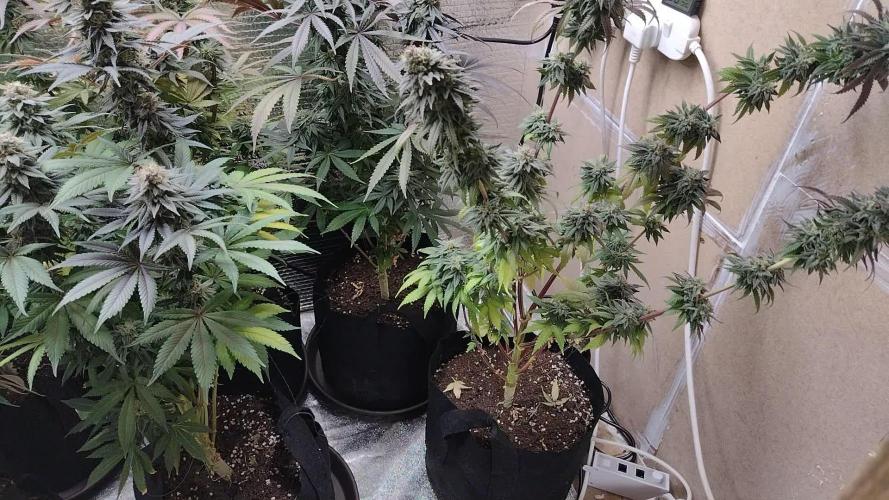
Stretch has finally almost stopped, canopy is almost too packed. Did my last bit of defoliation today and now onto the most interesting part.


Likes
36
Share
@OGTrauma
Follow
Im coming closer to the ✂️ time seriosly on this one homos and homies , now i tried some pics as close as my phone allows to show a more realistic approach of how plants are evolving besides al the self inflicted plagues by being a cheap bastard, slight light and nutrients burn , i can wait to the plants mature while im searching for the 🕵️♂️to check if thricome ratio should be mostly amber , so i tried some close ups to show you. The pics shows a bit of light bleach on the already damaged leaved yet the buds are full of hate and resin , that can be checked on previous week, the smell on santa bilbo evolved to sweet lemon juice, while g13 smells like earth , cream and synthetic berries ( like sour candy), Santa Bilbo is louder in terms of pressence and projection, while most g13 became purple bitches cosplays of purple bitch, my favorite russian cosplayer.🇷🇺😇💗
Im killing it with hesi boost, top candy and citric acid(ph regulation, clean roots ) as all they can be used on the final stage, and these lil potions don't damage their asses as they are basically different forms of sugars with a modest amount of pk , i think there is no more time for these hoes rather than this or maybe another week. They will be sacrificed in a global warming postpandemic chilean spring solstice.
What about the light's shit show , they show that a mainly 4000k & 6500k* spectrum mix (intentional as stated on the week i changed to 12/12 ) can give big fat stinky buds, so i expect that people that reach this journal and doesn't have the mediums or opportunity to proper growing supplies still can start with less and get some green , as weed is still controversial in a hell lot of countries, or places where high end technology is not on the local market yet.
* for further reference my dudes : https://www.migrolight.com/best-grow-light-spectrum/
BIG GAZ LEAKS MOTHERFUCKERS !!!! 🇨🇱

Likes
13
Share
@eecc_photo
Follow
Hello people...
So heres the new strains Gellato 41 by SEEDSTOCKERS.
New setup with Heavengrowlights 320w, lets see hoy they do.
left a couple of timelapses for the germination process
cheers feel free to coment

Likes
42
Share
@Natrona
Follow
Week 15 days 99-105 . I'm am flushing all plants with 1 gallon of filtered water each. I've reduced the light cycle from 18 to 14 hours to reduce heat stress. It may reduce yield as well based on comments I've read in other growers diaries. An oz per plant would be nice. Of course more would be better but an oz makes a pound of cannabutter. Reducing the light hours is reducing the purpleness in the stems of og kush and gorilla glue but Purple chill still has purple stems
The Natrona sisters spend their nights in the garage where the temps are 10-15 degrees cooler than in the day temps in the tent. Night temps ranged this week between 63-66 with rh 51-76%. The high rhythm comes after a rain.
During the day, I'm keeping the tent open while circulating 2 fans. Day Temps can reach 80 so it gets hot in there.
flooded each plant with 1 gal of water. From here forward I will be flushing all plants with filtered water at 1 gal for each plant every other day.
Monday, flushed with 1 gal of water. Starting this flush, I added ice to the top of the soil before watering. See photo.
This is a stress technique used to force plant phenotype colors. I don't think it will work for mine as I over fed. While I have 3 different strains, they look the same with blue green dominance.
Thursday, flushed with 1 gal of water. Starting this flush, I added ice to the top of the soil before watering. See photo
Saturday, flushed with 1 gal of water. Starting this flush, I added ice to the top of the soil before watering. See photo
Sunday photos
I'm not seeing any change in leaf or bud colorations from flushing out the fertilizers nor from the ice treatment.
General comments"
After putting the plants in the garage during the night, morning soil temperatures are within a degree of the night air temperature. This has been about 15 degrees cooler (50s) than the tent temperatures (75+). This week our weather has been unseasonably warm so the night temperatures have been 63-71 with Rh 51-70%
Tent temps in the day 75-80 and RH 47-59%.
Special thanks to @DreamIT for showing me how to add music to video. Check out my Gigi video above for a short clip.
Likes
127
Share
@Tropicannibis_Todd
Follow
💩Holy Crap Growmies , we are outdoors and in the Ground and there Doing Great💩
👉It's been another full week 35 days from seed and she's doing great , very nice Growth, considering shes been up against the wind and rain 👈
No problems 😊 so far so good 👍And she's now in full on flowering 😁👈
I GOT MULTIPLE DIARIES ON THE GO 😱 please check them out 😎
👉THANKS FOR TAKING THE TIME TO GO OVER MY DIARIES 👈
👉NutriNPK NUTRIENTS USED FOR FEEDING 👈rain water to be used entire growth👈
👉www.nutrinpk.com right now get 10% off using SPRING2022 as the coupon code👈

Likes
33
Share
@The_Moz4rt
Follow
The plant kept stretching during this week. I'm a little bit worried as I don't see the flowers touching each other to form nice colas, but she's healthy so I can't complain, it's my first grow after all. Just hoping in fatter buds and not many popcorns.
She's drinking a lot of water in these days and the EC was higher when checking it before the daily refill. Don't know why she's eating less, but I lowered it to 1.6 again. I give her what she wants.
Keeping an eye on her development and trying to figure out when to add the P-K booster.
No particular problems this week, everything is going ok.
I gave her another (hopefully not too heavy) defoliation at day 59 so i guess I'm not going to touch her again till harvest.
Likes
128
Share
@Tropicannibis_Todd
Follow
💩Holy Crap We Are Back At It And Loving It💩
Growmies we are at DAY 42 and she's just killing💀it👌
👉Added straws within the Tiny pot to help watering in week 4 👈
So I'm starting to see she needs watering every single day and now need nutrients 🙃
Lights being readjusted and chart updated .........👍rain water to be used entire growth👈
👉I used NutriNPK for nutrients for my grows and welcome anyone to give them a try .👈
👉 www.nutrinpk.com 👈
NutriNPK Cal MAG 14-0-14
NutriNPK Grow 28-14-14
NutriNPK Bloom 8-20-30
NutriNPK Bloom Booster 0-52-34
I GOT MULTIPLE DIARIES ON THE GO 😱 please check them out 😎
👉THANKS FOR TAKING THE TIME TO GO OVER MY DIARIES 👈
Likes
13
Share
@Growyourownathome2x2
Follow
Sunday the 14th of May Day 18 of 12/12 defoliation done still need to clean up the lower part of the plant a bit more I just hadn’t got the time to do them I will get back in on day 21 to clean up the bottom of the plants any branches that haven’t made up past the first trellis will definitely be removed and see how it’s looking all feeding same as previous week looks like the stretch is almost done and buds starting to form front left plant doesn’t look great but the other 3 are looking good nice bud sites for day 18 of 12/12
Likes
5
Share
@Major
Follow
hello that's it we're in the home stretch I'm starting to rinse my plants the buds are okay I'm very happy with my upcoming production. and already tested in smoke I'm happy😃😃😃😃😃😊

Likes
12
Share
@OGbros
Follow
the roots broke the plastic basket😱
Very strong genetic, very recommended👽


