The Grow Awards 2026 🏆 









Likes
Comments
Share
@HIAZ_urbanbudfarmer
Follow
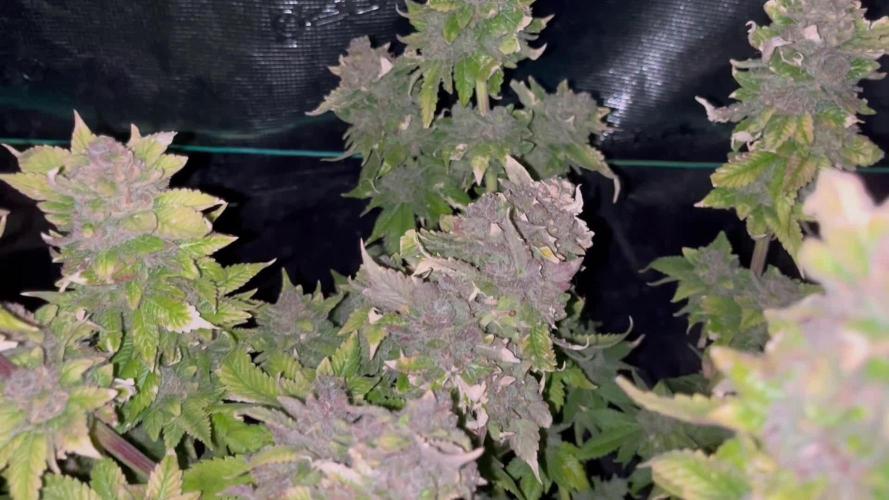
Moved these 2 girls into flowering tent, on 11/1/24. Changed them from 15ltr pots to 20ltr insulated buckets. Gave them a defoliation & lollipoping today .

Likes
40
Share
@BLAZED
Follow
Week 16 (Harvest)
1-2 Drying day 1
Temperature: 24.5 to 19.5 degrees
Humidity: 65% to 50%
The girls are ready to be harvested!
Before chopping them down, i took a lot of pictures.
I was able to remove most of the soil from the Biscotti #2 to see the rootball.
I hang the plants as a whole to have a slow dry.
The exhaust fan is on setting 4.
2-2 Drying day 2
Temperature: 19.1 to 17.5 degrees
Humidity: 62% to 57%
I changed the exhaust fan to setting 2 because setting 4 was a bit high in my opinion.
3-2 Drying day 3
Temperature: 19.9 to 18 degrees
Humidity: 62% to 59%
Today i checked up on the drying plants, and i see there are some buds touching other buds, so i chopped the plants in half.
The buds are still to the main stem for a slow dry, but are hanging more spreaded out to prevent any budrot issues.
I changed the exhaust fan to setting 1, as someone told me that it was enough air movement for drying.
4-2 Drying day 4
Temperature: 19.8 to 18.5 degrees
Humidity: 62% to 59%
5-2 Drying day 5
Temperature: 19.9 to 18.8 degrees
Humidity: 62% to 59%
Today i checked on the drying plants and the buds are shrinking a bit, they are getting a little bit crispy on the outside aswell,
I hope they wont dry as fast, and i aim for a 12/14 day dry.
For the next grow i already germinated 2x Chemdog (GreenHouseSeeds) 2x Gorilla Kush (GanjaFarmerSeeds) and 1x Deep Candy CBD (GreenHouseSeeds)
And I have some upgrades planned aswell!
I bought a autopot kit with 4 15L pots, this way the plants will have water and air 24/7 whenever they need it. I have seen alot of great results using autopots so i am very exited to try it out!
And I bought a small camera so i can shoot some weekly timelapses!
Feel free to Follow me if you like to get notified for the upcoming diaries!
Thanks for checking out this diary, peace!
(More harvest updates coming in the next couple of days!)
Huge thank you to Zamnesia for the seeds, and Plagron for the collection of nutrients, and the opportunity to participate in the POWERBUDS contest!
It was a fun and learningful adventure!


Likes
21
Share
@Rangaku
Follow
Gonna flush her in a few days , she’s a monster of beautiful buds , sneaky little taste of her already and it’s such a good smoke . Good times ahead

Likes
6
Share
@Ieiogrow94
Follow
Eccoci qui!!!
Tutto procede per il meglio, i pistilli sono usciti e ora si va dritti dritti alla maturazione, NE VEDREMO DELLE BELLE!!!
La piccola cresce molto vigorosa ed in salute, chissà cosa ne verrà fuori intanto possiamo solo ammirare questa bellezza!!
Grazie a tutti per il supporto ❤️🔥🌲

Likes
3
Share
@Mismatas
Follow
DIA DE LA COSECHA CON 57 DIAS DE FLORACIÓN, SOLO VIMOS QUE UNA SÍ PARECÍA UN AUTÉNTICA FAST VERSION MADURANDO DÍAS ANTES, AUNQUE QUIZÁS EN VERANO CON UN POCO MÁS DE TEMPERATURA, PUEDIESEMOS ADELANTAR NUESTRA COSECHA

Likes
50
Share
@D33jW
Follow
🌸 Runtz - Week 3 of Flowering 🌸
Everything is going according to plan! 🌿 I’m keeping stable conditions – 25°C temperature, 60% RH,
so a VPD is around 1.3. The plant looks healthy and strong, producing a lot of white pistils, which is a great sign of proper development.
As for trichome production, it could be a bit heavier, but I’m patiently waiting – Runtz still has time to show its full potential.
Watering is done every two days, with around 1L of water mixed with nutrients. This week,
I started adding Green Sensation in low doses to fully meet the plant’s phosphorus and potassium needs, which are essential for the flowering stage.
Grow Conditions (FLO Week 3):
🌞 Light schedule: 12/12
🌱 PPFD: 750 µmol/m²/s
💧 VPD: ~1.3 kPa
Now, it's just a matter of time before it starts frosting up nicely!
Can’t wait to see how it stacks up in the coming weeks! 🔥
Likes
6
Share
@Tezza2
Follow
The gorilla cookies is looking good but the purple lemonade is doing much better but i think the gorilla cookies is putting out alot of roots through the seven gallon fabric pot thats why it isnt as big as the purple lemonade
Likes
12
Share
@Willy_Balls
Follow
Increased light intensity to 85%
Girls are drinking 1.5 l a day.
Decided to go with multi feeding this time instead of crop steering. We will see the difference. At this point they are fed 3 times a day 600-450-450ml. 150ml shots every 10 minutes.


Processing
Likes
16
Share
@VIPgrower
Follow
Ok couple days into week 10 second week of flower I may have mixed a little stronger as getting too burn so on last feed used some clear and oh water turned light down to 600 watt also changed bulb to hps also tops looking yellow but might be just me also Atco stray of week 10 I trimmed a lot of leaf and unwanted branch’s off so will see how the year like it next feed will be half strength I think try that still on feed water schedule added another bag of co2 not sure why but whatever I also keep bending through the netting
Likes
52
Share
@DogDoctorOfficial
Follow
Let's realign our cosmic compass and embark on a harvest report for our magnificent Cosmos F1, a pure CBD strain that has taken us on an extraordinary journey. Brace yourself for cosmic revelations and interstellar delights!
After an impressive 11 weeks from seed and 7 weeks of flowering, the time has come to witness the cosmic culmination of our efforts. I carefully hung the entire Cosmos F1 plant to dry, allowing the cosmic energy to infuse every inch of this botanical marvel. It's a sight to behold, with majestic branches reaching for the cosmos, reminiscent of a cosmic dancer frozen in time.
As our cosmic queen gracefully dries, her vibrant hues continue to amaze. The shades of green, intertwined with delicate hints of purple and gold, are a testament to her genetic splendor. It's as if she has absorbed the cosmic essence of the universe, transforming it into a visually stunning spectacle.
Now, let's talk about the cosmic power of CBD. Our pure CBD strain holds the key to a transformative experience. With minimal psychoactive effects, this cosmic treasure offers a realm of therapeutic benefits. It's like a cosmic massage for the mind and body, soothing and relaxing, allowing us to explore the depths of cosmic tranquility.
The decision to hang the entire plant for drying is a testament to our dedication to preserving the cosmic integrity of our harvest. By allowing the branches to hang freely, we encourage a slow and controlled drying process, ensuring that the cosmic essence remains intact. It's a ritual that honors the plant's journey, preserving its cosmic magic for us to enjoy.
As we eagerly await the cosmic transformation, let us express our gratitude to the celestial forces that have guided us on this cosmic odyssey. The cosmos has aligned to bring us the extraordinary Cosmos F1, a gift from the cosmic garden gods themselves. We extend our heartfelt appreciation to the cosmic harmony orchestrated by @James and Royal Queen Seeds.
In the coming days, our dried cosmic buds will be ready for the next stage of our journey. From cosmic concoctions to cosmic culinary delights, the possibilities are infinite. Imagine infusing the cosmic power of CBD into soothing teas, cosmic creams, or cosmic confections. The universe is our canvas, and with our cosmic harvest, we can create cosmic masterpieces.
As we bid farewell to our Cosmos F1, let us cherish the cosmic memories we've shared. The vibrant colors, the pure CBD power, and the cosmic connection we've established with the universe. May our future endeavors be as cosmic and awe-inspiring as this one.
Until we meet again, my cosmic friends, lets keep exploring the cosmic wonders, nurturing our cosmic gardens, and let the cosmic energy guide our cosmic creations. May our harvest be abundant, our cosmic experiences be enlightening, and our cosmic journey be filled with celestial blessings.
As always thank you all for stopping by and for supporting me on this journey, i am super passion about growing and fell blessed to have you all with me on


Likes
103
Share
@PEAKYPLANTERS
Follow
Very well, my friends!
We are ready to try the Technique Scrog in the Peaky Gardens for the first time.
Although we practice manual irrigation, we will point to direct the airpot vessels to collect the water in inside after having it leaked into the boast!
Hard stems like tree trunks
Stay up to date
Likes
12
Share
@Siriuz
Follow
She is loaded right now very heavy and potent yielding plant oh yeah thanks 420 fastbuds I will be getting more of your seeds you rock
Guys im so happy I boughy fastbuds seeds
It was great to see this second seed pop an amazing grapefruit we did fiming and she eneded up with many colas and many flowers plus super frosty and smelly
Also turned purple all buds which to us was a surprise and did not expect that
Since last grapefruit was different than this
Thanks a lot for all your support
Imagine if we had a full spectrum light
I think we would be growing trees
Honestly we have more than we expected
COMING from an Indoor thats nearly located in a tropical climate of 30/33 degrees most of the year and with that said raising temps very hot sometimes very humid thats close to the equator
So we have to use A/C all times and maintain humidity levels by spraying all walls to keep it around 45/60% while ac is on remember droping temps so we have to make it as comfortable as possible and that its not easy in this side of the world
OR either you need a lot of money which I dont have yet to build a super setup and a separate ROOM with all of that temp and great humidity lvls so yeah we do what we can with our budget
We live somwhere where things are pretty much fckd up but it is what it is
Hey at least we are safe because it is illegal lol so yeah brothers we have hard times
And still with all risk we here doing our best
Showing all support
Showing im greatful
TO find a space like this where
We all can share like and Comment
And help each other grow better everyday
Blessings to you all
Keep EM buds coming
Happy growing
Likes
37
Share
@Capo420
Follow
Sorry for the late updates lately. Just very busy.
Everything is going smooth. Buds are ripening up on both these girls.
The smell is unbelievable so citrus and creamy sweetness.
I am very excited to harvest these girls.
Thank you to everyone that has liked/followed me so far.
Hoping to finish strong.
Happy Growing!
💚💪🌱😎🌱💪💚
Likes
6
Share
@1Prinz
Follow
Started the week by watering in the night from 24.06 - 25.06 with 300-400-400.
Biscotti is now (25.06) 57 cm high. The other ones are smaller.
Biscotti, Jack Herer and Blueberry are already flowering since around 5 days. Frosted Guava is starting to show her first nodes with hairs.
Train Wreck is starting lol pretty small and looks a little bit sick. But still he’s growing.
I sprayed also neem Oil (1ml in 0,5 ml warm water and with just a drop of kitchen soap) over Frosted Guava and Train Wreck when I watered them (24.06-25.06). Since then the spider mites very rarely appear.
29.06 watering with 400-400-400ml and with added Biobizz Fish-Mix (haven’t seen that I should switch in the flowering period to Bio-Grow), Top-Max and Bloom.
Watering with normal water 400-400-400
Likes
61
Share
@Esoteric_growing
Follow
Couldn’t be happier, pictures and video speaks a thousand words. Absolutely top tier cannabis, people that I have shown and smoked actually thought it was from Cali packs. Top work barneys top work👍


Likes
6
Share
@CalGonJim
Follow
12/15 3:01AM RICKY, BUBBLES AND MY OWN CREATION, BLUEBERRY KNOCK-OUT... BKO! ARE NOW TRANSPLANTED INTO 2 GALLON POTS AND UNDER BRIDGELUX LEDS.....AWESOME!!!!!!!
1216 5:43 AM all were watered and flushed. The EC going in was 1.4 about 1.5 and the EC on the runoff was between 1100 and Ricky 1136 on BKO and 1200 on blueberry.👍👍👍💦💦💦
12/17 1:13 AM I invented a nootropic you’re welcome fellow growtards👽
12/19 2:30PM Probably moving these to another diary with the Montel downfall of Jar Jar Binks grow
Likes
5
Share
@cookingwithninja
Follow
Plants are currently drying
2+ months later. And next project au79

Likes
36
Share
@Stevodidge
Follow
Lots of foliage growth over the last week. Not much height growth though. Little sister is now nearly twice the height of her but with much less foliage. Not sure if the height thing is something i should be worried about. Ive only got a 60cm x 60cm x 140cm grow space for 2 plants so short plants would be great, so long as they still produce a decent crop.
