The Grow Awards 2026 🏆 







Likes
Comments
Share
@Sorrnaparszarei
Follow
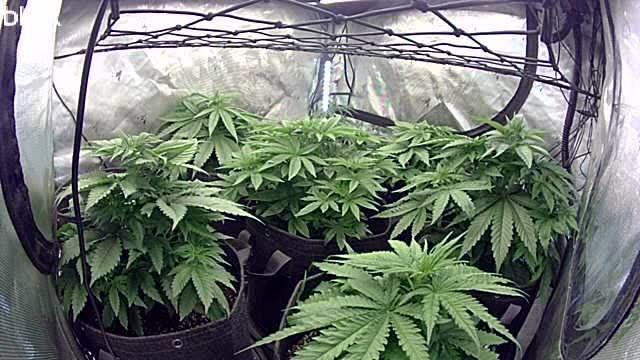
Whats is wrong with my plants?
I don't know
If you know please advise

Likes
16
Share
@Northern_Ent
Follow
Aug 3: still going strong starting the third week of flowering. I’m putting her in the garage at 9 pm, doing the 730 nm far red light to put plant into dark mode 2 h faster, and then out of garage at 7 am. So 10+ 2 h is 12 h dark and 14 h daylight or a 26 h day. The far red light definitely works as a bloom booster and helps the plants finish faster when the sun is stronger.
Did morning foliar spray of Extreme Blend and potassium silicate.
Aug 4: always some defoliation to be done and I took out all the small stuff that was growing into the centre. If I had a longer season I could have left some of these small branches but I want the energy directed toward the prime bud sites. Also removing leaves makes it more stable in the wind. Yet another growing trade-off.
Aug 5: she looks great coming out of the dark garage this morning. Lots of colas with lots of buds 👍👍
Aug 6: added UV lights from AC Infinity. This far north we run out of strong sunlight before it gets too cold in the fall. By adding UV lights, this will make Edmonton in September seem like California in July.
Along with genetics, UV light is the main factor controlling trichome and THC production. Adding UV light for a couple of hours per day centred at peak sun (currently 1:39 pm) should help a lot this far north.
At the other end of the light spectrum, I use Forever Green Indoor (FGI) 730 nm far red light. This is the third season using the far red light as a bloom booster and it definitely works. A few seconds at dusk is all it takes to put the plant into dark mode two hours faster, and is like getting a 26 h day. Bud ripen earlier and therefore under stronger sun. Both of these lights are low power LED used for a few hours (UV) or just a few seconds (far red). Gotta love science and technology when it allows us to figure this kind of out.

Likes
6
Share
@GoldenWeedGrower
Follow
Legend
Timestamp: 📅
EC - pH: ⚗️
Temp - Hum: 🌡️
Water: 🌊
Food: 🍗
pH Correction: 💧
Actions: 💼
Thoughts: 🧠
Events: 🚀
Media: 🎬
D: DAY, G: GERMINATION, V: VEGETATIVE, B: BLOOMING, R: RIPENING, D: DRYING, C: CURING
______________
📅 D08/V04 - 23/04/24
⚗️ EC: 0.8 pH: 6
🌡️ T: 24 °C H: 55%
🌊 6L
🍗 Calmag - Grow A-B - B52
💧
💼
🧠
🚀
🎬
______________
📅 D09/V05 - 24/04/24
⚗️ EC: 1.0 pH: 6.2
🌡️ T: 22 °C H: 65%
🌊
🍗
💧
💼
🧠
🚀
🎬
______________
📅 D10/V06 - 25/04/24
⚗️ EC: 1.1 pH: 6.3
🌡️ T: 21 °C H: 60%
🌊
🍗
💧
💼
🧠
🚀
🎬
______________
📅 D11/V07 - 26/04/24
⚗️ EC: 0.8 pH: 6.1
🌡️ T: 21 °C H: 55%
🌊 3L
🍗
💧
💼
🧠
🚀
🎬 1 TL video
______________
📅 D12/V08 - 27/04/24
⚗️ EC: 0.7 pH: 6.0
🌡️ T: 21 °C H: 50%
🌊
🍗
💧
💼
🧠
🚀
🎬 1 TL video
______________
📅 D13/V09 - 28/04/24
⚗️ EC: 0.7 pH: 6.0
🌡️ T: 21 °C H: 50%
🌊
🍗
💧
💼
🧠
🚀
🎬 1 TL video
______________
📅 D14/V10 - 29/04/24
⚗️ EC: 0.7 pH: 6.0
🌡️ T: 21 °C H: 50%
🌊
🍗
💧
💼
🧠
🚀
🎬 1 TL video

Likes
34
Share
@Salokin
Follow
Grow Diary - Week 1: Germination of Watermelon Candy F1 Hybrid Automatic
Introduction:
Greetings, Growmies! Salokin here, thrilled to share the exciting germination week of our newest addition, Watermelon Candy F1 Hybrid Automatic. A special shout-out to Patricia from the Zamnesia family for granting us the opportunity to be among the first to cultivate this fantastic strain. Our journey begins as we prepare these seedlings for their future home in the controlled environment of Tent X.
Germination Process:
On January 24th, the Watermelon Candy F1 Hybrid Automatic seeds were carefully placed in the EZ-Plug germination setup. After a brief 1 1/2 days in these nurturing plugs, the seeds sprouted, marking the commencement of their growth journey. The uniformity in their germination is impressive, showcasing synchronized and promising starts for each seedling.
Growing Environment:
While they're not yet in the Tent X environment, our Watermelon Candy seedlings are thriving in their current setup. We're preparing the optimal conditions for their transition into the controlled environment.
Observations:
The seedlings exhibit a thriving and lush green appearance, though slightly trailing their tent mates. This expected difference in early-stage growth is carefully monitored, and adjustments are made to ensure optimal conditions.
Acknowledgment:
A special thanks to Zamnesia Seeds and Patricia for the sponsorship and the opportunity to cultivate this exciting strain. We eagerly anticipate observing the Watermelon Candy F1 Hybrid Automatic's journey from germination to harvest.
Stay tuned for more updates as we nurture these promising seedlings through their growth stages.
Stay Lifted, Salokin

Likes
18
Share
@Canadian
Follow
The plant is monster even though I top at the 6th note she is 59 in tall almost 5 feet and smell nice fantastic today I brought them outside the tent to give them a good water down in order to drain out any excessive buildup in the soil.
I will continue to update but thank you for reading have a happy grow.

Likes
25
Share
@Grower_Of_Persia
Follow
week intel:
its time for second pruning they grew up too fast and need second pruning as below :
first i remove big fan leaves and only leaves then let them rest for 1 day then the second part of pruning will get done that is removing branches based on these conditions:
1-if the branch is very low and never can make it to the top ,
2- if branch is in shade even after pruning fan leaves ,
3- if there are too many branches at the small space then non of them will get resources so if there is no space for branch then , they must get remove.
everything is perfect!
stresses :
pruning big fan leaves and lower branches + a little E.C stress around 1.7 once a week
feeding:
i feed them 3 times this week with this order :
day 1 : i feed them heavy with silicate +base nutrients(calcium & micros + Bloom) about 884 ppm - 1.7 e.c to cause a little stress.
day 3 : i feed them low dose of Feeding Booster + Karbo Boost around 325 ppm - 0.6 e.c to let them recover a little but not fully recover still a little stress will caused.
day 5 : i feed them with low dose of Top-Max + B-52 around 213 ppm - 0.4 e.c to let them recover the stresses to get ready for another stress next week.
guide of the week :
no more stresses from now on till the end and from next week i'll reduce the amount of nitrogen and calcium to below half to the end.


Likes
13
Share
@Canadian
Follow
The plant is monster even though I topper at the 6th note she is 51in tall and smell nice fantastic today I brought them outside the tent to give them a good water down in order to drain out any excessive buildup in the soil.
I will continue to update but thank you for reading have a happy grow.
Likes
83
Share
@Southwest_budders21
Follow
Well Gsc is very close now the colours are so nice 😍 lots of pink, purple and green 😍 aiming for chop very soon 🤞🏻 skywalker seems to be nearing to the end but I'm sure still putting some weight on so will give 1-2 weeks flush now. Purple kush is packing on some weight now leaves look pretty but also stressed 😬 she's growing and the buds are looking stunning (JUST MY PERSONAL OPINION) so that's a good thing. I would definitely be thinking of adding the bakery seedco Gsc into the seed bank for future grows


Likes
9
Share
@bigolebuds
Follow
Week 8 12/22-29: Getting close to chop day.. planning to start the “flush” soon.. Trichomes looking cloudyyyy
Likes
9
Share
@Headies
Follow
This is the beginning of each week. So I flushed them and switched nutrients. They were mag deficient, nitro toxic. Not PH actually. I'm adding co2 next week after I seal the room. I think I need to back the PAR down to 800 but they are still alive and it's over half way done.
How any more weeks? I thought this was a 65 day auto. Hydro in a 5 gallon pot could add up to three weeks I heard with Autos. could these go 12 weeks total?

Likes
12
Share
@russrahl
Follow
Everything is looking good so far. Plants have really exploded in growth since the flip and are filling out the screen nicely so far. We will keep tucking till she stops stretching and hopefully get most of the screen filled. We flipped her a bit early In the screen fill stage do to a shortage of stock so we need a quick turn around on these girls cause even in Canada with legal weed it’s hard to find good medical grade that’s not ridiculously priced at a legal store. Wayyyyy cheaper to grow our own. Water was changed out at beginning of this week as well and nute’d at 3/4 strength with Remo flowing lineup and UC root at full strength. These girls are also the early version so should be 45 days or so apparently.... we will see...lol

Likes
2
Share
@Saintvicious
Follow
Just keep watering as it drys. Supporting buds along the way that are getting too heavy. Smells like skunk and gas. Little fruit but not much. Trics still getting thick. Look forward to it finishing. Tricomes still cloudy. Little amber on sugar leaves but it's still going strong. Some leave fading finally to fall colors.
Likes
15
Share
@SmokingTiki
Follow
The harvest is pretty small but in these conditions, I didn't expect much more. This grow was more for fun than for harvest so I'm quite happy with it :)
- I didn't weight wet buds.
- Drying was made around 21°C and around 55% of humidity.
Veg time : 29 days.
Flowering time : 48 days.
Total time from seed to harvest : 81 days.
Height : 53cm
Pot size : 10l
Likes
3
Share
@tastic7
Follow
Ok week 6. So putting my eyes to the plants and found out that, we have 1 confirmed female. I named her "Shiori"! There is one unknown sexed plant and three (mostly) confirmed males. Shiori was the one I wanted to be female due to her indica leaning leaves. I will take some cuts of Shiori before I flip.
Sunday update...
I decided to put these plants in the flower tent with their sister (Falda) who will be harvested in a few weeks.
Depending on which male shows some vigor, I might keep his pollen to possibly create f2's to pollinate three females (Bratz, Falda and Shiori)
Wish I could document all the grows I have going on right now but it's alot.
Sunday update:
I decided to move the five plants into one of my flower tents. Shiori was cut for clones (4), the rest weren't cloned because of assumptions of 3 males and 1 unknown still. Another AC infinity oscillating fan was added to the tent they are in. More updates soon.


Processing
Likes
9
Share
@MG2009
Follow
04/03/2020
Day 28 of flowering first pistils are fading and tons of new pistils popping up everywhere! Whew!
Got a couple nice pics this week, getting a faint scent of tangie and berries Mmmm!
Leaves are getting pretty frosty
Likes
2
Share
@Crop_Top
Follow
This week was spent doing some needed cleaning and minor defoliation and start aiming towards flowering in the next week or so. I dumped all pots and wiped out as well as the resivoir and added fresh water and nutes to all the plants. While plants were out of tent I did some very minor defoliating as well.
I picked up a few goodies this week. I noticed a fruit fly or two and decided to pick up an insect trap off amazon (let’s see how it works 🤞🏽). I also picked up a chargeable watering wand that is worth 3x its price for how easy it makes it to water/feed my plants. I just drop in in my 5 gallon bucket after nutes and pHing water and get to work without moving a single pot. Wish I got this sooner!

Likes
18
Share
@Cortez_The_Konqueror
Follow
Starting to take on some colors in the pistils on one of the 3 phenos.. this is when things will start happening quickly!