


@Foggedaboudit
Follow
Nearing the finish line with these. They just keep on bulking when you think they’re done! Sounds like one of them good problems to have, you know!
shorts_status_processing


@Eighty8Special
Follow
Day 60- Plain ph water.
Day 62- Fed Big Bloom and Tiger Bloom.
Day 63- Fed CalMag.
Day 64- Plain ph water.
Day 65- CalMag water.
Day 66- Big Bloom and Tiger Bloom.


@Canna96
Follow
Hey now, hope everyone is having a great week. The Glueberry OG is doing well, but it has been a struggle dealing with the heat and humidity in my region during late flower. I have 2 full size basement dehumidifiers running 24X7 and am able to maintain between 42-48% RH in the tent, however the tent is running between 68-80 degrees F, and I would definitely prefer slightly cooler. It is also a bitch to empty both humidifiers twice a day to prevent them from filling up and shutting off. I could build a reservoir and run lines, but I am just done flowering in the summertime, although I said the same thing in summer 2021.
I was hoping to harvest her on 4th of July of Weekend, however her trichomes are just not ready. She is literally covered in triches, but not seeing any amber on the colas, just a couple on the leaves. So I will giver her at least another week, and hopefully harvest the following weekend. I check the trichomes every day or two and my new plan is hopefully to start the flush by the 4th depending on the trichomes and harvest the following weekend. Since I am harvesting 3 plants, if I can't get them all trimmed in a day, I plan to just go lights off for the next few days and have an auto or two still in the tent auto feeding on water only, while the Glueberry OG starts to dry, and then harvest the other's in the next couple of days. I figure as long as everything is in complete darkness, and the temp and humidity are stable, it should be fine, as some people swear by a darkness period anyways, although I have never tried it. If anyone has any experience/advice with this hit me up!
I am trying to stay patient with this lady, but I am super excited to harvest her. Her Colas just started falling to the floor of the tent yesterday as they continue to pack on weight, Fortunately I saw it via Wyze Cam and was able to tie them up before they reached the floor. This lady smells absolutely amazing, this lady reaks of earthy diesel, and juicy fruit...Super excited to smoke and squeeze some of these nugs.
The Glueberry OG Auto is the second auto I have run by Dutch Passion, the other was their Auto Blueberry which was a MASSIVE plant. I definitely prefer Photos as I enjoy mainlining etc, but as far as autos go, I have not seen any stronger genetics than Dutch Passion. I don't want to speculate on a final weight, but she has 12 mains, and I am estimating each main will be in the 1-2 zip range, and that's not even counting all the side branches. I know some people lollipop all the lower branches, but I will be happy to turn the lowers into half melt, canna-sugar,, bubble hash, full melt, rosin, etc.
I am still running the Medic Grow Spectrum X at 100% in the F1 mode and running the UV/IR bar for 120 minutes prior to lights off. So far I am super pleased with this light, for the amount of PAR she puts out, she definitely runs cool comparatively to other LED's.
Thanks for stopping by, Stay Safe and Blaze On!!! 💪
Website: https://medicgrow.com/
https://growdiaries.com/grower/medicgrowled



@KnightRider
Follow
Hey Cannafam,
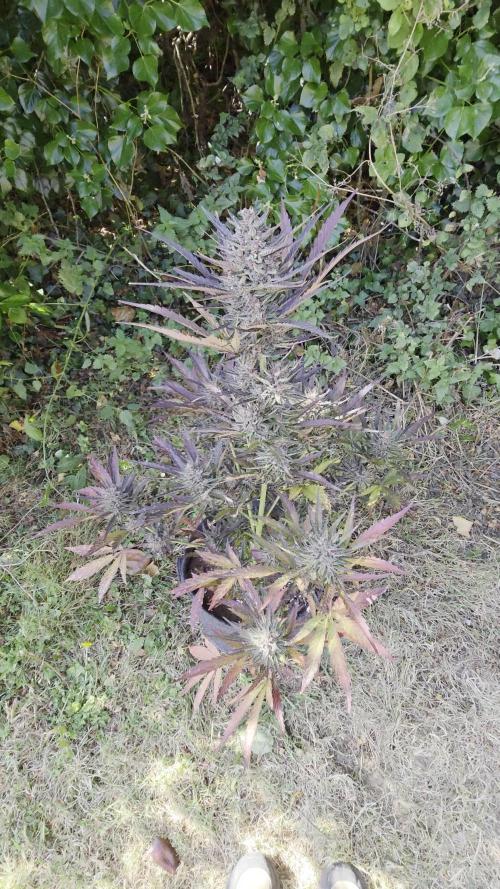
Well we've come to end for my Gauva gal and today i've decided to harvest. We are expecting some bad weather starting tomorrow for the week, and i don't want her to get ruined. Trichomes are mostly cloudy with a few clears and its best to harvest slightly early rather than run the budrot gauntlet!
The weather has been a good deal cooler over the past week and this had been a good turn as her her leaves have rapidly changed colour, shes rapidly turned into a dark purple, pink and red beauty 😊
Temps for Wednesday/Thursday were 22c day 14c night with rain on both days, but it has been dry since with nice sun. Friday to today 20c in the day and dropping down to 12c at night.
Humidity has remained generally high for most of the week at an average of 75%, although this has now come down to 53% for today, and daylight is at 13 hours 59 minutes.
Shes had one feed at the beginning of the week and plain waterings since. Her buds have filled out and are looking nice and chunky. Smell is a nice kinda fruity sugary candy waft which is very pleasant but not overpowering.
For the harvest ive taken the bigger fan leaves and also a few of the larger sugar leaves, shes been hung up in the garage for drying, which i anticipate take a couple of weeks and il then do a dry trim. I don't have hanging scales for wet weight but i'l give the final result when dry.
Throughout this gal has been absolutely solid and i would definitely grow again, but i may try another of the FastBuds/Mephisto crosses next year outside as from what i've seen they are a strong marriage 💪💪💪
Until the final update, thank you to anyone who has liked or commented. I hope you have enjoyed this diary and may you be happy and well 😊✌️💚
******** Update**********
Well this gal took 12 days to dry and has been curing just under a week. She came in at 64 grams so just over 2.25 ounces a really top result and the harvest will last me a good long time 😊
I generally cure for 4 weeks and im using the boveda 62% packs for long term storage. When you open the jar you get a sugary sweet candy smell a bit like sherbert with fruity undertones, and this is definitely the sweetest smelling strain that i've grown 😊 In the vaporizer at 200c she gives a sweet tasting toke sugary and kinda flowery tasting, which is a pleasant combo, she instantly unwinds the mind, makes you smile and within minutes any tension in the muscles goes. The high is not to overwhelming but still hits well, is uplifting and makes you smile to yourself. I I also found this one very good for pain relief from my muskoseletal issues and found that all pain in my hands arns and back was gone for a good couple of hours. This is good daytime strain for being chill but active.
To anyone checkin in i hope youve enjoyed this diary, and il see you soon 💚


@DogDoctorOfficial
Follow
💙 PROJECT BLUE TENT – WEEK 14 💙
🥒 PICKLE LEMON HAZE F1 – PHENO B
🍂 BEAUTIFUL FADING, DENSE FLOWERS, AND ANOTHER GIRL APPROACHING THE FINISH! 🌸❄️
Hello everyone, and welcome back to another chapter of Project Blue Tent! 💙🌱
My friends, here we go again!
Another week, another beautiful girl, and another opportunity to spend far too much time inside the tent taking photographs! 😂📸
Today, we're giving Pickle Lemon Haze F1 – Pheno B her individual spotlight.
And honestly, what a beautiful girl she is!
We're now at Week 14 of flowering, and just like the rest of the room, she's showing increasingly noticeable changes as she progresses towards the final stage.
The flowers are looking beautiful, the fading is becoming more pronounced, and we're seeing some lovely colour transitions throughout the plant.
The structure is established, the major training work is behind us, and we're firmly in observation mode.
No new structural interventions.
No unnecessary changes.
Just maintaining the established environment, observing the flowers, and enjoying the final chapters of this adventure.
We've also moved to plain water, with an EC reading of approximately 0.2 mS/cm and a natural water pH of 6.8.
Our under-canopy lighting experiment continues, we're working on some interesting 3D-printed irrigation accessories for the next run, and Matilda has returned for another little photographic adventure!
😂🕷️
So, even though we're repeating some of the same environmental updates across the individual diaries, there's still plenty to appreciate.
Because Pheno B has her own expression, her own characteristics, and her own story.
Let's get into it!
💙🥒🌸
🌱 A QUICK RECAP – WHAT IS PROJECT BLUE TENT?
For everyone joining us for the first time, let's quickly introduce the project.
Project Blue Tent brings together four individual plants from two different Zamnesia F1 cultivars.
🌈 BLUE WAFFLE F1 – PHENO A.
🌈 BLUE WAFFLE F1 – PHENO B.
🥒 PICKLE LEMON HAZE F1 – PHENO A.
🥒 PICKLE LEMON HAZE F1 – PHENO B.
Four plants.
Two cultivars.
One shared ecosystem.
All four girls share the same general growing environment, irrigation system, reservoir, overhead lighting, and supplemental under-canopy lighting.
Throughout the project, we've documented their development individually, from their early stages through transplantation, topping, training, SCROG, defoliation, and flowering.
We've experimented with different lighting arrangements, environmental settings, irrigation equipment, and nutritional approaches.
And now, we're approaching the end of this particular adventure.
One of the most interesting aspects has been observing how different plants develop under the same general conditions.
Although they share the same environment, their individual expressions aren't necessarily identical.
That's precisely why we've kept separate diaries for every plant.
We want to document what each girl actually shows us, rather than assuming that four plants growing together will follow exactly the same timeline.
And today, it's Pickle Lemon Haze F1 Pheno B's turn!
💙🌿
🌸 WEEK 14 – PHENO B IS LOOKING BEAUTIFUL!
Let's start with the obvious.
SHE'S LOOKING FANTASTIC!
😂💙
Pheno B continues to impress with her compact structure, beautiful flowers, and increasingly noticeable colour transitions.
The flowers are looking dense and well developed, and the overall appearance of the plant is changing as we move further into the final stage.
One of the things I particularly enjoy at this point is looking back at the photographs from the earlier weeks.
Remember when we were concentrating on building the canopy?
The topping, training, SCROG, branch positioning, and defoliation?
All those interventions happened much earlier in the project.
Now, we can appreciate the structure that developed throughout those weeks.
The branches are established, the canopy is in place, and the flowers are the main attraction.
We're not trying to reshape the plant anymore.
We're simply observing her development and documenting the changes.
And honestly, that's one of my favourite parts of the journey.
You spend so much time working with the plants that eventually you reach a point where you can step back, grab your camera, and appreciate what you've been building.
That's exactly where we are with Pheno B.
💙📸
🍂 THE FADING – ANOTHER BEAUTIFUL COLOUR TRANSFORMATION!
Now, let's talk about something particularly noticeable this week.
THE FADING!
As with her sister and the other girls sharing the room, Pheno B is showing increasingly visible colour changes.
We're seeing lighter green foliage, yellowing leaves, and warmer tones appearing throughout the plant.
And I absolutely love this stage!
The green appearance of leaves is primarily associated with chlorophyll.
As chlorophyll levels decline during natural plant development, other pigments that were already present can become more visible.
Carotenoids contribute yellow and orange tones, while anthocyanins are responsible for many of the red, purple, and blue colour expressions we sometimes observe.
Genetics play an important role in determining how individual plants express these colours, while environmental conditions can also influence their appearance.
And this is particularly interesting when looking at our four girls.
They're sharing the same general environment, yet their individual colour expressions and progression are not necessarily identical.
Pheno B is developing her own beautiful palette, and the photographs capture some lovely transitions throughout the foliage.
It's also worth remembering that fading alone doesn't establish whether a plant is ready for harvest.
We're looking at the complete picture, including flower development, trichomes, pistils, and the overall maturity of the plant.
We're not trying to force a particular colour or use fading as a harvest indicator on its own.
We're simply observing and documenting what happens.
And Pheno B is giving us plenty of beautiful details to photograph!
🍂🌈💙
❄️ THE FLOWERS – DENSE, BEAUTIFUL, AND FULL OF DETAILS!
Now, let's get closer!
The flowers are looking absolutely beautiful.
Their density and overall development are among the first things that catch my attention when looking at Pheno B.
The structure is established, and we're now appreciating the flowers developing throughout the canopy.
The photographs show different perspectives, from the overall plant structure to individual flowering sites and close-up details.
And that's something I always want to preserve in these diaries.
A photograph of the entire plant tells one story.
A close-up of an individual flower tells another.
And when we get into macro photography, we discover an entirely different level of detail.
The trichomes.
The pistils.
The textures.
The intricate structures of the flowers and surrounding sugar leaves.
It's fascinating how much there is to appreciate when we take the time to look closely.
The visible frost is beautiful, and the flowers certainly deserve their photographic attention.
We're continuing to observe their development without making assumptions based on appearance alone.
No rushing the conclusion.
No inventing a harvest date.
Just appreciating what we're seeing and documenting the progression.
📸❄️💙
🌿 THE INDIVIDUAL EXPRESSION – PHENO B HAS HER OWN STORY!
One of the most interesting parts of Project Blue Tent has been comparing the two Pickle Lemon Haze F1 sisters.
Both girls share the same cultivar and grow within the same general ecosystem.
Yet their individual development and appearance can still differ.
Their structure, flower formation, colour expression, and progression through flowering are all worth documenting separately.
And that's exactly why we don't want to turn these individual diaries into identical room reports.
The environmental conditions may be shared, but the observations belong to each plant.
Pheno B is showing her own characteristics, and we're continuing to record them as she progresses.
The same applies when comparing the Pickle Lemon Haze girls with our Blue Waffle F1 plants.
Different genetics can express different characteristics, and individual plants can progress differently even when grown under comparable conditions.
We're not trying to invent differences or attribute every characteristic to a single variable.
We're simply documenting what we actually observe.
That's the value of keeping individual diaries.
Every plant deserves her own chapter.
And Pheno B certainly deserves hers!
💙🥒🌱
👃 THE AROMA – THE ROOM IS GETTING INCREDIBLY AROMATIC!
Now, my friends, let's talk about something that photographs cannot capture.
THE SMELL! 😂🌸
The aroma throughout the room is beautiful, and spending time around these girls has become an increasingly enjoyable experience.
It's one of those things that makes the final weeks particularly special.
We can capture the colours, the flower structure, the visible trichomes, and all those intricate details with our cameras.
But the aroma?
That's something you need to experience yourself!
I'm not going to invent a detailed terpene profile or assign specific aromatic notes without proper testing.
What I can tell you is that the room smells incredible, and Pheno B is contributing to that wonderful experience.
Sometimes, the best part of a grow isn't something you can show in a photograph.
😂💙🌸
💡 UNDER-CANOPY LIGHTING – CONTINUING OUR EXPERIMENT!
Now, let's talk about one of the most interesting experiments inside Project Blue Tent.
Our LumiFlora under-canopy lighting arrangement!
As many of you already know, we're using two LumiFlora 150W full-spectrum fixtures positioned beneath the canopy in an X-cross configuration.
These fixtures supplement our main overhead LEDs, which provide the primary lighting from above.
Throughout this project, we've been interested in observing how the lower flowering sites develop under this additional illumination.
And now, during these final weeks, we're getting some interesting visual observations.
One thing we've noticed is that some of the areas receiving supplemental illumination are showing more pronounced reddish colour expression.
It's particularly interesting when comparing photographs from different positions throughout the canopy.
We're also observing relatively fast progression towards the finish across the room.
However, I want to make something clear.
We're documenting observations, not claiming that the under-canopy lighting or its red spectrum alone is responsible for the colour changes or the finishing timeline.
There are multiple variables involved, including genetics, plant maturity, environmental conditions, and the overall lighting arrangement.
To establish a direct relationship, we'd need controlled comparisons and appropriate measurements.
For now, we're documenting the setup and observing what happens.
That's the purpose of this experiment.
We want to explore supplemental lighting, understand how it fits into the overall environment, and learn from the results.
The fixtures remain in their established X-cross arrangement, and we're continuing to monitor the plants.
I'm particularly interested in reviewing the photographs and environmental records once the entire project is finished.
A massive thank you to LumiFlora for making this experiment possible!
💡🌱💙
💡 OVERHEAD LIGHTING – THE MAIN LEDS REMAIN AT THEIR ESTABLISHED SETTING
The main overhead LEDs continue providing the primary illumination for the canopy.
As discussed in the previous reports, we've been gradually reducing their output as we approach the final stage.
Our previous reference setting was approximately 90%, with gradual adjustments rather than sudden changes.
The idea is to maintain a balanced lighting environment while observing the plants.
The main fixtures and the supplemental under-canopy lights work together as part of the overall arrangement.
We're not assuming that increasing or decreasing one particular setting automatically produces a specific result.
Instead, we're documenting the configuration and observing the plants as they progress.
At this stage, the canopy is already established, and our attention is on the final development of the flowers.
No unnecessary changes.
Just the established lighting arrangement and plenty of photographs!
💡💙
🌡️ THE ENVIRONMENT – OUTSIDE FEELS LIKE SPRING!
Now, something interesting is happening with the weather!
The outside temperatures have increased again, and we're seeing readings around 22.4°C even after midnight!
My friends, is autumn taking a holiday? 😂🌸
It almost feels like spring outside!
Fortunately, we're adapting to these warmer conditions.
Our air conditioning is helping us maintain the established indoor environment, allowing us to keep the room within our intended operating conditions despite the changes outside.
Our current reference conditions are:
🌡️ Day air temperature: approximately 25°C.
🌙 Night air temperature: approximately 20°C.
💧 Relative humidity: approximately 55%.
💧 Solution temperature: approximately 21°C.
🌱 Substrate temperature: approximately 21°C.
🌫️ CO₂ level: approximately 666 ppm.
These are our reference operating conditions, rather than temporary readings that might appear while we're inside the room working or taking photographs.
The important thing is maintaining consistency and adapting to the outside conditions without making unnecessary changes to the indoor environment.
The girls are sharing the same general conditions, and Pheno B continues progressing within that established ecosystem.
Outside: spring vibes.
Inside: beautiful autumn colours.
I think we're enjoying both seasons at once!
😂🍂🌸
💧 IRRIGATION AND DRAINAGE – THE SAME ESTABLISHED SYSTEM
The automatic irrigation and drainage system continues operating as part of our shared ecosystem.
All four plants share the same reservoir and irrigation arrangement.
Our recorded watering volume remains approximately 1.6 litres per plant over 24 hours.
This is our reference measurement, while actual water demand can vary between individual plants.
We continue monitoring the system and observing the plants rather than assuming every girl consumes exactly the same amount.
At this stage, we're not introducing unnecessary changes.
The irrigation arrangement is established, and our attention is increasingly focused on observing the final development of the flowers.
And speaking of irrigation, we're already experimenting with something new for the next adventure!
More about that shortly.
💧🌱
⚗️ NUTRITION – PLAIN WATER, AND A DIFFERENT APPROACH TO THIS EXPERIMENT!
Now, let's talk about one of the most important changes in the current stage.
We've moved to plain water.
Our current readings are:
💧 EC: approximately 0.2 mS/cm.
💧 pH: approximately 6.8.
And I want to make an important distinction here.
The EC reading represents the water we're currently using, not a nutritional solution.
The pH of 6.8 is the natural pH reading of that water.
We're not adding additional nutrients or adjusting the water simply to chase a particular number.
There is no PLAGRON Hydro A.
There is no PLAGRON Hydro B.
There is no Power Buds.
There is no Green Sensation.
We're currently using plain water, without additional nutritional products.
Now, why are we doing this?
Well, this is where I want to explain a little about the approach we're taking with this particular project.
🌱 ORGANIC GROWING VS. MINERAL NUTRITION
One thing I always like to distinguish is the difference between growing in an organic living-soil environment and working with a mineral-based hydroponic setup.
They're different approaches, and they shouldn't necessarily be treated in the same way.
When working with organic living soil, the idea is to maintain and support a functioning biological environment.
The soil contains a complex ecosystem involving microorganisms, organic matter, and nutrient cycling.
You're working with a system where biological processes play a major role in making nutrients available to the plant.
Trying to chase every number, constantly force changes, or manipulate the system unnecessarily isn't necessarily beneficial.
Sometimes, the best approach is to establish a healthy environment, support the soil biology, and allow the system to function.
Mineral-based hydroponic nutrition gives us a different level of direct control over the nutrient solution.
We can measure EC, monitor pH, adjust concentrations, and make changes to the composition of the solution.
That doesn't mean every adjustment is necessary, or that chasing numbers automatically produces better results.
It simply means we have a different set of tools available.
And in this project, we're using that flexibility to explore different approaches and document what happens.
For this particular final stage, we've chosen to move to plain water.
Not because we're trying to force a particular outcome.
Not because we believe plain water magically removes nutrients from the flowers.
And not because every grower needs to follow the same approach.
It's simply the method we've chosen to document in this run.
We enjoy experimenting, observing, and comparing the results.
And that's what Project Blue Tent is all about.
Different systems, different approaches, and continuous learning.
💙🌱
🖨️ 3D PRINTING – MORE EXPERIMENTS FOR THE NEXT RUN!
While the girls are enjoying their final chapters, I'm already thinking about the next project!
And this time, we're getting creative with the 3D printer.
I've been working on some prototype irrigation accessories designed to improve water distribution across the coco surface.
The idea is to create a small distribution plate that sits beneath the watering point.
Instead of allowing water to fall directly onto one concentrated area, the design aims to spread it across a wider surface.
I've printed different versions and have been testing how the water behaves with each design.
We're looking at the distribution pattern, the dimensions, and whether the shape needs further adjustments.
These are still experimental prototypes.
We're not calling them finished products yet.
The objective is to evaluate the designs, identify potential improvements, and see which version might be suitable for the next run.
And honestly, I love these little side projects!
Cultivation isn't only about plants.
It's also about equipment, problem-solving, experimentation, and finding practical ways to improve the overall setup.
Sometimes a small modification can make a big difference to how convenient a system is to use.
We'll share more photographs and updates as the prototypes develop.
For now, it's another little experiment happening behind the scenes while the girls approach the finish.
😂🖨️💙
🕷️ MATHILDA RETURNS – ANOTHER LITTLE PHOTOGRAPHIC ADVENTURE!
And now, my friends…
LET'S TALK ABOUT MATHILDA!
😂🕷️💙
Our little spider friend has returned for another appearance!
This week, we decided to bring Mathilda into the tent for a little adventure and let her explore while we captured some photographs.
Nothing too serious.
Just a bit of fun, some interesting macro photography opportunities, and a chance to appreciate another tiny creature from a completely different perspective.
And honestly, she's a fantastic little photographic subject!
When you get close enough with a macro lens, the details become fascinating.
The legs.
The body structure.
The tiny features.
The way she moves around and explores her surroundings.
It's incredible how much detail we can discover when we take the time to look closely.
I've included several photographs from this little session because I wanted to share the fun with everyone.
Mathilda isn't part of our growing experiment, of course.
She's simply our unexpected photographic guest!
😂📸
And I think she's becoming quite comfortable in front of the camera.
Welcome back, Mathilda!
You're officially part of the Project Blue Tent photographic collection.
🕷️💙
📸 PHOTOGRAPHY – DOCUMENTING THE LITTLE DETAILS
As always, photography remains one of my favourite parts of these projects.
During the final weeks, there are so many beautiful details worth capturing.
The flowers.
The changing colours.
The trichomes.
The textures.
The individual characteristics of every plant.
And, of course, our little spider friend!
I'm continuing to enjoy macro photography and focus stacking, experimenting with different perspectives and trying to capture as much detail as possible.
Focus stacking allows us to combine multiple photographs taken at different focus distances to create a final image with greater depth of field.
It's a fantastic technique for documenting small, intricate subjects.
And between the flowers and Matilda, we've certainly had plenty of opportunities to experiment!
I hope you enjoy the photographs as much as I enjoy taking them.
Because these diaries aren't simply about recording measurements.
They're also about creating a visual history of the entire adventure.
📸💙
🔭 THE FINISHING LINE – WHAT HAPPENS NEXT?
We're getting closer, my friends!
Looking at the four plants together, it's becoming increasingly interesting to compare their individual progression.
The Blue Waffle girls and the Pickle Lemon Haze girls are showing their own characteristics, and we're observing how their development unfolds under the same general conditions.
Pheno B is showing beautiful fading, dense flowers, and an increasingly mature overall appearance.
We've moved to plain water, and we're continuing to monitor the plants rather than deciding on an exact harvest date in advance.
We'll keep observing the trichomes, pistils, flower development, and overall maturity.
And if the plants don't finish together, that's perfectly fine.
Each girl has her own timeline.
That's one of the most important lessons from documenting multiple plants individually.
We shouldn't assume that sharing a tent means sharing an identical finishing date.
Maybe we'll have a staggered harvest.
Maybe the girls will finish closer together than expected.
Let's see!
For now, we're enjoying the final chapters and keeping the cameras ready.
💙🌸
💙 FINAL THOUGHTS – ANOTHER BEAUTIFUL CHAPTER FOR PHENO B!
My friends, Pickle Lemon Haze F1 Pheno B is looking absolutely beautiful.
The flowers are dense, the frost is impressive, and the fading is becoming increasingly noticeable.
She's showing her own colour expression, with beautiful transitions throughout the foliage as she progresses through the final stage.
We're maintaining the established environmental conditions, continuing with the same irrigation arrangement, and using plain water with an EC of approximately 0.2 mS/cm and a natural pH of 6.8.
Our under-canopy lighting experiment continues to provide interesting observations, while the 3D-printing experiments are already preparing the way for the next adventure.
And let's not forget Matilda!
😂🕷️
This week hasn't been about making major changes.
It's been about observation, documentation, and enjoying the individual characteristics of this beautiful girl.
Sometimes, that's exactly what a grow needs.
The major work is behind us.
The canopy is established.
The flowers are developing.
The colours are changing.
And we're getting closer to the moment when we'll finally be able to document the end of this journey.
Four plants.
Two cultivars.
One shared ecosystem.
Different expressions.
Different finishing timelines.
And four individual stories worth telling.
Thank you for following another chapter of Project Blue Tent.
And thank you for taking the time to appreciate this beautiful girl with me!
💙🥒🍂🌸❄️
💬 COME JOIN THE DOGDOCTOROFFICIAL DISCORD COMMUNITY!
If you're already part of our Discord family, thank you for being there!
And if you haven't joined us yet, you're more than welcome!
We've built a community where growers can share their experiences, exchange knowledge, discuss equipment, show their gardens, share photographs, and learn from each other.
We organize community photo championships, giveaways, and plenty of activities throughout the year.
You don't need to be an expert.
You don't need an enormous garden.
You don't need expensive equipment.
Everyone is welcome!
Come and introduce yourself, share your photographs, join the conversations, and become part of the adventure.
💙 JOIN US HERE:
https://discord.gg/dogdoctorofficial
Growers helping growers.
Sharing knowledge.
Learning together.
And having a little fun along the way!
We'd love to see you there!
🙏 A HUGE THANK YOU – THE PEOPLE BEHIND PROJECT BLUE TENT!
A project like this doesn't happen alone, and I want to take a moment to thank everyone who has been part of this adventure.
A massive thank you to ZAMNESIA for providing the genetics and making it possible for us to document these beautiful Blue Waffle F1 and Pickle Lemon Haze F1 plants individually.
Thank you to PLAGRON for the Hydro nutrient line supporting the girls throughout their journey.
A huge thank you to ZAMNESIA for the Phytonaut LED lighting, curved scissors, and clip fans that continue playing important roles in our setup.
Thank you to MARS HYDRO for the irrigation and drainage equipment helping us maintain consistency throughout the tent.
A special thank you to LUMIFLORA for the two 150W full-spectrum under-canopy fixtures. We're enjoying exploring this supplemental lighting arrangement and documenting everything along the way.
WELCOME TO HEMP HOOKS!
Thank you for joining our adventure and for providing our community with a discount code.
🌐 https://hemphooks.com/
Discount code: DOGDOCTOR
Enjoy 15% OFF your entire order!
We're looking forward to exploring more of your products in upcoming runs and sharing our experiences with the community.
Thank you to GROWDIARIES for providing the platform where we can document our plants, share photographs, record our observations, and learn from the entire process.
And, of course, a massive thank you to everyone following Project Blue Tent, reading our reports, enjoying the photographs, and supporting the journey.
Your encouragement and support mean a lot.
Until the next chapter, my friends…
Keep growing.
Keep learning.
Keep experimenting.
Keep documenting.
And never forget to enjoy the journey as much as the destination!
GROWERS LOVE, HAPPY GROWING, AND TAKE CARE EVERYONE! 🌱💙🥒🍂🌸❄️



@BigBomber
Follow
Vegetative week 17 just started for the Crimea Blue ladies.
They got into a big storm last week but didn't got damaged at all. My spot is such a blessing, especially for the safety reason :)
They got a little taller but mostly they got bushier.


@Weedganja420
Follow
Ya esta esta Zkittlez produciendo resina! Me esta gustado mucho como va avanzando, espero que se pongan grandes esas flores.
Empezare a aplicrle Silick Rock de plagron a ver como va! Seguro que genial conociendo la calidad de sus productos.


@M420_GROWS
Follow
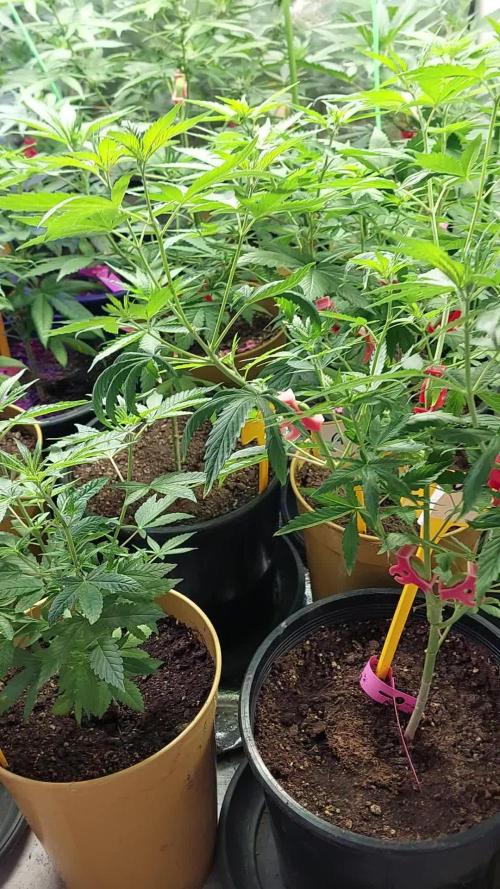
Alright, I moved her into Homebox Q60+ now and provided some professional light Q3W from Sanlight with 120W full spectrum range. This setup is much better for the plant compared to my setup in 1st week. Now it is also much easier for me to keep stable humidity and temperature.
Day 9 - Looks like she recovers from stress I gave her in 1st week. Stem looks quite thin to me - but since I have no experience I can't be sure if it is abnormal for this age or not.


@El3vated
Follow
So far everything is looking great! She is looking like life is good. I am gradually decreasing the grow food and gradually increasing the bloom food. I think I will increase the bloom food a little more. She is starting to get some frosty spots so that is good to see. Looking forward to the weeks to come!




@HowtoBubatz
Follow
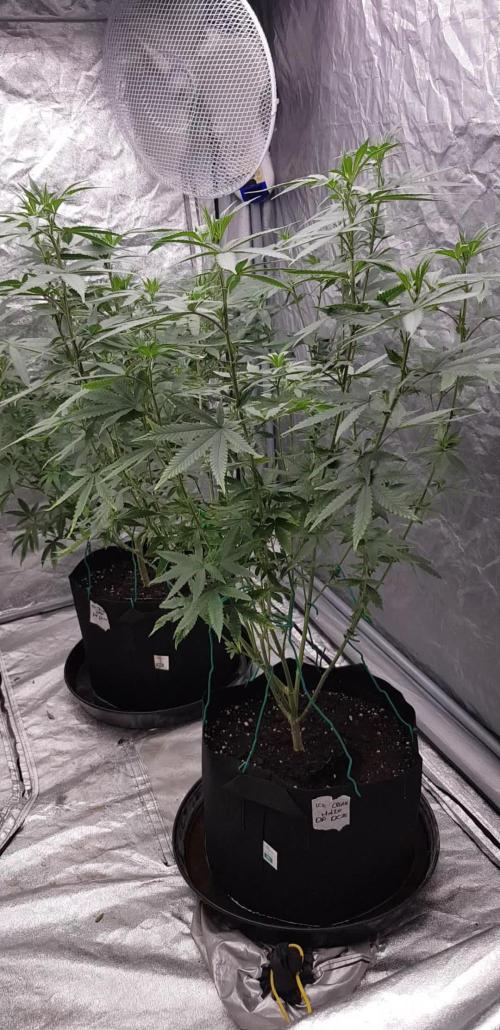
The transition is officially happening—the plant has now fully entered the flowering phase!🌱
The stretch is kicking in, and it’s growing rapidly, really taking off this week.
It looks incredibly healthy, with vibrant green leaves and strong development.
Thanks to the LST, it has spread out beautifully, allowing for even light distribution and great bud site exposure.
I’m really happy with how things are progressing and excited to see how the buds start forming in the coming weeks! This one is looking very promising.💪😎


@Ultraviolet
Follow
High UV-B radiation can necessitate increased magnesium because it plays a crucial role in mitigating the stress and damage caused by UV-B exposure. High UV-B can lead to the production of harmful reactive oxygen species, and magnesium helps the plant's antioxidant systems and chlorophyll function to cope with this stress, making adequate magnesium supply essential for plant health under such conditions.
Why UV? To do with the way anthocyanin is different from other pigmentations in that its colouration is not attached to the cell itself, it's a pH thing, if you force the color through high dose, as soon as she stops being in that environment, it will begin to revert back to chlorophyll, nitrogen deficiency causes anthocyanin to be produced in the first place, and nitrogen is needed to create new chlorophyll. When plants have a nitrogen deficiency, they produce anthocyanins to protect the leaves from stress while they try to salvage remaining nutrients, like nitrogen, before leaf drop. 24:1 C:N carbon&nitrogen ratio in medium will trigger autophagy, which will begin the dumping of nitrogen into the soil to feed micros as they FEED on nitrogen to convert carbon sugars into chemical energy via cellular root respiration (calcium/phosphorous VITAL for sugar processing). Couple the UV with a nitrogen dump for all the colors of the rainbow, and remove the possibility of allowing the conversion back to chlorophyll. 10/14 mimics late autumn, winter is coming, maximizing genetic expressions of desired purple genes if they do exist, I have seen no indications that I'd expect from previous grows. Oxygen is the oxidizer; if a soil cannot breathe, nothing good will EVER happen.
Raised UV to lower the dosage.
The leaves begin producing a protein hormone called florigen (produced via the Flowering Locus T gene). DELLA proteins.
The plant measures the duration of the night by monitoring the amount of Pfr that has reverted to Pr.
I imagine it like an egg timer with sand. You can speed up the flow of sand one way or another, determined by what type of red light and the ratio overall.
The standard flowering cycle for many indoor plants is 12 hours of light and 12 hours of darkness. By applying a short pulse of far-red light at the very beginning of the dark cycle, a grower can trick the plant's internal clock. Forcing the conversion: A pulse of far-red light (730 nm) rapidly converts the active (P_{fr}) back into the inactive (P_{r}) form, simulating several hours of dark reversion. This amplified "sleep" signal causes the plant to believe the night started hours earlier than it actually did. For a short-day plant, this rapid reset means it can perceive a 14-hour night even though it only received 10 hours of darkness. This allows growers to use a 14/10 light cycle (14 hours of light, 10 hours of dark) without disrupting the flowering of short-day plants, as the far-red pulse makes the night effectively "long enough". This provides plants with more light for photosynthesis and can speed up the flowering process.
What about all night? Or a pulse (15-30min)?
High Pfr (Far-Red) overnight mimics a short night:If you maintain a high Pfr:Pr ratio overnight, the plant never receives the signal that a sufficient dark period has occurred. This mimics the conditions of a short night, during which Pfr levels remain high. Flowering is inhibited: As a result, the plant will not flower. This is the same effect that is observed when a flash of red light interrupts a long night, which instantly converts any Pr back to Pfr and resets the dark-reversion clock. But it's not that simple, I do not necessarily want a 14/10 for the entirety of the flower. Suppose you give a 12/12 with the pr/pfr conversion to make her more of a 10/14. It may not be the best option for the entirety of flower.
A photoperiod cannabis plant will develop differently under a 14/10 light cycle compared to a 10/14 cycle during the flowering phase. The differing lengths of light and darkness trigger different hormonal responses, influencing the plant's growth, final yield, potency, and maturation time. A faster maturation time in flowering cannabis offers quicker harvests and lower potential risk, but can result in diminished potency, lower yields, and a less complex flavor and aroma profile comparatively. The trade-offs depend on the grower's priorities and the specific cannabis genetics.
14/10 physical light cycle with pr/pfr conversion for optimal yield to make the plant think it's on a 12/12. After the first 4/5 weeks of flower, when trichomes ramp up, I will change it to 12/12, keeping the pr/pfr conversion. I should switch her to a more 10/14. Although this is stressful, make sure she is not suffering from undue stress from other areas. If enough stress accumulates, there is a chance the increased levels of jasmonic acid will make her pop a few seeds. Be aware, play it by how she is at the time.
If you want to make the 10/14 make sure one also applies a second pulse of far-red light (15-30min) two hours into the dark period. This mimics an even longer night, causing the plant to perceive a very short day of 10 hours and a long night of 14 hours. A pulse of only far-red light during a short-day plant's dark period will not disrupt its sleep. Unlike a pulse of red light, which would actively interrupt the dark period and inhibit flowering, far-red light promotes the biochemical state that signals a long, uninterrupted night.
This simulates the shortening days of late autumn/winter and can stress the plant, triggering a defensive response. Some growers report that this low, controlled stress can increase resin and trichome production as the plant works to protect its flowers. This mimics a natural outdoor harvest cycle where days get progressively shorter and nights longer. Reduce relative humidity during the late flowering stage to around 30%. This is another controlled stressor that can boost trichome production while reducing the risk of mold.
Unlock the full genetic potential and allow for maximal expression of desired genes during critical times.
Autoflowers contain genetics from the Cannabis ruderalis subspecies, which evolved to flower automatically based on a predetermined internal clock, or age that flowers based on age rather than light triggers, red and far-red light do not play a role in initiating the flowering stage. However, they significantly affect other aspects of the plant's growth and morphology. The premise that autoflowers do not use phytochrome red (Pr) to phytochrome far-red (Pfr) conversion for any function is incorrect. Like other plants, autoflowers utilize the phytochrome system to sense their light environment and manage processes like germination, shade avoidance, and vegetative growth, even if the phytochrome system isn't what signals them to flower.
Thank you 🙏
Almost time. Sound the horn! Maintaining 12-1600ppm by the morning's compensation point alone. She is consistently experiencing noticeable growth every day. Sulfur is in prior to flower, medium loaded with abundance, CEC charged, as the plant grows, so does its respiratory footprint. The exhaust fan starts to flare up at night far more often. The pH is unlocking hydrogen, allowing the plant to cycle CEC for its needs, which is optimal for soil microorganisms. It is charged with controlled doses of sucrose at optimal uptake temperatures. Full negative pressure diffusion setup linked to RH for nights, with negative pressure linked to daytime heat extraction. Just need to throw in the second net, switch spectral ratio and enjoy the show.
The struggle of the butterfly to escape through its caterpillar sac strengthens its wings; without this struggle, it would not be able to fly.


@Z420Organics
Follow
Kannabia Run – Flowering Day 1 🌸
Today we flipped the lights to 12/12 and officially enter the flowering stage! 🌞🌙
In just one week, the plants have taken off, looking strong and healthy. 💪🌿
The Cherry Dreams, which had shown signs of stress, have fully recovered and are now ready for the next stage. One of them has an incredible aroma — fruity with a unique hint that reminds me of sweet candy and something wild 🍑
It would be perfect for cloning, but I haven’t started a mother plant program yet. Someday, I definitely will! 🌱
Everything looks beautiful and full of promise as we begin this journey! ♥️
Good luck on this run, Kannabia! 🚀


@kingmcdaid
Follow
Welcome everybody to week 2 of white widow X big bud from female seeds. So far so good it's looking healthy and growth is beginning to pick up speed. I did try to germinate two of these but only one popped. I'm not sure if the seed was inviable from the start or if it was something else. But lucky for the community we still have a representative for this promising strain. I gave her her first round of worm tea and have steadily been pushing the light intensity. I also rough up the main stem regularly to increasing it's strength. She has began to increase growth rate and I looking forward to it's continued progress. Thanks for checking in on my grow if you like female seeds genetics or the specific strain ww x bb or if your interested in organic/ living soil growing. Hit the follow button and let's watch her grow together!
