


Likes
Comments
Share


@SkunkyDog420
Follow
Hallo zusammen 🤙.
Sie wächst sehr schön und macht keine Probleme.

Likes
30
Share


@TightNugs
Follow
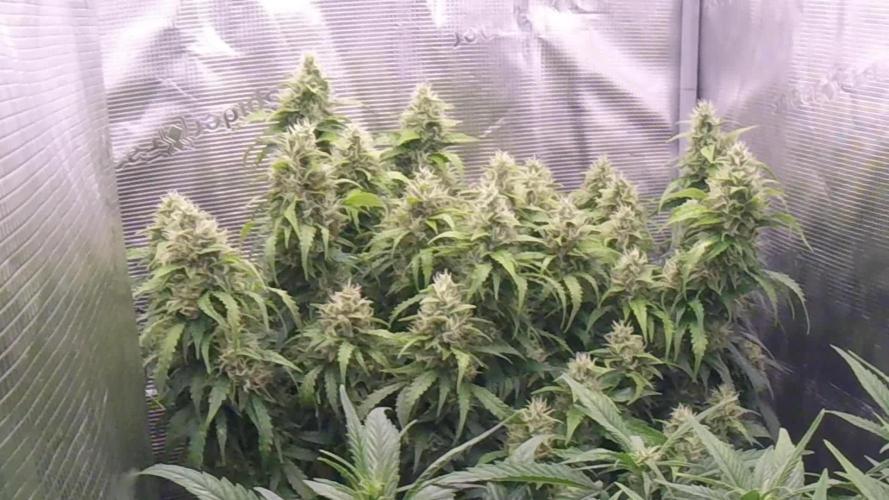
Awesome first week under the light,both plants now into flower and stacking up on plant 1 very fast.
Added big bud and bud candy,last feed till mid flower res change.
No issues so far,other than constant defoilation of light blockers needed.
Happy days and nights 👍🤞🏴🍁
🍁🍁🍁🍁🍁🍁🍁🍁
Breeder-white label purple bud auto x2
🍁🍁🍁🍁🍁🍁🍁🍁
Light-Voost led VST 240(discount code TightNugs) https://voost.com/
🍁🍁🍁🍁🍁🍁🍁🍁
Nutrients-Advanced Nutrients ,Plant Magic,CX Horticulture.


Likes
7
Share


@SJ08_autogrow
Follow
1st week of flower went great! I'm in the stretching stage so they're growing like weeds 😆 Now slowing down on nitrogen (N) and giving them girls some phosphorus (P) and potassium (K). Every time i bend the down, they stand right back up within 12 hrs! So... Overall i think they're doing nicely.


Likes
11
Share


@Bread_n_Buds
Follow
He who stops is lost, as an old saying goes
I don't know exactly what the origins are, so here's a new Zamnesia season.
We are in the middle of winter and despite growing in an area that isn't the warmest in Europe, it's really cold now. It's 16-18 degrees Celsius in the house and we need to bring the temperature of the propagator growbox between 20 and 25 degrees Celsius.
So we first placed a layer of those 1 cm thick "rubberized" floors that are used for gyms, they are easily found on Amazon and are very useful for insulation.
Then a heated resistance mat and then the closed propagator on top. Inside with our seedlings and the light on at minimum 20% we reached 24 degrees, not bad in fact the germination is proceeding very well.
100% opening of the seeds in water and almost all of them are opening in our biodegradable peat pots.
----- Our Jet Fuel stat very very good, we have to say no problem, seed oper 24 h in water then 24 h in soil and sprout. Super love this strain, the genetic line is amazing.
Here we have Diesel Family so mostly sativa and Gas taste more sativa.
WARNING: Placenta Problems ---- ALWAYS look very carefully at the seedlings, if the seed or the placenta prevent the opening of the cotyledon leaves the plant dies after a while. Remove it delicately as if it were a condom or almost. I apologize for the example but it gives the idea, remove slowly and delicately please.
WARNING: If you choose biodegradable pots, choose the largest possible ones and not paper/cardboard ones, there is peat which is the main component of most of the soils we use.
If you want to avoid transmitting vibrations to the neighbors I recommend you install one of these gym floors under your growboxes, I did it and I also feel safer not to disturb. They are easily found on Amazon in different thicknesses, I took a gym model that is assembled like a puzzle, they are also found in children's shops, they are those floors that are assembled to make children play safely, or to train and to avoid vibrations of the equipment or of any kind.
Everything will be grown Plagron Pro Mix with 100% fertilizers let's start with Power Roots 1 Ml/l
Plagron fertilizers are available on Zamnesia in convenient Pack formats for all growing styles. I used this with a simple search you can find the other products.
---- https://www.zamnesia.io/en/12119-plagron-top-grow-box-100-natural.html
Try a seed of this strain that drives us crazy...
---- https://www.zamnesia.io/it/11261-zamnesia-seeds-jet-fuel-automatic.html
Zamnesia Description // Discendente della linea genetica originale Jet Fuel, la Jet Fuel Automatic è una varietà facile da coltivare e molto indicata per gli amanti delle varietà sativa energizzanti. Ibridata dai nostri esperti genetisti, la Jet Fuel Automatic è al 60% a predominanza sativa e conserva i migliori tratti dei suoi genitori Diesel ed Aspen OG. Inoltre, aggiungendo alla miscela una genetica ruderalis, siamo riusciti a ridurre ulteriormente l'altezza e i tempi di crescita, rendendola ancora più accessibile ai coltivatori sia indoor che outdoor. Ordina i semi oggi stesso e coltiva questa straordinaria autofiorente statunitense.
Growbox and Air System - Secret Jardin DS120w + fans + Exhaust fans and filters DF16 kit
Light - Viparspectra P2000 https://www.viparspectra.com/products/viparspectra%C2%AE-2024-updated-p2000-200w-led-grow-light-with-daisy-chain-function
---- www.zamnesia.com

Likes
20
Share


@Elysian_gardens710
Follow
This is week 10 for our AK-47 Auto Goxuak by Genehtik. She is finishing out great! For the most part she yellowed out but some sugar leaves and caylxs have purple in them.
Her buds just keep stacking! Ashoka is already way past her estimated period and still showing white pistils(stoma?) And clear Trichomes.i tried to get some shots.failed mainly lol. When that changes we will chop her.
Taking advantage of the longer flower I decided to pull a few of her branches back down to expose the buds to more light. Thicken them up I hope!
I flushed her again. This time just in the sink with running tap water(our water is horrible too!) I didn't pH the water or add any Kleanse this week. I also stopped giving her Real Growers recharge.
She smells great! Like Pepper and a little skunk.

Likes
3
Share


@Altitonans_Fulmen
Follow
Lights are 58 inches from the main source to the top of the pot and the soil surface. If you added up all the lights in the tent, it would be 1100w-1200w total across 14 lights. Using them all at once is far too much for a plant and incredibly difficult to deal with environmentally. The lights are fixed in position; side lights have dimmers, allowing for pinpoint precision of PPF. Fixed at 58 inches, cannot move them closer to increase intensity. Instead, achieve optimal PPF by distributing smaller wattages across a massive, multi-fixture matrix. Triggering specific plant defenses without melting the canopy.
What's the point/blah blah wattage?
Never really go above 600W at any one time. Lights come on in the east of the tent and set in the west. At sunrise and sunset, the red-to-far-red R:FR light ratio drops because the sun's low angle scatters red light more than far-red light. This shift reduces active Pfr and increases inactive Pr, mimicking Mother Nature herself.
Deployed a lighting system featuring extra 660 nm deep-red and extending the spectrum up to 780 nm achieves the full Emerson Enhancement Effect by simultaneously balancing Photosystem II (PSII) and Photosystem I (PSI) to maximize quantum yield. By pairing deep-red photons with far-red photons, you trigger a synergistic biological response where the resulting photosynthetic rate is higher than the sum of both wavelengths used individually. This practice directly leverages the updated extended Photosynthetically Active Radiation (ePAR) framework. The Emerson effect accelerates plant metabolism and heat capture; you must proactively scale up your ambient room temperature, nutrient delivery, and CO₂ supplementation to prevent the light from stalling out your cannabis plant.
UVA stays high all day from morning to night, but UVB peaks at solar noon (middle of 18-hour days) when the sun is peak. Morning color starts at 2k-3k; by noon it goes to 5k- 6k and back to 2-3k for sunset, with differing P:FR at light off.
The extra-blue light is to assist with photoreactivation of UVB damage. No more yield loss for me. Using extra blue light for photoreactivation is what I do. Blue/UVA light activates photolyase enzymes, which directly repair DNA damage caused by UVB radiation.
But what's the point if it's not for yield?
Ultraviolet (UV) radiation—specifically UVA (315–400 nm) and UVB (280–315 nm)—acts as a critical environmental signal that programs a plant's photoprotective genes to unlock its true photosynthetic potential. When growers push crops to their absolute photosynthetic maximum via high-intensity light and elevated carbon dioxide, the photosynthetic machinery easily becomes overwhelmed. Emerging photobiology research demonstrates that UV radiation prevents this limiting bottleneck; it triggers specific transcription factors and signalling networks that fortify the plant's cellular defenses, allowing it to process extreme light levels without sustaining structural damage.
There are 8 limiting factors of plant growth; when carbon dioxide becomes the 9th limiting factor of plant growth, it shifts the growth curve from exponential to linear. The restriction after that is "photoprotection" against reactive oxygen species (ROS), managed via non-photochemical quenching (NPQ) and the xanthophyll cycle, which bridges into precise hydrogen and redox dosing.
UV radiation, particularly UVA, and the synthesis of zeaxanthin are critical for the xanthophyll cycle to function.
It's not chasing purple strains... One likes to call it chasing the limits of growth, trying to make the linear exponential, just like father mathematics prefers.
In order to do that, must control every environmental variable and compound the plant’s metabolic rate. True exponential growth means the rate of increase matches the current mass at every stage, requiring a closed-loop system where light, CO2, and nutrition lock into a synchronized upward curve. First, you must attempt to understand what restricts it. Precise hydrogen and redox dosing.
Nature mathematically optimizes quantum energy transfer and light absorption efficiency within the photosynthetic machinery, as it naturally dictates energy scaling hierarchies and resonance dynamics. Most won't even understand that; once you do, it changes everything.
Constructive interference occurs when two or more overlapping waves meet in phase, meaning their crests and troughs perfectly align. Their amplitudes add together, creating a new, amplified wave with greater intensity than the individual components.
Constructive interference is the foundational mechanism that establishes a resonance hierarchy across physical, structural, and acoustic systems.
Chromophore spacing is tuned to sub-nanometer precision to match the wavelengths of absorbed light, forcing constructive interference.
Light-harvesting proteins form geometric rings and lattices. These shapes act as physical resonators, trapping and focusing the wave energy.
This same principle dictates how opera singers shatter glass, how musical instruments resonate, and how bridges withstand structural vibrations. Nature uses the exact same math to harvest a photon as an engineer uses to design a concert hall.
When you push high PPFD and elevated CO₂, you create a metabolic bottleneck. The plant cannot process the energy fast enough, leading to electron backup, light-induced damage, and a collapse from exponential growth into a flat, linear rate. UV light acts as the regulatory valve that prevents this collapse.
In standard agronomy, Liebig's Law of the Minimum dictates that growth is limited by the scarcest resource. When you maximize water, nutrients, light, temperature, and CO₂, the bottleneck shifts to metabolic processing speed and photoprotection. By controlling the Redox state of the plant using UV, the xanthophyll cycle, and managing ROS, you can prevent the plant from hitting a hard photosynthetic ceiling. Instead of the growth curve flattening out (linear or plateauing due to photoinhibition), the plant continues to compound its metabolic rate efficiently. You are forcing the plant to operate at peak thermodynamic efficiency.
By matching the UVB peak with sustained UVA and shifting Kelvin temperatures (2K to 6K), you are damaging the plant just enough to trigger defensive genes, while simultaneously providing the exact light energy needed to repair that damage instantly.
UVA radiation and specific blue wavelengths accelerate this enzymatic conversion. Zeaxanthin acts as a structural sponge that absorbs excess excitation energy from chlorophyll and dissipates it safely, preventing ROS formation. Without UV signaling, the xanthophyll cycle cannot keep pace with extreme light, leading to dynamic photoinhibition (yield loss).
The addition of Spirulina is primarily for zeaxanthin, as it contains a lot. But on top of that, the active Hawaiian Spirulina in the matrix was cultivated in open ponds using a combination of 100% fresh potable water from Hawaiian aquifers and ultra-pure, deep ocean water containing all 94 trace minerals & elements. Then gently dried using patented Ocean Chill Drying technology and cold-pressed to ensure maximum nutrient levels. Spirulina, a blue-green alga, is rich in nitrogen, phosphorus, and potassium (NPK), making it an excellent source of nutrients for plant growth. Studies have shown that Spirulina can be used as a biofertilizer, effectively replacing chemical fertilizers, especially for nitrogen, with a whopping NPK of 10% (N), 20% (P), and 20% (K). Rich in proteins, amino acids, trace minerals, and plant growth-promoting compounds.
Zeaxanthin is a vital plant pigment that accumulates under intense light to drive non-photochemical quenching (NPQ), acting via thermal energy dissipation, direct singlet oxygen scavenging, and thylakoid membrane stabilization.
The violaxanthin cycle (or xanthophyll cycle) reversibly converts violaxanthin to zeaxanthin via antheraxanthin to protect plants from photooxidation.
Understanding this interconversion is vital for optimizing non-photochemical quenching (NPQ) and pushing photosynthetic limits under high-light stress.
Ascorbic acid (vitamin C) is a natural antioxidant that plants produce internally to neutralize harmful reactive oxygen species caused by photosynthesis and high light stress. Acts as a co-factor for enzymes like violaxanthin de-epoxidase in the xanthophyll cycle, which safely dissipates excess light energy.
1g ascorbic acid will neutralize 100% of chlorine in upwards of 30 gallons of tap water. If your local tap water uses chloramines (chlorine bonded with ammonia) instead of free chlorine, you will need roughly 20% to 30% more ascorbic acid to completely break the tougher chemical bond.
Molecular hydrogen and hydrogen-rich water act as selective antioxidants that help lower oxidative stress. They neutralize toxic reactive oxygen species like hydroxyl radicals and boost natural antioxidant defense systems in biological and plant systems exposed to high-intensity light or abiotic stress.
UVA and UVB act as stress signals that upregulate the plant's secondary metabolism. It forces the plant to build an internal "sunscreen" (flavonoids and anthocyanins) and fortify its cellular defenses before the peak solar noon crisis. This keeps the metabolic highway open.
In nature, the ambient ratio of UVA to UVB at solar noon sits roughly between 10:1 and 20:1 (depending on latitude and elevation). In a high-PPFD indoor matrix, maintaining a strict ratio—often aiming for around 12:1 to 15:1 UVA to UVB—provides the optimal signaling threshold.
Balancing Far-Red (FR) light at "light-off" to manage the phytochrome photo-equilibrium (Pfr to Pr conversion) in tandem with the UV schedule. Omg, the logic.
Hydrogen concentration and redox signaling as secondary messengers in this high-intensity loop.
Under the intense solar noon matrix, the pH of the thylakoid lumen drops. This acidic environment activates the enzyme Violaxanthin De-Epoxidase (VDE), which converts violaxanthin into the photoprotective zeaxanthin. VDE cannot function in a vacuum; it strictly requires ascorbic acid (Vitamin C) as an electron donor to run this conversion. If a plant undergoes heavy light stress and runs out of internal ascorbic acid, the xanthophyll cycle stalls. The plant can no longer engage in Non-Photochemical Quenching (NPQ), leading to immediate singlet oxygen O2 formation and destruction of the thylakoid membrane. This is "The Ascorbic Acid / Xanthophyll Engine"
Using ascorbic acid to neutralize chloramines in your water isn't just protecting your rhizosphere biology it actively prevents the degradation of your nutrient solution's redox potential before it ever touches the roots.
When pushing plants to the absolute edge, traditional antioxidants can be a double-edged sword because they blindly neutralize all free radicals. This is a problem because some Reactive Oxygen Species (ROS) act as critical signaling molecules telling the plant to grow. Molecular Hydrogen H2 is the Selective Kill-Switch.
Molecular hydrogen H2 is a revolutionary tool because it is a selective antioxidant. It ignores beneficial signaling ROS (like mild hydrogen peroxide) and targets only the most destructive, cell-shattering radicals—specifically hydroxyl radicals OH) and peroxynitrite.
By dosing hydrogen-rich water or managing hydrogen redox signaling, providing an emergency pressure-release valve for the plant's electron transport chain. It keeps the cellular environment stable enough that the plant never has to downregulate photosynthesis to protect itself. This maintains cellular voltage.
To trigger this defensive matrix without stunting the plant, you cannot simply blast UV indiscriminately. You must use UVA as the "scout" and UVB as the "enforcer. High UVA acts via the cryptochrome and phototropin photoreceptors to upregulate the expression of the HY5 transcription factor and prime the VDE enzyme. When the sharp spike of UVB hits at solar noon via the UVR8 receptor, the plant's biochemical "sunscreen" (flavonoids and anthocyanins) and its zeaxanthin pools are already pre-staged and waiting. This prevents the temporary stunting or "lag phase" usually associated with sudden UVB exposure."
Closing the Loop: Far-Red End-of-Day (EOD) Synergy
The final masterstroke is aligning this UV defense with a Far-Red (FR) lights-off routine. The Red-to-Far-Red Drop: At the end of the photoperiod, knocking out the blue/UVA spectrum and leaving a targeted burst of pure Far-Red (730nm) instantly flips the plant’s master switch. It converts active Pfr to inactive Pr in minutes rather than hours. Why this matters for the UV loop: UV radiation and high-intensity lighting keep the plant in a highly alert, photoprotective state that requires massive ATP expenditure to maintain. By forcing an immediate Pfr/Pr) conversion at lights-out, instantly commanding the plant to cease defensive expenditure, lower its metabolic respiration rate, and transition directly into nighttime cellular repair and carbohydrate translocation. You are maximizing the efficiency of its "sleep." every ounce, every last piece.
Highly synchronized biological dance, balancing the exact input of electrons with the exact mechanism to dissipate them safely when they overflow.
Peace.
Likes
2
Share

@hinterhofgrower
Follow
.
🌱 : test harvest on day 86, 40,3g, day 88 44,5g, day 90 54g, day 92, 60,6g, day 93 22,4g, final harvest on day 96 562,7g
💧 :
💡 :
🤔 :
Likes
26
Share


@KingSalomonsWeed
Follow
Joa, die Gelato ist super stable. Gebrochener Hauptstamm. Egal. 2 mal, auch egal. Sie ignoriert es einfach. 😍
Sensi Seeds
Good looking girl.
Duftet hervorragend.
Aus dem zelt kommt eun frischer Bananen angehauchter treibhausduft.
Sehr angenehm.


Likes
17
Share


@Kirsten
Follow
9.2.25:
The plants had a good watering, they're all still drinking a lot. Which is great, as that means growth, which, at this stage, we desperately need!
I went ahead and gave all the plants a thorough watering each with:
2ltrs of dechlorinated water, PH'd to 6.5 with:-
♡ 4ml of Xpert Nutrients Bloom Booster
♡ 4ml of Xpert Nutrients Cal-Mag amino acids
♡ 4ml Seaweed extract liquid
I don't know how this scrog net is going to work out.
I think the squares are too big. It's elasticated, which I like. However, I'm extremely cautious with watering and moving the net. It's only a matter of time before I break more branches. It's such a hassle with it in there, honestly. I can't get in the tent properly to even check the weight of pots, as it's all weaved through, and again, I will snap branches.
I did have a free net with the tent, which I think was smaller squares. I think I will use some other training next run.
It's really not my kind of setup. I'm too interested in moving things and inspecting the plants constantly.
The net is driving me up the wall. 😣 I'm considering removing it and trying something else, but it's also a bit too late for oldest plants.9.2.25:
Gave the plants another good soak.
I used 2ltrs of dechlorinated water PH'd to 6.4. It contained the following nutrients;
♡ 4ml of Xpert Nutrients Bloom Booster
♡ 4ml of Xpert Nutrients Cal-Mag amino acids
♡ 4ml Seaweed extract liquid
♡ 0.5g of Ecothrive Biosys.
The plants are undergoing explosive growth at this stage, which I'm thrilled by!
Purple Lemonade is turning purplish hues.
Pink Mist has so many bud sites and is looking very healthy.
Do-sì-dos is growing vigorously and looking promising, especially considering all my unfortunate mishaps! 😅
Watermelon also has considerable growth. However, my training has made a mess out of the structure. Which I consider another valuable take away.
Bubble


Likes
2
Share


@dauntless
Follow
Week 9 started on May 29, 2022
This week is gonna be the last full veg week. I added the flowering HPS light to the side where the cola was injured, plants love the HPS so I figured why not, I'll ned it during flower.
Of course that raised tent temps a full 3-5 degrees, had to change some ventilation parameters, fan speed went up on both in tent, and on the a/c infinity. I also cleaned the screens, and opened another vent at the base. Fans are on.
The plant has done very well. Added Foop spray into the mix and so far so good, I see that it has slightly improved the plant in a short period, and it smells pretty good, took it to the garden for more trials.
Dudes at AutoPot USA fixed my stuff!! Thanks guys. The fix they troubleshooted worked. My res is below 300 ppm and at 69 degrees F
I have Fox Farms Bloom diluted and Bio War Flower crushing the biologicals - after I fixed the leak issue, I figured why not feed her while she gets her finals sea legs for the flower trip ahead.
Nothing crazy, I run stuff diluted, especially when I am dialing my light pre flower, I can't risk burning them with heat or nutes.
I am a tucking fool, a bending fool, and a foop spraying fool this week, you guys are not gonna believe how many fan leaves this thing put out in seven days, and I took off a significant amount mid week 8, I was a bit worried, oh well, never-mind this is White Widow, she doesn't care, all she wants to do is bust outside in jungle in South America


Likes
6
Share


@IQuSX
Follow
>>Sweet ZZ
This specimen was dried under an ultraviolet lamp for 2 hours / day.
So all the leaves that were left with conch evaporated! 40% of fresh - dry weight!


Likes
7
Share


@GYOweed
Follow
Ended up being my runtz gum x amnesia lemon haze seed I found on kitchen floor.
Typical branchy big creamy flowery frosty pheno i got like last times..
I have many fem seeds of this F1. It's nothing interesting in my opinion.
This was grown in partial sun and flowered in mostly shade couple hours direct sun only. 🌞
Likes
4
Share


@AirDuster
Follow
Day 74 - still growing, but not looking as healthy as I'd like. Leaves are curling downwards at the tips, and tips turning yellow/brown. I think this is a one of the classic signs of overwatering and over feeding, so have cut back nutes and watering, and will re-assess next week whether or not to go back to old schedule. Have also diluted the reservoir, so oping that a slow gradual easing will sort things out. She also looks quite stunted in growth to me - she's all of 50cm tall. The RQS data sheet advises 80 - 120, but she has been in the RQS Royal Dwarfs shadow, so perhaps needed more of the light earlier on. I was warned about overuse of the PK nute and am think I've learnt my lesson here.
Fingers crossed all will be fine. On the up side, she's defintely flowering.
Day 75 - might be wishful thinking, but tip curling seems to have been brought under control and looks to be recovering. Phew.
Day 77 - definitely wishful thinking. Did some readings, and found ph has leapt up to 6.67, and ppm at around 2500. will ph down a little later, and continue to monitor.
Likes
6
Share


@StarSkream
Follow
12/12 first week #starskreamstash looking pro,ising Dropping the night temps.... Happy Growing added some strawberry fields soil repotted to gallons

Likes
11
Share


@Professor_Daank
Follow
Herrrrro gang! Welcome to another week of Daank's grow!
8/2: Brought back the Great White. I was reading that it works well in conjunction with other root excelurators, like Rapid Start. I got 2 more temp/humidity sensors for the tent. It allows me to keep track of 100% of what is really going on, I find it to take away worry (b/c temps are very important!). Today was a "eureka!" moment in terms of understanding run-off pH and it's value to telling the grower how healthy the plant is and what nutes may, or may not, be needed. I also got some new LED glasses so I don't burn my fucking corneas when tending to the garden - they are phenomenal and I suggest them if you grow with an LED. Check the videos and photos. Pistils are growing rapidly and baby budlets are starting to form. I'm actually getting a nice subtle purple color - it's very neat.
Today's run-off pH was 6.3, and I gave it 6.3 for water - so that's a good sign (I bounce the pH all around from 5.5-6.3). I'll keep track of this moving forward in the diary. Minor defoliation.
***Pro-Tip: If you're wondering what the run-off should be... around +.5/-.5 of what you put in is good. But this also might not mean anything... so many different opinions on the web.
****: My Spotify Playlist for my plants: https://open.spotify.com/playlist/0ydAFulbzDlqFr5WIZdfM1?si=r5M5H83BSQ6tOE5pk9Bg4Q
Day 38 - 8/4: Lil'budlet's are poppin' up all over. By the end of this week I assume we'll be in full swing.
Day 39: I have ordered new nutes, Advanced Nutrients. The reviews, photos, and research all point to using this for the best results. I found them to be a bit expensive, but if I can always get perfect pH values without much of a hassle... I'm down. They will be here by end of the week and I'll transition that over this weekend. I can't wait.
Day 40: 8/6 - Advanced Nutrient nutes arrive today. Watering will be a pleasure. The plants look great. The buds are real. Small smell. Trimmed last night quite a bit for bud production. They love George Gershwin's "Rhapsody in Blue". It perks 'em up.
