


Likes
Comments
Share


@BayAreaGrown
Follow
WEEK 1 flower so far the permanent marker is a very strong strain and it has a strong gas nose already

Likes
61
Share


@Roberts
Follow
Sweet Bourbon Kush is doing well. She got her first lst today. I am curious to see how big she will try to get in this 1.5 gallon Potter. Everything is looking good. Thank you Suoer Sativa Seed Club. 🤜🏻🤛🏻🌱🌱🌱
Thank you grow diaries community for the 👇likes👇, follows, comments, and subscriptions on my YouTube channel👇. ❄️🌱🍻
Happy Growing 🌱🌱🌱
https://youtube.com/channel/UCAhN7yRzWLpcaRHhMIQ7X4g

Likes
32
Share


@GODSGIFT_2005_JM
Follow
🍼Greenhouse Feeding BioGrow
⛺️MARSHYDRO
The ⛺️ has a small door 🚪 on the sides which is useful for mid section groom room work. 🤩
☀️ by VIPARSPECTRA (models: P2000 & XS 2000)
🌱 DUTCH HEADSHOP SEEDS:
www.dutch-headshop.eu
www.dutch-headshop.nl
ONE STOP SHOP
. 100% germination success on first try!
. Very friendly customer service
. Best bio-seed packaging
. Sells other products @ best prices:
. Nutrients
. Vaporizers
. Smoking accessories (grinders, cones)
. CBD Tinctures
. Resin Extracts
. Boveda humidity packs
. Ziplock bags
. Other health supplements such as:
. Lion’s Mane Organic Capsules
. Hemp Seed coffee

Likes
6
Share


@Growstopher
Follow
6.23.25.
8th week of flower. Quality looks good but quantity is not so good! About 2 weeks left to harvest looking decent! Already loweppm for the final weeks.
Foop nutrients
Bloom1- 15ml
Bloom2-15 ml
Sweetener- 20 ml
Humboldt secret nutrients
Cal-mag- 2.5 ml
Thanks for looking I appreciate it🏼

Processing
Likes
4
Share


@matzouf
Follow
~~14/09
Couldnt help myself to try some LST even though it might not be benificial to this plant. Increased the fish mix to 1ml/L, got a spider mite invasion on going. Currently treating with potassic soap and neem oil.
Beside that the plants looks healthy to me.
~~16/09
Some stylish rain cover for the rain to come (finally after almost 3 months!)
Likes
2
Share

@Growfather2
Follow
Hello everyone,
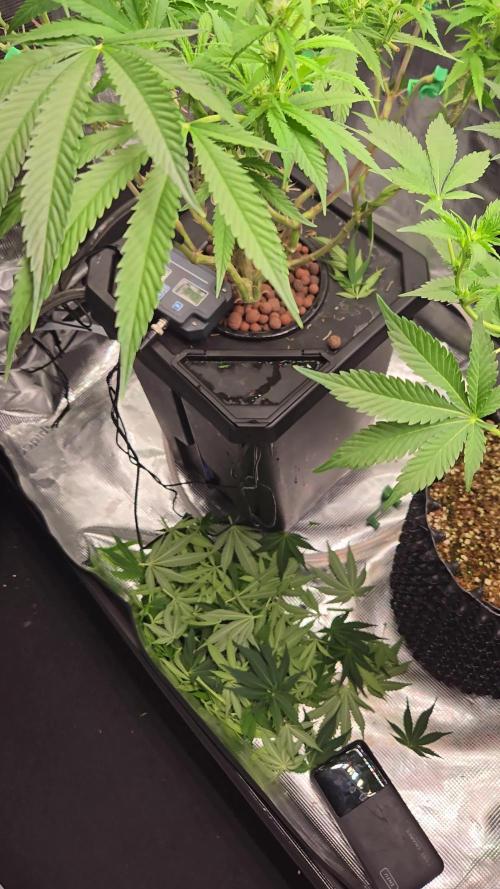
Going into week 3 of flower and everything looks fine the girls are doing great.
Did some defoliation on them.
Thanks for stopping by and have a nice day.
Growfather

Likes
19
Share


@Comfrey
Follow
Day 80
This morning I started defoliating Tropicana. She will be in the darkness for the next days. I already harvested a part of the head flower and let it dry trimmed. Because of extreme weather conditions and very high humidity I got a little bud rott. I found it out quit early I think. So I hope nothing will not happen any more. Just harvesting relaxed and drink a Tropicana tee.
Day 81
I decided to cut her down in the evening. The humidity in the basement room is high and I don‘t want to risk here anything anymore. Waiting for my first homegrown weed to be vaped.
Day 82
Tropicanas flowers hanging to dry in my basement. I check them once per day with a strong light.
Day 83
Same same. The smell is wonderful like a bit of gas combined with a fruity flower bouquet. Our neighbors in the house like the smell, too. 🙏
Day 84
I could try my first homegrown weed. It‘s absolutely tasty and have a very smooth vape. I was very surprised cause it‘s not cured yet. A longer vape report will follow when it‘s dried and cured.
Day 88
All flowers, sugar- and tee leafs are trimmed and filled in glasses for curing. I open twice per day for 20 minutes. Boveda packs 58% inside.
I will fill out the rest of the diarie when my buds are dried, cured and vaped. So far this was a very exciting journey for me. Growing cannabis and even legal on our balcony. Feels still a bit unreal, but it’s real!
Thank you for reading my diary! Thanks to all the people who worked on legalizing cannabis in Germany, especially to the „Deutscher Hanfverband (DHV)“!
I will give more updates and write a vape report after curing several weeks. Maybe with some Tropicana Cookies baked in Comfreys garden kitchen.
Likes
22
Share


@Naujas
Follow
well, that day dawned :) growing in a suitcase was really difficult, temperature, humidity, plant growth, everything was very difficult to control, but I managed something, it was an extremely interesting experience :) 119 gr wet, I think it will be between 25-30 gr dry , which I think is really good from the suitcase :) it was something different than usual, and now I'm going to grow another begina, which is much bigger than this one :) good luck to everyone, and thank you.:)

Likes
43
Share


@Regenwurm
Follow
Die Ladies sind auf dem richtigen weg, heute Tag 1 Low Stress Training, Klimabedingungen und Licht ist perfekt!
Dünger diese Woche leicht erhöht. Sonst gibt es nicht wirklich was zu berichten.
Bis nächste Woche 🖖🏽peace


Likes
4
Share


@Green_Thumb
Follow
Popped my first 3 seeds in! Parked the led right up on the pots. Decided to order a 1200W led along w/ my 600W for better coverage.


Likes
25
Share


@GreenHouseLab
Follow
Only running 1 Thin Mint x Cookies + Cream its front left in the tent, great internodal spacing came highly recommended. Switching to Bloom nutrients, two part Cropsalt. Irrigation frequency will be adjusted as flower development drastically increases over the next two weeks.
Likes
Comments
Share


@Piro420
Follow
Some light burn on some tops but looking like some very fat nice nugs.
Sticky and smelly I have a good feeling the terps are going to be
Likes
15
Share


@tomeugironella
Follow
Last week of veg for those girls ! I defoliated a bit 5 days ago and im planing on switching to 12/12 in 5/8 days ! They are happy tho 😁.
What are ur thoughts guys ?


Likes
23
Share


@elementhc
Follow
The 2 GSC extreme and one of the GG4 got harvested this morning Dec 20th.
The rest are a week or two behind.




Likes
40
Share


@MadeInGermany
Follow
Info:
Unfortunately, I had to find out that my account is used for fake pages in social media.
I am only active here on growdiaries.
I am not on facebook instagram twitter etc All accounts except this one are fake.
Hey everyone :-)
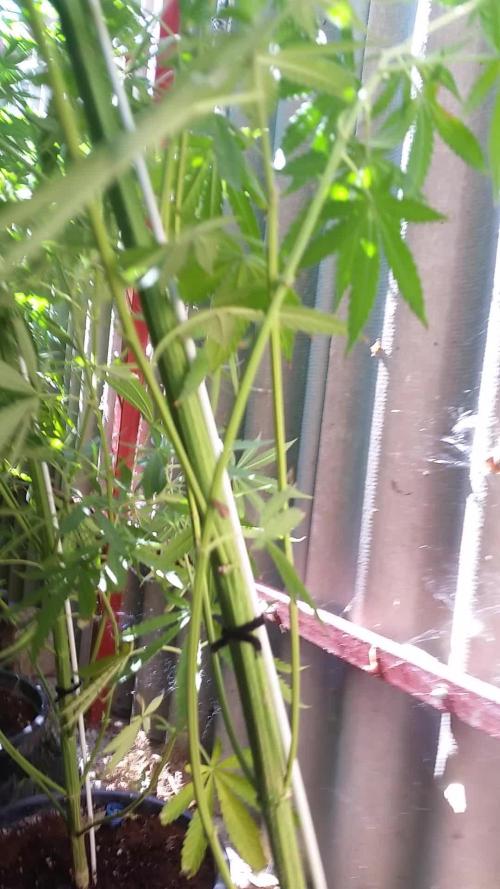
Another nice week goes by and it is slowly becoming a bush from training 😊.
This week it was poured 2 times with 1 l each time (For nutrients, see the nutrient table above).
She was trained once again with topping.
You still have some time until it blooms until space is free :-).
Otherwise everything was checked and cleaned like every day.
Have fun with the update and stay healthy 🙏🏻
You can buy this Nutrients at :
https://greenbuzzliquids.com/en/shop/
With the discount code: Made_in_Germany you get a discount of 15% on all products from an order value of 100 euros.
You can buy this Strain at :
www.Zamnesia.com
Type:
Runtz
☝️🏼
Genetics:
Zkittlez x Gelato
👍
Vega lamp: 2 x Todogrow Led
Quantum Board 100 W
💡
Bloom Lamp : 2 x Todogrow Led
Cxb 3590 COB 3500 K 205 W
Soil :
Canna Coco Professional +
☝️🏼
Nutrients :
Green Buzz Liquids :
Organic Grow Liquid
Organic Bloom Liquid
Organic more PK
More Roots
Fast Buds
Humic Acid Plus
Growzyme Big Fruits
Clean Fruits
Cal / Mag
Organic Ph - Pulver
☝️🏼🌱
Water: Osmosis water mixed with normal water (24 hours stale that the chlorine evaporates) to 0.2 EC. Add Cal / Mag to 0.4 Ec Ph with Organic Ph - to 5.8

Likes
30
Share


@Togoutouseg
Follow
J'ai lancé la floraison le 24 avril !!
J'espère que mes plantes vont faire de belles fleurs 🌱🌴