The Grow Awards 2026 🏆
Likes
Comments
Share
@MrJones
Follow
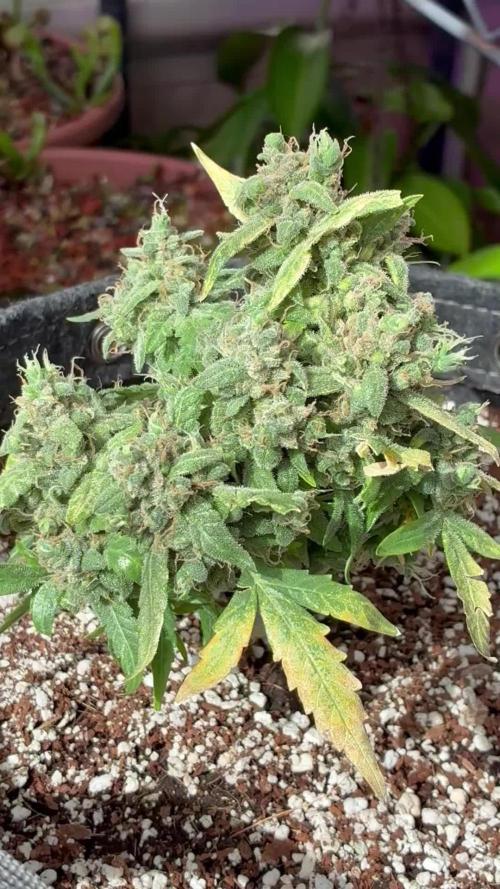
OSS Cheese XXL 🔹⊱╮🔹╰⊰🔹 GROW Started 03.10.24 INFORMATION 🔹╰⊰´🔹⊱╮🔹 🌞Environment - Maintaining 80F and 65%Humidity 🌾Training - These ladies are Pruned and Defoliated and ready for flower. ⚱️2-Gallon 📊6.2 PH 💧 Feeding - Using Horti Grow 8-11-21, Bloom 5-15-26, Late Bloom 0-24-26, Cal 12-0-0 🌞Medic Grow Smart 8 760 Watts 🕷️ IPM - CannControl from Mammoth and Mosquito Bits as needed 🔹⊱╮🔹╰⊰🔹 GROW Started 03.10.24 INFORMATION 🔹╰⊰´🔹⊱╮🔹 🌞Environment - Maintaining 80F and 65%Humidity 🌾Training - The girls are recovering from last week's Pruning and Defoliation, ⚱️2-Gallon 📊6.2 PH 💧 Feeding - Using Horti Bloom and Horti Cal 12-0-0 🌞Medic Grow Smart 8 760 Watts 🕷️ IPM - CannControl from Mammoth and Mosquito Bits as needed 🔹⊱╮🔹╰⊰🔹 PLANT UPDATES 🔹╰⊰´🔹⊱╮🔹 📝 Notes - On 🗓️05.11.24, This week, we are on Auto-Pilot and just Fertigating as needed; the ladies are stacking up nicely, and the leaves have grown back not sure if it is the genetics or the new nutrients; I would like to see less and will evaluate if more defoliation will be needed. 📝Fertigation injects fertilizers into an irrigation system to supply dissolved nutrients to crops. 🗓️05.11.24 Just feeding daily, sometimes twice; today, fed with Hort-Bloom @ 2.7 GRMS Per Gal and Horti-Cal @ 2.5 GRMS Per Gal. 🗓️05.12.24 Just feeding daily, sometimes twice; today, fed with Hort-Bloom @ 2.7 GRMS Per Gal and Horti-Cal @ 2.5 GRMS Per Gal. 🗓️05.13.24 Just feeding daily, sometimes twice; today, fed with Hort-Bloom @ 2.7 GRMS Per Gal and Horti-Cal @ 2.5 GRMS Per Gal. 🗓️05.14.24 Just feeding daily, sometimes twice; today, fed with Hort-Bloom @ 2.7 GRMS Per Gal and Horti-Cal @ 2.5 GRMS Per Gal. 🗓️05.15.24 Just feeding daily, sometimes twice; today, fed with Hort-Bloom @ 2.7 GRMS Per Gal and Horti-Cal @ 2.5 GRMS Per Gal. 🗓️05.16.24 Just feeding daily, sometimes twice; today, fed with Hort-Bloom @ 2.7 GRMS Per Gal and Horti-Cal @ 2.5 GRMS Per Gal. 🗓️05.17.24 Just feeding daily, sometimes twice; today, fed with Hort-Bloom @ 2.7 GRMS Per Gal and Horti-Cal @ 2.5 GRMS Per Gal. ╰⊰🔹╰⊰´🔹⊱╮🔹╰⊰🔹╰⊰🔹STRAIN INFORMATION🔹⊱╮🔹╰⊰🔹╰⊰🔹╰⊰🔹⊱╮ Cheese XXL cannabis seeds are a unique blend of Afghan Kush x Super Skunk, producing the most pungent dank weed. Cheese XXL is the third commercially available edition released by Original Sensible using and developing these Afghan and Skunk genetics. The first release of these genetics was their Skunk Afghani. The second improved version was Stinkin' Bishop, which had an enhanced and more potent THC content and was more intense in terms of smell. The third and improved release on a similar theme is this Cheese XXL, which has a similar THC content but an enhanced heavier yield. The smoke is incredible, with an outstanding flavor of pungent skunk and spicy, extra strong mature cheese created by the dominant terpene myrcene with its earthy solid scent accompanied by caryophyllene and pinene, which combine to create a peppery acrid cheesy odor. THC levels are exceptionally high in this Cheese strain, and the effect is well-balanced, developing mental and body relaxation with a remarkable alleviation of stress and depression. The intense solid aroma starts early in the flowering period; if you're growing Cheese XXL indoors, you'll need plenty of ventilation to disperse these babies' stinky "road kill" aroma! Cheese XXL is a cheese strain suited to indoor setups and thrives outdoors well. These feminized marijuana seeds are incredibly resistant to mold and disease and produce a substantial harvest that professional and amateur growers can quickly achieve. These Cheese weed seeds are outstanding. Break open the buds ready for use, and you'll see why the stench will make your eyes water! Cheese XXL from Original Sensible Seeds is a great choice to break into the commercial market of growing cannabis, so if you're looking to buy something special with extreme yield, potency, and flavor, Cheese XXL cannabis seeds are simply the best choice.
Likes
68
Share
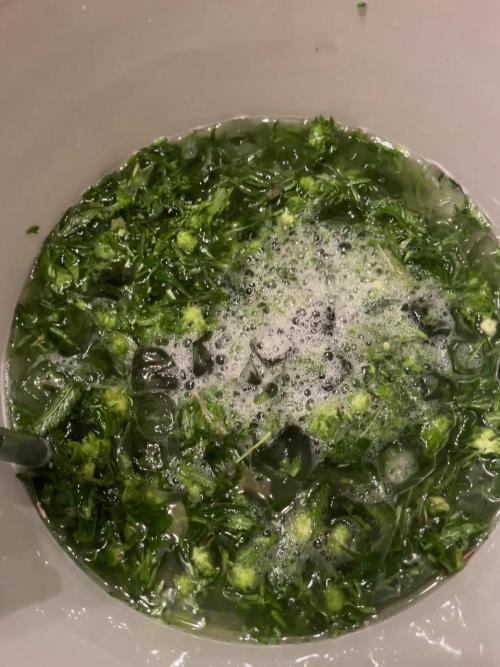
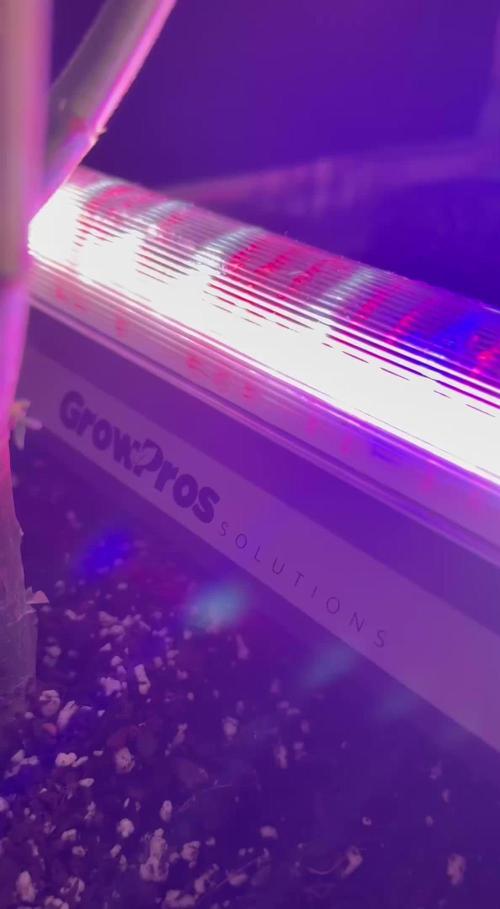
Removed autoflower and put her in her own pot outside the tent. Foliars applied in strong blue 430nm with 4000Hz tone. 20-minute dose prior to application. In essence, you're seeing a combination of the infrared light reflected by the plant, which the camera perceives as red, and any residual visible blue light the plant reflects, which results in a purple hue. I was doing more stretching of the stems, adjusting weights, just a little too much, and it snapped almost clean. I got a little lucky in that it was still connected, wrapped her almost instantly while holding her in place with yoyo's. The core framework is now in place. If your soil has a high pH, it's not ideal; you want a pH of 6.4, 6.5, or 6.6, which is ideal. If you are over a pH of 7, you have no hydrogen on the clay colloid. If you want your pH down, add Carbon. If you keep the pH below 7, you will unlock hydrogen, a whole host of new microbes become active and begin working, the plant will now be able to make more sugar because she has microbes giving off carbon dioxide, and the carbon you added hangs onto water. Everything has electricity in it. When you get the microbes eating carbon, breathing oxygen, giving off CO2, those aerobic soil microbes will carry about 0.5V of electricity that makes up the EC. The microorganisms will take a metal-based mineral and a non-metal-based mineral with about 1000 different combinations, and they will create an organic salt! That doesn't kill them, that the plant loves, that the plant enjoys. This creates an environment that is conducive to growing its own food. Metal-based: Could include elements like iron, manganese, copper, or zinc, which are essential nutrients for plants but can exist in forms not readily accessible. Non-metal-based: Examples like calcium carbonate, phosphate, or sulfur are also important for plant growth and potentially serve as building blocks for the organic salt. Chelation in a plant medium is a chemical process where a chelating agent, a negatively charged organic compound, binds to positively charged metal ions, like iron, zinc, and manganese. This forms a stable, soluble complex that protects the micronutrient from becoming unavailable to the plant in the soil or solution. The chelate complex is then more easily absorbed by the plant's roots, preventing nutrient deficiency, improving nutrient uptake, and enhancing plant growth. Chelation is similar to how microorganisms create organic salts, as both involve using organic molecules to bind with metal ions, but chelation specifically forms ring-like structures, or chelates, while the "organic salts" of microorganisms primarily refer to metal-complexed low molecular weight organic acids like gluconic acid. Microorganisms use this process to solubilize soil phosphates by chelating cations such as iron (Fe) and calcium (Ca), increasing their availability. Added sugars stimulate soil microbial activity, but directly applying sugar, especially in viscous form, can be tricky to dilute. Adding to the soil is generally not a beneficial practice for the plant itself and is not a substitute for fertilizer. While beneficial microbes can be encouraged by the sugar, harmful ones may also be stimulated, and the added sugar is a poor source of essential plant nutrients. Sugar in soil acts as a food source for microbes, but its effects on plants vary significantly with the sugar's form and concentration: simple sugars like glucose can quickly boost microbial activity and nutrient release. But scavenge A LOT of oxygen in the process, precious oxygen. Overly high concentrations of any sugar can attract pests, cause root rot by disrupting osmotic balance, and lead to detrimental fungal growth. If you are one who likes warm tropical high rh, dead already. Beneficial, absolutely, but only to those who don't run out of oxygen. Blackstrap is mostly glucose, iirc regular molasses is mostly sucrose. Sugars, especially sucrose, act as signaling molecules that interact with plant hormones and regulate gene expression, which are critical for triggering the floral transition. When sucrose is added to the growth medium significantly influences its effect on floral transition. Probably wouldn't bother with blackstrap given its higher glucose content. Microbes in the soil consume the sugar and, in the process, draw nitrogen from the soil, which is the same nutrient the plant needs. Glucose is not an oxygen scavenger itself, but it acts as a substrate for the glucose oxidase (GOx) enzyme, effectively removing oxygen from a system. Regular molasses (powdered if you can), as soon as she flips to flower or a week before, the wrong form of sugar can delay flower, or worse. Wrong quantity, not great either. The timing of sucrose application is crucial. It was more complicated than I gave it credit for, that's for sure. When a medium's carbon-to-nitrogen (C:N) ratio reaches 24:1, it signifies an optimal balance for soil microbes to thrive, leading to efficient decomposition and nutrient cycling. At this ratio, soil microorganisms have enough nitrogen for their metabolic needs, allowing them to break down organic matter and release vital nutrients like phosphorus and zinc for plants. Exceeding this ratio results in slower decomposition and nitrogen immobilization, while a ratio below 24:1 leads to faster breakdown and excess nitrogen availability. Carbon and nitrogen are two elements in soils and are required by most biology for energy. Carbon and nitrogen occur in the soil as both organic and inorganic forms. The inorganic carbon in the soil has minimal effect on soil biochemical activity, whereas the organic forms of carbon are essential for biological activity. Inorganic carbon in the soil is primarily present as carbonates, whereas organic carbon is present in many forms, including live and dead plant materials and microorganisms; some are more labile and therefore can be easily decomposed, such as sugars, amino acids, and root exudates, while others are more recalcitrant, such as lignin, humin, and humic acids. Soil nitrogen is mostly present in organic forms (usually more than 95 % of the total soil nitrogen), but also in inorganic forms, such as nitrate and ammonium. Soil biology prefers a certain ratio of carbon to nitrogen (C:N). Amino acids make up proteins and are one of the nitrogen-containing compounds in the soil that are essential for biological energy. The C:N ratio of soil microbes is about 10:1, whereas the preferred C:N ratio of their food is 24:1 (USDA Natural Resource Conservation Service 2011). Soil bacteria (3-10:1 C:N ratio) generally have a lower C:N ratio than soil fungi (4-18:1 C:N ratio) (Hoorman & Islam 2010; Zhang and Elser 2017). It is also important to mention that the ratio of carbon to other nutrients, such as sulfur (S) and phosphorous (P) also are relevant to determine net mineralization/immobilization. For example, plant material with C:S ratio smaller than 200:1 will promote mineralization of sulfate, while C:S ratio higher than 400:1 will promote immobilization (Scherer 2001). In soil science and microbiology, the C:S ratio helps determine whether sulfur will be released (mineralized) or tied up (immobilized) by microorganisms. A carbon-to-sulfur (C:S) ratio smaller than 200:1 promotes the mineralization of sulfate, when the C:S ratio is low, it indicates that the organic matter decomposing in the soil is rich in sulfur relative to carbon. Microorganisms require both carbon and sulfur for their metabolic processes. With an excess of sulfur, microbes take what they need and release the surplus sulfur into the soil as plant-available sulfate A carbon-to-sulfur (C:S) ratio higher than 400:1 will promote the immobilization of sulfur from the soil. This occurs because when high-carbon, low-sulfur materials (like sawdust) are added to soil, microbes consume the carbon and pull sulfur from the soil to meet their nutritional needs, temporarily making it unavailable to plants. 200:1 C:S 400:1: In this range, both mineralization and immobilization can occur simultaneously, making the net availability of sulfur less predictable. This dynamic is similar to how the carbon-to-nitrogen (C:N) ratio regulates the availability of nitrogen in soil. Just as microbes need a certain amount of nitrogen to process carbon, they also require a balanced amount of sulfur. Both mineralization and immobilization are driven by the metabolic needs of the soil's microbial population. Sulfur is crucial for protein synthesis. A balanced ratio is particularly important in relation to nitrogen (N), as plants need adequate sulfur to efficiently use nitrogen. A severely imbalanced C:S ratio can hinder the efficient use of nitrogen, as seen in trials where adding nitrogen without balancing sulfur levels actually lowered crop yields. Maintaining a balanced carbon-to-sulfur (C:S) ratio is highly beneficial for plant growth, but this happens indirectly by regulating soil microbial activity. Unlike the C:N ratio, which is widely discussed for its direct effect on nutrient availability, the C:S ratio determines whether sulfur in the soil's organic matter is released (mineralized) or temporarily locked up (immobilized). Applied 3-day drought stress. Glucose will hinder oxygenation more than sucrose in a solution because glucose is consumed faster and has a higher oxygen demand, leading to a more rapid decrease in oxygen levels. When cells respire, they use oxygen to break down glucose, and this process requires more oxygen for glucose than for sucrose because sucrose must first be broken down into glucose and fructose before it can be metabolized. In a growth medium, glucose is a more immediate and universal signaling molecule for unicellular and multicellular organisms because it is directly used for energy and triggers a rapid gene expression response. In contrast, sucrose primarily acts as a signaling molecule in plants to regulate specific developmental processes by being transported or broken down, which can be a more complex and slower signaling process. Critical stuff. During wakefulness (DC electric current) life can not entangle electrons and protons. During the daytime, the light is sensed as multiple color frequencies in sunlight. Coherence requires monochromatic light. Therefore, at night, IR light dominates cell biology. This is another reason why the DC electric current disappears during the night. The coherence of water is maintained by using its density changes imparted by infrared light released from mitochondria in the absence of light. This density change can be examined by NMR analysis, and water is found to be in its icosahedral molecular form. This is the state that water should be in at night. This is when a light frequency is lowest and when the wave part of the photoelectric effect is in maximum use. 3600
Likes
57
Share
@Kmikaz420
Follow
En voilà une de moins se n ai pas la plus grande du jardin mais c été la plus rapide !! 8 semaine demain. Autrement je passerai remplir le journal quand la plante sera sèche avec le poids etc etc.. Voilà la gorrila x purple punch à sécher et à été mis en bocale j ai recolter un petit 40g sec (pas mal vue la forme de la plante et ces branches toutes fine ) Par contre l odeur est magnifique sa sent le chewing gum fruit des bois sur un fond de canelle , café,très sucrée vraiment une odeur forte mais très agréable (je pense donc refaire cette strain très vite mais cette fois si avec toping .lst etc histoire de gonfler les chiffre;)
Likes
8
Share
@Monkeyboy
Follow
So wer at day 87 and going strong, banana peel water as feed. I think I'm going to give it one more week before harvest. Definitely a 100 day seed. Smells amazing. So can not wait.
Likes
12
Share
She is so beautiful her colors are coming in so nicely not to mention the pungent smell of gas that smells just how it did out the bag sheesh buds are nice and dense Im sad to see her coming to an end 😂 soon need to definitely try my hand at a reveg once she is done will continue to update as the weeks follow
Likes
9
Share
Para ser la primera vez que cultivo no puedo quejarme, pero si alguien me pudiese ayudar
Likes
2
Share
@fabialien
Follow
Semana del 19 al 25 de enero 2025
Likes
Comments
Share
These came up a week earlier but I just got time to document...there is one which looks deform hopefully the leaf structure form out as the times goes buy.
Processing
Likes
9
Share
Not much to be said for this lady. Her calmag issue seems to be still present and I'm suspecting lockout. She's on pHd water and calmag for now. Her aroma is amazing. So minty but cheesy at the same time. Amazing. She is fattening up good regardless of any issues. Not long to go for this girl!
Processing
Likes
62
Share
Week 6 - The Purple Power Is No Longer The Tallest In The Forest But It’s Still The Prettiest. The Purple Power Has Been Dethroned By 4 Of The Other Plants. Everyone Except For The Gorilla Glue Is On Bloom Nutrients. Height: Gorilla Glue: 19 Inches Purple Power: 28 1/2 inches Girls Scout Cookies(3gal): 30 inches Lemon OG: 34 1/2 inches Girls Scout Cookies(5gal): 34 1/2 inches Stardawg: 33 1/2 inches These Plants Are All Correct Measurements Size May Look Different In Picture Because Of Pot Size.
Processing
Likes
9
Share
Meine Ladys befinden sich nun in der zweiten Veg. Woche unter der Lampe von TZLed.de und scheinen sich Pudel wohl zu fühlen. DIese Woche werde ich sie einfach ganz normal wachsen lassen, bevor es dann in Woche 3 langsam ans LST geht.
Likes
25
Share
@DrGanj
Follow
COntinued to apply small amounts of pressure with LST but aside from that, letting her do her thing. Had to leave her for a few days and she got dehydrated, after a feed she perked up again but she's now started sucking all the nutes out of her lower growth. She has a lot so I'm hoping it doesn't affect the harvest. Would have preferred this to begin with my flush. For more content on all my grows please check out my Instagram! Link is on my profile!
Likes
42
Share
Without a doubt the best bud I‘ve ever grown! I have nothing but positive things to say about the genetics of this plant. This was my first mephisto grow so very impressed. Buds are sticky and dense after weeks of 90-100 degree weather. No signs of stress or slowing. The plants tackled every hint of def or toxicity with ease. Got a little less yield than I expected, but not complaining as quality is incredible!! Buds dryed for 6 days and cured for 7 as of review. Very dense and sticky. Yielded 5oz dry A-bud, 2oz dry fluff, and 15oz of wet trim. Pressed the fluff with a 11% yield. Rosin is budder-like and smooth. EDIT: Later edited on aug 17 to provide cure update. —-smoke report—- The finished cured bud reeks intensely of diesel, raspberry, and hash! The smoke itself is light on the lungs and heavy in texture. Smoke hints at flavors of raspberry and caramel with sweet notes. High produces strong headband and couchlock effect. Potency is high without a doubt. Smoking a few under 30 day cured bowls produces a high for a solid 3-6 hours even at a high tolerance level. As of mid-august, the cure is complete and stone has intensified. Feels waaay more indica this time. Fully cured bud can knock a seasoned stoner the fuck out. Blew my expectations out of the water This was my first mephisto grow and it made me a diehard fan. Can‘t wait to grow more later in the year!
Likes
78
Share
@Astroboy
Follow
Northern light day 28 of seeing the world 🤘👊🙏 She got topped a couple of days ago and her lower shoots removed. She got some sunny days but now lots of rain on the way. Transplant after major rain. It’s gazebo time
Likes
Comments
Share
Esta semana, poca cosa a añadir, tan solo que continuamos como la semana pasada. Riegos alternos entre abono y agua, según tabla de fertilización de JUJU Royal by BioBizz. Hemos aumentado la potencia de extracción para evitar olores.
Likes
22
Share
@Targona
Follow
18/09/2022 - 42 days since my little girl sprouted from seeds🌱 The second week of flowering of my Mandarine XL 🍊🍊🍊 Nutrients: Jungle Indabox - the girl responded well to the nutrient change, so I continue to feed the same as last week, when I set the nutrients for flowering Jungle Environ X - bud stimulators 🌼 I am giving Advanced Nutrients - bud stimulators, Bud Ignitor for the last time this week Atami - ATA Calmag - it is recommended to use Calmag when growing under LED lights Training: LST: just a slight LST, I attached some small twigs with string so that more light shines on them 💡💡 Defoliation: I did a bigger defoliation in the middle of the week so that the girl could breathe well and the big leaves wouldn't shade the twigs 🍃🍃 Light: Mars Hydro TS1000, the girls are doing amazing under this great light, I can see a big difference compared to my past results 💡💡💓 The girl is slowly turning into a big lady, her stems are strong, regularly grown, so that massive buds can form on them 🌸👩🌲 You can see white tufts of pistils on the stems, in this week of flowering they are just right and look like a blanket of snow ❄️❄️ She is already a strong lady revealing her beauty. 🌲💓 The box emits a soft scent that reminds of fruit and earth, but it's a gentle whiff 🍇🌍 Thanks for the likes and you can follow me on Twitter 🐦: @ Targona666 See you soon 😍
Likes
18
Share
@emanresU
Follow
Edit from 19th May. Literally 00:09 Pre-Flowering. Fat Banana looks like Hermie. Royal Critical = clean pre-flower. Edit from 19th May. 16:26 Fat Banana had balls sack and pistils growing all over the place. I nuked everything that had balls on it. I left only top node with pistils. Royal Critical is full of pistils, no balls. Now I wish I had photoperiod seeds instead of automatics. I would give Critical 1 extra week in veg. She is around 10-15cm smaller then Fat Banana. I switched the lights back to 400W. Edit from 20th May. 14:45 I think 32C is maximum what these plants can handle. With 600W I was reaching 34C on some top leaves and that could possibly turn the Fat Banana into hermit (she was the tallest). I open the tent a little (front doors), I put big-ass fan on second gear blowing strong wind through the mesh-window of a tent. I put the lights straight up to the ceiling, I literally can't put them any higher. Fat banana is now 58cm tall and around 80cm away from the light. Royal Critical is now 41cm tall and around 100cm away from the light. 50% Humidity 28C under the canopy/on the ground under the leaves 31C Air temperature. Fat Banana fan leaves temperature: 28.5C Fat Banana center/middle of the plant: 30.9C Royal Critical fan leaves temperature: 27.5C Royal Critical center/middle of the plant: 27.8C NOTE: Royal Critical ugly/yellow leaves have higher temp: 29-30C The rest of small plants range from 28 and 32C Surface area/soil temperature DRY: 35C Surface/Soil temp. WET/SHADOW: 28-29C That pistol/laser for checking temps was solid purchase. I can see back of my tent is more hot then other areas. Will do more Temp-Checks in the future. I also deleted few things from "Condition" tab because one day they are correct, the other something change and the info is not accurate anymore. I'll update info here in edits. ~~~~~~~~~~~~~~~~~~~~ Farm Control Sheet Date: 20th May 2024 Time: 16:57 Tent status: Side doors little bit open. Both windows fully open. Fan blowing air on second gear outside the tent, West window. Fan insides on full. Lights power: 400W Lights schedule: 18/6 Humidity: 50% Dry soil temp: 35C Wet soil temp:
 28.5C Fan leaves temp: 28.5C 
Center of the flower temp: 30C 
Stem temp: ~32C 
Air temp. Inside tent: 30-32C 
Air temp. Outside tent: 25.5C 
Air temp. Outside house:
 21C ~~~~~~~~~~~~~~ Farm Control Sheet Date:
 21th May 2024 Time:
 15:53 Tent status:
 Side windows full open. Front doors 75% open. Big-ass-fan on second gearwest window. Lights power:
 400W Lights schedule:
 18/6 Humidity:
 50% Dry soil temp:
 36C-38C in front // 38C-40C in back Wet soil temp: 
Fan leaves temp: 28-29C


Stem temp: 29C 

Air temp. Inside tent: 31C 

Air temp. Outside tent:

 26C Air temp. Outside house: 20C Details: Smol plants growing stronk! They have little bit crumbled leaves cuz of heat I guess. 32C @ 50% RH is max for my setup. Edit from 22th May. @ 13:10 Nothing changes. Plants are happy and praying to their god ( me ofc :) ) Same temps Same RH I watered them yesterday after long days/weeks of dry season (cuz of FuckYouGnats). Edit from 23th May. @ 11:40am Same temps or even a bit lower then in last two days. I like it. I closed 85% of windows in tent (door fully closed) to create negative pressure that's gonna suck out the hot air. It seems to work better than what I did yesterday. Today I gave them second dose of nematodes. There is really very little Fungus Gnats around now. Sometimes, occasionally one or two "teenagers" or "baby" Gnats would fly out from bottom of pot or top of the soil after watering but that's like nothing comparing to what I had at the beginning. Shit-ton of yellow-sticky-tape does the job as well, just put it everywhere you can. / What I'm singing to Lady Banan? https://www.youtube.com/watch?v=OZEddFi1W8k / What I'm singing to Lady Banan? Edit from 23th May @ 2pm So I'm reading about VPD now and I think, this is what is happening in my tent right now. High temps but RH at right levels makes the plant comfy in that zones. Right now plants sitting at 30.6C @ 55% RH So I'm sitting at 1.27 VPD? If I could lower my temps to 29C and keep RH at 55% that would be 1.20 VPD (which would be perfect) N o t B a d R o o k I e Edit from 24th May @ 11:24 am So in last 3 days the temperature outside my house is dropping + raining. So that means I have perfect VPD in my tent now. We are sitting at 30C @ 50-55% RH. Most plants have praying leaves, even Lady Banan stops being moody and just start fucking flowering like it should. Finally. But I can see she wanna grow even more upwards, like wtf, this is not 3 meter tent, its only 2.2m, chill the freaking out Lady Banan... Im gonna have literal forest if the rest of Bananas would grow like that. As you can see I'm kinda happy with the grow now. Fungus Gnats still present but under control. Yellow Sticky tape, especially under the mesh window, the tape is catching fuck-ton of these motherfuckers. Few days ago I did "Very Light Stress Training" with Royal Critical. So I basically just tackle the fan leaves in the way, where, when fan leaves are growing bigger, they push the side branches more to the outside (apologize for my English but you can check out the pictures and see what I mean). So she is training by her self, alone, with the power of nature = and it works, she is opening more and more every 2 days. Edit from 25th May @ 21:53 Yoyoyoyoyoyo! So my ADHD and Bipolar kicks in so Idgaf about temps, its colder, around 29C @ 45% They got a lot of fresh air today, I was "luchting" today. I think I had to water them today but... Will do tomorrow morning. I'm thinking about Pimpology classes for myself, for better communication with the bitches, you know what I mean... They ain't thickening up if they aint stressing! Edit from 26th May. Sunday. 7am DOUBLE DROP NEVER STOP LET THAT BEAUTY POP 69 PLANT SIZE: BANAN = 72CM CRITICAL = 65CM 😎
Likes
7
Share
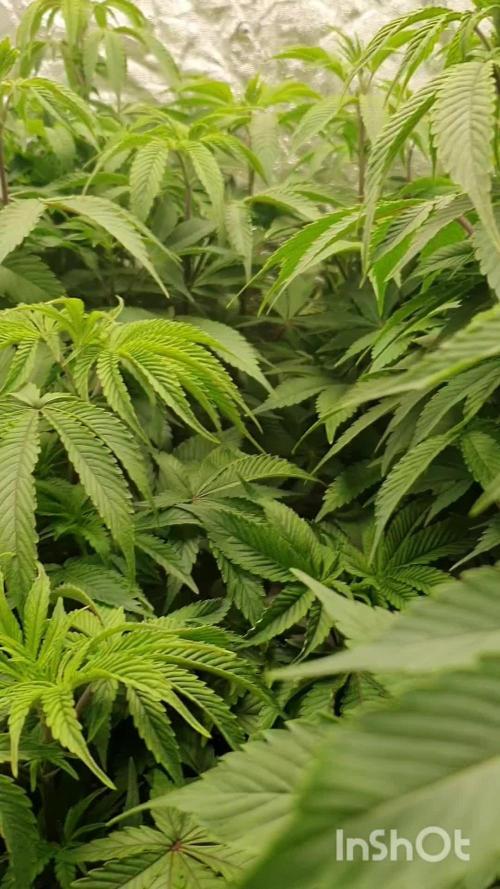
Hello everyone, Well the greenhouse is packed.and hard to move around in so I did a little video... See you guys next week.... 🤘🤘🤙🤙👍👍