The Grow Awards 2026 🏆
Likes
Comments
Share
@Robom069
Follow
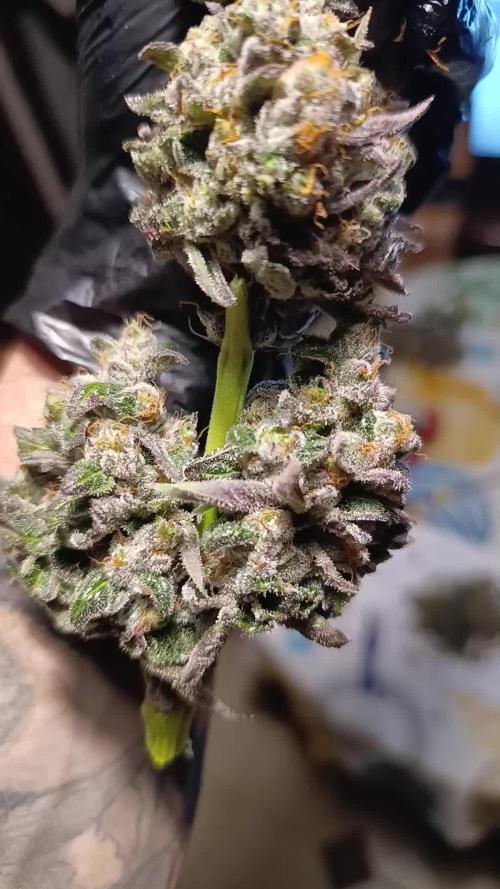
very big buds not so dense but still very good i guess left side acid dough right side black domina
Likes
18
Share
So I had some internet issues so I couldn't upload. But now everything is alright. This last week I only gave her water 2 times. first time I gave her 500 ml water and the second time only 250 ml water only. And I took more fan leafs off her as you can see I only had to hang her up without trimming or anything. After she is dried I am going to weigh her and see how much I got. ***************************************************************************************************** As for grow report : Blue kush is really easy to grow just make sure the temps optimal. The buds grow really dense thats 1 of the parts I like about this strain. She takes normal feeding. Very strong genetics. And she can take a few mistakes so this strain is perfect for beginners and in medium or expert hands she can get really nice with the colors and smell and taste. Next week i will post the weight and the dried product.
Likes
21
Share
@OGTrauma
Follow
Ill write from pc but as im trying to add a new nutrient i need to see if bulk ups without od The update, and some source of knowledge - sadly the product is not registered . https://www.growbaratochile.cl/thc-fertilizantes/sales-de-epson.html https://www.royalqueenseeds.com/blog-epsom-salts-a-natural-hack-to-grow-healthy-cannabis-plants-n837 Thus: big gas leaks homies have nice halloween, the reason i'd flooded with photo this week was i needed to record any negative reaction caused by the incorporation of epson salts on the watering as i understand this shit also adds sulphur and be spreaded on soil for slow release, fixing too light or weakened soils , something i can't do with cal mag from bac, but that product has other sceneario where i can both water or spray on veg until early flowering so i wanted to try it but i didn't know the ratio, and the purposed spoon i used it on 1.5lt of water on 9 x 11lt Killer Kush that were soft to mild on specific carencies , additionaly, of using a very demanding food schema by boosters can accentuate the lack of specific nutrients like Calcium and Magnesium , so this add thick kick of Mg prevention as it pretty neat it's understanding, except on instructing the dosage and application. I did some barrier as is the last week i can do foliar spray as these bastards but furthermore is really a red flag as u can create the conditions for contract some fungi. By a lot of having still figuring out the perfection of both illumination & thermals , still trying to enhance the light spectrum , and doing the first interaction with uv exposition to check that plants dont stress or physically burn, as i want to do the uv shit for late flowering as i expect by genetics this shit SHOULD BE A QUICK FLOWERING so, im entering to late flowering and do it for entire 4 weeks and then consider if plants show that are ripe enough, considering there is a quick underdeveloped automatic at bottom on a 12/12 scenario, and thus that motherfucker will not be forgiven by it unstability of this batch. 👻 Also i noticed i had slight fox-tailing that was quite provoked by messed up outside weather, so i still may need to ellaborate on lights to prevent excess of generated heat as well, as can incur in some penalty . I have a faint idea how to deal with as HEAT HERE WILL BE HELL.
Likes
27
Share
Week 4 begins for Mandarin dreams 1&2, 4 weeks to go! Both ladies are looking good but MD1 is showing purple discoloration in some of her leaves. MD2 is the runt of the two, but still looks great. Thanks for stopping by 👽🌳💚
Likes
13
Share
Recette du tco pour 20 litres. (Grammes : gr) 50gr biochar 250gr zéolite 3gr granulé Micro-Organisme IT45 10gr pollen d’abeilles 10gr levure de bière 3gr endomychorize 10gr consoude 20gr vers de farine 10gr cendre coque de ricin 12gr ortie microniser 15gr Kelp 10gr spiruline 10gr de cbd living soil 20ml de miel liquide 30ml de mélasse 20ml d’acide humiques et fluvic Mettre tous les ingrédients (sauf la mélasse ,l’acide h/f et le miel) dans un filtre 400micron, le placer dans un seau avec de l’eau (10litres). Rajoutez le miel et 10ml de mélasse Y mettre un micro bulleur alimenter sur une pompe à air et faire oxygéné le mélange pendant 24h. Rajout de 10ml de mélasse après 12h le début de la mise en route de la pompe. A la fin des 24h rajoutez le restant de mélasse et d’acide h/f, mettez y en plus 10litres d’eau au mélange. Reste plus qu’à arroser! j’y ai incorporé 7litre de mélange La veille j’ai préparé le pot à l’arrosage avec 500ml d’eau et 2gr de Bacillus IT35 Amyloliquefaciens X5 Bacillus Amyloliquefaciens : rhyzosphère, probiotiques. Aspersion et arrosage. Utilisable pour toutes cultures. La bactérie Bacillus Amyloliquefaciens se fixe dans la rhizosphère en se nourrissant des exsudats racinaires. En contrepartie, elle stimule la croissance racinaire en sécrétant des métabolites de croissance et solubilise le phosphore en sécrétant des phytases (enzymes). Effet probiotique consistant en l’utilisation de micro-organismes bénéfiques pour la nutrition et la santé des plantes. La spiruline, le plus riche et le plus complet des amendements organiques La Spiruline est une algue aquatique connue comme complément alimentaire, la Spiruline est aussi un amendement organique et écologique très complet. D'une grande qualité nutritive, elle apporte à vos plantes une quantité de nutriments, dont l'azote, phosphore, potassium, minéraux, acides aminés, vitamines, chlorophylle et protéine. Le charbon végétal actif est capable d’absorber jusqu’à cinq fois son poids propre en eau ainsi que les éléments nutritifs qui s’y trouvent. Il joue ainsi le rôle de catalyseur et d'amplificateur pour les fertilisants traditionnels, qu'ils soient d'origine organique ou minérale. Ce pourquoi il est idéal pour activer un sol et pour les thés de compost oxygénés. Le charbon végétal améliore la diffusion et la disponibilité des éléments nutritifs dans le sol et offre des conditions propices au développement des micro-organismes. Le Biochar peut être introduit dans une grande variété de sols. Il est particulièrement efficace dans les sols pauvres, difficiles et acides. Pour faire agir rapidement et efficacement sa capacité d’amendement, le charbon végétal est enrichi et biologiquement activé avec des micro-organismes. Le Biochar se comporte ainsi comme un structurateur et un activateur dans le but de valoriser les sols. Composition : • Charbon végétal actif 31%
• Matière organique 33%
• Matière sèche 75%
• C/N : 17
• PH : 7,2
• Azote (N) : 2,1 % dont 1,2 % azote organique
• Phosphore (P205) : 0,74%
• Potassium (K20) : 1,18%
• Calcium (Ca) : 6,8%
• Magnésium (MgO) : 0,65% Le pollen est l'ingrédient de base de la fabrication du miel par les abeilles. Riche en vitamines et minéraux, il est qualifié « d'aliment parfait », y compris pour les plantes ! Les zéolithes sont des roches cristallines, présentant des capacités d'adsorption particulièrement importantes vis à vis des polluants que l'on rencontre dans l'eau et dans certains liquides, ainsi que dans l'air et les gaz. Elles sont extrêmement poreuses comme les charbons activés et elles peuvent être chargées électriquement pour opérer comme des échangeurs d'ions. La zéolithe est un produit naturel qui respecte notre environnement. Utilisé dans le milieu industriel depuis de longues années déjà, ce minerai aux propriétés filtrantes particulières commence à se vulgariser dans le domaine de la piscine privée, de l'aquariophilie, des bassins d'agrément, de la récupération des eaux de pluie, ou encore de la culture des bonsaïs et autres plantations diverses par exemple... 4 points techniques majeurs : - Grâce à leur propriété hydrophile, les zéolithes peuvent adsorber l'eau jusqu'à 30% de leur poids total et sans aucune variation de volume : pas de gonflement en présence d'eau ni de craquement en cas de déshydratation comme certaines argiles. Les zéolithes sont d'ailleurs de puissants agents anti-mottant (anti-agglomérant). Cette propriété est très appréciée dans le cas des terrains de golf et autres aires de jeux. - Les zéolithes ne captent pas l'eau de façon irréversible, elles se comportent comme une réserve au voisinage des racines. Celles-ci peuvent capter l'eau en fonction de leur besoin. Les zéolithes permettent ainsi de réduire les besoins d'arrosage jusqu'à 35 %. - Une zéolithe se comporte comme une "Zone de Stockage" qui retient l'azote et les éléments minéraux nutritifs au voisinage des racines et les relâche lentement en fonction des besoins de la plante. Cela se traduit par une croissance harmonieuse mais rapide du végétal. - La capacité d'adsorption et l'énorme rapport surface/volume des zéolithes, vont permettre à la fois la rétention de la solution du sol et une bonne oxygénation au voisinage du système racinaire. Les zéolithes favorisent donc l'organisation biologique des sols en contribuant au développement de la micropopulation. L'apport en nutriments (N, P, K) est réduit de 20 à 25 %. Ces derniers, adsorbés par la zéolithe, sont beaucoup moins sensibles au lessivage et à l'évaporation. Composition minéralogique : * Chabasite 70 % * Phillipsite 2 % * Feldspath 5 % * Augite 3 % * Illite - Mica 2% Analyse atomique: * Sio2 52 % * AL2o3 17 % * CaO 5,7 % * K2O 6,1 % * MgO 2 %, * Na2O 0,6 % * Fe2O3 3,6 % Amendement calcaire, dolomie et gypse avec préparation microbienne à base de Bacillus Amyloliquefaciens IT45 et Saccharomyces cerevisiae LYCC6420 Formulation : micro granulés (1 – 1,6 mm) à base de rhizobactéries favorisant la croissance des plantes qui se multiplient et colonisent rapidement la zone des racines, et de levures Saccharomyces cerevisiae souche LYCC ayant un effet probiotique. Les PGPR produisent des enzymes qui solubilisent le phosphore à partir de complexes inorganiques et organiques dans le sol et stimulent la croissance des racines efficaces augmentant ainsi la zone d'interception des éléments nutritifs. Les levures LYCC permettent une occupation de la rhizosphère par une flore bénéfique. Composition :
• Matière sèche : 96,8%
• Matière organique : 91,5%
• N total : 6,6% dont N soluble dans l'eau 0,17%
• P total : 2%
• K total : 1,7% Micro-granulés : 
• Oxyde de calcium (CaO) total : 30%
• Oxyde de magnesium (MgO) total : 7%
• Anhydride sulfurique (SO3) : 13% La levure de bière est une matière vivante qui permet un meilleur fermentation pour les thés de compost oxygénés notamment conseillé pour accompagner les croissances ou apporter un gros coup de pousse pendant la floraisons. La levure stimule la vie des sols également à l'arrosage direct en apportant tout aussi bien que dans le TCO sa population l'espèce micro-bactérienne positive pour votre sols ainsi que des oligo-éléments et diverse vitamines. Composition : • 2,8% (N) total dont 1% (Norg), • 2,3% (P205) • 1,6% (K20) • 35% de MO • C/N : 8. PH : 8,4. Sous forme de poudre mouillable. Il contient des spores du champignon mycorhizien Rhizophagus Irregularis MUCL57891 avec des levures inactivées spécifiques. 2000 spores/gramme d’endomycorhize Rhizophagus Irregularis MUCL57891 et Saccharomyces Cerevisiae LYC6420 inactivée. Se connecte efficacement au système racinaire et forme un vaste réseau souterrain de filaments, qui agissent comme des extensions pour atteindre les nutriments et l’eau au-delà de la rhizosphère Composition : • Poudre contenant 2000 spores/g. d’endomycorhizes Rhizophagus irregularis La Consoude (Symphytum Officinale) est une plante présentant de nombreuses propriétés. Particulièrement riche en Potassium (K) organique, la consoude est une alliée idéale pour les périodes de floraison. La consoude a tout pour plaire : riche en vitamine B12, elle agira également comme stimulateur racinaire, mais aussi comme biostimulant cellulaire, grâce aux alcaloïdes, aux allantoïnes et jusqu'à 30% de protéine ! 100% déjection de vers de ténébrions.
Très riche en microorganismes, le guano de vers de farine est une matière directement composté par les vers. En effet, c'est bien la digestion de matières végétales par des larves, insectes ou autres arthropodes qui valident le processus de compostage, que ce soit en zone de production de cultures d'insectes, pour le compost maison ou la dégradation de litière forestière. Les bactéries et autres champignons obtenus grâce au système digestif de nos vers, permettent la dégradation accélérée des éléments nutritifs dans vos supersoils, et les symbioses permettant l'assimilation des éléments nutritifs. Cette bio-activation intense mettra dans vos sols, à la disposition de vos plantes, un panel tellement varié de nutriments frais qu'il nous est aujourd'hui technologiquement impossible de pouvoir tous les nommer et de les compter. Le guano de vers de farine fournit une grande polyvalence. Très équilibré, il s'utilise en entretien ou en apport ciblé seul ou en complément de d'autres amendements ou fertilisants organiques. Il agit comme un puissant activateur de sol et/ou de substrat. Cendre coque de ricin NPK 0,1-18,6-16,5. 0,1% (N-Azote), 18,6% (P205-Phosphore), 16,5% (K2O-Potasse), 11,7%(Ca0), 9,1 (Mg0) - Origine : Inde ACTION SOL • rend rapidement accessible au sol Phosphore, Potasse, Magnésium et Calcium. ACTION PLANTE • Apport aux stades agronomiques propices. • Produit riche en éléments fertilisants : combinaison NPK 35%. • Régularité de l’apport, milieu et fin de floraison. . Favorise la sénescence. Analyse chimique : • NPK 0,1-18,6-16,5 • N-Azote 0.1% • P205-Phosphore 18,6% • K2O-Potasse 16,5% • CaO-Calcium 11,7% • MgO-Magnésium 9,1% Ortie bio micronisée Stimule la vie du sol et la végétation. Composition : • 2,8% (N) total dont 1% (Norg), • 2,3% (P205) • 1,6% (K20) • 35% de MO • C/N : 8. PH : 8,4 KELP poudre
ascophyllum nodosum
- amendement sol Croissance et floraison - Meilleure germination - Meilleur développement racinaire Meilleure assimilation - Résistance aux stress osmotiques - Augmente la production de chlorophylle = plantes plus vertes = lumière mieux captée - Lutte contre le stress osmotique - Développement des Micro-Organismes dans le sol – Riche en vitamines, fer, iode, oligo-éléments, hormones de croissance auxines et cytokinines - Idéal en épandage et pour les thés de compost oxygénés. Important : notre Kelp est un goémon noir mais il n'est pas le varech bien moins fertile de la même famille qui est l'algue qui pullule et pollue la Bretagne, notre algue pousse uniquement à plus de 50 mètres de fond dans les grands courants froids au large de la Norvège.
Likes
4
Share
@ramofre98
Follow
Amazing week, very satisfied, thank u wedding glue
Likes
29
Share
@Rangaku
Follow
Good week of fattening up and the last week of feeding done she’s getting a flush for the next week and cropping on Boxing Day . An absolute dream to grow , she’s handled temps well above 35c not one drama the entire grow . I’ve been smoking this flat out the last week and it’s a top smoke , full berry taste and an almighty stone that last for ages , best thing is there’s about a pound of it to smoke . Merry Christmas to me
Likes
6
Share
12 day dry @ 58-63RH & 60-66F in blacked out dry tent | Glass Jar Cure with Inert gas Early taste test and I actually love this bud, is the best in house strain I've grown so far & the second Platinum cross. Flavorful Funky Sweet Orange cream cereal terps, the texture of the bud is buttery smooth, fluffy and pink/orange color when ground up. Bud has deeply potent effects that is IMO the perfect amount of heavy on the body but still euphoric and creative.. it makes you calm and happy! is checking off so many boxes not even cured, just smelling this batch makes a true connoisseur grin and bag appeal is insane
Likes
21
Share
Likes
14
Share
Erntetag für meine Lemon Orange an BT60. Mega frosty Blüten. Mehr nach dem Ernten. Update: Die Ernte ging sehr schnell, da sie nicht viele Verzweigungen gebildet hat. Erntemenge ist jetzt nicht im XXL Bereich, aber immer noch XL.
Likes
11
Share
The plants are now in full stretch and I have done some defoliation and LST in the last week. 2 plants came out to give the others enough space. I saw that I had significantly too much nitrogen in my plants. You couldn't really see it under the LED light. The next few times i give them pure water.
Likes
Comments
Share
This was week 4 of flower, she smells nice! I use living soil so there isnt much to do. I just observe make sure all is going well.
Likes
11
Share
🌱🌱🌱Continuamos este cultivo, con esta hermosa cepa de FastBuds, Girl Scout Cookies Auto, de lleno en el periodo de Floración .🌱🌱🌱 👨‍🍳👨‍🌾🏻 Nutrición y Bitácora 👨‍🌾🏻👨‍🍳 -Día 29. Sigue creciendo vertical. -Día 30. Se riega con una solución nutritiva NPK de 1.5 Litro con Plagron Power Roots (3.75 ml), Plagron Pure Zym (1.5 ml), Plagron Alga Bloom (3 ml) y Plagron Sugar Royal (0.75). -Día 31. Se riega con una solución nutritiva NPK de 1.5 Litro con Plagron Power Roots (3.75 ml), Plagron Pure Zym (1.5 ml), Plagron Alga Bloom (3 ml) y Plagron Sugar Royal (0.75). -Día 32. Se riega con agua 700 ml de agua declorada, y se realiza una leve defoliación para mejorar la penetracion luminica y despejar brotes tapados por hojas grandes hacia el interior de la planta. -Día 33. Se riega con una solución nutritiva NPK de 3 Litros con Plagron Power Roots (7.5 ml), Plagron Pure Zym (3 ml), Plagron Alga Bloom (6 ml) y Plagron Sugar Royal (1.5 ml) + la adición de Trichodermas (1.5 ml). -Día 34. Responde bien al riego con 3 litros del día 33, ya casi seca el sustrato y sigue creciendo y formando mas flores🌺💪. -Día 35. Se riega con una solución nutritiva NPK de 3 Litros con Plagron Power Roots (7.5 ml), Plagron Pure Zym (3 ml), Plagron Alga Bloom (6 ml) y Plagron Sugar Royal (1.5 ml). 🚀Equipamiento🚀 Indoor de 60x60x159 cm y una iluminación BlackCob F320, se activa solo 1 modulo (160w) a 45 cm del canopy por el resto del cultivo. Intractor de 135mm, extractor de 135mm, filtro de carbón, ventilador "oscilofan", ventilador "clip fan", este ultimo ventilador se ajusta en la parte baja de la carpa para mejorar la circulación de aire bajo el canopy, 2 termohigrometros y una malla SCROG de kanovi a 15 cm de la maceta. Acompáñenme para ver los resultados de este hermoso desafío, un saludo cultivadores 🔥🔥🔥
Processing
Likes
3
Share
@Cultiv8or
Follow
I think there’s been some sort of salt build up / nutrient lock. The lower leaves have been turning a lighter green and some even yellow on SL plants. Most stems are red. Seems like it’s a pH problem. I flushed them with 4-5 litres of water to reduce the nutrient concentration in the roots. Going to introduce molasses in next feeding! Organic Unsulphered And also stop the Micro (nitrogen)
Likes
59
Share
@Neo09
Follow
🌌🛸 hey hou, just putting in all pics from begging till now, cos im really low with the time,.. behind this project is biggest story of my life, not only grow story, its much more behind.. i wish nobody to get such a grow in way as i do,. actually is nothing possitive there and this project i started, cos i lost everthing what in life importnt is. with this project, once, i wanted to give back just a litle bit of that what i got,.. and it still not eneough,. some things you cant buy, you cant pay,.. and you can get back... peace and stay hard, thing about what you decide, think about twice..
Likes
39
Share
@J_diaz420
Follow
Se hace defoliación extrema 5 días antes del corte para intentar hacer madurar la planta de forma mas pareja.✌️👨‍🌾🏻
Likes
7
Share
She reeks ooh my God if you haven't grown this strain you gotta she smells horrible rotten fruit jet fuel sweet she looks wonderfull All she is getting is water from here on out Gallons on gallons start the Flushing 11/26/23
Likes
10
Share
Week 9 of flower, the buds are still showing white hairs and 50/50 clear/cloudy trichomes. Buds getting too heavy to hold themselves up! Tried out using a single scrog, I would definitely use two nets going forward.
Likes
78
Share
@Hou_Stone
Follow
I continue to do a little defoliation on my 4 Banana Krumble They grow well with strong secondary branches but a little less height than the other varieties present in my culture This week with supports I start trying to balance the height of all my plants so that they are approximately the same distance from the lamp ------------------------------------------------------------ 💧Watering On average I water each pot with: Day 36 : 0.75 Liters Day 40 : 0.75 L I use tap water, adjust the ph to around 6 and water 💧Spraying I mix a little black soap and neem oil in 1L of water and spray everything in the tent just before my lights go out, keeping any electrical appliances away while I spray. I try to soak all the plants. and I repeat this 2 times this week and the next before the buds appear. I do this to keep pests away and reduce the risk of mold. ------------------------------------------------------------ 🔥❄️Temperature of the week : Day : 19-23°C (Humidity : 60-75%) Night : 16-18°C Outside the tent it is around 17°C with 70% humidity ------------------------------------------------------------ 🚀Equipment of the week ⭐️ : It's starting to smell a little too green in my house, I'm adding my carbon filter this week Light FC3000 Mars hydro. power 95% at 45cm Extractor 6 inch Mars Hydro + carbon filter . power 3/10. ON 24/24h 1 oscillating fan, on 45 minutes / off 15 minutes in loop (I reduce its use at night) ------------------------------------------------------------ 📜Links : 🌱Banana Krumble seeds : https://shop.greenhouseseeds.nl/feminised-cannabis-seeds/usa-genetics/banana-krumble/ Mars Hydro : 5% off with my discount code "houstone5" 💪 https://www.mars-hydro.com/?acc=hou-stone 👨‍🚀My Instagram : https://www.instagram.com/hou_stone420/ ------------------------------------------------------------ ☮️Thanks for your visit 💚🤸‍♂️
Likes
7
Share
@Lonnert
Follow
Start of week 8. reduced nutrients to only Part A. targeting 60 ppm of N only to start the fading process. 7-10 Days till the finish line
Likes
12
Share
This week was a busy one in the gardens! After a 7 day dry my harvest from last week was ready to come down! It did dry out a little quicker than I'd like, but still went in the jar around 57% and still smells really terpy and not like hay. I kept the humidity around 50-60% in the dry room however I didn't supplement humidity with a humidifier, i do have an ACI humidifier, but I didn't wanna run it in the summer and accidentally mold the crop! I just ran my dehumidifier at that setting so maybe it got a little dry in there! I trimmed all 5 plants in one day to prevent over drying in about 13 hours. I used a trim bin, trim brush by canna brush and a normal pair of springed shears. I'm curing in Mason jars now. I was able to move the plants in the tiny Mars Hydro Clone tent to my flowering tent. My Vivosun 4x8x6, under my HLG Blackbird at setting 1 to get adjusted. This week I'll get my par meter back from my grow bro and get a good reading. Im going to be transplanting these plants to their final containers as soon as I hit the local grow shop and grab a little more soil! After that I'll adjust the par for full veg and let them really rage! It feels good to finally get some space for them. My larger tent is way better equipped ventilation wise as well, I have 4 clip fans and my 8 inch exhaust fan in there. I currently have the tent sitting at 74-71°F and 56% Humidity. Ethos: Lilac Diesel #22 (x) Grandpa's Cookies #7- This Seedling has a decent internode spacing between it's branches and is keeping them mostly even with very little low stress training. I have been bending the top most branches to help the plant get a little bushier! It's leaves are very dark and doing a little clawing so I'm holding off on the Trinity by Roots Organic! It doesn't appear to bad! It's main stalk is very thick and reminds me of Raspberry Ripple #1! When it's in veg! I'm excited to see if this plant is one I'll keep around or not! I'm definitely hoping it's stretch in flower is containable in my shorter space! Raspberry Ripple Clones (#1 and #2)- The Number One Phenos are looking beefy already, one plant is starting to yellow just a little bit and looks like it could use a transplant here soon! Other than that these ladies are raging as usual. The higher ppfd has kept them really bushy and symmetrical. The Number 2s are still looking really healthy but are the smallest plants in the garden as usual! Finished Flowers (Raspberry Ripple #1 and #2)- This harvest definitely hits a lot harder than my last one! Having the microscope to really get a good look at my trichomes and pushing the plants and extra two weeks really made a big difference! Ripple #1- These buds are big and purple! Decently frosted! The leathery, black licorice smell Ripple #1 gives off, is really strong this round! The harvest weighed 7oz 25 grams, 6 oz and 16 grams of "A" Nugs, and 1 oz 9 grams of popcorn buds! Ripple #2- The Ripple #2 is a little less dense than the #1 but it is pretty frosty and smells like a mixture of yogurt and hazy weed. This harvest weighed 5 oz 20 g, 4 oz and 6 grams of decent sized nugs and 1 oz 13 grams of popcorn nugs. Giving me a total harvest of 13 oz and 17 grams, 10 oz and 20 grams of "A" nugs and 2 oz and 23 grams of popcorn nugs. In a 4 x 4. That pretty much sums up the harvest and this week! Thank you for checking out my growdiary! -Starfish