Likes
Comments
Share


@Earthsower
Follow
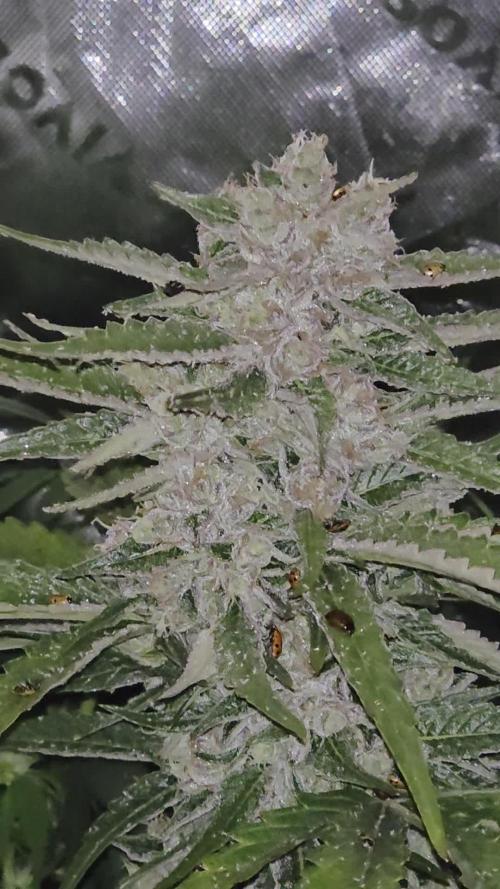
She received 100ml of made solutions of an E.C of 1.7 before I repotted her she has received no water. She is about 10 cm with long internode spacing. Another set of five fingered leaves coming through the peak. Maturity is on the horizon. The next feed signs of wilting!


Likes
4
Share


@Skuuuunk
Follow
Germinated 10/06
Defoliated pretty heavily a few days before the pictures. Have lights cranked up to 8 now. Turned down chiller 2 degrees and humidity down 5%. Changed feeding ratios to 1-1-1 for “Flora Trio”.
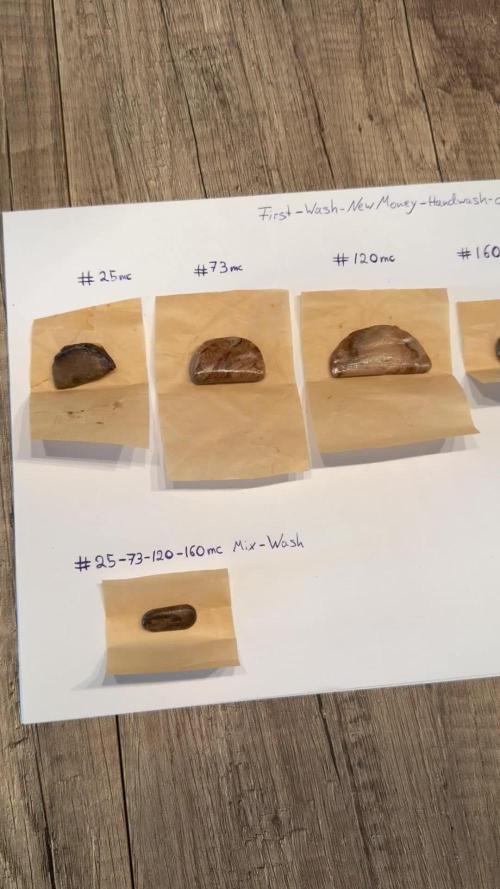
Quit using Flora Micro and switched to my own blend (see photo). Now using 3 different solutions, Miller Microplex, Calcium / Potassium Nitrate, Ammonium Sulfate. Still same target ppm as FloraMicro, just can’t mix sulfates with Calcium Nitrate so I dose Ammonium Sulfate into my res first and then wait 15 minutes.

Likes
22
Share


@Gram_Solo
Follow
HARVEST TIME!!! 👨🌾✂️
ALL 5 Banana purple have been chopped trimmed and now curing in grove bags! Drying took around 11 days so perfect. Dry Tent was around 19 - 21 degrees 60% humidity
🍌🍇🥊🔥🔥🔥🔥🔥
Dry Weight
Mainline banana purple - 47.82 gram
Thai stick looking one bpp - 54.03 gram
BIG MOMMA Purple - 49.96 gram
7gallon banana Purple - 50.55gram
Tall Banana purple - 61.05gram ( we have a winner 🏆 )
So happy with results.
If I hadn't done any mainlining or anything we might have pushed 60gram+ from them all.
I probably won't be doing the main line technique on banana purple again and will just let them go mad as it looks like a 7-10 gram difference in untrained and trained plants. Think I stressed them Bit too much on a couple of them maybe light or nutrients
Didn't know about foxtailing until this week when i read about , it hapend on both purples hopefully doesn't effect potency that much.
Got a big bag of trim after using spiderfarmer Bowl trimmer ✂️ will try make butter or something lol
Smell is! Literally blackcurrant fruit juice with a hint of foam sweets 😋 tried some that has cured for 4 weeks omg turns me into a potato instant couch lock straight to sleep 👌 can't wait to grow this again top notch!
See how long it lasts haha
💨💨💨💨

Processing
Likes
55
Share


@hawkeye_diesel66
Follow
She's growing nice and healthy. She recieved a good drink the other day. On day 33 she recieved a good cut and most of the bigger fans and keaves were removed as well as a fre lower nodes. She really didn't seem to be bothered by the cutting.

Likes
11
Share


Likes
5
Share


Likes
104
Share


@SmokingTiki
Follow
4 plants out of 6 are growing quite well, I only need 3 so it's alright. The growth is a bit slower than during my previous Sensi Seeds grow (if interested, see here https://growdiaries.com/diaries/157797-grow-journal-by-smokingtiki/week/869197). In my previous grow I was using a 24h light schedule so that's maybe the reason. The roots continue to reach the bottom of the pots. I increased the light power again.
Plants heights at the end of the week :
-------------------------------------------
Blackberry Cake 1 : 3cm
Blackberry Cake 2 : 6,5cm
Jack Herer 1 : 10cm
Jack Herer 2 : 10cm
Cashew Kush 1 : 12cm
Cashew Kush 2 : 2,5cm


Likes
12
Share

@MindFlowers68
Follow
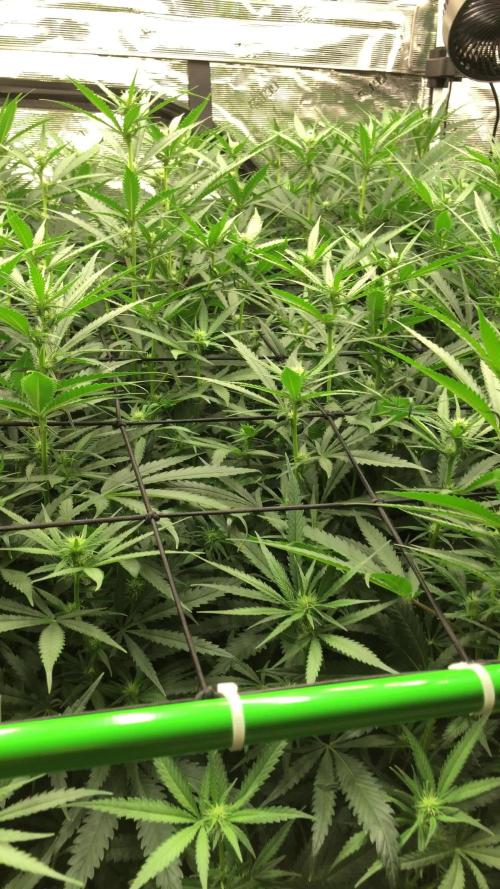
Got a little hot outside this week again and temps in the tents reached a high of 92. They hovered around 85-88 most of the time, and nighttime temps around 75. The plants have been loving the tropical like environments, and in fact showing less signs of stress now they are in warmer temps. I got my magnesium dialed back in with a few applications of Epsom Salt. The pants drank twice as normal this week. I also gave them a feeding with my fermented fruit juice I made and they seem to be loving it. I got a new bottle of cal-mag and does not seem to be as acidic, so i can add a little more than I was without it ruining my ph. It too about 15ml per gallon of the FFJ to Ph my water down form 7.8 to 6.5. I tested it before use and its PH is around 2.5. Between the Epsom salt, FFJ, and kelp. The plants are really starting to bounce back from their slight unhappiness. They are all looking near 100 percent health. At the end of the week they are are raging and praying to the light like theirs no tomorrow. Glowing vibrant lush green, the buds are also already a decent size for only being week 2. The plants and in much need of some defoliation but I will wait one more week after stretch to get that taken care of. The dehumidifier running during night cycle has been keeping things in check. The clones rooted and I potted them up to 1 gallon so I now have small moms. I got new worms and my worm bins cleaned out and set up again. Each of the 65 gallon pots got a small ball of worms added to the top soil to get the worm populations growing in them again. I was hoping those casting I added a few weeks ago with added worm eggs would hatch some but no luck so i just got some from Uncle Jim's worm farm.


Likes
3
Share

@Organic_G
Follow
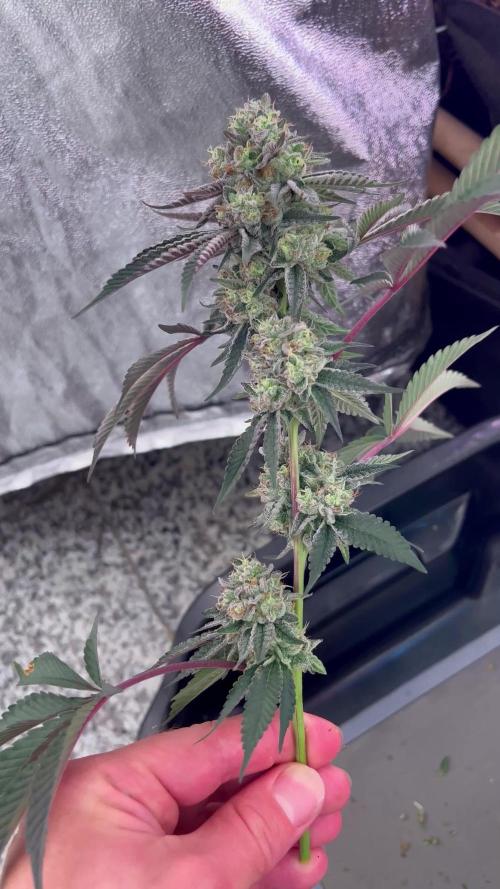
Das obere Drittel wird geerntet, sehen wunderschön aus.
Die Qualität wird von Grow zu Grow immer besser.
Super Juicy, richtig lecker und einfach wunderschön wie aus dem Lehrbuch.
Sind nun am Trocknen danach kommt der Rest ab.

Processing
Likes
10
Share


@TrimQueen
Follow
So, guys.. This is her first month blooming. 4 complete weeks has passed. Here we are for 2 more. Gave Her a super powerful egg shell fert (all powdered - Phosforium Whelthy.)
07/10/20 - We are in the middle of week 5. Thats the way they look like. For me a good number of buds and they are as dense as I thought they would be by this time. I think everything is under control despite some foxtails cuz the heat. Loving the experience.
Likes
4
Share


@PabloTheGrower
Follow
Buds are very resinous, but due to the stretch they are very spaced between each other. Also I'm getting trouble to fatten them up. Seem airy and the tips are drying a litle bit.
Likes
29
Share


@Spliffing_Around
Follow
Now they are a bit bigger , this is the start of week 2 , now day 19 in real time from germination.
I would appreciate any help to maximise the yield.
I feed around 500-600 ppm. How much should the drain be ? I have to plants struggling, one had 500 run off , should I give nutes or flush them more ?
Likes
12
Share


@Darkst
Follow
Looking pretty good so far two weeks left the buds are starting to get heavy the stems are bending
Likes
38
Share


@TastieTom
Follow
Today officially starts week 4 of flower..
-
The best part of my day is waking at 530am to open my tent and get a big whiff of that beautiful aroma. MMMM. Gave the girls a good watering this morning and picked out some dying vegetation from under the canopy to keep things clean. Humidity is still a bit low, but with all the vegetation in there I don't mind. I'd literally cry if I got bud rot or some crap like that.
-
I noticed that the critical kush stems seem kind of of flimsy compared to the other strains. No doubt it smells amazing, but as she puts on more weight it's likely to become a problem. Maybe I should consider silica on the next run.?! Of the 3 kiwi skunk phenos, only one seems to be producing any significant tricombs or smell. The other two look as though they will be good yielders, however, I seriously doubt any real potency.
-
Of the 9 plants I currently have growing, I would expect I'll probably only keep 3, maybe 4. There's no point wasting time on mediocre bud.
-
I think the pheno hunt is the best part of the growing process. Every seed is like having a new child. Sometimes, they grow up to be such beautiful creatures. Other times, you can tell their clock ain't ticking right. You can end up with fat high powered coals or those small, no good popcorn buds. And, at the end of the day, unlike kids and wives, you can throw them away and not feel sorry for ordering new replacements online when you get tired of their BS.
-
-
-
I love that my tent is right next to my desk. It's the best view anyone could ever ask for! 😍
-
Went through today and pulled out a small bit of water leaves to increase airflow from the bottom up to the top, as well as to allow the light to reach deeper in to the canopy. I don't get too crazy with the plucking. Only if its covering another cola or overlapping causing moisture to build up on the leaves. It works well, in my case, to keep the humidity down and limits places for any potential pests to hide while flowering. I usually pull out a handful every other day or so.
-
-
Switched my center light (600w) down to 50% (flower spectrum only) on the 28th. With all of my lights on full spectrum, there's more than enough light for the plants (~1200w eq). I noticed new pistils emerging that shouldn't be and I fear it's causing light stress and/or foxtailing to the critical kush, which is directly in the center of the tent. Since it happened on my last grow with the blue dream and it's not inherently genetic, I'll err on the side of caution this time around.


Likes
7
Share

@The710Garden
Follow
Good yield,good terpprofil on Both phenos Crazy trichome Productions!
I will Look what she will she will do it i dial her in in a next run,theres so much potential in this genetic!

Likes
31
Share


@OutForReal
Follow
Day 134 [19.01]
This weed is smelling like too much 🤔 my garden is surrounded by the smell of it 😱
The buds are hard like rocks and frosty like you want to 💎
Day 138 [23.01]
She is on the list of the plants that have been infested by gnats but she is solo the most resistant.
The last feeding with extra PK seems to have been too strong and the plant started to burn from nutrients excess or ph fluctuation so I've flushed heavily before the harvest.
Harvest F+61

Likes
2
Share


@kissrubb
Follow
Buenas, buenas estamos en la semana 1 de floracion y las plantas comienzan ha estirarse y a mostrar su sexo, hemos aplicado diferentes tecnicas para maximizar la malla de scrog