


Likes
Comments
Share


@Roberts
Follow
Gorilla Jealousy F1 has fill in well over the last week. She got her roots pruned today. Along with some lst, and defoliation. She has been growing really well. I will likely move her into my small tent once the photoperiod in there now is done flowering in 3 weeks roughly. My plants have flowered really well in that tent, and environment. Nothing more to report at the moment. Thank you Spider Farmer, and Seedsman. 🤜🏻🤛🏻🌱🌱🌱
Thank you grow diaries community for the 👇likes👇, follows, comments, and subscriptions on my YouTube channel👇.
❄️🌱🍻 https://www.seedsman.com/?a_aid=Mrsour420. This is my affiliate link to seedsman.
Thank you Happy Growing 🌱🌱🌱
https://youtube.com/channel/UCAhN7yRzWLpcaRHhMIQ7X4g

Likes
9
Share


@Chuckwaggon420
Follow
Dry ice is staring to turn slightly purple might be cause of night temp drops but i havnt dropped them that far yet so will come back to that subject later!! End of week 6 of flower so day 42 flower starting to fatten up everyone is for the winter chop! Just been running molases letting the soil do its job of finishing these girls out. I want to push them as long as they can go hopefully past day 56 into the hugh 60s range. I just do what the plants tell me to do. Smells amazing like a sweet kushy skunky! Way strong smell just barley move a bud and u get smacked with a aroma that is very nice. Stay tuned 💚💚


Likes
34
Share


@CHILLING_RACOONS
Follow
Dear Friends, 👨🌾 👩🌾
we are here to show you our journey with the MIMOSA X ORANGE PUNCH™️ by Barney’s Farm.
Germination started on the 10/11/2022, the root sprout on the 12/11/2022.
✅ VEGETATIVE week #5
📅this week goes from 12/12 to 18/12.📅
💡💡💡Viparspectra XS2000 is working at 50% power.
💉🔍Fertilization schedule:🔍💉
14/12 eposom salts 2g/l foliar and 1g/l irrigation
This new strain is hybrid produced from a cross between Mimosa Evo and Orange Punch.
It is a mostly indica strain, so, short flowering and big and dense buds! It is one of the most colourful editions to their Cali Collection.
This strain will surely be amazing, I can’t wait to smell the tangerine aroma and its sweet smoke.
We are glad to have the opportunity to try this strain from this experienced seed bank, we will do our best to grow this baby as well as possible. THANK YOU Barney’s Farm ❤️❤️❤️
***WE ARE BACK!!!
We are back after a little pause.
We take a break because we were too busy to post high quality diaries. In the last diaries we tried to post as good as possible and we have to publish about 6 or 8 diaries (in addition to these that we will publish shortly). We opened also an educational Instagram page, we growed a lot in a short amount of time BUT, Instagram suspended our account and we lost all our posts, I was so sad and disappointed... a lot of work lost in a night....***
🤓+DATA SHEET+🤓
MIMOSA X ORANGE PUNCH™️ Cannabis Seeds Strain Specifications
Type: Feminised photoperiodic
Genetics: Mimosa Evo x Orange Punch
Effect: Euphoric, Happy, Uplifted
Outdoor Yield (g): up to 1.5 kg per plant
Indoor Yield (g):up to 700 gr/m²
Flowering Time (days): 55 - 60
Indica %: 65% Sativa %: 35%
Taste: Citrusy Candy Orange
💸💸💸💸💸 Buy MIMOSA X ORANGE PUNCH™️: https://www.barneysfarm.com/mimosa-x-orange-punch-552
_______________________________________________________________________
🔧💡OUR SET UP💡🔧
✔️ 💲💲💲VIPARSPECTRA 🚀🚀🚀🌕🌕
ViparSpectra®️ XS2000 240W Infrared Full Spectrum LED Grow Light:
Excellent ratio between wattage and ppfd, excellent light penetraton, perfect light spectrum (it also has IR 🤩) and it has the best build quality on the market. Until now, built quality is really awesome. You can touch that quality. Materials are really strong, excellent driver and the best leds on the market. Heat dissipation is perfect, the lamp is never too hot and it has a passive dissipator so you will have zero noise. It also has IP65 certification. I like that this lamp is bigger than others, so the 240w of power are well distribuited on the space. Viparspectra has an awesome customer service, and shipping was creazy fast!
This awesome brand also offers 3 years warranty.
This lamp has no rivals.
A special thanks to Emily of Viparspectra ❤️❤️❤️❤️
HERE YOU CAN BUY THIS PROFESSIONAL LIGHT: https://www.viparspectra.com/products/xs-series-xs2000 or https://amzn.to/3dyUoJl
and here you can buy other awesome stuff: https://www.viparspectra.com
✔️ 💲💲💲MARSHYDRO 🚀🚀🚀🌕🌕
📦120X120 GROW TENT: an awesome box, easy and fast to assembly. Made by strong materials, solid zips and it is totally lightproof. The position of holes is optimal and the two lateral windows will make easier the work inside the box. There is also a double end, so you are 100% sure that dirt or liquids will not spill out. You can find it here: https://www.mars-hydro.com/grow-tent/buy-mars-hydro-grow-tent-48x48x80-1680d-4-x-4-size-keeps-all-light-in-top-quality-1680d-canvas-is-tear-proof-and-double-stitched-light-blocking-fast-installation-for-sale
💡TS 600 FULL SPECTRUM 100W LED GROW LIGHT : with this light you will achieve excellent buds, you will not need anything more. This lamp replace a 150w HPS lamp, but, with this Led Light you will smoke bigger, harder and tastier buds because Led have a complete spectrum and a powerful light penetration, so your plants will work as much as possible to make you happy. Psssssss it it extremely cheap and it is only 100w, your bills will never be too high, YOU HAVE NO EXCUSES!! Here if you want this little beast: https://www.mars-hydro.com/led-grow-light/mars-ts-series-led-grow-light/mars-tsw-600-led-full-spectrum-hydroponic-led-grow-light
Thank you Eleen of Marshydro❤️❤️❤️❤️
💣Quantum board - 480w - 4x120w Boards by Zhoangshan Koray Opto-Electronic Ltd.
Samsung LM301B 288 led/board 3000K 0dB noise
+24led/board led Osram 660nm
Efficiency 2.6 umol/J 220 lm/w
Driver: Meanwell HLG-480H-36B
💣Quantum board - 240w - 2x120w Boards by Shenzen Yuanhui Led Ltd.
Samsung LM301H 504 led 3500K 0dB noise
+24led/board led Osram 660nm
Efficiency 2.7 umol/J 220 lm/w
Driver: Meanwell HLG-240H-48B
-ESTRACTION FAN:
Blauberg 125 Turbo Pro Series
Maximum air flow: 430-560 m³ / h 50W 32-44 dBA
💊💉💊FEEDINGS:
We are growing in BioBizz Light Mix, it is perfect also for the first weeks.
TOP CROP:
-DEEPER UNDERGROUND: to stimulate roots system
-TOP VEG: for a excellent growth in the vegetative phase
-GREEN EXPLOSION: to promote creation of bud sites and to allow a faster growth
-MICRO VITA: bacterias for equilibrate the soil and to make the plant healty
-BIG ONE: to stimulate bud sites and to stimulate resin production
-TOP BLOOM: to achieve excellent big and hard buds
-TOP CANDY: to feed the buds with molasses for a tastier smoke and to gain weight
-TOP BUD: to enlarge buds and to gain weight
PLAGRON: PK 13-14 to have big and hard buds and to feed plants with lower effort
ADVANCED NUTRIENTS: Sensi Cal-Mag Extra-> for cal mag deficiency
GROTEK: CAL MAG for cal mag deficiency
HESI: PowerZyme to clean and balance the soil. It feeds the plant cleaning the soil.
GHE: - Final Part (ex Ripen) accelerate the final flowering phase, dissolves minerals in excess
- Flash Clean to flush the plant and to be sure that all excesses are out from plant and pot
These two products improve A LOT the smoke of our babies
-PURPINATOR to stimulate flavonoids and to have a better taste and smell.
____________________________________________________________________________________________
🙏❤️ THANK YOU FOR BEING HERE ❤️🙏
Please leave a comment with your opinions, it is very important to us to have a comparison.
If you like our job, tap the weed button and follow us. It will be really appreciated.🙏
We want to thank again everyone that help us in our project. You support us to support our dream. ❤️
SPREAD THE LOVE OF THIS PLANT ALL AROUND THE WORLD
🌿Thank you again🌿
❤️Sweet hugs❤️
👨🌾CHILLING_RACOONS👩🌾

Likes
11
Share


@GorillaZativus
Follow
👑Actualización Jardin 21-22 días . Llenamos pan de raíz en 7 días.
⌛️Videos :
🎥pretransplante 21 días , con preventivo diatomeas espolvoreo.
🎥6 transplantes con su pan de raíz , great white premium@y granular , orca , mycochum , tierra de algas , phoskaya, kodama .
8 Litros : mycochum 3,5 ml , orca 1,5 para activar los microorganismos y riego post transplante en 2 litros .
🎥 22 días despertándose post aplicación de knactive + proactive.
🌱Solución foleo 2 litros :
knactive + proactive (4,0 ml ) y ( 0,8 de proactive ( melazas , quitina , etc ) Y sumamos foleo, antes que se de despertaran .
Ec : 0,5
Ph: 6,2
🌱metimos más amarres al y full lst .

Likes
15
Share

@Bncgrower
Follow
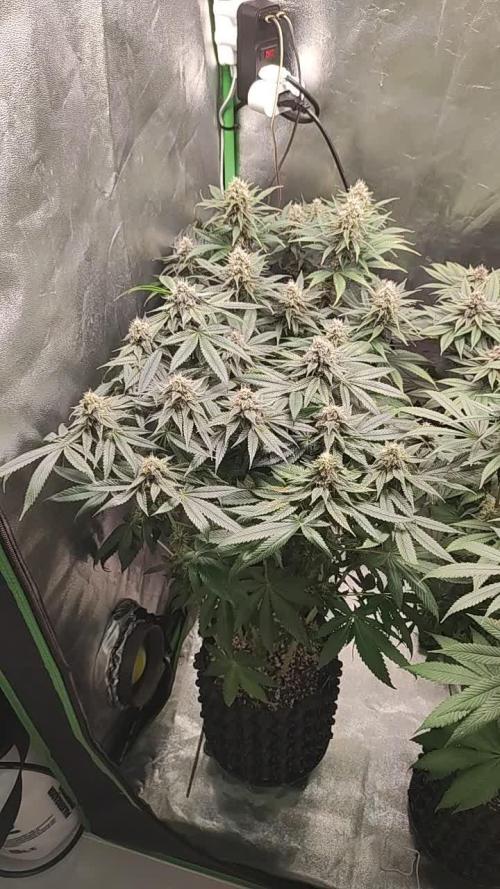
Waiting the process lol.. another week completed and this girl is smelling a very very good and appeary everything is ok.. 🤞💪🌿

Likes
31
Share


@Mr_Motalovah
Follow
Hello Growers and Tokers! 👋 👩🌾 🧑🌾.🔥💨
Sorry for the delay on the weekly updates, had some things I had to attend but I'm back and at it!
21-day defoliation has come..
These pictures were taken on day 20 of flower
Nice progress with these ladies, I honestly did expect them to stretch this much.
They were pretty heavy on leaves so I did a bit of cleaning of big fan leaves and bottom useless growth..
I admit, went a bit too far with one of them. Should've left a few more fan leaves behind.. 😪😓
Other than that, things are looking good. Bud sites are more visible, sure hope they keep growing out.
Stopped adding grow nutrients, only bloom now.
That's it for this week hope you're enjoying this progress like I am.
Have a good one!
One love!

Likes
17
Share


@Elmobud
Follow
So this week I have started to flush the girls as its been 10 weeks now so after another 2 week of flush that's 12 weeks surely they have to be ready but the hairs are still pointing straight out and are still white which is abit weird as this strain is supposed to be a 8 week strain 🤔, Happy Times Happy Growing 😁 🌿
Likes
12
Share


@Staffedition
Follow
Привет друзья.
Моей растихе сегодня 88 дней.
Растение пришло в себя.
20.10 буду переводить на цвет.
Начал применять LST технику на 19 дне и продалжаю применять её через день, а 18 августа добавил ДЕФОЛИЗАЦИЮ
С 20.08 ДЕФОЛИЗАЦИЮ делаю каждые 3,4 дня
С 20.08 LST технику делаю каждые 4.6 дней
На сегодняшний день влажность 54%
5.09.2023 заметил высокий Ph 7.9
С 48 дня Ph не ниже 5.8
На сегодняшний день Ph 6.0
Начал кормить с 60 дня Canna Terra Vega
PPM 450
Погладитель влажности хорошо справляется со своей задачей. Рекомендую
Всем мира и добра!
Не забудь поставить лайк❤️, если понравилась как прошла неделя
И читайте наш TELEGRAM: https://t.me/smail_seeds
#Smail_Seeds 😀#Cali Buds
Likes
24
Share


@AutoCrazy
Follow
Week 6
This Lady is up to 8 tops😎. Now I just have to get each top in the right locations at which point I’ll let them get a few nodes taller and then flip. This Lady is growing a little slower than her roommate (A Mimosa EVO) so I left a few extra fan leaves on her in the hopes that will speed her up a bit. I have noticed that this plant seems to throw the two main branches at a node but it also throws out additional branches. I’ve had a plant do this before and in my experience it makes the buds denser. We will see how it goes with this lady.
Cooler internals are:
6.0 pH
0.4 EC
56 F solution temp.
I can’t wait to flip the tent !!!! 🔥🔥
Onward 😎🍻

Likes
16
Share

@GoldenWeedGrower
Follow
📅 19/05/26
🗓️ D078 (B6 / D1)
🌡️ 1.1
💨 -
💧 -
🥗 -
⚗️ 1.2
🔬 5.8
🛠️ -
📋 -
📅 20/05/26
🗓️ D079 (B6 / D2)
🌡️ 1.4
💨 1300
💧 -
🥗 -
⚗️ 1.2
🔬 5.0
🛠️ Some little adjustment
📋 -
📅 21/05/26
🗓️ D080 (B6 / D3)
🌡️ 1.4
💨 1300
💧 15L
🥗 All nutrients
⚗️ 1.6
🔬 5.0
🛠️ -
📋 -
📅 22/05/26
🗓️ D081 (B6 / D4)
🌡️ 1.2
💨 1500
💧 -
🥗 Bloom A-B
⚗️ 1.9
🔬 4.8
🛠️ LST and defolation
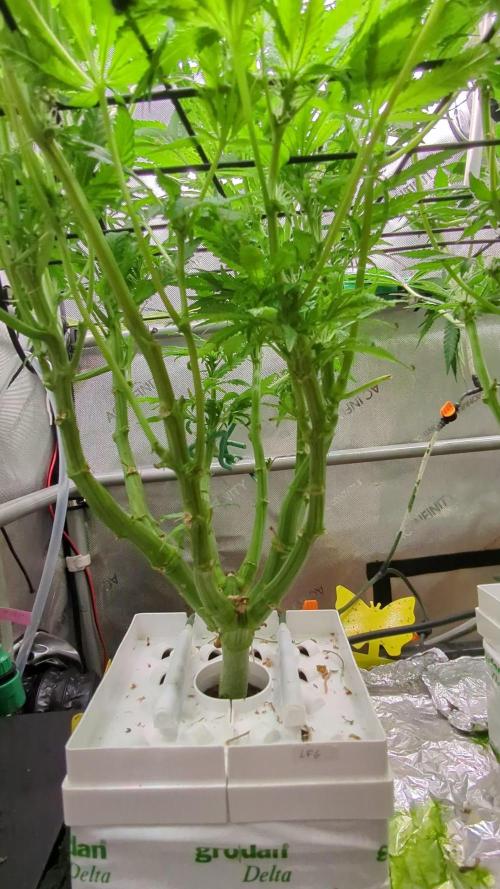
📋 pH is still low but I decided to leave it as is. LFG: I like the way she's growing - Super Boof is performing better than what I thought - Bruce Banner is the queen, there are already first buds formation - Lemon Cherry Gelato I hate he way she's growing so much that I eliminated all her clones, now I've only BB and LFG.
📅 23/05/26
🗓️ D082 (B6 / D5)
🌡️ 1.2
💨 1500
💧 -
🥗 -
⚗️ 1.7
🔬 4.3
🛠️ -
📋 -
📅 24/05/26
🗓️ D083 (B6 / D6)
🌡️ 1.2
💨 1500
💧 -
🥗 -
⚗️ 1.7
🔬 4.6
🛠️ Adding some ice to water to get the temp go down. Also LST and defolation
📋 -
📅 25/05/26
🗓️ D084 (B6 / D7)
🌡️ 1.2
💨 1600
💧 2L
🥗 Calmag, Bloom A-B
⚗️ 1.9
🔬 4.3
🛠️ -
📋 -
=============================================================
Legend:
📅 DATE
🗓️ DAY (StageWeek / Day)
🌡️ VPD
💨 CO2
💧 WATER ADDED
🥗 FOOD ADDED
⚗️ EC
🔬PH (adjustements)
🛠️ ACTIONS
📋 NOTES
📅🗓️🌡️💨💧🥗⚗️🔬🛠️📋

Likes
29
Share


@DaddyPrime
Follow
8/25 put in closet for 48 hrs of darkness before harvest
8/28 actually did almost 3 days of darkness but started trimming and chopping. Getting ready to hang.
Day 1. 8/29: 72°F and 50% humidity. Still wet. Even the small buds
Day 2. 8/30: 70°F and 47% humidity
Day 3. 8/31: 70°F and 52% humidity. Looking more dry than id prefer after 3 days of drying. But the conditions arent exactly ideal.
Day 4. 9/1: 70°F and 49% humidity. Humidity dropped which sucks!
Day 5. 9/2: 75°F and 37 humidity. Temperatures rose and humidity dropped a lot. Buds are super crispy. Im gonna let them go another day.
Day 6. 9/3: time to jar the buds for curing.
Dry weight is 43 grams
Likes
2
Share

@bigsmoke42069
Follow
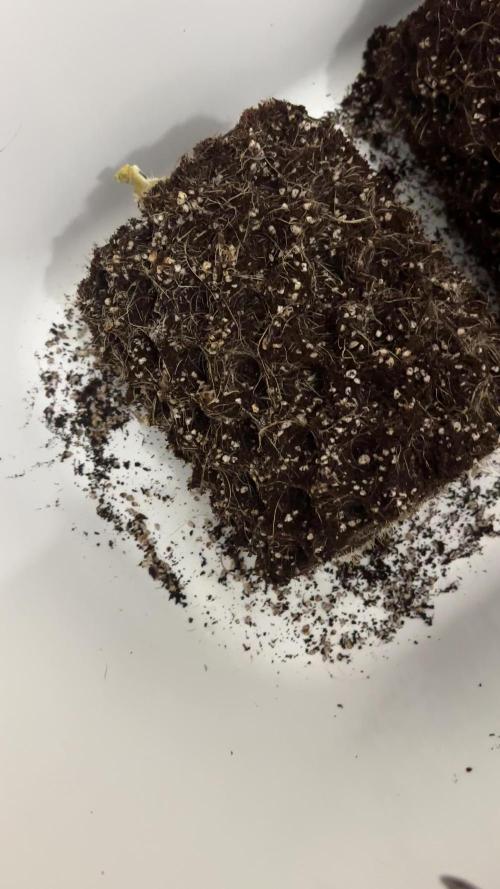
Chop day 6.10.25
Cut at 18pm
10.11.25
RH in tent got a little low to 56%. so I put a humidifier with a controller to keep the RH at 60%
10.14.25
Started to trim
(did not weight the plant at the end.)

Likes
16
Share

@38PLAN
Follow
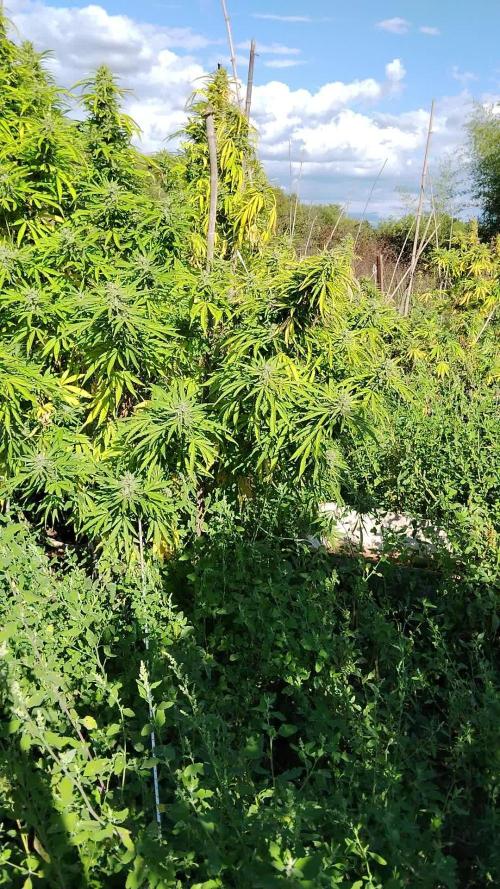
Siamo arrivati praticamente alla fine,pochi giorni ed incomincierò a tagliare,le apicali delle due piante potate si sono seccati,erba suprema,quantità già incontrollabile,perlomeno per i miei mezzi

Likes
165
Share


@Tropicannibis_Todd
Follow
💩Holy Crap Growmies We Are Back💩
So what do you say we have some fun 👈 We got some EXOTIC SEEDS 👉 👻👻👻MONSTERMASH👻👻👻 😛
Well my friends we are just at the 28 day mark and as you can see shes doing great 👈
👉 So now i felt i need to start training her over to maximize her growth by doing some LST 👈 Just noticed she's starting to preflower 😛
Lights being readjusted and chart updated .........👍
👉I used NutriNPK for nutrients for my grows and welcome anyone to give them a try .👈
👉 www.nutrinpk.com 👈
NutriNPK Cal MAG 14-0-14
NutriNPK Grow 28-14-14
NutriNPK Bloom 8-20-30
NutriNPK Bloom Booster 0-52-34
I GOT MULTIPLE DIARIES ON THE GO 😱 please check them out 😎
👉THANKS FOR TAKING THE TIME TO GO OVER MY DIARIES 👈

Likes
10
Share


@Mr_Ewell
Follow
The strain was easy to grow. The autos were topped and suppercropped. Along with lst. Amazing yeild for my first grow. Almost a pound with 300w led. Trichomes were hard to read and took forever to turn. Went for 17 weeks from sprout. Didnt flush as long as a wanted so curing is my focus rn.

Likes
86
Share


@DogDoctorOfficial
Follow
Greetings, fellow growers and cosmic adventurers! As we bid farewell to Week 10, we find ourselves at the culmination of an extraordinary journey with our beloved Apolo F1. Join me as we embark on a retrospective voyage through the highs and lows, the triumphs and challenges, of this cosmic odyssey.
Our journey with Apolo F1 began ten weeks ago, a small seedling filled with potential and promise. From those humble beginnings, she grew and flourished under our watchful gaze, unfurling her leaves and reaching for the stars with each passing day. Through meticulous care and nurturing attention, we witnessed her transformation into a true botanical queen.
Throughout her growth cycle, we employed various techniques to coax the best from our cosmic companion. From LST to topping, we shaped and sculpted her canopy, encouraging lateral growth and maximizing light penetration. As a result, Apolo F1 flourished, her branches reaching skyward in a testament to the power of cultivation and the wonders of nature.
Central to Apolo F1's journey was the nourishment provided by Aptus Holland, our steadfast companion and sponsor. With their nutrient lineup, we crafted a symphony of minerals and organic compounds, tailored to her specific needs at each stage of growth. From seedling to harvest, Aptus Holland's nutrients fueled her cosmic voyage, ensuring robust health and abundant yields.
And now, the moment we've all been waiting for: the harvest. With bated breath and eager hands, we carefully snipped each bud from the canopy, marveling at their dense, resinous beauty. Apolo F1 had exceeded our wildest expectations, her compact stature yielding a bounty of cosmic goodness. As she hangs upside-down, her buds curing in the cool darkness, we reflect on the journey that brought us here—a journey filled with wonder, growth, and boundless possibility.
Before we bid adieu, let us extend heartfelt thanks to Royal Queen Seeds for crafting the genetic marvel that is Apolo F1. Their dedication to excellence has brought joy and inspiration to growers around the world, and we are grateful for their contributions to our green adventures. Likewise, a shoutout to Grow Diaries and the entire community for their unwavering support and camaraderie. Together, we have cultivated a garden of dreams, and the harvest is sweeter for it.
As we gaze upon Apolo F1, our cosmic queen, we are filled with a sense of pride and accomplishment. She is more than just a plant—she is a testament to the power of cultivation, the wonders of nature, and the boundless potential of the human spirit. Until we meet again, may your gardens flourish and your green adventures be ever cosmic.
Genetics -Apolo F1 @rqs_esp @royalqueenseedssp @rqsglobal
Food - @aptusholland @aptus_world @aptus_es @aptus_portugal @aptusbrasil @aptusplanttechaus @aptus_thailand @aptusplanttechnz @aptususa_official
LES @lumatekeu
Controls - @trolmaster.eu @trolmaster.agro @trolmaster.support
As always thank you all for stopping by, for the love and for it all , this journey of mine wold just not be the same without you guys, the love and support is very much appreciated and i fell honored and blessed with you all in my life
With true love comes happiness , Always believe in your self and always do things expecting nothing and with an open heart , be a giver the universe will give back to you in ways you could not even imagine so
#aptus #aptusplanttech #aptusgang #aptusfamily #aptustrueplantscience #inbalancewithnature #trueplantscience #rqs #ApoloMission #MoonHarvestAdventure #playwithlego #lego #legotime #legovideo #tothemoonandback
More info and complete updates from all my adventures can be found Link in the profile description
Friendly reminder all you see here is pure research and for educational purposes only
Growers Love To you All


Likes
6
Share

@Northern_Ent
Follow
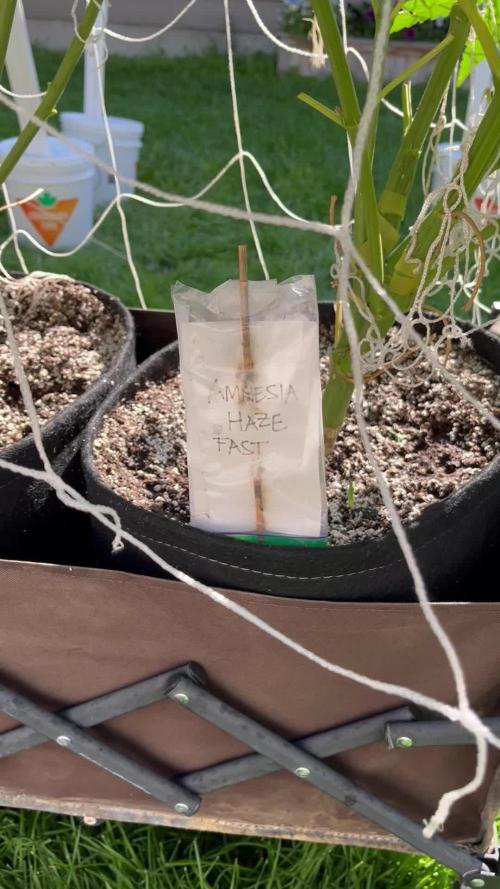
Aug 15: Amnesia Haze Fast is looking good. Late start and heavy hail damage near the end of veg stage has made her smaller but she is healthy and flowering strongly. Plagron nutrients are working great.
Here at 53 N latitude the sunlight, particularly UV light drops quickly starting in mid-August. I have UV lights from AC Infinity that are setup on days with no chance of rain. Easy to do and seems to help a lot.

Likes
8
Share

@Sadhus
Follow
# **Dognabis Cup – Rapport Semaine 9 (Jour 64-70)**
**Grower** : @Sadhusfrgrow
**Strain** : Permanent Marker
**Zone** : FLO (TCS-1)
**Plantes** : 3
**Date** : 15 novembre 2025
---
## **Observations générales**
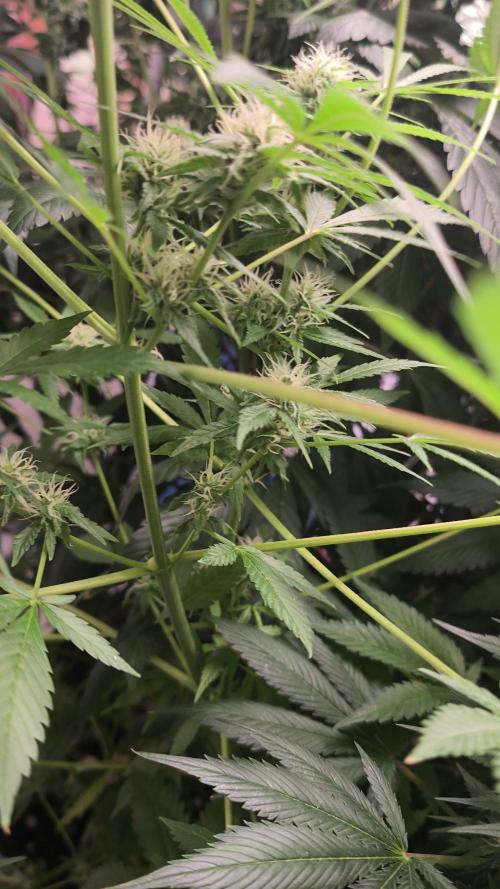
- **Croissance** : 3 plantes, **1 seule a percé légèrement la canopée** (+10-15 cm au-dessus des autres). Les 2 autres restent **très en retard** (retard structurel accumulé depuis la vége).
- **Structure** : Canopée **inégale**, mais **fleur légère et aérée** pour l’instant → bon signe pour éviter le botrytis.
- **Action** : **Ajout de K-Boost** (potassium) pour soutenir la floraison et densifier les buds.
- **Phase** : **Semaine 6 de flo** (début de prise de poids).
---
## **Tableau récapitulatif – Semaine 9 (Jour 64-70)**
| Paramètre | **Jour (Mon Dieu)** | **Nuit** | **Cible** | **Écart** | **Commentaire** |
|---------|---------------------|--------|---------|---------|---------------|
| **Température** | 24.4 °C (avg) Max 26.3 °C Min 21.6 °C | 22.2 °C (avg) Max 23.8 °C Min 20.5 °C | 24 °C / 22 °C | ✅ OK | Stable, légère surchauffe jour (26.3 °C) |
| **Humidité** | 63.2 % (avg) Max 69.3 % Min 51.2 % | 61.1 % (avg) Max 66.6 % Min 52.1 % | 60-65 % | ⚠️ Légère hausse | À surveiller, risque condensation |
| **VPD** | 1.14 kPa (jour) 1.05 kPa (nuit) | | 1.0–1.4 kPa | ✅ Optimal | Excellent pour flo précoce |
| **PPFD (Light)** | 991 µmol/m²/s (avg jour) Max 1064 Min 35 | 1.05 (nuit) | 900–1000 | ✅ OK | Bonne intensité, mais inégale (canopée) |
| **CO2** | — (non mesuré) | | 900 ppm | ❌ Manquant | À activer si possible |
| **Solution (pH / EC / Temp)** | pH 6.08 EC 2.67 mS/cm Temp 16.8 °C | | pH 5.8–6.2 EC 2.4–2.8 | ✅ OK | EC un poil haute → surveiller lockout |
| **Moyenne (substrat)** | Moist 21 % | | 15–25 % | ✅ OK | Substrat bien géré |
---
## **Analyse détaillée**
### ✅ **Points positifs**
- **VPD parfait** (1.1–1.2 kPa) → transpiration optimale, bonne absorption.
- **Fleurs aérées** → faible risque de moisissure pour l’instant.
- **K-Boost ajouté** → bon timing pour densifier les buds (semaine 6 flo).
- **PPFD moyen à 991** → dans la zone cible pour flo.
### ⚠️ **Points à corriger**
- **Canopée très inégale** → 1 plante domine, les 2 autres en retard → **perte de rendement**.
- **Humidité jour 65 %** par moments → risque botrytis si fleurs densifient.
- **EC solution à 2.67 mS/cm** → un peu haute → risque de brûlure des pointes.
- **CO2 non mesuré** → potentiel non exploité.
---
## **Objectifs Semaine 10 (Jour 71-77)**
| Objectif | Action | Cible |
|--------|-------|-------|
| **Égaliser canopée** | LST / tuteurage léger sur la plante dominante | Réduire écart à
