




Likes
15
Share


@Bluemels
Follow
Tag 84: Die Triple G hat die vergangenen heiße Woche sehr gut vertragen. Ihr Geruch wird immer intensiver von Tag zu Tag.
Tag 89: Nachdem die Triple G etwas aus der Form geraten ist habe ich das Netz ein ganzes Stück nach oben geschoben, das war eine klebrige Angelegenheit 😛
Aber es hat sich gelohnt die einzelnen Triebe bekommen jetzt gleichmäßiger Licht.

Likes
37
Share

@PEAKYPLANTERS
Follow
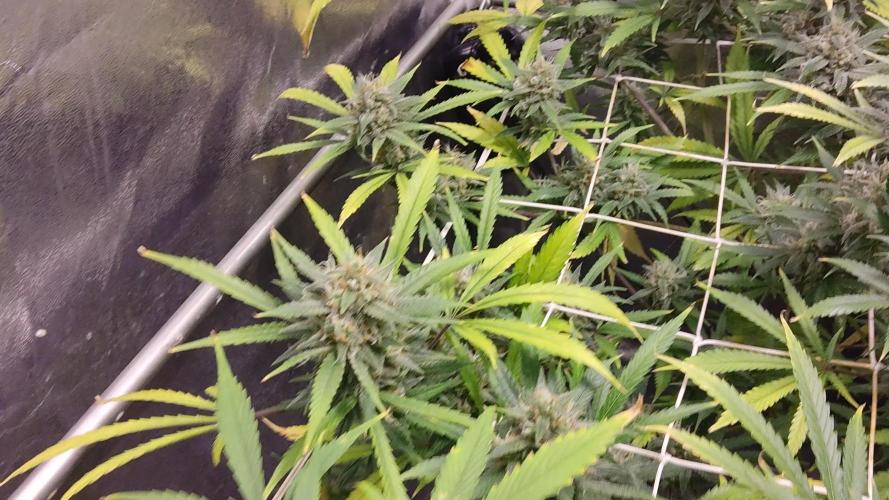
My baby does not pass well enough for an automatic, I would say that I could not ask for more

Likes
201
Share


@MagnoliaFrost
Follow
10/5
Day 28 - LED lamp now on 24h
-
Water: Both plants got 1L of water with nutes.
Summary for the day:
I still do some LST but truing to do less and focusing on spreading the tops. LED in 40cm full effect. Did some defoliation today but not sure if I'm doing right.
-
12/5
Day 30 - LED lamp now on 24h
-
Water: Both plants got 1L of water with nutes increased to 1.5ml because it's been 10 days since I started with giving them 1ml each time they got water.
Now I started to see they drink much more. Last time it was 3 days between watering. This time it was only 1 day since they got 1L water. Maybe increase 1L to 1.5L next time.
Summary for the day:
I still do some LST but truing to do less and focusing on spreading the tops. LED in 40cm full effect. Did some defoliation today as well.
-
14/5
Day 32 - LED lamp now on 24h
-
Water: Nothing
Maybe increase 1L to 1.5L next time.
Summary for the day:
I still do some LST but truing to do less and focusing on spreading the tops. LED in 40cm full effect. Did some defoliation today as well.
-
15/5
Day 33 - LED lamp now on 24h
-
Water: Both plants got 1L of water with 1.5ml nutes x2 (A+B)

Processing
Likes
8
Share


@e4rtht0ne
Follow
The main buds are really starting to develop and it looks pretty healthy. Some rusty spots developing on some of the older fan leaves. Added a pick if anyone knows what it might be? Big fat calyxes starting to appear frosty with trichomes. Defoliated a few leaves, may have over watered trying to fix the cal mag issue and the damaged leaves were a bit wilted. Did one big final adjustment to her shape to open her up. Was concerned about how dense it was getting and light and air penetration with rainy weather coming as it buds out made me want to give her some breathing room.

Likes
16
Share


@Marijuanaisland
Follow
Notei que a g13 HAZE 2 fenos diferentes a mesma alimentação para as duas uma demonstrou sobrealimentação mais todas estão bem

Likes
5
Share


@DaddyPrime2
Follow
5/02/2024
Day 10. Or day 3 of actual veg stage.
5/03/2024 so the story of the two seeds, I really was rooting for the darker shaded one. In actuality, that same night, I noticed that the plant actually looked damaged or burnt almost and over the course of the week, eventually got worse and eventually gave up and flopped over. Once again, this is MY fault that it died. I’ve basically culled down to a single seed/cultivar on accident. Maybe it’s subconscious spiritual intervention for me to find the VERY best 😂
Likes
59
Share


@AsNoriu
Follow
Day 29. All goes well and easy, now i know size of pot, its around 720 ml .
Girl is stretching, but not so bad, was thinking to take off few bottom branches - but i will leave her untrained i think.
In few days i will water her, but generally she drinks almost nothing, compared to girls grown in tents with good air, light and humidity ....
Stem went still nice even without any fan, she is stiff ...
Found my first Liberties, wonderful mushroom trip ;))))
Day 30. She is healthy green and i think if i will need to add anything - it will be potassium in middle of flower, maybe even nothing ...
Girl started to drink faster. Think tomorrow is watering day again ....
Day 31. 70 ml of 6.3 ph water in. Before it sprinkled 1g. of BioSys.
Day 34. 150ml in !!! Had some run off and collected it. Think it will be enough for 3-4 days, girl is drinking a lot recently
;)
Happy Growing !!!!

Likes
4
Share


@pzwags420
Follow
On day 1 week 2 flower the Gals are really stretching now, hope I have enough room 😂They seem to be taking the flower nutes well even without a transition phase 😀. On day 3 the gals have stretched so much they are within 6 in of my light hoping The stretch will slow down soon yikes 😱. I defoliated the lower and upper canopy to bring in more light and air flow. On day 6 the stretch seems to be slowing down. I increased my light intensity from 75% to 100% to see if I can halt anymore stretching. I also bent my highest colas down as they were touching the grow light 😂. On day 7 flower clusters are forming and the stretch has slowed. I will continue to bend over the tallest colas and do my best to manage the canopy without too much loss of yield. It looks like some of my colas might get light stressed/burnt. There is not much else I can do except learn from my mistakes...next time I would flip the plants earlier and give them stronger light intensity before flowering stretch. The top leaves are canoeing so I reduced light intensity back to 75% to see if they improve. I got my first clog in my blumat systems main line... I will be switching to liquid based fertilizers for the next run as I believe my fertilizer caused the clog. I released the clog by using a pipette filled with water. I took the pipette and squeezed liquid through the main line exiting my reservoir. Then the lines were running smooth 😂
Likes
59
Share


@Insaniac_0
Follow
(11/11-11/17)
***All feeds with nutes use either a whole ratio or combination of "Veg Mix" and "Bloom Mix"concentrates DILUTED in water until a total ppm of add-in is reached using a (Total Dissolved Solids) TDS Meter measured in PPM (parts per million). The "Veg Mix" concentrate will eventually be added in smaller ratios and "Bloom Mix" concentrate will eventually replace the "Veg Mix" concentrate entirely. The ppm and ratios of each feed will be listed when I feed. Veg mix recipe is on week 2. Bloom Mix recipe will be noted in this top message of the week that I make it.***
Week 1 Notes & Observations:
Both plants are coming along pretty good. No concerns rolling into week 2, I will be starting nute supplements in the diet this week but plan to add them slowly to the regular routine.
Day 18, WOW what a difference the feed made with Plant 1!? She was a good inch behind plant 2 at the start of the week and today she 'looked' bigger, so I measured, 2 days after the deep nute feed, and now she's an inch taller than plant 2.😮
VPD this week will reduce the humidity in the tent to about 70-75% and temps will be monitored for 75- 78F daytime and 68-70F overnight. Lights should adjusted to provide 300 max, but will try to hold the 280 setting as long as I can this week. Meaning no increase over last week other than growth.
Feed & Monitor:
Day 16 (last feed was day 11)
Tested and Calibrated my ph pens. Starting weight from each pot was 18 lbs and 8 oz, P1 weighed 15lbs 9oz and P2 was 15lbs 15oz before feed. Each plant got 1 gallon of purified water with 75ppm Veg Mix (recipe above and makes 1 gallon at about 3600 to 4000ppm concentrate to dilute each feed, i.e. I only fed 75ppm above the purified water ppm this feed) The ph on this feed was balanced to 5.75ph to combat the higher runoff ph from the last feed. P1 weighed 21lbs even and P2 weighed 21lbs 5oz after feed. I got about 5 cups of runoff on P1 and 6 cups on P2. Top soil tested at: P1 (6.37, 6.37, 6.37, 6.32) avg 6.357 and P2 (6.55, 6.61, 6.52, 6.42) avg 6.525 - Runoff for P1 ph was 6.29 with 1530ppm and P2 was 6.29 with 1580ppm.
Hope everyone enjoys the daily progressions of overhead and side profile (Organized Chaos). I will try to add a video and black back or cover pics by end of week every week.
Likes
12
Share


@Staffedition
Follow
Привет друзья.
Моей растихе сегодня 88 дней.
Растение пришло в себя.
20.10 буду переводить на цвет.
Начал применять LST технику на 19 дне и продалжаю применять её через день, а 18 августа добавил ДЕФОЛИЗАЦИЮ
С 20.08 ДЕФОЛИЗАЦИЮ делаю каждые 3,4 дня
С 20.08 LST технику делаю каждые 4.6 дней
На сегодняшний день влажность 54%
5.09.2023 заметил высокий Ph 7.9
С 48 дня Ph не ниже 5.8
На сегодняшний день Ph 6.0
Начал кормить с 60 дня Canna Terra Vega
PPM 450
Погладитель влажности хорошо справляется со своей задачей. Рекомендую
Всем мира и добра!
Не забудь поставить лайк❤️, если понравилась как прошла неделя
И читайте наш TELEGRAM: https://t.me/smail_seeds
#Smail_Seeds 😀#Cali Buds
Processing
Likes
7
Share


@Kushizlez
Follow
(Days 28-35)
(Day 29) Everything seems to have recovered fine from topping so I transplanted into their 1.7 gallon pots. They were pretty rootbound so this should make them nice and happy. Going to start LST after recovery. Got a ton of holes poked around the rim of the bucket which should make tying down easier.
I’ve been asking around on some forums and reading some articles and I’ve decided to switch out my MH bulb for the included HPS bulb. Apparently HPS bulbs will stretch the nodes out quite a bit more and provide higher PAR value for the same amount of electricity. My plants are looking pretty small for day 29. Although, that could just be from stuffing 15 plants under one 250-400w light.
I’ve been powering the lights up to 400w at night and back down to 250 during the day. 400 just gets it too hot during the day (86-88) without ventilation. That temperature should be fine in veg once my co2 has really built up some mycelium.
(Day 32) Just got 14/15 topped. The BCTG runt is just going to be lst’d and not topped or fimmed. I decided to just fim the plants I started later so they’d have a bit more time to recover and catch up to the others. I also LST’d all 9 quite well. Almost had a stem break but she’s doing just fine now. The deformed bbb was accidentally fimmed and as a result it’s got a very trippy looking main stem that has branched off into 6 mains.
I definitely have fungus gnats. Fuckers must have got in with that coco I bought from hydro store. This has never happened to me with just promix but the benefits of coco are too much to pass up. I might order an OG BioWar/capsbennies/grubgrenade to help naturally get rid of them.
I’m getting some confirmed yellowing on bottoms of the zkittlez and WW’s. They must be heavy feeders because no other plant in the tent is getting yellow like that. I’m going to feed a compost tea, top dress everything at full strength and mulch in some worm castings to help break it down faster. Will also do a foliar spray with some insect frass, microbes and m1pps.
(Day 33) Got some more of that marine phytoplankton stuff to help stabilize my RO water. It’s got a good amount of soluble magnesium and trade minerals in it so that should help stop the yellowing on the zkittlez and WW.
(Day 34) Things are looking great so far and they’re all recovered from topping/transplant/lst and thriving. Some slight yellowing and a few of the plants are cupping from heat and high humidity. I just put in a dehumidifier to help bring the rh down. The m39/zkittlez bagseed plant is just outpacing everything in the tent by 4-6 days. No wonder organized crime used to grow it. I hear it can completely flower in 45 days with a solid yield and very little trimming or leaf matter. It’s very weak on the high and smell though. Nonetheless it should be nostalgic to try those old terps. There is still a small chance that it’s a super vigorous zkittlez plant too.
Plants should be showing sex this coming week. Hoping for 8+ fems but I can make do with just 4. 1-3 is unlikely but that would piss me off beyond belief. I’ve heard of it happening though.
Likes
27
Share


@NORTHWALESAUTOS
Follow
Sadly missed a week due to personal reason..
Anyway way this forbidden runtz is outstanding... she's grown so fast. She's smelling really good at the min..
Not a lot has change fees wise. Iv given her some boost so won't be long now.
Likes
3
Share

@Centollo
Follow
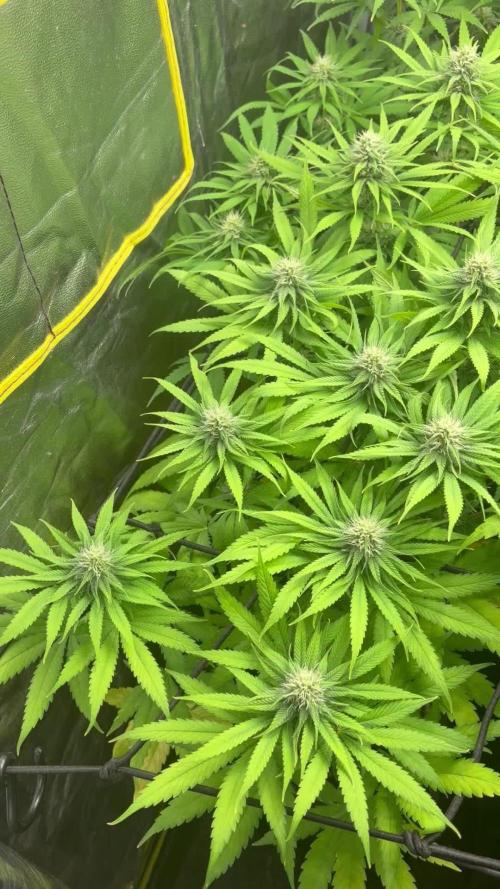
Inicio de la quinta semana de floración. He aumentado la dosis de Topmax y de Biobloom. Todo va de maravilla y están engordando bien. Poco más que decir, feliz semana a tod@s!


Likes
119
Share


@Tropicannibis_Todd
Follow
💩Holy Crap Growmies We Are Back💩
Well after another short break we are back at it 😁
So what do you say we have some fun 👈 We got us the Strawberry Pie from FASTBUDS 😛
Seed soaked for 24 then placed in a tub with paper towels , once it cracked and rooted , placed into its main pot 👌
Lights being readjusted and chart updated .........👍rain water to be used entire growth👈
👉I used NutriNPK for nutrients for my grows and welcome anyone to give them a try .👈
👉 www.nutrinpk.com 👈
NutriNPK Cal MAG 14-0-14
NutriNPK Grow 28-14-14
NutriNPK Bloom 8-20-30
NutriNPK Bloom Booster 0-52-34
I GOT MULTIPLE DIARIES ON THE GO 😱 please check them out 😎
👉THANKS FOR TAKING THE TIME TO GO OVER MY DIARIES 👈
Likes
7
Share


@Huntress007
Follow
I am pretty happy for this being my 1st grow ever! Nice looking buds and lots of fun! I did expect the nugz to be bigger but I an happy with the experience!
Likes
2
Share

@PapaTerps
Follow
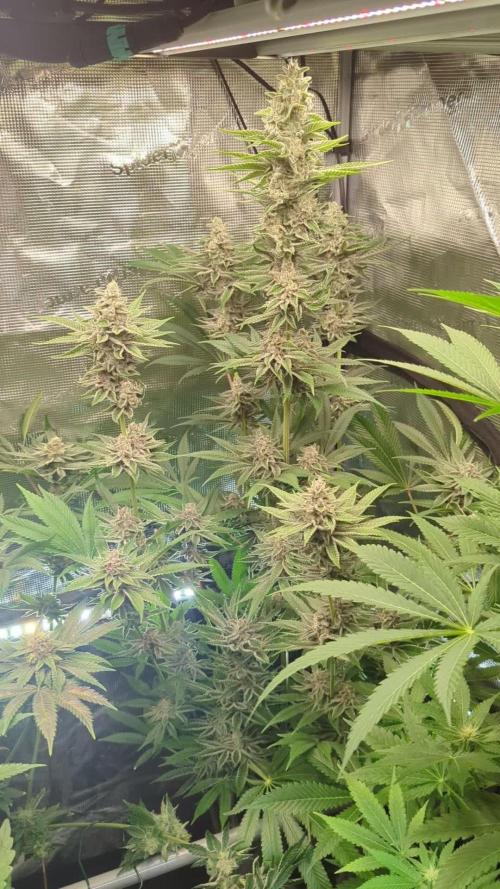
Blue Zushi - Dutch Passion
Day 96 - Watered with 3 litres of RO tap water, with defined nutrients, pH'd to 6.3. She required extensive defoliation this week, to allow more light to reach the lower bud sites. She is bulking really well and is probably just about finished, so I'm expecting her to begin the maturity process now 👍🏻

Likes
13
Share


@Megaprezoni
Follow
Day 14 from planting directly in substrate.
Do my plants look healthy? i don't know cause this is my first grow.
Likes
4
Share

@DogDoctorOfficial
Follow
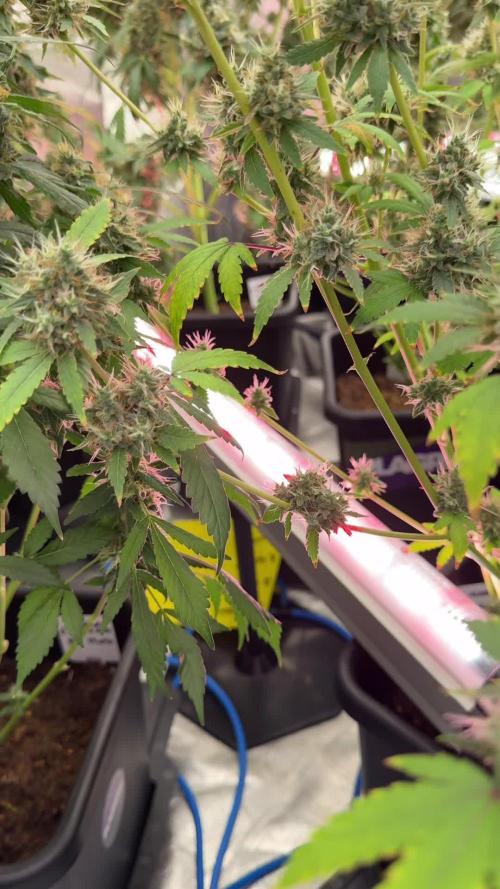
💙 8×8 Adventure – Week 13 🌿 Blueberry Muffin – Pheno B
✨ Still Small. Still Delayed. Still Beautiful. And Just A Little Ahead of Her Sister.
Welcome back to another chapter of the 8×8 Adventure! 🌱💚
And guess what?
Guess what?
GUESS WHAT? 😂💙
She's still small.
😂
I know.
Nobody is shocked.
Our little Blueberry Muffin Pheno B is still very much...
Blueberry Muffin Pheno B.
Compact.
Small.
Delayed compared with much of the room.
But...
beautiful.
Absolutely beautiful.
And here's the interesting part:
She's a little bit ahead of her sister.
Not by some enormous amount.
Not suddenly racing through the room.
But enough that I can see it.
She's moving.
She's developing.
She's progressing.
And when I look at both Blueberry Muffins together, I can't help but smile.
Because despite both of them being compact...
despite both of them being smaller plants...
despite both of them being delayed compared with many of their neighbours...
they are both beautiful.
💙🌸✨
And that's really the story this week.
We're not trying to make them bigger.
We're not trying to make them faster.
We're not trying to make them something they're not.
We're simply letting them be Blueberry Muffin.
And this girl?
She's doing it beautifully.
So let's give her the spotlight.
────────────────────────
🌱 THE 8×8 ADVENTURE — SAME ROOM, DIFFERENT PERSONALITIES
────────────────────────
For anyone discovering this diary for the first time, welcome to the 8×8 Adventure.
The concept behind this project is simple:
Twelve different plants.
Different genetics.
Different phenotypes.
One shared room.
One general environmental strategy.
One 12/12 lighting schedule.
One irrigation philosophy.
One nutritional program.
One lighting ecosystem.
One grower.
And somehow...
twelve completely different personalities.
😂💚
That's the part I love most.
The room is the same.
The ecosystem is the same.
The environment is the same.
The lighting is the same.
The feeding is the same.
And yet every plant seems to have received the instructions...
and then immediately decided to ignore half of them.
😂
Some stretch.
Some stay compact.
Some become monsters.
Some remain little.
Some move quickly.
Some take their sweet time.
Some seem to know exactly where they're going.
Others appear to be improvising.
And Blueberry Muffin Pheno B?
She's definitely in the:
"Yeah, I'll get there eventually."
😂💙
But she's getting there.
And that's what matters.
────────────────────────
💙 STILL SMALL — AND STILL BEAUTIFUL
────────────────────────
Let's not pretend she's suddenly become a giant.
She hasn't.
😂
She's still small.
Still compact.
Still one of the more petite girls in this room.
But honestly?
I wouldn't change that.
Because the moment I stop comparing her size to the larger plants...
I can really appreciate her.
Look at the flowers.
Look at the structure.
Look at the way she's developing.
Look at the details.
This is a beautiful little plant.
And that's the important part.
She's not competing in a height competition.
She's not trying to occupy every square centimetre.
She's simply making the most of the structure she has.
And she's doing it very nicely.
────────────────────────
🌸 A LITTLE AHEAD OF HER SISTER
────────────────────────
Now here's the little difference this week.
She's still delayed.
But she's a little bit ahead of Pheno A.
And I find that fascinating.
Because they're both Blueberry Muffin.
They're both compact.
They're both small.
They're both sharing the same room.
They're both receiving the same general environment.
And yet...
their clocks aren't identical.
Pheno B is just nudging forward a little faster.
Not dramatically.
Just enough for me to notice.
And this is exactly the kind of difference I love documenting.
Because if we only looked at the genetics name...
we might assume these plants should behave the same.
But they don't.
They're individuals.
And even within the same genetic line, they can have their own rhythm.
Pheno A has her story.
Pheno B has hers.
And we're going to document both.
That's the beauty of the 8×8 Adventure.
────────────────────────
? STILL DELAYED — BUT NOT LEFT BEHIND
────────────────────────
When I say she's delayed, I don't mean she's doing badly.
That's important.
She's simply further behind compared with many of the other plants in the room.
And that's perfectly okay.
The room doesn't have a single finish line for every plant.
The plants don't all have to arrive at the same time.
They're not identical machines running on identical timers.
They're living organisms expressing their own genetics.
And Blueberry Muffin Pheno B is telling us:
"I'm taking my time."
😂💙
Fine.
Take your time.
As long as you're moving.
And she is.
She's developing.
She's flowering.
She's progressing.
She's becoming more beautiful.
So there's absolutely no reason to rush her.
────────────────────────
🌿 TWO COMPACT GIRLS — TWO DIFFERENT STORIES
────────────────────────
This is actually becoming one of my favourite comparisons in the room.
Blueberry Muffin Pheno A.
Blueberry Muffin Pheno B.
Both compact.
Both small.
Both delayed.
But not identical.
One is a little ahead.
The other has her own rhythm.
And that's exactly why separate phenotype diaries are so valuable.
Because if I put them together into one generic report and simply said:
"Blueberry Muffin is small and delayed..."
we'd lose so much detail.
Instead...
we can look at each girl individually.
We can follow her development.
We can see her structure.
We can document her timing.
We can appreciate her personality.
And then, when the adventure is complete, we can look back and compare the two.
That's where the real fun is.
💙🌸
Same genetics.
Same room.
Different personalities.
────────────────────────
💡 SAME PHOTONS — DIFFERENT RESPONSE
────────────────────────
The lighting environment remains unchanged.
We're keeping the same ecosystem across the room.
The Future of Grow Black Series LEDs continue providing the main lighting, with the additional Black Series 600W fixtures remaining part of the upgraded setup.
After adding the extra fixtures, we reduced the output to approximately 59% from the plug, giving us around:
☀️ ~1,500 PPFD across the upper canopy
with the actual intensity naturally changing according to plant height and position.
And Blueberry Muffin Pheno B?
She's using those photons in her own way.
Not by becoming huge.
Not by stretching across the room.
Not by trying to dominate the canopy.
She's simply developing within her compact structure.
Same photons.
Same artificial sun.
Different interpretation.
And that sentence basically describes the entire 8×8 Adventure.
💙🌿✨
────────────────────────
🌱 SAME FEEDING — SAME OPPORTUNITY
────────────────────────
The feeding program also remains unchanged for the room.
We're not making plant-specific changes simply because one girl is slower.
The current recipe remains:
🌱 Plagron Pure Zym — 1 ml/L
⚗️ Plagron pH Plus — 0.03 ml/L
🍋 Plagron Lemon Kick — 0.03 ml/L
🌸 Plagron Terra Bloom — 2 ml/L
🌱 Plagron Power Buds — 1 ml/L
🍯 Plagron Sugar Royal — 1 ml/L
Current solution readings are approximately:
⚗️ pH — 6.04
⚡ EC — ~2.05 mS/cm
Same feeding.
Same general irrigation.
Same environment.
Same room.
And Blueberry Muffin Pheno B gets the same opportunity as everybody else.
Then...
she decides what to do with it.
And she's doing something pretty damn beautiful.
────────────────────────
🌿 THE ROOM IS STABLE — AND WE'RE LEAVING IT THAT WAY
────────────────────────
This is another thing I really want to emphasize this week.
The room is stable.
The plants are developing.
The environment is consistent.
And honestly?
It seems to be working.
So we're not changing things just because we can.
We're not chasing numbers.
We're not trying to force the slower girls to catch up.
We're not reinventing the ecosystem every week.
The room is alive.
The plants are alive.
They're progressing.
They're enjoying the conditions.
So for now...
we keep things stable.
Sometimes the best adjustment is no adjustment.
😂💚
────────────────────────
✂️ NOT MUCH TO DO — AND THAT'S PERFECT
────────────────────────
There's not much we're doing to this girl now.
And honestly?
That's exactly how I like it at this stage.
The structure is established.
The flowering sites are there.
She's developing.
She's healthy-looking.
The room is stable.
So why interfere?
Why start creating work when there isn't a problem to solve?
😂✂️
We're simply watching.
Observing.
Photographing.
Enjoying.
And letting her continue.
The grower doesn't need to be constantly touching the plant.
Sometimes we just need to stand there and admire the work the plant is doing.
And this little girl?
She's giving us something worth looking at.
────────────────────────
📸 THE CAMERA DOESN'T CARE HOW BIG SHE IS
────────────────────────
This is another thing I love about photographing the smaller plants.
From across the room...
she's small.
Very small.
But put a camera close to one of her flowers?
Different story.
😂📸💙
Suddenly the scale disappears.
You don't see a small plant anymore.
You see a flower.
You see the structure.
You see the pistils.
You see the texture.
You see the details.
And that's one of the reasons these individual reports are so enjoyable.
The camera allows us to give these smaller plants the attention they deserve.
Because size isn't everything.
Sometimes the smallest plant has some of the most interesting details.
And Blueberry Muffin Pheno B definitely deserves her close-up.
────────────────────────
🔬 GENETICS ARE WRITING THEIR OWN STORIES
────────────────────────
This is probably the biggest lesson of this entire adventure.
We can control the room.
We can control the environment.
We can control the lighting.
We can keep nutrition consistent.
We can maintain the irrigation strategy.
But we cannot tell every phenotype exactly how to behave.
They decide.
And Blueberry Muffin Pheno B has decided:
"Compact.
Slow.
Beautiful.
And I'll get there when I get there."
😂💙
And honestly?
I respect it.
Because that's the whole reason we're doing this.
We're not trying to make every plant identical.
We're trying to discover what they actually are.
And this girl is showing us exactly who she is.
────────────────────────
🌸 BEAUTIFUL DESPITE THE DELAY
────────────────────────
This is what I want people looking at these reports to remember.
Delayed does not mean ugly.
Small does not mean weak.
Compact does not mean uninteresting.
And slow certainly doesn't mean unsuccessful.
Look at her.
She's beautiful.
She's flowering.
She's developing.
She's expressing herself.
She's simply doing it on another timeline.
And that's completely fine.
Actually...
I think that's what makes her more interesting.
Because every week she makes us wait a little longer.
😂
And every week she gives us another reason to keep watching.
────────────────────────
🌡️ WEEK 13 — CURRENT CONDITIONS
────────────────────────
The room continues under the same stable setup:
🌸 Flowering — Week 13
💡 Light schedule — 12/12
💡 Future of Grow Black Series LEDs — upgraded setup
🔌 Approx. lighting output — ~59% from the plug
☀️ Upper-canopy PPFD — ~1,500
🌡️ Day temperature — ~27°C
🌙 Night temperature — ~26°C
💧 Relative humidity — ~61%
⚗️ pH — ~6.04
⚡ EC — ~2.05 mS/cm
🌡️ Solution temperature — ~25°C
🌱 Substrate temperature — ~25°C
🌬️ CO₂ — ~693 ppm
🌱 Pot size — 15 L
💦 Irrigation — ~1.45 L per plant / 24h
Same room.
Same conditions.
Same environment.
Same ecosystem.
Same feeding.
Same lighting.
Different personality.
And Blueberry Muffin Pheno B continues proving that she has her own clock.
────────────────────────
💚 I'M REALLY GLAD WE KEPT WATCHING HER
────────────────────────
There's something satisfying about these slower plants.
Because if you're only looking for speed...
you might overlook them.
You see another plant racing ahead and think:
"That's the exciting one."
But then you keep watching.
Week after week.
And the little one keeps developing.
Keeps flowering.
Keeps becoming prettier.
And eventually you realize:
"Wait a minute..."
😂💙
This little girl is actually beautiful.
That's what happened with both Blueberry Muffins.
They're not the biggest.
They're not the fastest.
But they're both beautiful.
And that's enough.
────────────────────────
🔭 WHAT HAPPENS NEXT?
────────────────────────
Honestly...
we wait.
😂💙
I don't know exactly how much longer she has.
I don't know exactly when she'll decide she's finished.
And I'm not going to pretend I do.
She's already shown us that her timing is different from many of the other girls.
So we'll let her continue.
Maybe she'll accelerate.
Maybe she'll continue slowly.
Maybe she'll surprise us.
That's the fun.
We're not here to force the ending.
We're here to document it.
One week at a time.
One photograph at a time.
One phenotype at a time.
────────────────────────
✨ FINAL THOUGHTS — GIVE THIS LITTLE GIRL HER SPOTLIGHT
────────────────────────
Week 13.
And Blueberry Muffin Pheno B is still...
small.
😂💙
Still compact.
Still delayed.
Still beautiful.
And just a little bit ahead of her sister.
And honestly?
I love that.
Both Blueberry Muffins are showing us something very similar...
but they're still individuals.
They're both small.
They're both compact.
They're both taking their time.
They're both behind much of the room.
And yet...
they're both absolutely beautiful.
That's the part I don't want to lose.
Because it's easy to look at the room and focus on the giants.
The huge plants.
The massive structures.
The girls taking over every available centimetre.
But sometimes...
you need to look down.
😂💙
And there she is.
Our little Blueberry Muffin.
Doing her thing.
Quietly.
Beautifully.
At her own speed.
And she's still here.
Still developing.
Still shining.
Still giving us another chapter.
So let's give her the spotlight.
Let's appreciate the compact structure.
Let's appreciate the beautiful flowers.
Let's appreciate the fact that she's moving forward.
And let's appreciate the individuality.
Because that's what this whole adventure is about.
Same room.
Same ecosystem.
Same photons.
Same feeding.
Same grower.
Different personalities everywhere.
And we're going to expose every single one of them through their own story.
💙🌸✨
Blueberry Muffin Pheno B...
you're small.
You're delayed.
You're taking your sweet time.
But you're beautiful.
And that's more than enough.
Keep doing your thing, little girl.
Keep growing.
Keep developing.
Keep shining.
And whenever you're ready...
show us what you've got.
We're still watching.
────────────────────────
🙏 THANK YOU
────────────────────────
A huge thank you to Zamnesia for the Blueberry Muffin genetics and for giving us the opportunity to discover these individual phenotypes. 💙🌸
Thank you to Plagron for supporting the nutritional side of this adventure. 🌱
A massive thank you to Future of Grow for the Black Series lighting and especially for supplying the two additional Black Series 600W fixtures that have expanded the lighting capability of the 8×8 Adventure. 💡🙏
Thank you to Lumiflora for adding another lighting dimension deeper into the canopy.
Thank you to TrolMaster for helping us maintain the environment behind the scenes.
And of course...
thank you to everyone following along on GrowDiaries.
Every comment.
Every question.
Every observation.
Every photograph.
Every week spent following these twelve very different girls.
It all becomes part of the story.
And Blueberry Muffin Pheno B?
She's definitely writing her own.
Slowly.
Compactly.
Beautifully.
And completely in her own way.
💙🌸✨
She's not the biggest.
She's not the fastest.
She's not the earliest.
But she is absolutely one of the most interesting.
And now we're going to keep watching both Blueberry Muffins and see where their separate journeys take them.
Same room.
Same conditions.
Same ecosystem.
Different personalities.
Different stories.
And that's exactly why I love this adventure.
Keep shining, Blueberry Muffin.
Your spotlight is yours.
💙🌸✨
Growers Love & Happy Growing! 🌱💚💙
Likes
Comments
Share

@DaddyPrime2
Follow
10/16
day 2 of drying. i trimmed a couple buds wet but theyre so dang sticky. will update as things progress. drying conditions have been 60-62
10/20/24 jarred for curing. jars have been 62-65% burping multiple times a day.
11/07/24 she has a really nice high. intense mental high with quite a bit of physical relaxation. laughing non stop. watching movies that felt super intense but not paranoid or any discomfort. couldn't/didnt want to move my legs. a very well balanced and comfortable


