The Grow Awards 2026 🏆
Likes
Comments
Share
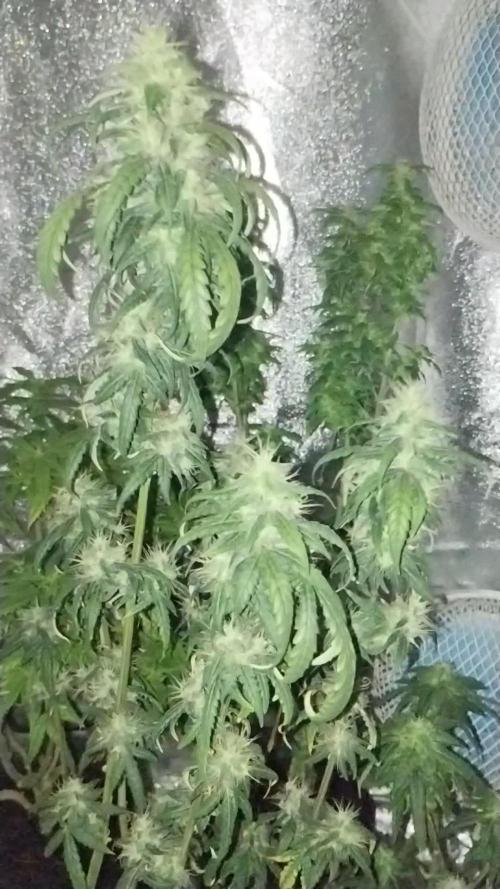
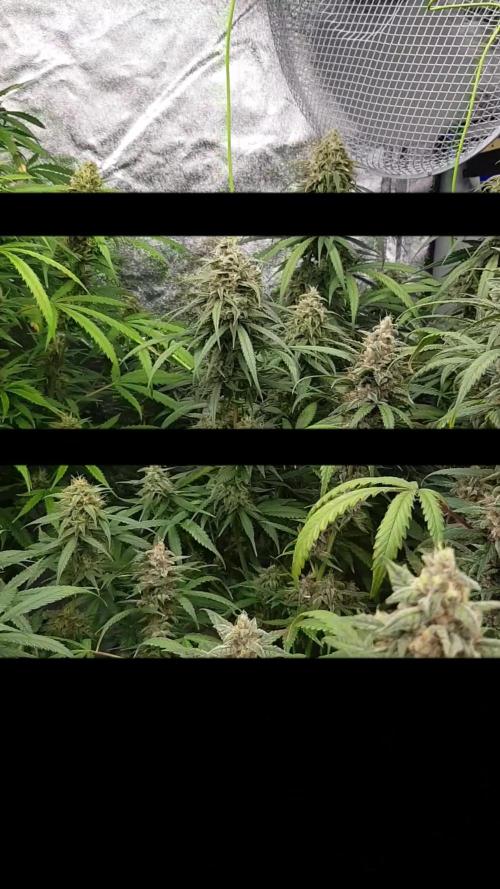
Today I have diced it is time to switch to 12/12 scheme. Net is almost covered and I am expecting some stretch during pre-flower phase. Watering volume is increasing day by day, thanks to my dehumidifier I can keep the VPD around 1.2. Temperature is a thing... probably need to cool down some in a few weeks. Thankfully I am already adding CO2 so that should do it. As you can see I have raised EC a bit. That was easier than bringing the PH down with PH-minus. Some little burned tips on the leaves but I do like the overall colour. So let's see how it goes. 15/06: Sorry... something more important came up than updating my report.... On Monday, I start working for a boss... it's been over 20 years, so it will take some getting used to... I also suddenly had to buy a car because I hate cycling. I usually dislike driving too, but as long as the car has enough power, I can live with it and stay dry. Regarding the ladies... the problem with the persistent lighting does indeed seem to be an internet issue, as it hasn't occurred again. Furthermore, the amens is just brutally large compared to the others and will soon overgrow the whole net. I don't mind... I always prefer the strongest. In the photo from 3 days ago, this is still fairly visible, but in the photos below, it's getting harder to see... Harvesting will also be fun... Keeping the stuff separate by type will be a challenge. Water values are currently nice and stable, though I did increase the CO2 slightly to an average of 1350ppm. I've also already hung my blooming lamps (not visible in the photo). These are again Chinese quantum boards, but 400W each. They will run 4 hours a day for the last 3 weeks. This way, the dehumidifier doesn't have to work as hard, and I keep the stuff around 30˚C. Actually quite satisfied.... the first signs of flowering seem visible, but not convincing enough to take pictures yet...
Likes
18
Share
@Yasyjlakh
Follow
Hello everyone, here is finishing the second week of flowering, she start to feel a good smell , especially swelling the buds in a crazy way , the colors mmmh I’m admiring them grow and I give fertilizers, in 2 weeks I think to defoliate them a bit
Likes
19
Share
Vamos familia, empieza lo bueno, y es que estás gorillas si han estirado, la primera semana de floración, aportamos algo de big bud para ir amoldándolas. Es una cepa que se comporta bastante bien en indoor, tallo grueso y bastante distancia entre internudos, deseando ver que flores nos da. ph controlado en 6,5 ahora va todo fenómeno, temperaturas ideales, humedad correcta 50 % , y pronto la bajaremos a 40 %. Hasta ahora lo que hay, próximamente nos vemos familia.
Likes
35
Share
@farahweed
Follow
The first week of flowering!!!😍😍 Wow, how attractive!! It is very attractive to me. How about you??🌱🌱🌱🌱 Please coment to me!! I changed the light cycle this week. I changed the lighting time from 18 hours to 12 hours. I feel that after doing this, the plant will grow faster in the flowering stage!!! This week I used short flowering feeding
Likes
10
Share
Eccoci di nuovo qui!!! Super eccitato per questa nuova collab con Anesia Seeds, team davvero al top, che mi ha dato l’opportunità di testare questa nuova genetica e di condividere i progressi con tutti voi!!! Come sempre partiamo nei bicchieri per poi travasare.. Questa volta verrà svolto tutto sotto la Lumatek Zeus 465 ProC, mi aspetto molto da questo ciclo!! Che bellezza finalmente il raccolto ed il test e... UNA GENETICA SPAZIALE DAL SAPORE UNICO E ODORE TROPICALE INTENSO, un vero piacere per i sensi la seconda miglior genetica del ciclo SUPER CONSIGLIATA A TUTTI.. Grazie a tutti per il supporto ❤️🍀🔥
Likes
2
Share
Likes
5
Share
Had a few hiccups. Plants ended up developing a nitrogen toxicity from too much worm casting. I simply did a flush on them with water PH’d to 6.3 and allowed the soil to dry out
Likes
4
Share
Esta semana me doy cuenta de la rapidez y buena calidad de la cepa. 🤩 Paso de los cubos de lana de roca a los slabs del mismo material. Empiezo floración modo horario pero pre-floracion con liquidos hasta que salga la primera flor. Riego automatico 3” al encender las luzes y 3” media hora antes de apagarlas.
Likes
7
Share
5.8.25. 1st week of flower just started! I had some issues during 3rd week of veg. I was doing the tie down method but wasn’t going so good seemed to be stressing plant out to much. I stopped tying down took all ties off and now is putting on nice healthy growth! Full steam ahead! Thanks for checking out grow! Have great week! !
Likes
13
Share
@ytOracle
Follow
Ich habe diese Woche mit dem entlauben angefangen. Und am zweiten Tag habe ich sie getoppt, beim versuchen mit low stress Training ist mir die Spitze abgebrochen. Passt war nur zu früh. Ich frage mich Ob es sinn macht den unteren Abzweig vom Seitentrieb auch abzunehmen da er so gewachsen ist das ja auch kein Licht abbekommt.
Likes
120
Share
Germination date 🌱 02/12/2021 Day 87 02/03/2022 Strain 🍁 Barneys Farm Biscotti Mintz (Biscotti x Mintz) THC% • 30% 🤤 💡 Mars Hydro FC-E6500 • Power draw 650W + 5% • Max coverage 5 x 5 • LED 3978 pcs high quality chips • Max Yield 2.5g / watt • Noise level 0 DB • Removable Driver & Light bars • Daisy chain • Fast cool system https://marshydroled.co.uk/ 🇬🇧 PROMO CODE • (organicnature420) DISCOUNT https://www.mars-hydro.com/ 🇺🇲 PROMO CODE • (ORG420) DISCOUNT 👍🏻 ⛺ Mars Hydro 150 x 150 x 200cm 📤📥 AC infinity 6inch 💧 10lt dehumidifier ❄️ 3.1kw air con system 💉 Nutrients GreenBuzzLiquids 🇩🇪 ⭐⭐⭐⭐⭐ Organic Grow Liquid • 1-4ml until 2wk flower Organic Bloom Liquid • 2-4ml flower stage Organic More PK • 2-4ml +wk3 of flower Organic Calmag • 1-2ml/lt whole grow Fast Plants Spray • first 2wks at night lights off More Roots • 2-5ml veg +2wks flower Fast Buds • 5ml 12days before flower until wk1 Humic Acid Plus • 2-5ml whole grow Growzyme • 2-5ml whole grow Big Fruits • 2-5ml flower stage Clean Fruits • 5ml flush 1wk Ph powder Root Gel Living Organics https://greenbuzzliquids.com/ PROMO CODE • organicnature420 15% off ✌️🏼 🥥 Growing Media • Coco Coir Notes 📝 Packed on some lovely weight the last week. I could easily flush this tomorrow with clean fruits for the next week but definitely want to see if she will get bigger. Only a slight Amber on the trics so another week will be fine. Girls look a little different, ones alot more ginger than the other but both look fire 🔥 Remember to give GreenBuzzLiquids a follow, I promise you won't be disappointed 👍🏻 Discount codes in bio for Mars and GreenBuzzLiquids 👍🏻 game changers 🏆
Likes
19
Share
@Hashy
Follow
******************************************** Week 13 Late flower (week 9 flower) ******************************************** Light cycle=12/12 Light Power=120w 50% Extractor controller settings (during lights on). High temp= 26c Temp step=0c High Rh= 46% Rh step=0% Speed max=10 Speed min=3 Extractor controller settings (during lights off). High temp= 20c Temp step=0c High Rh= 50% Rh step=0% Speed max=10 Speed min=3 Smart controller settings (during lights on). Lights on=9.00am Smart controller settings (during lights off). Lights off=9.00pm VPD aim=1.0-1.5 DLI aim=40-45 EC aim=1.0-1.8 PH aim=6.0-6.5 💧💧💧💧💧💧💧💧💧💧💧💧💧💧💧💧 NPK= 5-14-20 Method= Automatic Feed=Late Flower nutes Neutralise=0.1ml/L Plagron bloom=2.5ml/L Plagron Power buds=1ml/L Green Sensation=1ml/L Easy Ph down=0ml/L (1ml=24 drops, 1 drop=0.04ml) Easy Ph Up=0.0ml/L (1ml=24 drops, each drop is 0.04ml) Ec=1.2 PH=6.3/6.0 Runs=10 Run times=3mins (0.75L/0.375L each) Gap times= 17mins Total runtime=30mins(6.0L/3.0L each) Total flowrate= 0.25L/0.125L/min each Auto start time=10.00am Auto stop time=1.03pm 💧💧💧💧💧💧💧💧💧💧💧💧💧💧💧💧 ******************************************** ******************************************** 📅3/5/25 Saturday(Day 85) 📋 Removed Radiator summer conditions from now on. Small defoliation 💧 Automatic Water Ec=0.2 PH=6.6/6.5 Volume=10L Volume left=2.5L Volume used=7.5L Volume each=3.75L Total runoff=0.6L Ec=2.1 PH=6.4/6.4 💧 📅4/5/25 Sunday(Day 86) 📋 📅5/5/25 Monday(Day 87) 📋 📅6/5/25 Tuesday(Day 88) 📋 📅7/5/25 Wednesday(Day 89) 📋 💧 Automatic Late flower nutes Ec=1.2 PH=6.2/6.0 Volume=5L Volume left=1L Volume used=4L Manually Volume =1L Total used=5L Total runoff=0.8L Ec=2.5 PH=/6.6 💧 📅8/5/25 Thursday(Day 90) 📋 📅9/5/25 Friday(Day 91) 📋Day 63 of flower ******************************************** Weekly roundup. 📋My lung room is a little less crowded now I can take the radiator out of there. It's now the job of keeping the room cool as the season has changed. She's in late bloom now as pistils are starting to brown. The Fat bastard name really suits this plant, nice big flowers, I do have a bit of fox tailing going on the very top of the main cola but that can be expected for how close she is to the light. Still a way to go yet but she is doing great. Back soon. Take it easy. ********************************************
Likes
1
Share
Hasta ahora muy bien mis planta aunque muy resistente presenta unos cuantos acaro aunque ya no puedo aplicar preventivos en el punto de floración en el que se encuentra ya solo qued a mirar el desarrollo de la planta
Likes
2
Share
@aquaMan
Follow
Premise was to see how "optimal" i can get my first ever Grow. After some Research i came up with the idea to build an Aeroponic System myself using Water Buckets and Venturi Injektors to provider proper aeration. Sadly Seedlings had to wait in EazyCubes cause some parts and Nutrients didnt arrive on time. System was fully operationable on Day 16. Atami Nutrients are inside the System since Day 24, Calmag has been added Day 28. Before that, some Tri-part Nutrient. Planning on switching to Plagron in the Long run, as well as adding Co2, a water chiller and a ~700W LED. Stats: - 5 30L Buckets, 4 Plants and 1 Reservoir - Recirculation happens through 90mm PVC pipes - 16000 l/h pump going through 4x 1" Venturi Injektors pulling around 700 liters of Air per hour - 1mx1mx2m Growtent - 250W The Jackson Nemesis LED Happy about any Questions and Suggestions!
Likes
6
Share
5/25 Some pics may be repeated because I forgot to add a new week. Waited until about 11 to bring the girls outside. They were definately dry on top so I used the rest of the gallon to water them. When going outside I noticed a specific kush plant that's lighter than the rest. I really need to up my water volume on these big plants. They are also getting close to not liking it in the 1 gal. and are ready for a transplant. I cleaned the cage so as soon as the weather permits these girls will be outside in the direct sunlight. Basking in the sun in the cage to finish hardening before going into their final homes which will be 20-30 gal smart pots and a 50 gal grow pot. Well SOME of them are ready for transplant. The link kush seems to take its time but it looks extremely indica-E. Weather looks like it will be amazing this week so I'm obviously stoked. Wouldn't suprise me if these girls were outdoors be the end of the week! EDIT: THE GIRLS STAYED OUT FOR 3.5 HOURS AND LOOKED FANTASTIC. TUEY GOT SOME INTENSE SUN, EXPOSIRE TO THE HIGH RH AND A LITTLE EXPISURE TO THE HIGH WINDS. SPECIAL KUSH SEEMS TO BE THRIVING. I THINK IT WILL DO WELL IN THIS CLIMATE. THAT ONE MK ULTRA IS GROWING AT A RIDICULOUS RATE. I WATERED THE PIBK KUSH THAT WAS LIGHT. I CANT WAIT FOR THE UPCOMING WEATHER. I CAN EXPOSE THE PLANTS TO SOME DIRECT SUNLIGHT AND SEE HOW THEY HANDLE IT. I CAN ALSO GET THE GROW BAGS READY WITH SOIL MOXED AND THEM IN THE RIGHT LOCATION THE DAY BEFORE THE TRWNSPLANT TO FINAL HOME BUT IM GETTING AHEAD OF MYSELF. IM HAPPY THUS FAR. I also added another half hour of darkness so the plants will be closer to actual daylight times. They're down to 16.5. I'd like to have them lower by now but it is what it is. If some reveg I'll deal with it. 5/26 Plants seem to grow an inch I'm a day. MOST are getting to the point where they want to stretch their feet out. Good thing they'll be going in their final homes as soon as they are hardened off completely. I brought them out around 8 this morning. I have to be back at noon but I'm uncertain if leaving them out that long is a good idea. I'll probably have to check them in an hour or so. They're in the lean-to but THAT gets direct sun until the sun rises high enough in the sky to block it. I put them in here rather than the cage so they can build a tolerance to these harsh winds. Topsoil was dry as fuck. I watered everything. I focused on those that SEEMED the lightest and the largest plants. That MK Ultra plant I fimmed is going to be MASSIVE. I'll update what I do as I do it. Oh I also cleaned the bags twice and they are hanging inside the cage with the direct uv rays hitting any part that's discolored. I MIGHT do one more cleaning but I doubt it. Twice is enough. Technically three times but still. I want things to go right. It looks like I've got some pretty good phenos. EDIT: I PULLED IN (BLOCKING VIEW FROM PART OF THE DRIVEWAY OFF) BECAUSE THAT WAS CLOSER TO MY PLANTS. I GET OUT AND START ADMIRING MY PLANTS AND LOOK ACROSS THE STREET TO SEE TWO STATE TROOPERS AND SOME DETECTIVE ACROSS THE STREET. DAD SAID AN AMBULANCE CAME BUT LEFT WITH NO LIGHTS ON. THEY WERE TALKIMG TO THE COUPLE SEPERATELY. I ATE LUNCH AND THEY WERE STILL THERE. MY HOT WIFE WENT OUT AND THE ALL STARTED FUCKING RUBBER NECKING. MEANWHILE I BROUGHT THE PLANTS INSIDE WITH THE SMALL COVER MY S.U.V PROVIDES LOL. PLANTS WERE LEFT IN DIRECT LIGHT UNTIL IT ROSE HIGH ENOUGH TO CUT IT OFF TO THE LEAN TO. PLANTS SEEM LIGHT. WELL SOME DO. I NEED TO GET A GOOD WATERING SCHEDULE DOWN. JUDGING BY HOW THESE PLANTS TOOK IT TODAY I THINK THEYLL BE OUTSIDE IN FOREVER HOMES WITHIN A WEEK. 5/27 Just poked my head in and checked on them real quick. NO damage whatsoever from all that time in the sun. I left them inside this morning so I can bring them out later in the day to see what happens. I'll add pics later and update what I do. EDIT: BROUGHT THE PLANTS OUT TO THE CAGE AT A LITTLE BEFORE 10AM AND LET THEM BASK IN THE 85° SUN. THE WIND WAS A LITTLE ROUGH ON THEM. IT WAS ACTUALLY THRASHING THEM BUT MY INTUITION SAID 'LEAVE THEM BE' SO I DID. I DID MORE CLEANING AND FIGURED OUT SPACING IN THE CAGE AND I MIXED A 30GAL GROW BAG AND 2 20GAL GROW BAGS WITH A 50/50 MIX OF FOX FARM OCEAN FOREST AND HAPPY FROG. SOUL WAS MIXED WITH A GRADE STAKE AFTER BEING PUT IN A GALLON AT A TIME (TO ENSURE EQUAL PARTS) AND FINALLY MISED BY HAND. TAKES A LOT OF WORK. IM NOT GOING TO BE AS PICKING WITH THE OTHER ONES. I STILL HAVE MY 50 WITH SOIL IN IT. MAINLY DUE TO LAZINESS AND THE PAIN IN THE ASS IT IS TO MOCE THE FUCKER. PLUS IF IM LOW ON SOIL (WHICH IM NOT) THAT WAS GOOD SOIL AND THE PLANT HAD NO PROBLEMS SO I GUESS IF NEEDED IT FOULD BE REUSED. I NORMALLY JUST EMPTY THAT FIRST AND MIX A SHIT TON OF SOIL IN THERE AND SHOVEL IT IN THE BAGS. THIS WAS MUCH HARDER. PLANTS GOT CLOSER TO 2 HOURS OF DIRECT SUNLIGHT BEFORE I MOVED THEM TO THE LEAN TO. I WILL UPDATE WHEN I HRING THEN IN BUT DESPITE THE HARSH SUN AND WIND THEY SEEM FINE. EDIT: BROUGHT THE GIRLS IN AT TWO BECAUSE MY WIFE HAD AN APPOINTMENT. NO DAMAGE WHATSOEVER. I THINK IF I USE THIS WEEK TO INCREASE DAYLIGHT HOURS AND UP THE WATERING THESE PLANTS WILL BE READY TO GO IN THEIR HOMES. A FEW ARE BIG AND DEF READY TO STRETCH THEIR FEET. 5/28 With the increased sun some these plants are out growing their containers. PLANTS SPENT APPROX AN HOUR AND A HALF IN DIRECT 85° SUN. EVERYTHING SEEMED FINE AND I WAS GOING TO LEAVE THEM FOR THE DAY IN THE CAGE. THEN I NOTICED THE BIG MK ULTRA'S MAIN STEM (IT GOT FIMMED BUT THE MAIN ONE) WAS STARTING TO DROOP A LITTLE. I PICKED THE PIT UP AND DESPITE A LITTLE BIT OF MOUSTURE ON THE TOP THE PIY WAS LIGHT AS A FEATHER. PLUS SETTING ON THE THEM ON THE TAR WASN'T THE BEST IDEA EITHER. I MISED UP SOME WATER AND WATERED THE PLANTS THAT SEEMED LIGHT. I NEED TO PICK UP LIKE ONE MORE BAG OF OCEAN FOREST FOR MY 50 GAL. I'M GOING TO TRY TO FINISH MY OTHER TWO 20'S AND THE TWO 10'S TONIGHT SO I'LL KNOW WHAT IM LACKING. ITS BASICALLY JUST THE 50. IF MY INTUITION SAYS ITS OK ILL TALE THE "COOLER" DAY TOMORROW AND TRANSPLANT THE THREE PLANTS TGAT ARE GETTING TO BIG FOR THERE POT. ÌF NEEDED I MIGHT GET SOME SCREENS TO USE AS A "BLIND" SO THE PLANTS DONT GO STRAIGHT TO FULL SUN ALL DAY. EDIT: TJAT HUGE MK ULTRA REVOVETED NOCELY ONCE WATERED AND PUT IN THE SHADE. IT NEEDS TO BE TRANSPLANTED. I MAY DO ITCTOMORROW. PLANTS HAVE GOT TO BE CLOSE TO HARDENED. I MIXED ALL MY SOIL AND FILLED ALL THE GROW BAGS WITH THE MIX. I FINISHED CLEANING THE CAGE AND REMOVED BAMBOO AND TRELLISING. TOMORROW IS GOING TO BE A MILD DAY AND PERFECT FOR TRANSPLANT. SOME OF THESE GIRLS ARE GETTING VERY BIG. I RAN OUT OF SOIL AFTER THE LAST 10GAL GROW BAG. ITS NOT FILLED "ALL" THE WAY AND I GAVENT FILLED MY 50 GAL. I'LL GET THE REST OF THE SOIL I NEED FOR THAT 50 TOMORROW.
Likes
25
Share
ANTHOCYANIN production is primarily controlled by the Cryptochrome (CR1) Photoreceptor ( !! UV and Blue Spectrums are primary drivers in the production of the pigment that replaces chlorophyll, isn't that awesome! 1. Diverse photoreceptors in plants Many civilizations, including the sun god of ancient Egypt, thought that the blessings of sunlight were the source of life. In fact, the survival of all life, including humans, is supported by the photosynthesis of plants that capture solar energy. Plants that perform photosynthesis have no means of transportation except for some algae. Therefore, it is necessary to monitor various changes in the external environment and respond appropriately to the place to survive. Among various environmental information, light is especially important information for plants that perform photosynthesis. In the process of evolution, plants acquired phytochrome, which mainly receives light in the red light region, and multiple blue light receptors, including his hytropin and phototropin, in order to sense the light environment. .. In addition to these, an ultraviolet light receptor named UVR8 was recently discovered. The latest image of the molecular structure and function of these various plant photoreceptors (Fig. 1), focusing on phytochrome and phototropin. Figure 1 Ultraviolet-visible absorption spectra of phytochrome, cryptochrome, phototropin, and UVR8. The dashed line represents each bioactive absorption spectrum. 2. Phytochrome; red-far red photoreversible molecular switch What is phytochrome? Phytochrome is a photochromic photoreceptor, and has two absorption types, a red light absorption type Pr (absorption maximum wavelength of about 665 nm) and a far-red light absorption type Pfr (730 nm). Reversible light conversion between the two by red light and far-red light, respectively(Fig. 1A, solid line and broken line). In general, Pfr is the active form that causes a physiological response. With some exceptions, phytochrome can be said to function as a photoreversible molecular switch. The background of the discovery is as follows. There are some types of plants that require light for germination (light seed germination). From that study, it was found that germination was induced by red light, the effect was inhibited by subsequent far-red light irradiation, and this could be repeated, and the existence of photoreceptors that reversibly photoconvert was predicted. In 1959, its existence was confirmed by the absorption spectrum measurement of the yellow sprout tissue, and it was named phytochrome. Why does the plant have a sensor to distinguish between such red light and far-red light? There is no big difference between the red and far-red light regions in the open-field spectrum of sunlight, but the proportion of red light is greatly reduced due to the absorption of chloroplasts in the shade of plants. Similar changes in light quality occur in the evening sunlight. Plants perceive this difference in light quality as the ratio of Pr and Pfr, recognize the light environment, and respond to it. Subsequent studies have revealed that it is responsible for various photomorphogenic reactions such as photoperiodic flowering induction, shade repellent, and deyellowing (greening). Furthermore, with the introduction of the model plant Arabidopsis thaliana (At) and the development of molecular biological analysis methods, research has progressed dramatically, and his five types of phytochromes (phyA-E) are present in Arabidopsis thaliana. all right. With the progress of the genome project, Fi’s tochrome-like photoreceptors were found in cyanobacteria, a photosynthetic prokaryotes other than plants. Furthermore, in non-photosynthetic bacteria, a homologue molecule called bacteriophytochrome photoreceptor (BphP) was found in Pseudomonas aeruginosa (Pa) and radiation-resistant bacteria (Deinococcus radiodurans, Dr). Domain structure of phytochrome molecule Phytochrome molecule can be roughly divided into N-terminal side and C-terminal side region. PAS (Per / Arndt / Sim: blue), GAF (cGMP phosphodiesterase / adenylyl cyclase / FhlA: green), PHY (phyto-chrome: purple) 3 in the N-terminal region of plant phytochrome (Fig. 2A) There are two domains and an N-terminal extension region (NTE: dark blue), and phytochromobilin (PΦB), which is one of the ring-opening tetrapyrroles, is thioether-bonded to the system stored in GAF as a chromophore. ing. PAS is a domain involved in the interaction between signal transduction-related proteins, and PHY is a phytochrome-specific domain. There are two PASs and her histidine kinase-related (HKR) domain (red) in the C-terminal region, but the histidine essential for kinase activity is not conserved. 3. Phototropin; photosynthetic efficiency optimized blue light receptor What is phototropin? Charles Darwin, who is famous for his theory of evolution, wrote in his book “The power of move-ment in plants” published in 1882 that plants bend toward blue light. Approximately 100 years later, the protein nph1 (nonphoto-tropic hypocotyl 1) encoded by one of the causative genes of Arabidopsis mutants causing phototropic abnormalities was identified as a blue photoreceptor. Later, another isotype npl1 was found and renamed phototropin 1 (phot1) and 2 (phot2), respectively. In addition to phototropism, phototropin is damaged by chloroplast photolocalization (chloroplasts move through the epidermal cells of the leaves and gather on the cell surface under appropriate light intensity for photosynthesis. As a photoreceptor for reactions such as escaping to the side of cells under dangerous strong light) and stomata (reactions that open stomata to optimize the uptake of carbon dioxide, which is the rate-determining process of photosynthetic reactions). It became clear that it worked. In this way, phototropin can be said to be a blue light receptor responsible for optimizing photosynthetic efficiency. Domain structure and LOV photoreaction of phototropin molecule Phototropin molecule has two photoreceptive domains (LOV1 and LOV2) called LOV (Light-Oxygen-Voltage sensing) on the N-terminal side, and serine / on the C-terminal side. It is a protein kinase that forms threonine kinase (STK) (Fig. 4Aa) and whose activity is regulated by light. LOV is one molecule as a chromophore, he binds FMN (flavin mononucleotide) non-covalently. The LOV forms an α/βfold, and the FMN is located on a β-sheet consisting of five antiparallel β-strands (Fig. 4B). The FMN in the ground state LOV shows the absorption spectrum of a typical oxidized flavin protein with a triplet oscillation structure and an absorption maximum wavelength of 450 nm, and is called D450 (Fig. 1C and Fig. 4E). After being excited to the singlet excited state by blue light, the FMN shifts to the triplet excited state (L660t *) due to intersystem crossing, and then the C4 (Fig. 4C) of the isoaroxazine ring of the FMN is conserved in the vicinity. It forms a transient accretionary prism with the tain (red part in Fig. 4B Eα) (S390I). When this cysteine is replaced with alanine (C / A substitution), the addition reaction does not occur. The effect of adduct formation propagates to the protein moiety, causing kinase activation (S390II). After that, the formed cysteine-flavin adduct spontaneously dissociates and returns to the original D450 (Fig. 4E, dark regression reaction). Phototropin kinase activity control mechanism by LOV2 Why does phototropin have two LOVs? Atphot1 was found as a protein that is rapidly autophosphorylated when irradiated with blue light. The effect of the above C / A substitution on this self-phosphorylation reaction and phototropism was investigated, and LOV2 is the main photomolecular switch in both self-phosphorylation and phototropism. It turns out that it functions as. After that, from experiments using artificial substrates, STK has a constitutive activity, LOV2 functions as an inhibitory domain of this activity, and the inhibition is eliminated by photoreaction, while LOV1 is kinase light. It was shown to modify the photosensitivity of the activation reaction. In addition to this, LOV1 was found to act as a dimerization site from the crystal structure and his SAXS. What kind of molecular mechanism does LOV2 use to photoregulate kinase activity? The following two modules play important roles in this intramolecular signal transduction. Figure 4 (A) Domain structure of LOV photoreceptors. a: Phototropin b: Neochrome c: FKF1 family protein d: Aureochrome (B) Crystal structure of auto barley phot1 LOV2. (C) Structure of FMN isoaroxazine ring. (D) Schematic diagram of the functional domain and module of Arabidopsis thaliana phot1. L, A’α, and Jα represent linker, A’α helix, and Jα helix, respectively. (E) LOV photoreaction. (F) Molecular structure model (mesh) of the LOV2-STK sample (black line) containing A’α of phot2 obtained based on SAXS under dark (top) and under bright (bottom). The yellow, red, and green space-filled models represent the crystal structures of LOV2-Jα, protein kinase A N-lobe, and C-robe, respectively, and black represents FMN. See the text for details. 1) Jα. LOV2 C of oat phot1-to α immediately after the terminus Rix (Jα) is present (Fig. 4D), which interacts with the β-sheet (Fig. 4B) that forms the FMN-bound scaffold of LOV2 in the dark, but unfolds and dissociates from the β-sheet with photoreaction. It was shown by NMR that it does. According to the crystal structure of LOV2-Jα, this Jα is located on the back surface of the β sheet and mainly has a hydrophobic interaction. The formation of S390II causes twisting of the isoaroxazine ring and protonation of N5 (Fig. 4C). As a result, the glutamine side chain present on his Iβ strand (Fig. 4B) in the β-sheet rotates to form a hydrogen bond with this protonated N5. Jα interacts with this his Iβ strand, and these changes are thought to cause the unfold-ing of Jα and dissociation from the β-sheet described above. Experiments such as amino acid substitution of Iβ strands revealed that kinases exhibit constitutive activity when this interaction is eliminated, and that Jα plays an important role in photoactivation of kinases. 2) A’α / Aβ gap. Recently, several results have been reported showing the involvement of amino acids near the A’α helix (Fig. 4D) located upstream of the N-terminal of LOV2 in kinase photoactivation. Therefore, he investigated the role of this A’α and its neighboring amino acids in kinase photoactivation, photoreaction, and Jα structural change for Atphot1. The LOV2-STK polypeptide (Fig. 4D, underlined in black) was used as a photocontrollable kinase for kinase activity analysis. As a result, it was found that the photoactivation of the kinase was abolished when amino acid substitution was introduced into the A’α / Aβ gap between A’α and Aβ of the LOV2 core. Interestingly, he had no effect on the structural changes in Jα examined on the peptide map due to the photoreaction of LOV2 or trypsin degradation. Therefore, the A’α / Aβ gap is considered to play an important role in intramolecular signal transduction after Jα. Structural changes detected by SAXS Structural changes of Jα have been detected by various biophysical methods other than NMR, but structural information on samples including up to STK is reported only by his results to his SAXS. Not. The SAXS measurement of the Atphot2 LOV2-STK polypeptide showed that the radius of inertia increased from 32.4 Å to 34.8 Å, and the molecular model (Fig. 4F) obtained by the ab initio modeling software GASBOR is that of LOV2 and STK. It was shown that the N lobes and C lobes lined up in tandem, and the relative position of LOV2 with respect to STK shifted by about 13 Å under light irradiation. The difference in the molecular model between the two is considered to reflect the structural changes that occur in the Jα and A’α / Aβ gaps mentioned above. Two phototropins with different photosensitivity In the phototropic reaction of Arabidopsis Arabidopsis, Arabidopsis responds to a very wide range of light intensities from 10–4 to 102 μmol photon / sec / m2. At that time, phot1 functions as an optical sensor in a wide range from low light to strong light, while phot2 reacts with light stronger than 1 μmol photon / sec / m2. What is the origin of these differences? As is well known, animal photoreceptors have a high photosensitivity due to the abundance of rhodopsin and the presence of biochemical amplification mechanisms. The exact abundance of phot1 and phot2 in vivo is unknown, but interesting results have been obtained in terms of amplification. The light intensity dependence of the photoactivation of the LOV2-STK polypeptide used in the above kinase analysis was investigated. It was found that phot1 was about 10 times more photosensitive than phot2. On the other hand, when the photochemical reactions of both were examined, it was found that the rate of the dark return reaction of phot1 was about 10 times slower than that of phot2. This result indicates that the longer the lifetime of S390II, which is in the kinase-activated state, the higher the photosensitivity of kinase activation. This correlation was further confirmed by extending the lifespan of her S390II with amino acid substitutions. This alone cannot explain the widespread differences in photosensitivity between phot1 and phot2, but it may explain some of them. Furthermore, it is necessary to investigate in detail protein modifications such as phosphorylation and the effects of phot interacting factors on photosensitivity. Other LOV photoreceptors Among fern plants and green algae, phytochrome ɾphotosensory module (PSM) on the N-terminal side and chimera photoreceptor with full-length phototropin on the C-terminal side, neochrome (Fig. There are types with 4Ab). It has been reported that some neochromes play a role in chloroplast photolocalization as a red light receiver. It is considered that fern plants have such a chimera photoreceptor in order to survive in a habitat such as undergrowth in a jungle where only red light reaches. In addition to this, plants have only one LOV domain, and three proteins involved in the degradation of photomorphogenesis-related proteins, FKF1 (Flavin-binding, Kelch repeat, F-box 1, ZTL (ZEITLUPE)), LKP2 ( There are LOV Kelch Protein2) (Fig. 4Ac) and aureochrome (Fig. 4Ad), which has a bZip domain on the N-terminal side of LOV and functions as a gene transcription factor. 4. Cryptochrome and UVR8 Cryptochrome is one of the blue photoreceptors and forms a superfamily with the DNA photoreceptor photolyase. It has FAD (flavin adenine dinucle-otide) as a chromophore and tetrahydrofolic acid, which is a condensing pigment. The ground state of FAD is considered to be the oxidized type, and the radical type (broken line in Fig. 1B) generated by blue light irradiation is considered to be the signaling state. The radical type also absorbs in the green to orange light region, and may widen the wavelength region of the plant morphogenesis reaction spectrum. Cryptochrome uses blue light to control physiological functions similar to phytochrome. It was identified as a photoreceptor from one of the causative genes of UVR8 Arabidopsis thaliana, and the chromophore is absorbed in the UVB region by a Trp triad consisting of three tryptophans (Fig. 1D). It is involved in the biosynthesis of flavonoids and anthocyanins that function as UV scavengers in plants. Conclusion It is thought that plants have acquired various photoreceptors necessary for their survival during a long evolutionary process. The photoreceptors that cover the existing far-red light to UVB mentioned here are considered to be some of them. More and more diverse photoreceptor genes are conserved in cyanobacteria and marine plankton. By examining these, it is thought that the understanding of plant photoreceptors will be further deepened.
Likes
8
Share
These little ladies have been moved to their fabric pots and so far seem to be doing well. We had an issue with damping off and unfortunately lost some others. We look forward to a nice easy grow before the outdoor fun begins, hopefully it grows without a hitch!
Likes
4
Share
Starting 2º flora week