The Grow Awards 2026 🏆
Likes
Comments
Share
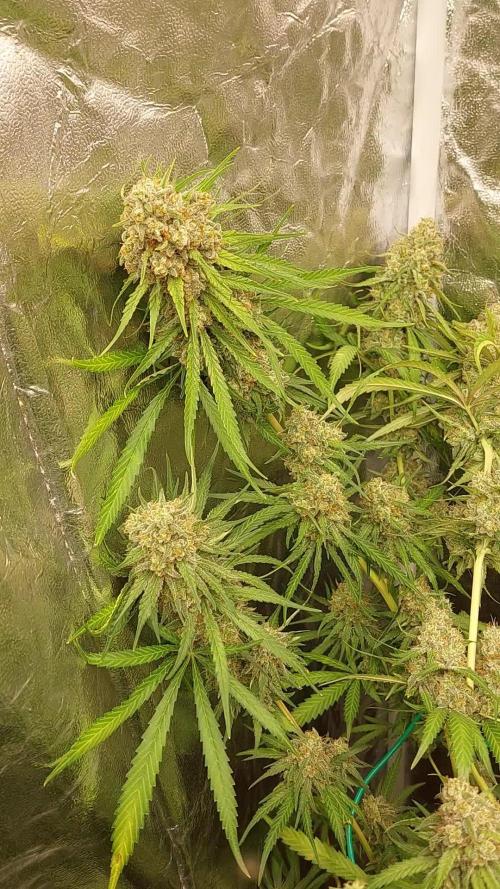
June 15: looks really good and will do second round of topping tomorrow. The last 30 days have been cooler than the historic average, and last year was way above average. So, she’s doing great despite cool weather. June 16: adjusted tie downs and watered with soluble seaweed extract. June 17: second round of topping to make 8 colas done this morning. Will do another round in a week or two to get the final 16 cola layout I want. June 20: released tie downs this morning. Looks really good on the last day of spring. Solstice and the photoperiods are right on schedule, unlike my two autos. Made second compost tea as shown in video. Key things are blackstrap molasses (sugar and trace metals), good compost, and I use coco coir for something for the bacteria to physically live on (substrate or matrix). #seedsman420growoff #seedsmanseeds
Likes
23
Share
MATARO BLUE by KANNABIA Week #9 Overall Week #8 Veg This week it's gotten extremely hot she's covered to help protect her with a sun screen that being said she's doing good dealing with the elements. Stay Growing!! Kannabia.com MATARO BLUE
Likes
11
Share
Kind of given up on this one. I had an issue catchung runoff which led to me not watering plants enough Not watering plants to runoff will result in higher substrate Ec(Generative cue and also could burn plants) Also its about 20• outside which does not work for the plantsr dark period. December and january are tough months. I recently learned that i should
Likes
6
Share
@IQuSX
Follow
Hi, topman!! The hard work of forming the "@" form will go into the uppercase "a" form. Defoliation is waiting for this plant, it is growing very powerful and green, considering that the humidity dropped to 20-30%... and the temperature rose at the moment to 33.4•C... Useful mushrooms grow near the neighbor of plants, so soon they will be looked through from our substrate! Let’s see>>
Likes
9
Share
Day 23 - Annoyingly, one of the main shoots snapped off after I pegged it down. It was fine when I left it, but as it is such a vigorous grower, it snapped off under the pressure of its own growth. All is not lost, as I will top it 4 times instead of my usual 3, to make up for the lost buds. This plant appears to be a BEAST so I think she can take it no problem. I should end up with 24 glorious main colas and a load of b-grade for the hash making pile! I gave her around 2 litres of treated water (see germ page for details). Around 500ml directly into the base of the plant, and the rest spread around the pot. It's important during this late vegging stage to water into the edges of the pot as much as possible, and encourage maximal root spread. Big roots = big fruits She's starting to smell earthy! Day 28 - she doesn't need any water today. The pot is still heavy. She's growing fast, so I'm confident I can top her one more time. I've pegged down 4 of the arms into a circle shape around the edge, and tied two arms together pointing vertically straight up. It should look stunning in a couple of weeks!
Likes
55
Share
2nd net is up. Early bud formations are promising. holding up to the extremes pretty well, some leaves taking minor damage, but overall, she is holding up, gave her 1 night at 50F see how she would react, stressful. Not advised as it messes with her metabolism, but I want to see if it triggers any anthocyanin response. Love to see her purp up but no signs yet. Remember, For every molecule of glucose produced during photosynthesis, a plant needs to split six molecules of water. This process provides the hydrogen needed for synthesizing glucose and other organic compounds, while oxygen is released as a byproduct. Homework. If Rubisco activity is impaired and it cannot properly function or regenerate its substrate, the plant's leaves are likely to turn a pale green or lime green, a condition known as chlorosis. Essentially, Rubisco activity is highly regulated and susceptible to various environmental and metabolic factors that can cause it to become inhibited, leading to an apparent failure in RuBP regeneration due to a lack of consumption. Rubisco regeneration is intrinsically linked to nitrogen supply because Rubisco is a major sink for nitrogen in plants, typically accounting for 15% to over 25% of total leaf nitrogen. The regeneration phase itself consumes nitrogen through the synthesis of the Rubisco enzyme and associated proteins (like Rubisco activase), and overall nitrogen status heavily influences the efficiency of RuBP regeneration. RuBisCO is a very large enzyme that constitutes a significant proportion (up to 50%) of leaf soluble protein and requires large investments in nitrogen. Insufficient nitrogen supply limits the plant's ability to produce adequate amounts of RuBisCO, thereby limiting the overall capacity for photosynthesis and carbon fixation. Maintaining the optimal, slightly alkaline pH is crucial for the proper function and regeneration of Rubisco. Deviations in either direction (too high or too low) disrupt the enzyme's structure, activation state, and interaction with its substrates, leading to decreased activity and impaired RuBP regeneration. (Lime/yellowing) Structural Component: Nitrogen is an essential building block for all proteins, and the sheer abundance of the Rubisco protein makes it the single largest storage of nitrogen in the leaf. Synthesis and Activity: Adequate nitrogen supply is crucial for the synthesis and maintenance of sufficient Rubisco enzyme and Rubisco activase (Rca), the regulatory protein responsible for maintaining Rubisco's active state. Nitrogen deficiency leads to a decrease in the content and activity of both Rubisco and Rca, which in turn limits the maximum carboxylation rate, Vmax, and the rate of RuBP regeneration Jmax, thus reducing overall photosynthetic capacity. Nitrogen Storage and Remobilization: Rubisco can act as a temporary nitrogen storage protein, which is degraded to remobilize nitrogen to other growing parts of the plant, especially under conditions of nitrogen deficiency or senescence. Nitrogen Use Efficiency (NUE): The allocation of nitrogen to Rubisco is a key determinant of a plant's photosynthetic nitrogen use efficiency (PNUE). In high-nitrogen conditions, plants may accumulate a surplus of Rubisco, which may not be fully activated, leading to a lower PNUE. Optimizing the amount and activity of Rubisco relative to nitrogen availability is a target for improving crop NUE. Photorespiration and Nitrogen Metabolism: Nitrogen metabolism is also linked to the photorespiration pathway (which competes with carboxylation at the Rubisco active site), particularly in the reassimilation of ammonia released during the process. To increase RuBisCO regeneration, which refers to the process of forming the CO2 acceptor molecule Ribulose-1,5-bisphosphate (RuBP) during photosynthesis, the primary methods involve optimizing the levels and activity of Rubisco activase (Rca) and enhancing the performance of other Calvin-Benson-Bassham (CBB) cycle enzymes. Biochemical and Environmental Approaches: Optimize Rubisco Activase (Rca) activity: Rca is a crucial chaperone protein that removes inhibitory sugar phosphates, such as CA1P (2-carboxy-D-arabinitol 1-phosphate), from the Rubisco active site, thus maintaining its catalytic competence. •Ensure optimal light conditions: Rca is light-activated via the chloroplast's redox status. Adequate light intensity ensures Rca can effectively maintain Rubisco in its active, carbamylated state. •Maintain optimal temperature: Rca is highly temperature-sensitive and can become unstable at moderately high temperatures (e.g., above 35°C/95F° in many C3 plants), which decreases its ability to activate Rubisco. Maintaining temperatures within the optimal range for a specific plant species is important. •Optimize Mg2+ concentration: Mg2+ is a key cofactor for both Rubisco carbamylation and Rca activity. In the light, Mg2+ concentration in the chloroplast stroma increases, promoting activation. •Manage ATP/ADP ratio: Rca activity depends on ATP hydrolysis and is inhibited by ADP. Conditions that maintain a high ATP/ADP ratio in the chloroplast stroma favor Rca activity. Enhance Calvin-Benson-Bassham (CBB) cycle enzyme activity: The overall rate of RuBP regeneration can be limited by other enzymes in the cycle. •Increase SBPase activity: Sedoheptulose-1,7-bisphosphatase (SBPase) is a key regulatory enzyme in the regeneration pathway, and increasing its activity can enhance RuBP regeneration and overall photosynthesis. •Optimize other enzymes: Overexpression of other CBB cycle enzymes such as fructose-1,6-bisphosphate aldolase (FBA) and triose phosphate isomerase (TPI) can also help to balance the metabolic flux and improve RuBP regeneration capacity. Magnesium ions, Mg2+, are specifically required for Rubisco activation because the cation plays a critical structural and chemical role in forming the active site: A specific lysine residue in the active site must be carbamylated by a CO2 molecule to activate the enzyme. The resulting negatively charged carbamyl group then facilitates the binding of the positively charged Mg2+ion. While other divalent metal ions like Mn2+ can bind to Rubisco, they alter the enzyme's substrate specificity and lead to dramatically lower activity or a higher rate of the non-productive oxygenation reaction compared to Mg2+, making them biologically unfavorable in the context of efficient carbon fixation. The concentration of Mg2+ in the chloroplast stroma naturally increases in the light due to ion potential balancing during ATP synthesis, providing a physiological mechanism to ensure the enzyme is activated when photosynthesis is possible. At the center of the porphyrin ring, nestled within its nitrogen atoms, is a Magnesium ion (Mg2+). This magnesium ion is crucial for the function of chlorophyll, and without it, the pigment cannot effectively capture and transfer light energy. Mg acts as a cofactor: Mg2+ binds to Rubisco after an activator CO2 molecule, forming a catalytically competent complex (Enzyme-CO2-Mg2+). High light + CO2) increases demand: Under high light (60 DLI is a very high intensity, potentially saturating) and high CO2, the plant's capacity for photosynthesis is high, and thus the demand for activated Rubisco and the necessary Mg2+ cofactor increases. Mg deficiency becomes limiting: If Mg2+ is deficient under these conditions, the higher levels of Rubisco and Rubisco activase produced cannot be fully activated, leading to lower photosynthetic rates and potential photo-oxidative damage. Optimal range: Studies show that adequate Mg2+ application can enhance Rubisco activation and stabilize net photosynthetic rates under stress conditions, but the required concentration is specific to the experimental setup. Monitoring is key: The most effective approach in a controlled environment is to monitor the plant's physiological responses e.g., leaf Mg2+ concentration, photosynthetic rate, Rubisco activation state, and adjust the nutrient solution/fertilizer to maintain adequate levels, rather than supplementing a fixed "extra" amount. In practice, this means ensuring that Mg2+ is not a limiting factor in the plant's standard nutrient solution when pushing the limits with high light and CO2. Applying Mg2+ through foliar spray is beneficial to Rubisco regeneration, particularly in alleviating the negative effects of magnesium (Mg) deficiency and high-temperature stress (HTS). While Mg can be leached from soil, within the plant it is considered a mobile nutrient, particularly in the phloem. Foliar-applied Mg is quickly absorbed by the leaves and can be translocate to other plant parts, including new growth and sink organs. Foliar application of: NATURES VERY OWN MgSO4 @ 15.0g L-1 in a spray bottle. For those high-intensity workouts when 1 meal a day is just not enough! Foliar sprays are often recommended as a rapid rescue measure for existing deficiencies or as a supplement during critical growth stages, when demand for Mg is high. Application in the early morning or late evening can improve absorption and prevent leaf burn. The plant was getting a little limey yellow in the centre. Shortly thereafter, she was back in business, green mostly regenerated. The starting point [of creativity] is curiosity: pondering why the default exists in the first place. We’re driven to question defaults when we experience vuja de, the opposite of déjà vu. Déjà vu occurs when we encounter something new, but it feels as if we’ve seen it before. Vuja de is the reverse—we face something familiar, but we see it with a fresh perspective that enables us to gain new insights into old problems. Confidence is evidence... nothing more. You are confident because you have driven 10,000 times, you are confident because you have spoken 10,000 times. People think confidence is a feeling, but it's not. If you want more confidence, then you need to create evidence, take more shots, collect more data, build more experiences, take more risks; fail, confidence doesn't come first; it is the reward you get for doing the work. no one else wants to do.
Likes
27
Share
Let’s Go day 29!! This week went real nice ! Girls are staying very healthy and building up nicely and even started showing signs of female sex which is super great ! We started doing a little bit of leaf tuck training method on em , nothing to big as like I said I want these girls just to do there thang an grow more on naturally side! My Air temp and Humidity have been on point all week, staying from 70-75 degrees throughout the day and humidity staying around 58-61% humidity , my girls are loving that summer an 75 feeling !! Can’t wait to see what we do this week ! Hopefully you all enjoy, and are ready for another great productive week ! Peace love an positive vibes to y’all Cheers 😶‍🌫️💨💨💨💨🤙🏻Happy Grows✌️🏻Week 4 let’s get it !
Likes
14
Share
Good morning I germinated my seeds for 24 hours in water and then in an airtight paper towel bag. 48 hours everything has germinated 8/8. thank you for taking a look at my profile, kisses see you soon
Likes
59
Share
Buds are very sticky. Will harvest on the next visit
Likes
62
Share
@ClubRiot
Follow
Start week 4 , Bio Grow 2 ml/L + Cal-Mag Xtra 2 ml/L ( Ph 6.6).
Likes
35
Share
@nonick123
Follow
Día 115 (23/09) Riego con 250 / 500 ml H2O Día 116 (24/09) Riego con 500 / 1.000 ml H2O - Hace mucho calor! (31 ºC) LemonPaya empieza a formar nuevos pistilos a velocidad decente! Día 117 (25/09) Riego con 500 / 1.000 ml H2O - Hace mucho calor! (31 ºC) OnionOG #1 empieza a oler a tierra húmeda y champiñón 😍 Purple Punsh S1 está empezando a llenar los bordes de las hojas de abanico de una espesa capa de tricomas. Increíble! 💥 Día 118 (26/09) Riego con 500 / 1.000 ml H2O - Sigue haciendo muchísimo calor! Hoy hemos tenido un día con 37 ºC de máxima! Increíble la cantidad de tricomas que están formando Purple Punsh S1 & KS1! Las hojas está completamente perladas! 😍💥 Día 119 (27/09) Riego con 500 / 1.000 ml H2O Que calor! Seguimos con 32 ºC de máxima! Día 120 (28/09) Riego con 500 / 1.000 ml H2O OnionOG #1 muestra unos cogollos brutalmente densos y gruesos! I'm in love! Día 121 (29/09) Riego con 1 litro H2O pH 6,5 + Kelp Hidrolizado 0,3 g/L 💦Nutrients by Lurpe Solutions - www.lurpenaturalsolutions.com 🌱Substrate PRO-MIX HP BACILLUS + MYCORRHIZAE - www.pthorticulture.com/en/products/pro-mix-hp-biostimulant-plus-mycorrhizae
Processing
Likes
10
Share
@Dunk_Junk
Follow
She's clearly not happy. She hasn't been happy for a couple of weeks looking back at past weeks.
Likes
53
Share
_________📅 Week 11 | Day 71 - 77 📅 🌼🌸🌺Flower🌼🌸🌺 __________ 14.07.25 | Day 77🌞 🔸Not much to report for this week the buds are swelling steadily, A&B has the “smallest” buds so far if you were to compare them. The smell isn't very strong yet, but I'm still very pleased with the results 🔸The environment could be a little better, but it's still limited, but when we go into late flowering I really have to do something about the high humidity. _________________________________________________________________________________________ current conditions: 🌡️🔆= 25-26° 🌡️🌜= 20-21° 💨 Hum. = 66% 🔦 PPFD = 900 umol 12/12 🔦⌚DLI = ~ 38 _________________________________________________________________________________________ equipment to use: 💡 Light: 2 x Sanlight Evo 4- 120 on 90% 3 osziling clips fans ⛺ 120 x120 x 180 🍯 Pots: 18 liter pot 🌱 Soil: Bio-Bizz light mix 💊 Nutrients: Advanced Nutrients 💧 Water: Tap Water 0,5 EC _________________________________________________________________________________________
Likes
7
Share
This is the full detailed pictures of my first grow.
Likes
3
Share
The ladies were flushed on the 68th and will be flushed again on the 71st. Analyzing the resin with a magnifying glass, I think we will not have a harvest before the 75th. B3 this blooming I think she will be looked after with more than 80 or 83 days.
Likes
200
Share
@yan420
Follow
🌸🍊✨🍭🌸🍊✨🍭🌸🍊✨🍭🌸 Back at it with Kannabia — huge thanks for the NEW EXCLUSIVE Upcoming Kannabia's seed Launch 🙏🍨🍊 Grateful for the trust and for everyone following along, I’ll run her clean and showcase what she can do. Dessert-party goals: berry–citrus sherbet terps, creamy finish, tight stacks, easy trim, zero drama. Veg 24/0, clean manifold + LST, flip on a happy, even canopy. Coco’s fresh, seed goes in now. 🚀 Added on 12.10.2025 🌞 Light conditions: Limited direct light for the first 4 weeks — ~4 h/day on weekdays and ~10–11 h on weekends due to tent sharing and work schedule. 🌸🍊✨🍭🌸🍊✨🍭🌸🍊✨🍭🌸 💭❗💭❗💭❗💭❗💭❗💭❗💭 ❗Events & thoughts worth noting❗ 💭❗💭❗💭❗💭❗💭❗💭❗💭 10.08.25 GW1 Sowed seed, soaked starter pot with #1 12.08.25 GW1 Seed popped hip hip hurray 28.08.25 VW2 Stopped using GreenBuzzBloom, took it out of the schedule. 01.09.25 VW3 TriPartMicro 10→30ml, TriPart bloom 10→30ml 12.09.25 VW4 Applied nemadodes against thrips and fungus gnats. 20.09.25 VW6 topped and trained for first time, decided against a full manifold as I lost a few weeks already. 26.09.25 VW7 Topped her one more time for 8 mains 27.09.25 VW7 Topped up the pot with perlite instead of clay pebbles this time, just trying things out, TriPartMicro 30→40ml , TriPartBloom 30→20ml 10.10.25 VW9 have her a haircut, umm be trimming the side shoots tomorrow, rest in the video 📹 12.10.25 VW9 done some extra trimming to clean up a bit and chose two extra side shoots to nurture info mains, so kept the 8 original mains plus 2 rest in the video 📹 17.10.25 VW9 FfJ/fpj fish mix 30 → 60 ml 20.10.25 VW10 Feed tweak: added 3 g Calcium Nitrate/ 30 L (≈ 15 ppm N + 10 ppm Ca) 24.10.25 VW11 did a defoliation and trimming session 📹 27.10.25 VW11 Epsom Salt 0 → 2.5, Calcium Nitrate 3 → 9 g 01.11.25 VW12 CalMag 60 → 30ml, TriPartBloom 20 → 30ml, Magnesium 2.5 → 3.5g 02.11.25 VW12 Did a cleanup in preparation for flowering, rest in the video 📸 12.11.25 VW13 Did another cleanup in the tent 🎥, also switched to the FERMAKOR PK Micro schedule, (10.11.25) added Phosphoric acid as a pH down in preparation for flowering 14.11.25 FW1 FERMAKOR PK Micros 40 → 50 ml 05.12.25 FW3 about 2 weeks ago Calcium Nitrate 35 g → 25 g, FERMAKOR PK Micros 50 ml → 60 ml 12.12.25 FW4 Calcium Nitrate 25 g → 20 g, FERMAKOR PK Micros 60 ml → 80ml 16.12.25 FW4 Calcium Nitrate 20 g → 17 g, FERMAKOR PK Micros 80 ml → 110 ml 20.12.25 Calcium Nitrate 17 g → 15 g 26.12.25 Ffj fpj 30 →0ml 🌱💦🌱💦🌱💦🌱💦🌱💦🌱 🌿 Day to day tasks & actions 🌿 🌱💦🌱💦🌱💦🌱💦🌱💦🌱 Fed about 5l a day of #1 and on the weekends I do a pure FERMAKOR PK flush 2l runoff (*RUNOFF reused for tomato plants) 💧💧💧💧💧💧💧💧💧 🌱 Nutrients in 30 L #1 – FERMAKOR (progression kept) 💧💧💧💧💧💧💧💧💧 Calcium Nitrate (Calcinit / Nitcal): 45 → 40 g → 35 g → 25 g → 20 g → 17 g → 15 g = 1.50 g/L → 1.33 g/L → 1.17 g/L → 0.83 g/L → 0.67 g/L → 0.57 g/L → 0.50 g/L = 207 ppm N / 253 ppm Ca → 184 / 225 → 161 / 197 → 115 / 141 → 92 / 112 → 78 / 96 → 69 / 84 PK Concentrate (FERMAKOR Base): 30 → 40 ml → 50 ml → 60 ml → 80 ml → 110 ml = 1.00 → 1.33 ml/L → 1.67 ml/L → 2.00 ml/L → 2.67 ml/L → 3.67 ml/L → balanced 1:1 P:K + light micros (from extract) Home-made FFJ/FPJ (Fish + Veg): 30 ml → 0 ml = 1.00 ml/L → 0.00 ml/L Epsom Salt (MgSO₄·7H₂O): 8 g = 0.27 g/L → ~26 ppm Mg + ~35 ppm S Fetrilon Combi 1 (Micros): 0.5 g = 0.017 g/L → Fe 0.7 ppm · Mn 0.7 ppm · Zn 0.3 ppm · Cu 0.3 ppm · B 0.1 ppm · Mo 0.02 ppm Phosphoric Acid (pH down) + Citric Acid (chelation): as needed → First set pH with phosphoric acid, then add a little citric only if you want extra chelation Target pH: 5.8 – 6.0 (drop test yellow-green) 📦 TOTAL (corrected): Liquids (PK + FFJ/FPJ): 60 → 70 → 80 → 90 → 110 → 140 → 110 ml per 30 L = 2.00 → 2.33 → 2.67 → 3.00 → 3.67 → 4.67 → 3.67 ml/L Solids (CaNO₃ + Epsom + Fetrilon): 53.5 → 48.5 → 43.5 → 33.5 → 28.5 → 25.5 → 23.5 g per 30 L = 1.78 → 1.62 → 1.45 → 1.12 → 0.95 → 0.85 → 0.78 g/L ⚙️✂️⚙️✂️⚙️✂️⚙️✂️⚙️ ✂️ Tools & equipment ✂️ ⚙️✂️⚙️✂️⚙️✂️⚙️✂️⚙️ ✂️ 2× MarsHydro SP3000 ⚙️ MarsHydro 150mm ACF Ventilator ✂️ Trotec dehumidifier (big unit) ⚙️ Mini no-name dehumidifier ✂️ Kebab skewers (LST – stainless) ⚙️ Wire + roast skewers (LST assist) ✂️ Scissors (HST) ⚙️ Vacuum (for spills & cleanup) ✂️⚙️✂️⚙️✂️⚙️⚙️✂️⚙️✂️⚙️✂️⚙️ --- 🍊🍧🌬️🍬🍊🍧🌬️🍬🍊🍧🌬️🍬 Mystery seed (Kannabia Seeds) — NEW EXCLUSIVE 🍊🍧🌬️🍬🍊🍧🌬️🍬🍊🍧🌬️🍬 Species: Hybrid (GF / swift-flowering line) Genetics: TBA (breeder sheet pending) THC: TBA Effect: Euphoric, relaxed, creative (target profile) Flavor: Berry–citrus sherbet, sweet candy, creamy finish Flowering (indoors): ~6–7 weeks target (GF) Resistance: High (aim: no drama) Indoor yield: TBA Outdoor yield: TBA Structure: TBA Notes: Brand-new exclusive from Kannabia’s GF line — I’ll update specs when the breeder card drops. Goal is rich sherbet terps (berry–citrus + cream), low leaf-to-calyx, easy trim. Stage harvest stays on the table if tops finish early. YouTube Link: https://youtube.com/-m8h?si=A7x4Zlr2kj-_ga31
Likes
29
Share
-Began flowering at the beginning of the week -Watering every second day -Will give a small top dress soon of Gaia Green all purpose