






Likes
12
Share


@MicroHidroGrow
Follow
Última semana. Hice el primer lavado con flawless finish circulando durante unas 12hs. Luego ya puse agua y quedó circulando en proceso de lavado. Es el final y ya estoy ansioso. Esperaba tener listos los esquejes de la próxima camada, pero aún no tengo todos. Así que voy a ver cuantos pongo la próxima vez. Una planta quedó un poco atrasada respecto del resto. Así que voy a ver si la dejo una semana más cuando haya cortado. De todos modos no me preocupa, ya que era la planta que dejé sin guiar ni cortar y era el esqueje más nuevo de todos. Seguiré subiendo algunas fotos por si hay cambios, aunque no creo que haya mucha modificación.
Día 47. Las flores estan muy duras. Parece que va a ser interesante la cosecha. En pocos días estaré cortando.

Likes
29
Share


Likes
17
Share


@Growshh
Follow
Went into 48 hours or darkness on day 66, then chop...14-21 day 60/60 dry ahead. Will report on harvest and smokes in a few weeks. Another great scrog under the belt!


Likes
6
Share


@Lickey
Follow
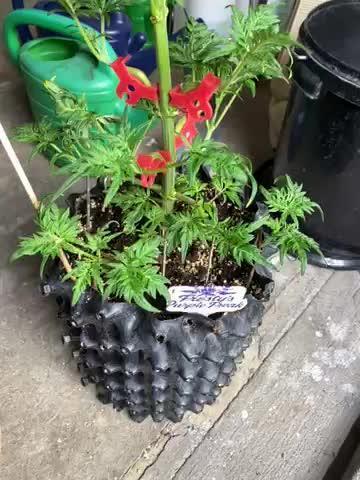
Got some plants from a friend. Cut clones and moved into tent with hot pepper plants
Likes
17
Share


@bsplayerone
Follow
Week 8 - we are getting so close. The bud smells so amazing. It’s a citrus earthy smell that I can’t wait to taste. The weather is cooling down and she seems to like that. I wish I had more hours of light, but she’s as big as she is going to get.
Likes
22
Share


@eldruida_lamota
Follow
Vamos que os explico un poco critical es una variedad indica con una floración rápida, sus flores son compactas , y bastante resinosas, tiene aromas fuertes.
El ambiente en el secado estuvo en 23 grados de media y 40% de humedad se pasaron rápido al bote de cristal, 7 días en concreto.
Hasta aquí todo familia, espero que os agrade un saludo y buenos humos💨💨💨


Processing
Likes
5
Share


@Green_Blood
Follow
Things are moving along in flower.
Really pleased how these Rainbow Pie girls are really bulking up.
They all seem to be praying up to the light and happy.
the wedding cake pheno ended up being a real stretcher.
She was the shortest plant before flipping into flower.

Likes
1
Share


@Mastercheef
Follow
They’re hungry and sucked up their second dose of heavy feed. But this time it’s the bloom solution. Sf2000 at full power! One plant has a clear genetics problem and I fear I’ll have to set my controls just to handle the good pheno and hope for the best with tiny Tim.

Likes
5
Share


@Funkyfreshgreens
Follow
More defoiliation. lower half of both plants almost striped.
Banana blaze almost finished alot of amber appearing :) 3ish weeks maybe. Without 2 pot changes and some issues this might have be ready now. smell has become more potent can't wait to smoke.
More defoiliation on the orange bud this week hopefully see improvements nxt wk. Main colas looking thick
Both plants got 500ml of feed this week with orange bud getting watered once 300ml with 1ml alg a mic.

Likes
110
Share


@Dennis_Bong
Follow
!!!!!!!!!!!!!!!!!!!!!!!!!!!!!!!!!!!!!!!!!!!!!!guckt euch letzen Report an !!!!!!!!!!!!!!!!!!!!!!!!!!!!!!!!!!!!!!!!!!!!!!!!!!!!!!
Blüte hat begonnen:
Edit:11.05
Die Pflanzen sind innerhalb von 2 Tagen explodiert. Ich habe das Licht nun auf 75 Prozent gestellt und noch einmal Cal-Mag nachgegeben, da die letzte Gabe nur eine halbe war. Die beiden Titan sehen fast identisch aus. Die beiden Epsilon sind circa 3 Tage unterschiedlich, eine ist etwa 5 cm kleiner als die andere und hat noch kaum Blüten. Ich denke, in 3 Tagen wird das der Fall sein. Die Cosmos F1 ist im Umfang circa 50-50 cm, kaum Blüten bisher. Ich hoffe, sie wird nicht noch viel größer, da der Platz langsam eng wird. Ich bin von dem Wachstum dieser Pflanze absolut begeistert. Mal gucken, was die Blüte bringt.
Edit ende
Ich habe alle Blüten entfernt, die nicht im direkten Licht sind, und alle Blätter, die die Blüten bedecken.
Die Pflanzen weisen einen Cal-Mag-Mangel auf, was bei der Blüte normal ist, gerade bei diesem Licht.
Ich habe dem Gießwasser etwas Cal-Mag hinzugefügt.
Die Pflanzen sind drei Tage älter als im letzten Report.
letzte Woche :
Die Pflanzen sind seit der Keimung auf diesen Fotos genau 30 Tage alt.
Ich habe eine Pflanze ausgetauscht, da es sich um eine Epsilon F1 handelte, die vermutlich Mutationen aufwies. Sie hatte verkümmerte Blätter, die nicht wie die ihrer Artgenossen aussahen, und wuchs deutlich langsamer. Daher habe ich sie nach 2,5 Wochen ausgetauscht. Der kleine Mann(die ausgetauschte Pflanze) leidet natürlich jetzt ein bisschen unter Lichtstress, deswegen werde ich wohl nur eine sehr gestauchte Pflanze erhalten. Aber besser, als die Fläche leer zu lassen.
So viel zu dem, was nicht funktioniert hat:
Die Sanlight stand die ersten 2 Wochen auf 20 Prozent.
Dann habe ich sie teilweise mit dem Dimmer höher gestellt: 2 Stunden auf 25 Prozent.
Eine Woche später bin ich auf 30 Prozent und 2 Stunden mit 35 Prozent gegangen.
Für Woche 4 habe ich 40 Prozent und 2 Stunden auf 45 Prozent gewählt.
Ich erhoffe mir, die Pflanzen so schneller an die starken Lampen zu gewöhnen.
Im Nächsten grow soll bei jeder Pflanze die TDS per Infrarot gemessen werden. Da werde ich dann ein Experiment zu machen, wie die Lichtsteigerung am besten umzusetzen ist.
Zu den Lampen kann ich bis jetzt nur Positives sagen. Im Gegensatz zur dazugehörigen App, diese ist wirklich nicht sehr gut umgesetzt. Das Menü und die Einstellungen sind teilweise irreführend und nicht sehr durchdacht. Ich muss mir immer wieder die Tutorials in der App ansehen, da diese immer wieder angezeigt werden.
Noch dazu hätte ich gerne die Möglichkeit, mehr Einstellungen treffen zu können. Das ist aber Meckern auf hohem Niveau, weil auch die App das macht, was sie soll, nur eben meiner Meinung nach nicht sehr gut umgesetzt.
Die Pflanzen wurden von mir mit Klipsen aus dem 3D-Drucker gestützt. Diese Klips kann man Stück für Stück im Winkel verstellen, so dass man die Triebe damit neigen kann. Das habe ich von Tag zu Tag im Winkel verstellt, so dass ich am Ende einen 45-Grad-Winkel habe. Das habe ich insgesamt über 6 Tage gemacht.
Die Pflanzen haben an sich ein sehr gleichmäßiges Wachstum. Die Cosmos F1 wächst so optimal, dass kein LST mit den Klipsen nötig ist. Ich habe an den Pflanzen keine Mängel entdecken können und auch keine Anzeichen von Mutationen.
Die Pflanzen haben im Durchschnitt eine Höhe von 35 cm, wobei eine etwas stärker abweicht mit 22 cm (wieder eine Epsilon F1). Der Umfang mit LST bei der Cosmos F1 liegt ohne LST bei 20 cm im Durchschnitt, wo wir wieder die Epsilon im Negativen haben mit 14 cm.
Die Pflanzen wurden alle entlaubt, das eine Woche vor der Blüte. Morgen werden die Pflanzen erneut entlaubt und ge-lollipoppt.
!!!!!!!!!!!!!!!zusätliche infos werden morgen ergänzt + Fotos !!!!!!!!!!!!!!!!!!!!!!!!!!!!!!!!
*1. Foto Mutation:
Dieses Foto wurde nur 5 Minuten nach dem Umtopfen der Pflanze aufgenommen. Vorher stand sie in einem größeren Topf, in dem sie genauso aussah. Ich habe sie umgetopft, weil ich den Topf brauchte, aber die Pflanze nicht wegwerfen wollte. Der Pflanze geht es gut, aber sie sieht im Moment etwas mitgenommen aus. Bilder folgen

Likes
10
Share


@Bud_vista
Follow
Welcome to week 9 friends!
Since the last defoliation on end of week 8 she dealt very well with. She’s still looking strong but you can tell that the leaf tips starting to burn because of high nutrient levels. In this late stage this shouldn’t be a problem, I will not further increase the amount of nutrients she gets.
The buds gaining in weight from day to day. She’s doing great and some of her trichomes already starting to turn milky.
Looking forward to this week since I can not doing that much at this flower stage beside of checking if she needs some watering.




Processing
Likes
5
Share


@Cogollo_eu
Follow
From/Desde: 30/06/18 || To/Hasta: 06/07/18
From day/Desde día: 29 || To day/Hasta día: 35
-----WEEK SUMMARY-----
30/06/18: Video 1 & Photos 2 to 5
01/07/18: Photos 6 to 9
02/07/18: Photos 10 to 13
04/07/18: Photos 14 to 17
The video shows one morning i went to my friend's house where i have the plants, just to record at what time the plants get the firsts rays of light.
This little beast begin to grow heavy, she doubled it's height along this week, i'm also in love with the way it's colas are growing, they are going to be enormous. No much more to tell this week, just growing cool.
-----SUMARIO SEMANAL-----
30/06/18: Vídeo 1 y Fotos 2 a 5
01/07/18: Fotos 6 a 9
02/07/18: Fotos 10 a 13
04/07/18: Fotos 14 a 17
El vídeo muestra un timelapse de una mañana que fui a casa de mi amigo donde tenía las plantas a comprobar a que hora empezaban a recibir luz las plantas.
Esta pequeña bestia ha empezado a crecer a lo bestia, esta semana va a doblar su altura, me encanta como están creciendo las colas, van a ser enormes. No hay mucho más que contar esta semana, simplemente está creciendo a la perfección.


Likes
7
Share


@Kirsten
Follow
17.3.25:
So I watered with 2ltrs of dechlorinated water PH'd to 6.4 with 4ml Xpert Nutrients Cal-Mag amino acids.
I have really overdone the nutrients, I got carried away 😅
To try and rectify the situation, I've cut everything out except Cal-Mag amino acids.
I will try to just stick to this with some Biosys, but I'm running out of that now, too.
Anyway, with Or Without, I'm sure it'll balance out. Fingers crossed 🤞
Likes
7
Share


@SamDo
Follow
Week 19 of Vegetative Growth
(Transition Week – Pre-Flower Move)**
This week marks an important milestone for the Pineapple Upside Down Cake: she was finally moved into the tent where she’ll spend her entire flowering phase.
She’s not flipping yet — this stage is all about controlled acclimation before the real show begins.
Up until now, she was growing under a 5000K blue-leaning veg light at low wattage, which kept her compact and focused on structural development.
Inside the flowering tent, the lighting is completely different: a full-spectrum 3500K panel, warmer, broader, and naturally more stimulating.
A spectrum switch like this can easily stress a plant, especially in late veg, so the intensity was intentionally reduced to 300 PPFD to give her a soft landing.
Temperature conditions also shifted: about 21°C during the day and 17°C at night, with the light set to 25% power.
It’s a cool, stable environment — ideal for a plant adjusting to a brighter and wider spectrum.
The second key topic of the week was training strategy.
Her growth was accelerating fast, and the debate was wide open:
Should she be topped?
Should we go for a scrog?
Should we prune more aggressively?
In the end, the most coherent choice was a clean LST session.
Her main branches — roughly ten apexes — were gently bent and opened to create a wider, flatter canopy.
This approach keeps stress minimal while giving her a solid architecture to handle the upcoming stretch.
Over the next few days, she’ll naturally stand back up, and once she does, her true structure will become clearer.
At that moment, we’ll be able to judge whether she needs extra shaping: a light defoliation, selective pruning, or even a late top if it really makes sense.
For now, the plan is simple and strategic:
• monitor her adaptation to the new spectrum,
• watch how she reacts to the LST,
• keep the environment stable,
• and only move to flowering once she shows full vigor again.
Summary for Week 19 (Vegetative Growth):
– Successful transition into the flowering tent
– Spectrum shift managed smoothly with 300 PPFD
– Cooler environment helping with acclimation
– Clean LST performed on about ten apexes
– No visible stress, good potential for a controlled stretch
– Next step: wait for full adaptation before flipping
See you next week for the follow-up — the pre-flower phase is getting close.
