The Grow Awards 2026 🏆 







Likes
Comments
Share
@Salokin
Follow
Welcome back to our Gary Payton grow diary!
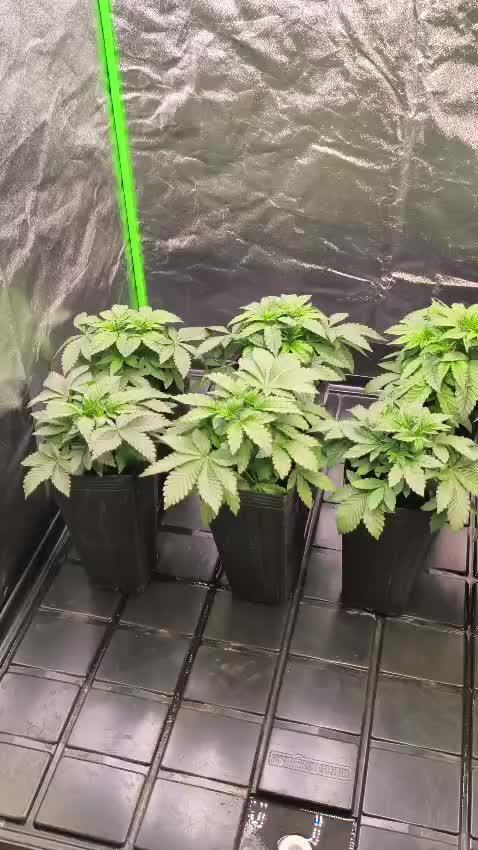
As we move into Week 6, our Gary Payton plants are settling well into their new pots and exhibiting strong growth. The decision to let them grow to their full size without topping is proving to be an interesting experiment.
Week 6 Highlights:
The plants have shown impressive growth following the transplant. Their stems are thickening, and the foliage is becoming denser, indicating healthy and vigorous growth. The roots have continued to develop robustly, aided by the Great White powder applied during the transplant. The plants are well-established in their new 12.5L pots. The introduction of Sugar Royal, Plagron Alga Grow, and Great White into the nutrient schedule is supporting the plants' vegetative growth. The plants are responding well to this regimen. The TrolMaster-controlled 4x4 tent continues to provide an optimal environment, with precise control over light, temperature, and humidity. This setup is crucial for maintaining the plants' health.
Upcoming Plans:
We will maintain the current nutrient schedule to support ongoing vegetative growth. As the plants continue to grow without topping, we will monitor their height, structure, and overall health. This will help us understand the full potential of the Gary Payton strain when grown to full size. Ongoing adjustments to the TrolMaster system will ensure optimal growing conditions as the plants progress.
Stay tuned for more updates as we continue this exciting journey with our Gary Payton plants.
Stay lifted,
Salokin



Likes
17
Share
@Sativa_Juice_Grows
Follow
Shes coming along well
Branches are getting heavy
gonna have to prop some up soon
Saw like 3 or 4 amber trichomes.
Still looks like she has a little of
time left. Unfortunately I have to move
so im hoping theyre ready in the next 30-45 days.
Smells alot like mashed blueberries more than candy now.

Likes
5
Share
@killerjoint
Follow
10-24-2024
ALL THE STRAIN RECOMMEND FLOWERING TIME IS 7-8 WEEKS
TRY TO FINISH WEEK 8
STILL HAS 19 MORE DAYS...
LAST FEED WITH NUTS .BURNED SOME OF TOP FAN LEAVES ......
BUT CHECK OUT QUEEN,DR SLEEP , WULFF ,POWER... CRAZY FROST TOE TO HEAD
SMELLS .............NEED TO RUN FANS WITH HIGHER SPEED FOR SMELL...
NO MORE NUTS....JUST WATER .....STAY IN THE COURSE...
STAY GREEN ....
10-27-2024
-HIT THEM WITH HUMBOLDT COUNTY NUTS
G10 -5ML PER GAL
SNOW STORM -5ML PER GAL
PURPLE MAXX-7ML PER GAL
EVERY TWO DAY NEED TO WATER....


Likes
5
Share
@MrGoonai
Follow
02/24/25 - Short Facts:
- Plant is looking horrible, quite many leaves have necrosis -- had to cut many off
- VPD increased to 1.2, but I can only get it up to 1.1
---------------------------------------------------------------------------------
So, what is there to say? I haven't had as much time lately, so I haven’t been keeping a close eye on the plants in general—especially on the 1:Walt. But a few weeks ago, I noticed that something was wrong and concluded that it had to be a sulfur deficiency.
So I bought Epsom salt, which contains both sulfur and a lot of magnesium. And here was my first mistake: I misdiagnosed the deficiency. My next mistake was using way too much Epsom salt—far more than I should have. That was a big mistake, which only made things worse. This is how the plant started to look like, but unfortunately, I caught it too late—like I said, I was quite busy.
It was so obvious that something was going wrong. The leaves at the top of the plant looked worse and worse by the day.
So I did some research and came to the following conclusions:
- I misdiagnosed the problem. It was never a sulfur deficiency but actually a manganese deficiency. The small spots all over the leaves later became necrotic, eventually killing some of them.
- By adding too much Epsom salt, I disrupted the balance between calcium and magnesium. This inhibited calcium uptake, leading to the symptoms of a calcium deficiency as well.
I bought some "micronutrients" that do contain manganese and I watered it in and also sprayed the foliage.
Right now, the plant looks so bad that I don’t know if she’ll be able to finish flowering or if I’ll have to do an emergency harvest.
The next big problem is that I won’t be here for about ten days, starting on Wednesday next week. So yeah... not good.


Likes
31
Share
@Regenwurm
Follow
Die Bedingungen sind in der letzten Blütewoche sehr gut!
Die Entwicklung der Blüten sind sehr gut und es geht dem Ende zu. Ich denke in 2-3 Tagen sind Sie bereit zur Fällung.
Tage der Keimung = 4 Tage.
Tage in Wachstum = 28 Tage
Tage Blüte = 42 Tage
Wachstum h Woche 9 = 0 cm
2 mal in dieser Woche mit Purolyt Mischung 1:25 besprüht
Lichtstärke: 75 %
PPFD: ca. 630 umol
Lichtabstand: 35 cm
Std Tag/Nacht: 18/6
Temperatur Tag: ca. 26,0 Grad
RLF Tag: 50%
Temperatur Nacht: 22 Grad
RLF Nacht: ca. 50 %
VPD Wert: ca. 1,0-1,2
PH Wert Wasser/Düngelösung: 6,3
EC Wert: 0,4
Ventilator Oszillation: Stufe 1
Befeuchter: an
Entfeuchter: aus
Zusätzlicher Entfeuchter: 0 Stk. außerhalb vom Zelt im Raum
Bewässerung: 2* bewässert mit Dünger mit den o.g. Mengen,
Purolyt Besprühung: 2 mal
Fast Plant Spray: 0 mal
Controlling: Grow Control
Dünger: Greenbuzz Nutrients
Licht: Pro Emit Vollspektrum
Abluft: EC Carbon Active 750 m3 gesteuert
Danke an James von Royal Queen Seeds für die F1 Seeds.
https://www.royalqueenseeds.de/56-f1-hybrid-cannabissamen
Danke an Greenbuzz
https://greenbuzznutrients.com/de/
Ihr bekommt 25 % Rabatt bei der Nutzung des Codes auf der GB Homepage
https://greenbuzzliquids.com/de/shop/
Code: GD42025
(Mindestbestellwert 75€)


Processing
Likes
15
Share
@Dico29
Follow
Seems to be going good, idk if I should ad more bloom booster or just use molasses. Also the broken cola I replanted, seems to still be alive but don’t really know what else to do. Just hope I can get these out of some random guys back yard soon.

Likes
10
Share
@CrazyFlowers07
Follow
Ciao a tutti oggi 3/06/2022 è il primo giorno di vita della pianta ✌️🏼✌️🏼 Buon seguimento 😝😝
Likes
16
Share
@osmrducks
Follow
Day 22: Honestly didn't think I would have made it this far. The girls are looking great minus a couple of issues. I have over watered them and over fed too! Not to mention trying to LST too early. I will wait a bit longer before watering this time.
Day 23: MORNING - They were super dry. I have been over watering a bit so I watered maybe 1/2 gallon for all 6. I also did some more LST and took 1 large fan leaf off of each plant. I will update again before lights out.
Day 23: NIGHT - The girls are responding very well to the LST. I don't think they are liking the 80°. I am starting to have issues with lower humidity again. I need to try and figure some sort of ducting out or possibly even get a small AC unit for the grow room.
Day 24: MORNING - I removed a couple more leaves that were covering potential bud sites. I have also done a partial main-line on the smallest girl. It looks to be already showing pistols. I've had to open the tent with a big fan blowing directly in with the humidifier behind it. The girls were getting hot and dry.
Day 24: NIGHT - Well 5 are showing to be female. The biggest plant is showing no signs of sex. I am guessing it will be the mystery seed. I will be doing no more LST to these ladies for at least a week or better. I think I have stressed them out enough the past 2 days.
Day 25: These girls are very resilient!! I tortured them all weekend and the one I nopped off to do a sort of mainline grew by 20% at least.
Day 26: It is the official 3 week mark today and the girls are starting to flower. I tied em down to get light to all bud sights. I will 100% not touch them unless they need it from this point!!!! They are soo small and I need not stunt them any more!! I have removed the Mystery Seed as it looks to be a male and I do not want to take the chance!! Also fed and watered today. Only 200 ppm for the feed.
Day 27: Nothing new to report. These girls are gonna be tiny :| I must've stressed em too much too soon :( Looking good though I think! 💪
Day 28: I never do what I say. Dumb! Broke main stem on one of the best plants. Taking it as a lessons learned. It's been two hours and she looks SICK! Oh well.
Likes
5
Share
@ScouseCityLX
Follow
Exited to try one of fastbuds newer strains! Was hard to decide over this and Banana Purple Punch but I went for Cherry Cola Auto this time!

Processing
Likes
3
Share

Processing
Likes
260
Share
@love_2_grow
Follow
D50.
The start of the fourth week of flower, and she is just doing her thing without much attention from me.
She drank close to one-quarter of the reservoir in one day, so I expect to fill it again later this week.
------------------------------
D52.
I've started removing some LST wires and removed a couple of leaves to increase air circulation. That's about it.
------------------------------
D54.
I’m at Spannabis in Barcelona, so there is no plant news today. Completely mad here, though. There are loads of seed banks, many other vendors, and tons of people. Officially there’s no smoking allowed, but… there’s smoking EVERYWHERE, lol
Heading back to the madness tomorrow.
------------------------------
D56.
I literally came back home from Spannabis only a few minutes ago. The plant looks good and there's nothing to report.
------------------------------
Likes
16
Share
@DogDoctorOfficial
Follow
Cosmic Noodles — Week 4 Report (Draft Framework)
1. Week 4 Context (12/12 Cycle)
• Plants are now well established structurally.
• Stretch is active but controlled.
• Environment remains stable and unchanged, which is clearly paying off.
⸻
2. Training Progression (End of Week 3 → Week 4)
End of Last Week
• Introduced gentle lateral bending using light wire.
• Goal: break apical dominance early without inducing stress.
• Response: immediate redirection of growth, no negative reactions observed.
This Week (Week 4)
• Introduced metal clamps to reinforce and stabilize bends.
• Purpose:
• Hold branches closer to horizontal / toward the floor
• Encourage more even stretch and node activation
• Maintain structure without repeated manual adjustment
• Training intensity remains controlled and intentional, not aggressive.
👉 Important note for education:
This is guidance, not force. Plants are being shown where to grow, not pushed.
⸻
3. Plant Response & Vigor
• Overall health: Exceptional
• Lush green coloration
• Fast growth rate
• No stress markers (no clawing, no discoloration, no leaf deformation)
• Training response:
• Trained plants are accelerating growth and showing earlier developmental cues.
• Untrained / lightly trained plants remain relaxed and expressive.
• Leaf management:
• Only gentle leaf tucking
• No defoliation at this stage
• Inner node spacing remains excellent, so intervention is unnecessary.
⸻
4. Pre-Flower Observations (Very Important)
• The plant grown in the plastic recipient pot, which experienced:
• A different early light behavior
• Slight vegetative overlap
• More active training
➡️ Is showing early pre-flower signs.
This is not surprising and is actually educationally valuable:
• Training + structural stress (positive stress) often accelerates maturity signals.
• Slight differences in early light exposure can shift hormonal timing.
Meanwhile:
• 12/12 from seed plants
• Still in a clean transitional phase
• No visible pre-flower yet
• Strong branching (notably under ~6 nodes with good lateral expression)
• Internodal spacing is ideal
• Development is uniform and calm
This staggered response is normal and healthy, not a concern.
⸻
5. Nutrition & Environment (Week 4)
• Nutrition:
• Same recipe
• Same measurements
• No changes introduced
• Plants are responding beautifully, so stability is prioritized.
• Flower nutrition:
• Not yet introduced.
• Decision point clearly defined:
• Full transition only once the entire room enters pre-flower / flower.
• If a few plants advance earlier, a localized, light flower feed patch may be applied — cautiously and intentionally.
This shows discipline, which is what separates dialed grows from reactive ones.
• Room temperatures:
• Stable
• Supporting vigorous metabolism without stress
• No signs of heat or cold response in leaf posture
⸻
6. Grower Philosophy (This Week’s Key Message)
“Everything is the same because everything is working.”
This is one of the strongest educational points you can make:
• No chasing symptoms
• No premature feeding changes
• Letting genetics + environment express naturally
⸻
7. Outlook for Week 5
• Expect wider pre-flower expression across the room.
• Training effects will become more visible in canopy distribution.
• Nutrition transition will be timed, not rushed.
FOR DISCOUNT CODES AND MORE JUST FOLLOW THE LINK https://website.beacons.ai/dogdoctorofficial
📲 Don’t forget to Subscribe and follow me on Instagram and YouTube @DogDoctorOfficial for exclusive content, real-time updates, and behind-the-scenes magic. We’ve got so much more coming, including transplanting and all the amazing techniques that go along with it. You won’t want to miss it.
GrowDiaries Journal: https://growdiaries.com/grower/dogdoctorofficial
Instagram: https://www.instagram.com/dogdoctorofficial/
YouTube: https://www.youtube.com/@dogdoctorofficial
⸻
Explore the Gear that Powers My Grow
If you’re curious about the tech I’m using, check out these links:
🔆 Lighting & Environmental Control
• Future of Grow — Advanced LED lighting technology
https://www.futureofgrow.com/
DISCOUNT CODE: DOG20
• Lumiflora — Under-canopy LED lighting
https://lumiflorade.com/
• TrollMaster — Environmental controllers and automation gear (past collaboration)
⸻
Genetics
• Zamnesia Seeds — Genetics used in this project
https://www.zamnesia.com/
⸻
🌱 Soil, Substrates, Boosters & Root Support
• Plagron — Substrates, bio mixes, and supportive products
https://plagron.com/en/
⸻
🎒 Storage, Curing & Preservation
• Grove Bags — Curing and storage solutions
https://grovebags.com/
⸻
📸 Photography Equipment & Tools
(Not sponsors, but part of my creative toolkit)
• Sony A6700
• Sony full-frame macro lens + few more
• Stacking photography workflow - learning
• iPhone (for behind-the-scenes shots)
We’ve got much more coming as we move through the grow cycles. Trust me, you won’t want to miss the next steps, let’s push the boundaries of indoor horticulture together!
As always, this is shared for educational purposes, aiming to spread understanding and appreciation for this plant. Let’s celebrate it responsibly and continue to learn and grow together.
With true love comes happiness. Always believe in yourself, and always do things expecting nothing and with an open heart. Be a giver, and the universe will give back in ways you could never imagine.
💚 Growers love to all 💚
📸 P.S. – The Eye Behind the Lens
All photos in this diary (for now — except for the ones showing the camera, which I took with an iPhone) are taken with a Sony A6700 paired with a Sony full-frame macro lens and a few more.
Photography is part of the story — it’s how we share the fine textures, the glow, and the quiet details that words can’t always capture.
I’ve also started experimenting with photo stacking — a technique where multiple images, each taken at a slightly different focus point, are layered together to create one perfectly sharp image from front to back.
It’s not digital enhancement or AI; it’s pure photography — a way to reveal the plant’s beauty in microscopic depth, from trichome to petal.
You’ll even see a few shots of "ghost me" capturing the shots — camera, lens, setup — because every grow deserves not just to be cultivated, but documented like art.
FOR DISCOUNT CODES AND MORE JUST FOLLOW THE LINK https://website.beacons.ai/dogdoctorofficial
NEW DISCORD - Official Server Invite Link : https://discord.gg/ksjAkA5T74


Likes
5
Share
@hi_bengal
Follow
They pulled out of the power outage wish I coulda seen what they done without all the undue stress from bad temps and no light for a day....
Likes
5
Share
@ReddDwarfBear45
Follow
The grow is going great for my first time however I have made a lot of mistakes up to this point but the Gurlz are still thriving.