


Likes
Comments
Share


@Juschiln420
Follow
Well, she has not been happy with me for a little while now. I'm not sure if it's a potassium deficiency or a cal mag issue. I've been adding more and more cal mag and slightly upping the potassium so idk. Hoping I can get her happy again so she will produce but she hasn't been working with me. We will see
6/25 added 2L
6/26 added 2L, 3ml micro, 3ml bloom, 3ml koolbloom, 1ml gro, 10ml Seaweed extract, 2ml orca, 2ml calmagic, 3ml Floralicious
6/27 added 2.5L
6/28 added 2.5L
6/29 added 2.5L
7/1 refreshed, gave 8ml hydroguard, 8ml orca. 20ml Seaweed extract, 4.5ml calmagic, (wk8) 2.25ml gro, 9ml micro, 15ml bloom, 5ml Koolbloom, 4ml Floralicious,
Record kept here:
https://1drv.ms/x/c/fa218bbdbbfbd064/EZcr2ra_BRhPpa2h_1UbO8MB5taPKHGbugxYoEcQivqWMg?e=ZAvS9Q
👋👋👋 Hello, Thanks for checking out my grow!! Please like and follow I really appreciate it!🤟 Please feel free to leave questions and comments below!!👇 I really appreciate all advice!!! Check out my Instagram, you can message me there too! And check out my youtube for more content! Mistakes were made, but what better way then to live it and learn it yourself!!!!

Likes
11
Share


Processing
Likes
18
Share


@Organic_LarF
Follow
High GD community,
Week 4.
Starting to veg real good. As writing this, ive just bended those 2 ladies all the way down.
1 week left for them to grow potential, friday transplant into the 12 liter pots.
That will give them 5 days to recover and spread their roots before they get the switch.
See yall next week For more,
Grow safe buds
🙏🍀🍀🍀🙏

Likes
9
Share


@Bafforr_autoflower
Follow
Se realiza transplante a maceta definitiva de 20 LT AIRPOT
Sigue el riego día por medio

Likes
23
Share


@GrowGuy97
Follow
Wish the buds would have got a little bigger but feel like that’s particularly my fault for a short Veg but overall I am blow away by the outcome for all the seeds to just be random bag seeds! 2 of the plants are drying now 3rd one will be cut tomorrow & the other 2 got probably 2 more weeks! Will do a taste & smoke report and also give a weight as soon as they dry & cure a little bit but honestly couldn’t be happier with my first grow! Thanks for all the support & help along the way & happy growing friends!🤙🏼✌️🏼🌱
Update on 1st plant - dry weight 42g, still smelled pretty Earthy when I put it in the jar but the smell is definitely coming out now, extremely sticky & frosty buds❄️: 1:🏼🙏🏼
Update - plant 2 Dry weight was 40 grams! Extremely happy with the out come this is honestly some of the best bud I have ever smoked! Amazing to me this came from a random bag seed, it has a very citrusy flavor, smells & smokes amazing! Honestly a 10/10 in my book, wish I could knew what strain this was so I could grow it again!😫❄️✌️🏼🌱
Update - plant 3 Dry weight 34g, smells & look phenomenal, the buds are much smaller & had the smallest yield so far but this is by far the best smelling so far! Will have a smoke update on this one soon, stay tuned friends & happy growing!✌️🏼🌱
Update - plant 5 dry weight was 52g it dried a little faster than plant 4 which I will probably jar tomorrow! Will update again with a smoke report soon, this plant brought my total so far up to 168 off 4 plants👍🏼 Thanks for following friends & happy growing! Also the butter I made from the trim was 🔥🔥
Likes
2
Share


@autofloweronly
Follow
Jelly cak3 is the new name I came up with lol. But this week is going good. I decided to give her a super chop. A little grow science can’t hurt right. I’m hoping this makes the bud bigger,dense and delicious
Likes
20
Share

@Michijardinero
Follow
Muy buenas familia aquí estamos una semana más mostrando el avance de mis nenas hoy finalizamos la segunda semana y damos comienzo a la 3° en el siguiente riego le pondré todo de floración asta el momento le puse de crecimiento ya tienen los 53cm de alto el foco lo tengo más o menos al 80% y a 30 cm de altura bueno de momento seguimos con los mismos parámetros ya están empezando a asomar los moñitos jiji espero todo siga bien y disfrutemos de una buena cosecha aunque es muy muy temprano para decirlo jejejeje alli les del un vídeo y unas fotos para que vean como va la cosa y como siempre mi frijol (el Michi jardinero) no pierde la oportunidad de hacer una poda mientras las miro 🤣🤣🤣🤣🤣🤣🤣bueno familia cualquier error que vean o cualquier tip que quieran dar bienvenido es que tengan una buena semana familia nos vemos en 7 días paz


Likes
4
Share


@SlickCityOrganics
Follow
From sprout, I've been watering every 3-4 days. Been very consistent with this. Yellow tips been appearing. I think it could be Magnesium or Calcium deficiency. Hit it with some Calmag with iron.
Likes
6
Share
@Chrisandweed
Follow
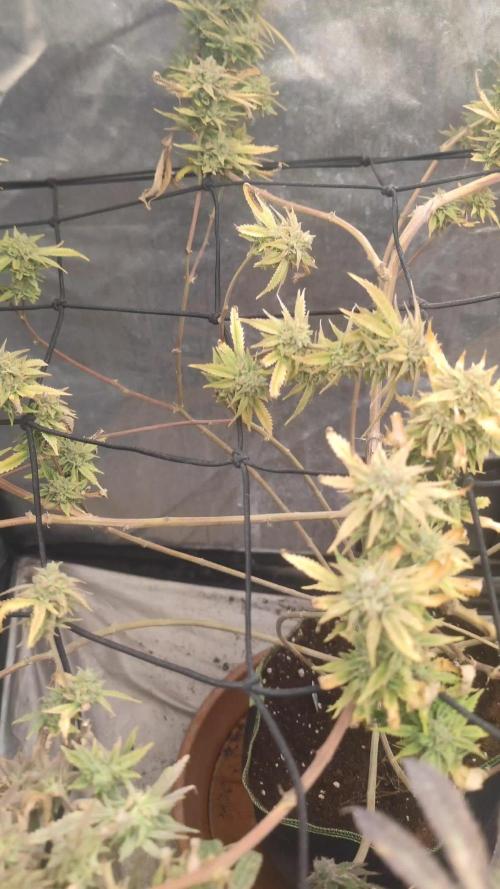
Puues ya queda meenos, o una semana si corren o dos, pero no mas. Las puntas blancas! Jajajajaja blaancas infestadas de resina.
Likes
6
Share


@Genussmittel420
Follow
day 1 - shes getting her sugar on the leafs now clearly and you can start to really notice her smell after just a few minutes of the tent being open. not too strong of a smell yet but there is still much time to improve, really happy with the bud developement so far!!!
day 4 - trichome producktion is just kickin off since 1-2 days, love to smell her sweetness. stretch has come to a stop a few days also.
day 6 - when i opened the tent today she was showing me her flowers big. there was a big diffrence visible for my eye from last open yesterday to today and i like it! the pistils on the main bud start to get orange color and the others also seem to get a few pistols with color totay!
Likes
12
Share


@GirlGoneWeed
Follow
Plants continue to enjoy the heat of the summer,
Growing big fat leaves, going bone dry from sunrise to sunset and drinking lots of water every day at dusk. Some mild calcium deficiency started appearing the yellowing of the leaves with brown-ish spots, corrected with foliar spray Element XX (calcium supplement)
I have also introduced my spray homemade pesticide with natural ingredients, you can find the recipe on my Instagram @Girlgoneweed (under the highlights), spraying 2x a week to keep rodents, deer, aphids, mites, mildew and other threats away.
Thanks for following along, Happy Growing !! xoxo


Likes
40
Share


@MadeInGermany
Follow
Info:
Unfortunately, I had to find out that my account is used for fake pages in social media.
I am only active here on growdiaries.
I am not on facebook instagram twitter etc All accounts except this one are fake.
Flowering day 1
since time change
to 12/12 h.
Hi guys :-) .
The time has finally come 👍
You have been switched to 12/12 hrs and are ready to flower.
Of course, cuttings were cut beforehand to keep the genetics.
For 4 days now she has also been getting Fast Buds from GreenBuzzLiquids.
They were also sprayed again with GBL Fast Plant spray.
She is very healthy and I am excited to see how she gets going again in bloom :-).
This week it was poured twice with 1.2 l each time (for nutrients, see nutrient table above).
Then I filled canisters with fresh osmosis water for the next few weeks 👍.
The tent was cleaned and every plant was checked for health.
At the moment I am tinkering with the ventilation because there are currently 4 fans with 4 activated carbon filters running, which I want to make more efficient by putting a hose through 2 tents.
These are the things about which you desperately at the beginning but learned from them in the end.
I wish you all a nice week.
Stay healthy 🙏🏻
You can buy this Nutrients at :
https://greenbuzzliquids.com/en/shop/
With the discount code: Made_in_Germany you get a discount of 15% on all products from an order value of 100 euros.
You can buy this Strain at :
www.Zamnesia.com
Type:
Runtz
☝️🏼
Genetics:
Zkittlez x Gelato
👍
Vega lamp: 2 x Todogrow Led
Quantum Board 100 W
💡
Bloom Lamp : 2 x Todogrow Led
Cxb 3590 COB 3500 K 205 W
Soil :
Canna Coco Professional +
☝️🏼
Nutrients :
Green Buzz Liquids :
Organic Grow Liquid
Organic Bloom Liquid
Organic more PK
More Roots
Fast Buds
Humic Acid Plus
Growzyme Big Fruits
Clean Fruits
Cal / Mag
Organic Ph - Pulver
☝️🏼🌱
Water: Osmosis water mixed with normal water (24 hours stale that the chlorine evaporates) to 0.2 EC. Add Cal / Mag to 0.4 Ec Ph with Organic Ph - to 5.8

Likes
10
Share


@PolezGardn
Follow
week four flower everything looks fine so far :D
I water them with 1.5l every 48h
the light I use was set to 100% and it hangs 80cm away from the tops
Likes
21
Share


@Rap_a_cap
Follow
No rain from April, it rains the day before the harvest........WTF
Perfectly ripened, this half of a plant will become among the prettiest buds ever grown. See U in few days for harvest.
Spoiler: great smoke!