Likes
Comments
Share
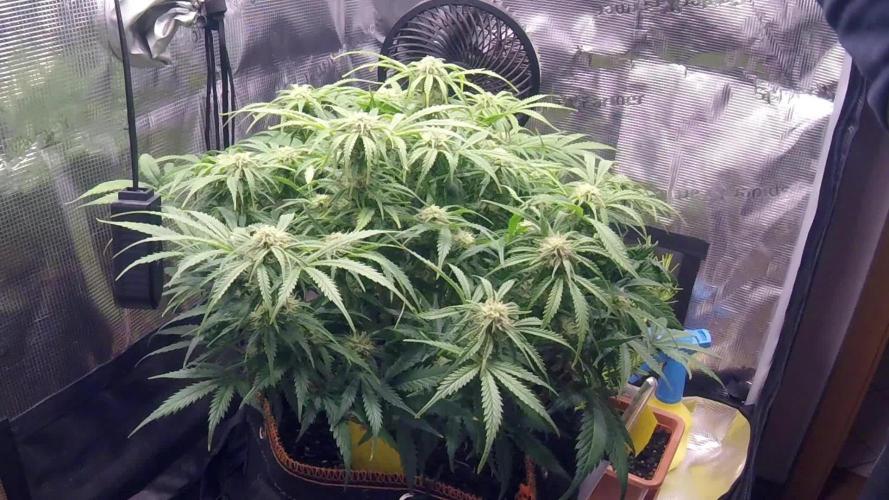
Protejere a mis nenas 2 semanas más seguirán en exterior pero las pondre en un lugar que no se mojen tanto con la lluvia igual aprovechare las lluvias para regarlas en cuanto necesiten agua estás bellezas y les he colocado un poco de lombricomposta esperando que tenga buen efecto en ellas.
Likes
23
Share
The plant was harvested on the 73rd day. It was hung not as a whole plant but by separate bud sites. Bud sites had the larger fan leaves removed before the drying process. Temps for the drying were 62F 55%RH for 10 days. She then had a quick cleaning of sugar leaves and jarred for cure. Final report will be coming shortly.😍 Final report: (Smoke report not loading comments) After months cured in a jar I rolled up a joint and smoked it. It had a nice smooth smoke with the flavor of vanilla cake/cookie . She also had a hint of citrus. After the harvest was done I prepped the area for next year's outdoor grow. I will continue to prep the area for the next few months by adding goodies to the area to bring in the worms.😍
Likes
12
Share
@Brickie74
Follow
This week went well. No issues and the Snak plant grew 2 inches this week. She looks healthy and strong. I will be doing a little more research on topping this strain. I have never grown anything from Mosca Seeds. I don't know this strain well so I want to know if it will be tall and thing or short and bushy or something in-between before I decide if I should top her o not.
Likes
61
Share
Trichome check I’ve discovered she is around 30% Amber. 🛋️🔒 Going to have to chop her down now. She sure is frosty ☃️❄️🏂 No purple in sight 👀 😬😒😪😢😭 30% amber GGGGGGGGGodaaam 🤯🤯🤯🤯🤯
Likes
16
Share
Sep 7: nice lemony smell happening and the buds are forming. Not a particularly fast flowering plant but it’s going good. Sep 8: got some time under the UV light this afternoon. Once the Blueberry Pie is done she’ll get more UV light hours but for now she has to wait her turn. Sep 12: cool nights starting to cause some purple colour. Nice smell to her, but really leafy and seems a bit slow. Watered with potassium silicate and cal-mag today.
Likes
5
Share
Всем привет друзья! Не много заработался, не до репортов было! Ни чего не буду говорить плохого и хоршего. Давайте дождемся харва и посмотри что покажут веса. Куст не много капризный, рос в постоянном необоснованном стрессе. Не знаю что ему не хватало. Все приборы показывали на отлично! Всем мира и добра!
Likes
25
Share
Week 2 has started. So far i‘m very happy with Advanced Nutrients.
Likes
20
Share
@Tracie67
Follow
All is good. Plant is starting to turn yellow and the trichomes are getting cloudy. I think I have another 2 weeks until time to chop. Very excited with this one.
Likes
2
Share
Remember that, however you are played, or by whom, your soul is in your keeping alone. Even though those who presume to play you be kings or men of power, when you stand before God, you cannot say, 'But I was told by others to do thus,' or that virtue was not convenient at the time. This will not suffice. Remember that. Day:18 84°F and 65% RH (VPD) for the vegetative stage. Approximately 1.15kPa(assuming leaf temperature is about 2°F cooler than the air), which falls right into the ideal vegetative sweet spot (0.8kPa to 1.2kPa). At 1.15kPa, plants can draw water and nutrients efficiently without risking stress or wilting. It keeps the leaf pores (stomata) open, allowing for ideal carbon dioxide intake and maximizing vegetative growth. VPD is determined by the leaf's temperature, not just the ambient air. Because leaves usually run 1° to 3°F cooler than room air under bright grow lights, my actual VPD will be slightly lower, closer to the 1.0kPa mark. As she transitions from vegetative growth to flowering, one can gradually lower the humidity (to around 45–60%) and drop temperatures slightly to prevent disease from settling inside dense buds when they appear. Night:6 At 70°F and 60% relative humidity, Vapor Pressure Deficit (VPD) is 0.86 kPa. This is right on the cusp of whats optimal for the vegetative stage. During the nighttime, plants generally close their stomata and undergo cellular respiration rather than photosynthesis. Transpiration slows to a near stop, making VPD less critical at night than during the day. However, maintaining a nighttime VPD between 0.8 and 1.0 kPa is highly beneficial in that it ensures the air is dry enough to prevent powdery mildew or bud rot, but moist enough to keep the plant from undergoing unnecessary stress. This range keeps the environment comfortable for cellular processes and prevents large atmospheric swings. Keeping it all flowing. (Not pushing them yet, these are photoperiods) The optimal soil (root zone) temperature for cellular root respiration and nutrient uptake in cannabis is between 68F & 72F This narrow range balances biological energy production (cellular respiration) with the dissolved oxygen levels in the soil, maximizing plant growth and health. Warmer soils hold significantly less dissolved oxygen. When soil temperature exceeds 74F oxygen depletion occurs, inhibiting cellular respiration almost entirely, At 68-72F root cells generate optimal adenosine triphosphate (ATP) via respiration to power root-tip elongation and the active transport of water and nutrients. Too Hot (Above 78F) Root respiration increases, demanding more oxygen, while the water's oxygen-carrying capacity drops. This creates a prime environment for anaerobic pathogens and Pythium (root rot). Too Cold (Below 60F) Root metabolism and cellular respiration slow to a crawl. This severely impairs nutrient and water absorption, leading to yellowing, wilting, and phosphorus deficiencies. A lot depends on whether it's automatic or photoperiod; with photoperiod, there is not as much of a need to push "hard" as the real countdown only begins once the flower is initiated. Automatics, on the other hand, the chronological "clock" begins ticking the moment the seed germinates. It is of critical importance that the seedling growth gets off to the races, understanding that early growth is like compound interest, which will pay off come harvest. This reality is why getting autoflowers "off to the races" early on yields such exponential benefits. The "compound interest" is directly related to the surface area of the leaves. Larger, faster-growing seedlings process more light and build bigger root networks early on, which translates into an explosion of vertical and lateral growth during their short vegetative window. The margins for error are so thin with autoflowers; this early-stage momentum depends on several critical practices. Seedlings exposed to increased atmospheric CO2 levels early in life will develop at an increased rate. To effectively "extend" or optimize the capacity of Photosystem II (PSII) for increased photosynthetic efficiency. In standard oxygenic photosynthesis, Photosystem II (PSII) is naturally limited to the red-light spectrum, peaking at 680nm. Extending its light-harvesting capacity past 700nm into the far-red region requires bypassing the natural limits of standard chlorophyll a. Adding 730 nm (far-red) LEDs alongside standard red/blue lights has been shown to increase canopy photosynthesis by 20–30% in several crops by acting synergistically with shorter wavelengths. However, the limitation is that excessive, pure IR/Far-red light (without accompanying red light) can trigger the "shade avoidance response," causing plants to grow tall, weak, and spindly rather than robust. Utilizing infrared light (specifically the 700-750 nm far-red range) is a viable method to boost photosynthetic efficiency. It acts as a bridge to allow PSII to utilize a broader spectrum of light, breaking the traditional 700 nm barrier. UVR8-mediated signaling (often in conjunction with CRY proteins) triggers protective mechanisms that maintain the stability of the photosynthetic apparatus (including LHCII and reaction center proteins), thus ensuring that the efficiency of Photosystem II remains higher in UV-B-exposed plants compared to plants lacking this receptor. ΦPSII indictates the rate of electron transfer from water to plastoquinone, which drives the production of ATP and NADPH. There is a close link between ΦPSII and the true rate of CO2 fixation (Φ*co2). ETR stands for Electron Transport Rate. It measures the speed at which electrons are moved through the thylakoid membranes in a plant's chloroplasts during the light-dependent reactions of photosynthesis. Infrared light (particularly Near-Infrared or NIR) improves cellular energy by interacting directly with the electron transport chain (ETC) in mitochondria. This process boosts adenosine triphosphate production, which acts as a metabolic coefficient multiplier by accelerating enzyme activity dramatically. Extend then multiply. Far-Red photons interact with plant photoreceptors to accelerate the plant’s biological "clock" or trigger a shade-avoidance response. Autoflowers don't use the plant's biological clock, although the IR will initiate a shade avoidance and make them stretchy. You can just add equal measures of 660nm-680nm to negate the shade avoidance effect. Replacing nights' "darkness" with a combination of IR+ and 660nm. Because autoflowers don't require a dark period to flower, many growers just blast them with light. 18/6 24/0. However, this ignores the plant's metabolic rhythms, where daytime photosynthesis (light reactions) must be perfectly balanced with nighttime carbon fixation and assimilation (Calvin cycle) to avoid bottlenecking plant development. Cellular respiration is a 24/7 process, but it can only function while the plant has the free oxidative capacity to do so. A 100% photosynthetically active leaf cannot perform cellular respiration. The viral trend of defoliation of every leaf that isn't "getting enough light" is of great detriment overall, putting 100% of the cellular respiratory "workload" and responsibility on the 0/4/6 hours of darkness in sub-optimal conditions for enzymatic activity. Photosynthesis captures nearly 100% of the initial energy as carbon, while cellular respiration is the process that unlocks 90% of that captured energy into usable ATP so the plant can use it. Respiration is considered only roughly 30% to 40% efficient. It captures enough of the potential energy in glucose to synthesize around 30 to 38 ATP molecules per glucose molecule. The remaining 60% to 70% of the energy in the sugar is not captured in ATP; instead, it naturally escapes into the environment as heat, which helps regulate plant temperature. In plants, the primary enzymes of the Electron Transport Chain (ETC) and the ATP synthase complexes are typically adapted to function optimally in warmer temperatures (roughly 77°F to 95°F, depending on the specific plant strain). As temperatures rise within this physiological range, molecular collisions increase, speeding up respiration and ATP production. The cannabis plant has a branched respiratory pathway. During heat or cold stress, plants activate Alternative Oxidase (AOX). AOX burns sugars to dissipate energy as heat rather than coupling it to ATP production. This pathway actually functions optimally at elevated temperatures to help protect the cell from the damaging build-up of Reactive Oxygen Species (ROS) during heat stress. Enzyme activity generally scales with heat; there is a strict biological limit. If canopy temperatures in a grow room exceed 104°F, the enzymes and their supporting lipid membranes lose stability. Not saying you need to go crazy, just optimize nights the same as we optimize days. Phosphorus is the driving force behind early seedling development. It acts as the "energy hub" of the plant, directly driving cell division, robust root growth, and the creation of DNA. Without an adequate, easily accessible supply early on, the plant's overall growth potential and final yield can suffer permanently.
Likes
18
Share
Last week I fought some yellowing of the leaves. Did some small adjustments on PH to keep it in the 5.6 range. Seemed to stop it from progressing. For Week 3 Veg I topped the plants. I plan to flip the lights at the end of week 3 and move into flower. Lights are still at 25% power Day 17 Leaves are getting darker. Everything is looking good. Day 18 Turned room temp down to 73F from 76F. Fearing it is warming up my res tank too much. Day 19 Starting to get yellowing again. checked everything and can't find a good reason for it. Did notice some cloudiness in my res tank. Added 2 ML/Gal of peroxide. have Hydroguard on the way to help. I'll be adding more fans this weekend. I have light air movement currently. Also found a few spider mites and sprayed Greencleaner to all plants. Current environment settings: Room Temp 72.74 F Room Humidity 63.63% (After spraying, Trending down). Room CO2 589PPM Tank PH 5.718 Tank PPM (500 Scale) 813 Tank Temp 74.5 F Day 20 Recalibrated my EC probe just to be sure it was also accurate. wasn't off by much. Dialed back my flooding to every 5 hours to encourage Rooting. <-- Strong roots = strong Plants Sprayed for mites again.
Likes
6
Share
@DE_BW
Follow
Day 37 marks the official start of flowering, with strong stretch, healthy pistil formation, and a fully stabilized canopy after completing all LST work. Feeding is set at 2-2-2.5 (Micro/Grow/Bloom), no additives yet, and root pressure looks excellent with visible post-watering guttation and vigorous growth. Environment is stable at 23.5°C and 50% RH, main light runs at 100% from 80 cm to allow stretch before lowering both lamps for full flowering intensity next week.
Processing
Likes
45
Share
@SupaDank
Follow
End of day 27 flower for White Widow and Royal Gorilla. White Widow seems to be packing on more weight then RG but both are starting to get frostier by the day. Day 3 flower for Platinum Banana and Critical. They are showing flowers now Lollipop all 4 girls and changed all reservoirs to fresh nutrients. WAiting to refill my CO2 tank so these girls can pack on my weights. Take care and keep growing my friends...
Likes
16
Share
@simps
Follow
Ok so I transplanted pheno one growing pretty good not bad happy with growth pheno 2 is growing really strong looking like a good plant so all is well I transplanted into 2 gallon plastic pots I’m using fox farm ocean forest soil no additional Supplement mix just straight out of the bag I do add a little bit of extreme gardening root booster The soil’s pretty good I’ve never really needed to add too much to it
Likes
11
Share
@Chubbs
Follow
What up fam, weekly update one these lovely girls. They're doing ok, especially for only getting calmag and Ph'd well water up to this point. I'll introduce Bloom nutes this coming week as it looks like this will be the last week of Veg. Next the preflower stretch begins. All in all Happy Growing.
Likes
29
Share
calyxes are swelling. pistils are starting to ripen curling inwards and turning orange. Trichome production is getting higher. I committed a mortal sin and squeezed a bud with my hands. It was pretty dense. I was pruning a few fan leaves on the main cola that were blocking a lot of light and accidentally cut a bud off. I dried it and concluded that I lost about a gram 🙁 The nug was pretty dense for being only 5 1/2 weeks at the time.I hope they are rock hard when ready. There are some of the most unique terpenes I've ever smelled. They smell like sweetened condensed milk with a sour earthy smell with a hint of skunk. My cat loves cannabis leaves....
Likes
2
Share
@CalGonJim
Follow
5/5 MONDAY Took out the AC Infinity lights and just went with the 2 cheap blue and red lights. Samsung 301B.. H?....great lights but so powerful and no blue red combo. I noticed the plant grow towards the red spectrum LED than the whiter ones on the AC system. There are 2 on each bar. I use the AC lights as auxiliary when I get need it for taller plants with lots of vegetation. 2pm looking great. '"Sir, I have seen nae deerskin treaty, nor have I seen fairies or water sprites. But what I do have are Malay coins, enough to bury you. Prayer beads, not enough to get you to heaven. And hashish, enough to ease my grieving when the East India Company slit your throat, which, of course, they will." ― Brace in a conversation with James. 5/5 11pm Monday night, MORNING for me.....WHAT IS THIS????? CONKEY IS ALIVE!!!!!! CONKEY IS ALIVE!!!!!! CONKEY IS ALIVE!!!!!! CONKEY IS ALIVE!!!!!! CONKEY IS ALIVE!!!!!! HOLDY SHILT I CANT BELIVE IT, NOW WHAT THE FUCK DO I DO???? I GOT OUTSMARTED BY A SEED!!!!!! A-FUCKING-GAIN!!!! HOW CAN I NOT BE SMARTER THAN A SEED....??????🚨 5/6 1230am..... ALL OF THIS IS SOMEONE ELSE FAULT....... Now I have a freakshow Siamese twin plant, PERFECT. When Im not flying off in a rage about things I break....it's a fucking comet of disaster.... I typed comedy you stupid ficler.... Maybe I keep them in the same pot and call them Cory & Trevor!!! 2am They are getting a little humid so I have to open the top for a while. The cheaper lights work better. and are less than 15w 5/7👍🚨Looks like Cory & Trevor are fighting 😂😂 5/8 looks good. 8am getting great photos on small iPhone by pulling back a little bit so it doesn’t focus too far behind. 5/10 2am. I was able to empty my disgusting body of toxic shit...these plants are rebuilding by digestive tract and systems. A multi-year painful endeavor I have achieved through weed. so fuck you if you dont like it. I will defend my rights with overwhelming force. if you try and take it. you know exactly what I mean and yes this means you badgey mc fafo. 5/11 12 pm
Likes
15
Share
@Uwish
Follow
Hello guys, Here I am again to present you a new run, still with the best leds of the market nevertheless as I changed my growing space from 120x120 to 150x150. So I had to update the material inside... I will run with 3 EVO 5-150 lamps of 320W or 960W with Bluetooth dimmers. For the Hydro system, it will be the V-SYSTEM from Alienhydroponics. In fertilizers I am always with Advanced Nutrients. I work with osmosis water. Currently, 4 clones took on 4. Once the roots are ready, I will transfer the cuttings from the propagator to the V-SYSTEM. ------------------------ since the 16/08, when I transplanted the plants in the RDWC system, I noticed some points that I will mention below and correct next time. 1. The cuttings are too small, allow enough time so that I can completely fill my pots with clay balls. 2. Cut out the bottom of the pots from the cuttings. 3. 3/4 of the cuttings are touching the water, so one is late. Next time when transplanting, add more water, up to the basket in order to immerse all the plants and not to create a difference between each one, consequence now I have 3 that are ready to explode and one that will struggle behind, problem corrected today by increasing the volume of water. 4. The b-52 is a real pain in the ass in RDWC, you have to clean the 2 filters almost every day, with this new soup I'm testing without and I think I'll continue like this just with the base sensi grow A and B, as I use Root rot X, I won't use voodoo juice since all the bacteria would be killed. 5. Use of Voodoo Juice is useless if using Root Rot X which will kill the bacteria. I don't know why but when I transplanted in the RDWC, I put my set up in growth mode, except that the plants were not ready for it, moreover, I made a FIM on each. So I lost some days, these last days I went back to a ppdf of 150, now that my roots touch the water, I declare growth 0 on 22/08, I will do between 21 and 28 days of growth. And as my roots are doing well and touching the water I'll go to a PPFD of 300 ++
Likes
55
Share
@BodyByVio
Follow
Just got done with trimming the 4x4 @greenhouseseedco Super Silver Haze / @blimburnseeds Silver Surfer Haze tent. The final yield is exactly 1000g plus some (kind of a lot)that I smoke in the last 2 weeks 😃 Also got 6, gallon size ziploc bags filled with good quality trim for concentrate. To be honest I was expecting a little more but keeping in mind that this grow I did not supplemented with bottled CO2 I think I’m good with the results. Definitely I enjoyed a lot this grow and I’ve learned even more.
Likes
8
Share
@Elixire
Follow
Flipping the light to 12/12 start to see some stretching. They looking good but the canopy is not actually well leveled. Lets wait for them to completely stretch