




Likes
Comments
Share

@Growitworldwide
Follow
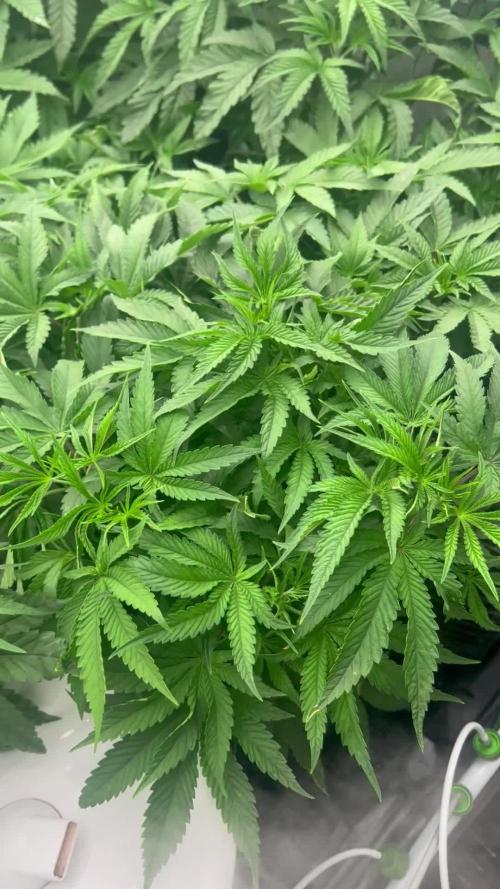
They are huge. I think I will start doing defoliation 2 times per week.
PH 5,5 - 5,7
EC 2,50 - 2,75
See you next week guys!

Processing
Likes
8
Share


@Caribbeangrower971
Follow
Sorry no photo for weeks 4 and 5
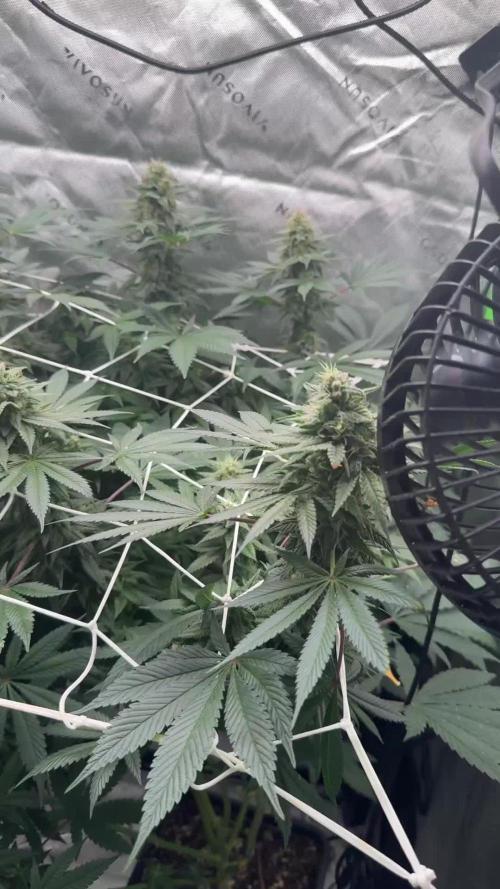
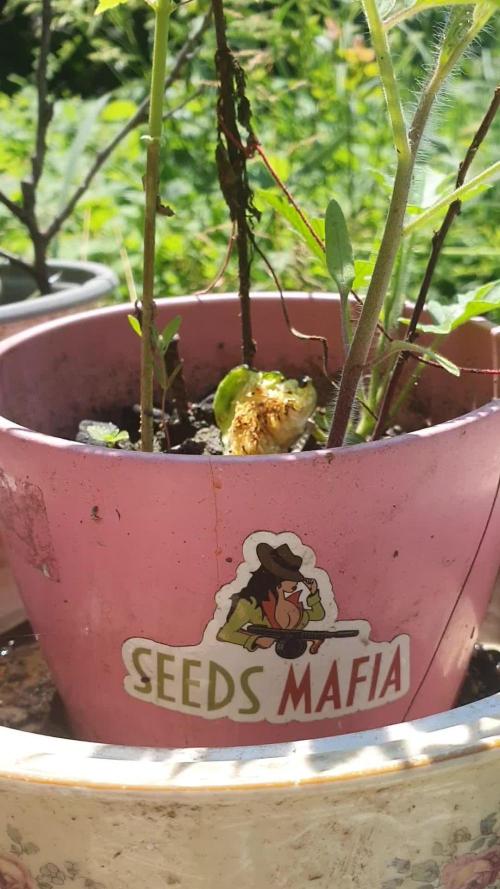
Week 4 still veg
Week 5 start bloom i let them out now for 12/12light schedule
Week 6 pistils are comming everywhere
Stretching is close to the end
all organic (medium nutrients sun)

Likes
3
Share



Likes
3
Share


@jaydee702
Follow
finally stopped stretching this plant stretcheed for an extra week and a half before blooming . havent seen any male flowers .She is looking like shell take all of 9 weeks flowering to full ripeness.
Processing
Likes
12
Share


@rhodes68
Follow
9/14 Week 9 and she is doing fine
Little vid she is front rt
Nuets not changing for now
9/16
Doing well but some white tips are saying we gotta reduce the salts so will be dropping CT nuets 10% and upping PK to 2.5
Extra space is really doing them well
Defoliation again tonight the war on stemmed leaves has begun
9/17
Held a meeting of the minds and decided the best course of action is to flip the light schedule so I can feed them more appropriately, twice a day.
Leaving nuets as they are as this will drop pot EC. Setting the alarm for the AM before lights out at 7:30 and changing the sched to 6AM-6PM summer is done no need for current schedule. Lights be out from 7:30AM to 6AM long I know but should not bother them.
9/19
Lights on girls feed buds look fine
Video enjoy


Likes
2
Share


@kissrubb
Follow
Actualización 05/10/2024
¡Hola, growers! Perdón por no poder compartir las semanas completas, pero poco a poco volvemos a la normalidad. Las fotos que ven corresponden al día 01/10/24 y, como pueden ver, están llenas de terpenos y tricomas por todas partes. Tanto la Fruit Gum como la Biscotti x Candy Rain son dos de las cepas más resinosas que he cultivado y, además, desprenden un olor increíblemente fuerte.
La Fruit Gum tiene esos toques dulces y nostálgicos, como a chicle de mascar, que me transportan directamente a mi infancia. En cuanto a la Biscotti x Candy Rain, su aroma es como el de una clásica galleta americana casera, ¡muy intenso! Ambas cepas me están impresionando mucho por su resinosidad y aromas únicos.
Cabe destacar que las genéticas de Uktha Genetics me han sorprendido gratamente; los resultados están siendo fantásticos. Eso sí, estas cepas comen como camiones, pero mientras se mantenga un control exhaustivo de las fertilizaciones y del medio de cultivo, no hay problema de sobrefertilización.
Pronto cortaremos una de las plantas que está bastante adelantada. Espero que disfruten tanto como yo este proceso y, como siempre, ¡buenos humos para todos! 🌱💨

Likes
80
Share


@TheCannaProphet
Follow
~MERINGUE by DUTCH PASSION~
Well friends, here we go on another 'canna-venture' together!
The grow room has had a complete remodel and some upgrades done to it including brand spanking new 4x8 and 4x4 tents and a Trolmaster Hydro X controller along with a new Control Panel.
This strain by Dutch Passion is one of my all time favorite strains that I've cultivated previously with phenomenal results so I'm looking forward to seeing what this girl has to offer when she's grown to her full potential!
I'm going to things a bit different this time around. I have a brand spanking new AC Infinity 4x4 tent and was just given one of HLG's newest lights for 2022, The Blackbird! I've got this 600w monster hooked up to my Trolmaster Hydro X Controller so I've got full control over timing, dimming and Sunrise/Sunset. This beauty is going to annihilate the 4x4 for sure! 😎👍
I'm going to grow her all by herself and veg her for around 70-90 days after witch I'll install a trellis net in the tent and spread her out. Once she's recovered from her 'net training' I'll flip her to 12/12 and hang on! 🤪
It's ALWAYS been a blast for me growing strains from Dutch Passion because their genetics are extremely stable which allow me to just concentrate on the essentials: Light, Environment, Water, Nutrients and possibly a bit of LST... not complicated, just basics like keeping a constant temperature and RH in the tent at a level that gives a good VPD, watering when almost dry and maintaining proper light levels according to their stage of growth and they REWARD you with some of the most EPIC cultivars you've ever grown! 👍👍👍
____________________________________________________________________________________________________________________________________________________________________________________________________________________________________________________________________________________________________________________________________________________________________________________________________________________________________________________
~STRAIN INFORMATION**~
~Unique USA genetics~
~Very sweet aroma and fruity flavors~
~Compact buds with one of the highest THC levels~
~Quality of the flowers is top-notch with an amazing bag appeal~
Meringue has a very sweet aroma and fruity flavor
Meringue is a hybrid indica/sativa strain with a complex fruity aroma that leans to the tangy side of the spectrum but a bit sweeter. It smells like oranges, mango and honey with some earthy, sour hints. Her aroma profile is also very pungent.
Meringue is a connoisseur’s delight
Meringue is a high-quality strain. She might not be the biggest overall yielder but the level of quality is definitely a reason to keep growing her again and again. Expect solid yields of stunning looking buds. Although the flowers can be a bit smaller, they are rock-hard and thus will still put down some weight on the scale.
When handled well she will deliver you some of the most beautiful looking nuggets on the planet. The dark hues in the flowers and leaves makes the white layer of resin really pop out for an eye-catching bag appeal.
Meringue is grown by crossing Wedding Cake x Animal Cookies.
Wedding Cake, also known as Pink Cookies, is a USA cross of the famous Girl Scout Cookies and Cherry Pie. These 2 strains make for the intense sweet tangy taste of the variety. It is also noted for its extremely high THC content.
Animal Cookies is another popular USA variety which is a child of the legendary GSC line and Fire OG. She is a clone-only variety that flowers in about 9 week and grows very dense and compact buds that can show some dark coloration in the flowers. This strain has a sweet and sour aroma with a strong body-effect that will suit the more experienced smoker.
-The genetics used to create Meringue ensure the following characteristics-
~A sweet tangy aroma from the Wedding Cake
~The dense, compact and colored buds from the Animal Cookies
~High potency levels thanks to both the Wedding Cake and Animal Cookies genetics
Meringue is top-notch variety with a high cannabinoid profile and an intensely sweet, pungent aroma.
~Meringue Effects~
Meringue is a crossing of 2 popular hybrid USA strains. She leans a bit more to the Indica side which is shown in the shorter flowering time and bud structure. The effect of the variety is quite euphoric with a powerful sense of well being and relaxation. When you smoke more during a short period of time you will be rewarded with a deep body stone which could give a couch-lock experience.
Meringue feminized seeds vs Lemon Meringue strain
Any fans of the USA Lemon Meringue variety will love the Dutch Passion Meringue. Both varieties share a THC rich high and a connoisseur flavor profile. However feminized seeds of the Dutch Passion Meringue are thought to produce frostier plants and a superior vaping experience.
-The growth and flowering time of Meringue-
We recommend a veg period of about 4-6 weeks for these feminized seeds. Meringue can have a bit of a slow start while showing some stretch during the latter part of the grow period. On the other hand, she doesn’t stretch a lot during flowering, so she can be a bit challenging to understand. Meringue can have quite an unusual growth pattern with leaves that have elongated stems and which are pointed upwards with some distance to the main stem. This requires the use of certain growing techniques, like leaf tucking, to make sure she receives sufficient light from top to bottom.
Meringue stays fairly compact and within 3-4 weeks there is already a lot of resin on the flowers. After 6 weeks of flowering the buds start to show orange pistils, they seem to ripen quite fast. Luckily all plants show amazing resin production, making them very appealing to the eye.
The flowering time is about 8 weeks. In combination with the recommended veg phase, it will take around 12-14 weeks from cannabis seed to harvest.
The yield of the Meringue
Meringue produces XL harvests of top-notch quality cannabis; between 400 and 500 grams per m2 is possible. The buds are really frosty and dense.
Our expert advice:
Meringue is the perfect strain for professional home growers or licensed producers looking for a variety with the highest possible resin levels. Buds are literally coated in layers of resin. We would recommend to look out for the plants which show the most hybrid leaf and plant structure.
These are generally the biggest and best yielding phenotypes. Consider using a UV light during the last few weeks of flowering and notice how the trichome production goes into overdrive. If you’re looking for something truly unique with an amazing bag appeal then please look no further, Meringue is the strain you need!
~More info about Meringue
Meringue isn’t the most straightforward plant to grow so she can be a bit challenging to understand. The thing that stands out the most is the slightly unusual growth pattern, therefore more leaf picking is necessary, otherwise the lower buds will not receive enough light.
Because of the slightly larger internodal distance, buds don’t have the tendency to become really big, which could make her a bit more interesting for growers with higher humidity levels. There should be enough fresh air around these flowers though, because they become rock-hard.
Buds are covered in trichomes, lab results showed all phenotypes were close to and above 20% THC, suited for hardcore smokers.
** Credit to Dutch Passion
____________________________________________________________________________________________________________________________________________________________________________________________________________________________________________________________________________________________________________________________________________________________________________________________________________________________________________________
~THE SETUP~
~Initially seed was lightly scuffed, then soaked for 3 hours in 78℉ distilled water after which it was transferred to a moist paper towel laid out in a Jiffy Pellet plastic starter tray with lid. Underneath the tray was placed a Mars Hydro Heat Mat with Controller that was set to 78℉ where it stayed until a tap root emerged.
~Planted into Jiffy Peat Pellet that was hydrated with distilled water warmed to 78℉ with a 7.0 ph.
~Once roots emerged from the Jiffy Pellet she was transferred to a 1qt plastic pot. As she grows I'll be moving her into larger pots along the way up until she's in her 10g fabric pot.
~Grown in a 10g fabric pot filled with Mother Earth 70/30 Coco/Perlite medium and fed Dutch Pro nutrients throughout the entire grow with de-chlorinated water ph'd @ 6.2-6.8.
~19/5 light cycle for vegetation, then 12/12 to flower with supplemental UVA added during the last weeks of flower. Lights are controlled by a Trolmaster Hydro X controller set for a 15min Sunrise/Sunset simulation.
~ Supplemental co2 provided throughout vegetation and flower - monitored and controlled by an AutoPilot APC8200 co2 controller.
____________________________________________________________________________________________________________________________________________________________________________________________________________________________________________________________________________________________________________________________________________________________________________________________________________________________________________________
Weekly Updates:
12/1- I soaked the seed for 3 hours in 78℉ distilled water after which it was transferred to a moist paper towel laid out in a Jiffy Pellet plastic starter tray with lid. Underneath the tray was placed a Vivosun Heat Mat with Controller that was set to 78℉. After 30 hours she had not popped open yet so I soaked another seed for 3 hours and then into a paper towel and onto the heat mat it went.
12/3- This afternoon I checked and the seed had a root that was about 1/4 to 3/8" so at 5 pm I transferred it into a Jiffy Peat Pellet that was hydrated with distilled water warmed to 78℉ with a 7.0 ph using a tine off of a plastic fork as a 'mini trowel' to make a hole in the pellet and to gently cover the tap root, leaving only the seed head slightly exposed. This method accomplishes most of the initial work the seed has to do by eliminating having to orientate itself, push it's root down and head up. By the next morning she had her cotyledon leaves opened!
12/5- Well this is Day ONE for the Dutch Passion Meringue! I'll keep her in the covered/heated Jiffy tray until I see her roots beginning to emerge from the peat pellet, then I'll transfer her gently into her 2qt plastic starter pot to begin growing.
12/7- Today when I checked her, she had roots just starting to emerge from her pellet, so tomorrow I'll transfer her into her 'starter' pot.
😎💚 Thank you for checking out my passion in life! Please visit as often as you wish and I hope you enjoy this journey as much as I know I will! Grow Strong! 💪😎🤙
Likes
13
Share


@Limelight
Follow
It was relatively easy. Thanks to all growmies that helped me along the way!!
Likes
3
Share


@Naujas
Follow
42 days!!!! the girl looks very good :) she is already blooming :) the girl drinks every other day with 6.3 ph water and biobizz nutrients, next week I will give her more than 1000ppm :) she must like it :) so far very nice growth @FastBuds as always never ceases to amaze :) good luck to everyone.

Likes
6
Share

@BettyFlores
Follow
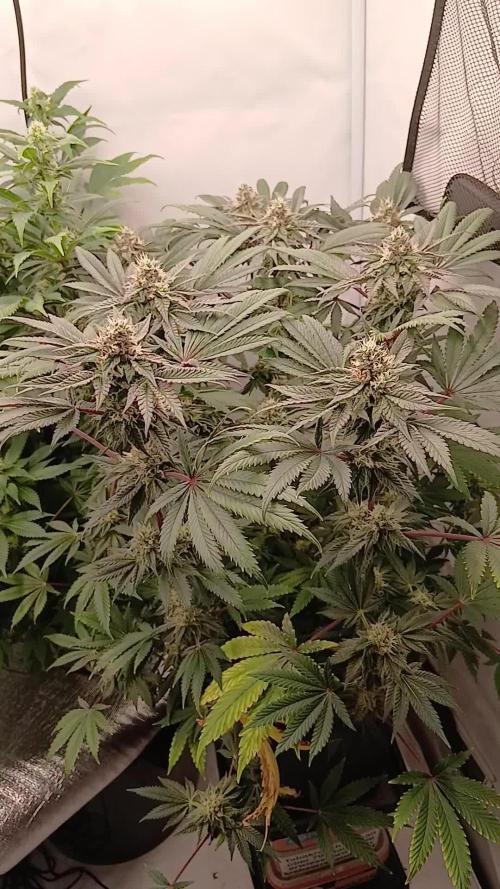
04.12.2025 Well, not much time left to be harvested. Her trichomes are already milky and the sugarleaves are very frosty. Her buds are getting bigger and the colors are really beautiful, with her orange pistiles. I'll give her some more days and check again on her. And I'm suspicious that I unintended pollinized some parts of her, while intentionally pollinating the Gelato x Black Lebanon with the Agent Orange-Male. Looking forward 🌸💜

Likes
32
Share


@hodette
Follow
So apparently ive been stoned as fuck... These plants have been in 3 gallon pots the whole time 😂 So the one plant that is a week behind the other one and I these plants look so different from each other for some reason. they are both dank as fuckkkkk

Likes
13
Share


@tiasmaaa
Follow
topping for the second time, still one more topping and we'll stop stress them and just let them grow :)

Likes
2
Share


@eldruida_lamota
Follow
Vamos familia primera semana floración de estás Pink Runtz de RoyalQueenSeeds.
Que ganas tengo de ver el progreso de esta variedad, las plantas están sanas, se ven con un color bien verde y espectacular.
La cantidad de agua cada 48h entre riegos.
Esta semana ya añadimos nutrientes de floracion estas próximas semanas veremos cómo avanzan.
Agrobeta:
https://www.agrobeta.com/agrobetatiendaonline/36-abonos-canamo
Hasta aquí todo, Buenos humos 💨💨💨

Likes
46
Share


@Rollex420
Follow
After 65 days of flowering, the Mimosa was removed and dried. I was quite satisfied with this plant. it was easy to grow and didn't need much maintenance.. the smell is exactly like mandarin as described by Barneys Farm. buds are quite heavy, very hard and compact. The harvest was weighed after hanging the plant in the tent for seven days. (54.9g) trimmed weight, Now it's drying in glass jars ✌️🏻😎

Likes
4
Share


@GODAXE
Follow
27.08.2024
D48 since cutting,
lady starting to bush like their mother, as i did nt have place for 8 massive bush in the tent i proceed to some pruning and set some bud clip.
overall look
GBC #1
16 inch, flowering
GBC #2
16 inch, flowering
GBC #3
16 inch , still in veg, 😰
GBC #4
18 inch, full bud mod 😍
GBC #5
18 inch , full bud mod 😍
GBC #6
19 inch, flowering
GBC #7
20 inch, start flowering👍
GBC #8
18 inch, flowering
i will not weekly uptade, but keep you tuned
