





@DivineBuds420
Follow
There hasn't been all that much happening this week.
The plants are still having to fight against the weather, and the partly strong winds and increasingly cold nights are definitely leaving their mark.
🌱 SIRIUS BLACK
Sirius Black is developing increasingly yellow leaves.
The yellowing is mainly affecting the older, larger leaves and seems to be slowly spreading from the edges and tips towards the centre of the leaves and further towards the stems.
It looks to me like there might be some kind of issue with nutrient uptake, although I'm not completely sure what is causing it yet.
For now, I'll keep a close eye on her and see how the symptoms develop.
This week, all of the plants received 10 ml of BioTabs Bio PK 5-8. 🌱
🌿 GOLOSA
Our mutant Golosa continues to surprise me. 🤩🌱
The two main branches that developed from her unusual growth pattern are now producing two very different-looking flowers.
The thinner main branch is developing what looks like a completely normal flower, while the thicker one is producing a strange, elongated, almost doubled flower structure.
The shape strongly reminds me of some of the images I've seen online when looking at examples of what is described as polyploid growth.
At this point, I'm obviously not saying that this is actually polyploidy — I'm simply describing what I'm seeing.
What makes it even more interesting is that the main stem almost looks as if it is made up of three stems fused together, before splitting again at the top into one single and one doubled growth structure.
It's honestly pretty wild to look at. 😂🌱
Because this plant is showing such unusual growth, I decided to take a cutting from this particular specimen as a precaution, just to preserve the genetics for now.
I'm really curious to see how these unusual structures continue to develop. 👀🌸
🌸 APPALACHIAN KUSH
Unfortunately, I found some bud rot developing in the main cola of the more advanced Appalachian Kush.
I removed the affected area quite generously for now and will be monitoring the plant very closely over the next few days.
If the problem continues to spread, I may have to harvest her earlier than planned.
That's obviously not something I want to do, especially with the flowers still having some time to develop.
On the other hand, I have to weigh that against the risk of allowing the problem to spread further.
If it does continue, the priority will be damage control rather than waiting for the perfect harvest window.
If I end up harvesting her early, my current plan is to freeze the freshly harvested material and potentially process it into bubble hash at a later point.
For now, though, I'll give her a few more days and keep a very close eye on that main cola and the other buds. 👀🌸
The weather is definitely making this outdoor run more challenging than expected.
Let's see what the next few days bring. 🤞🌱💚


@Papa_T
Follow
Day 8 Flower - Sunday Aug 8 2021
-More growth
-No Water, pot is getting light again
Day 9 Flower
-Feeding Day
4.7 Litres @ 6.41 PH / 1020 - PP
-Raised light intensity to 6
-Introduced a framenting CO2 system (it’s not a sealed tent I’m aware that it’s probably not effective at all but it’s cheap and it’s better than none)
Day 10 Flower
-Not much to talk about
-No water
Day 11 Flower
-Showing signs of possible phosphorus deficiency?
-Will feed as plant seems dry enough
- 3.8 Litres @ 6.03 PH / 447 PPM
Monitor how she responds
Day 12 Flower
-No water
Looks as if it responded well to feeding
-Buds really coming along
Day 13 Flower
-No water
-Defoliated and removed weak branches
-recharged the CO2 system
Day 14 Flower
*NOOB ALERT*
This is where I start losing it a little and my cycle of feed flush and feed and flush starts.
-Plant not looking happy at all
-Gonna do a full dose watering
-4.8 Litres @ 6.22 PH / 1230 PPM no run off


@NoProbation4Weed
Follow
bending some sticks to give better light penetration to lower parts of the plants.
Added green grass layer for bacteria and better watering ability.
Just added NeemOil one time to prevent fungus gnats. Rest of the time only watering once a day a little amount.
Terps start to develop:
Tezla OG = kushy, planty smell
Marshmallow OG = Kushy Earthy smell
Nutter Budder = Super Nutty and Calí Kushy Smell the best one out of the three yet.


@BearBuds
Follow
We have made it to the end of Week 6. Conditions in the tent have improved DRAMATICALLY. The heat wave has finally passed and the temperature has finally leveled out. Not only that, the super weird monsoon weather that we were having has also passed and now the humidity is not rising above 60%. This turn for the best is really showing and also fixing the pH problem I had also probably helped a lot. Going to push the PPM a little more this week, between 750-850 The color of the buds is really coming through now, especially in the pineapple express and zkittles. The melonsicle seems to be growing much more like a traditional sativa. I feel it's about a week behind schedule with the rest of the plants. It seems to be on a true 9 or 10 week tract at this point. I think the blue gelato is going to be a bust in terms of yield. It just got heavily over shadowed by the other three plants from the beginning. It has stayed quite small and I am not sure it will yield heavily. Hopefully the smoke is quality and I will be impressed enough with my first Barney's Farm experience to try again.


@GroloCup
Follow
After a questionable start, she's up and going, so the grow off is official! I have plugged in some organic items into a Pro Mix HP base to get this lady out of the blocks organically and get that root system spread out through the nursery pot. I fed some wicking cord through the drainage holes to make a sip system, basically bottom watering to deepen the root system development. I layered the soil into the pot so the available nutrients increase as the roots descend. I added a little mycorrhizae in the soil where the seed was placed to get things cooking and used Recharge adjusted to 6.0 pH to buffer my amended starter mix. Now that she's showing a little more vigor, I'm adding a little Kelp, CalMag+, and MegaCrop for her to sip on... A little organo-salt treatment that will make sure she's got all she needs available to allowing her to really blow up!


shorts_status_processing


@GORILLASGANJAGROW
Follow
Yeet yeeet! Everything's looking great! Still trying to use up this Nitrogen in this soil b4 I flip... Bc I haven't fed ANYTHING other than plain distilled water... I need to flush and re water with correct nutes b4 flipping to flower


@GodZilla_Owner
Follow
The buds are still growing and I have already discovered the first amber-coloured trichomes on Bruce Banner and S.A.D. #4.
I think the harvest will be ready in 2-3 weeks. Until then, I will continue to observe the trichomes with the microscope.


shorts_status_processing


@gablmo
Follow
Finally flower. They are 4 feet now. What am I going to do? I don't want them to burn into the light.


@GanjaReaper
Follow
Day 10:
They have been growing nicely. Beautifull green leafs, no deficiencies or stress.
I did some Defoliation and I'm planning to top some plants but not all of them since they make nice main colas as well.
Also nice roots so far, will let those grow for another 1-3 days before repotting them into 7L pots.
While doing that I will add some new clay for beneeth the pots to have a good run-off. I will add some mycorizza as well to improve the roots and
I will water them again with lots of Regulator(anti-stress) and Rhyzotonic( root stimilator).
Some days after that, they are ready to get pushed into flowering. Sativas like to grow twice and sometimes even more in size.
So the size which they are at the end of this week will be enough.
So at the end of this week you will see them being in 7L pots and in a bigger grow space under lots of lamps.
There are like 3-5 plants not growing nicely. Might have to kill them. I'm not going to waste time,energy,nutrients on those if they don't grow in size in a couple of days.
So might end up with just 235 plants.
Il update again at the end of this week.
Day 14:
I almost finished the rest of the grow room. I still need to adjust and replace the lamps some more and other things.
Did many defoliation below the plants. Thoose branches are never going to preduce nice and thick buds anyways. Such a waste of energy and nutrients.
Because of the removing of branches and leafs, They get a better airflow and better exposure of light as well.
So for now they look a little bit ugly haha and not so bushy anymore, but they will grow into fine looking ladies.
I kept 5 or 7 branches each plant and some bigger plants I even topped because I don't want them to stretch alot.
Another reason is that I want bigger stems. If other plants that didnt get topped, not improving stems I can still top them until the end of week 1 of flowering.
I'm putting them into flowering, by putting the lightschedule to 12hours of light and darkness. It will take a few days before they start preflowering.
The first buds will be seen in like 10-14 days.
Untill next week!



@Mighty_Monaco
Follow
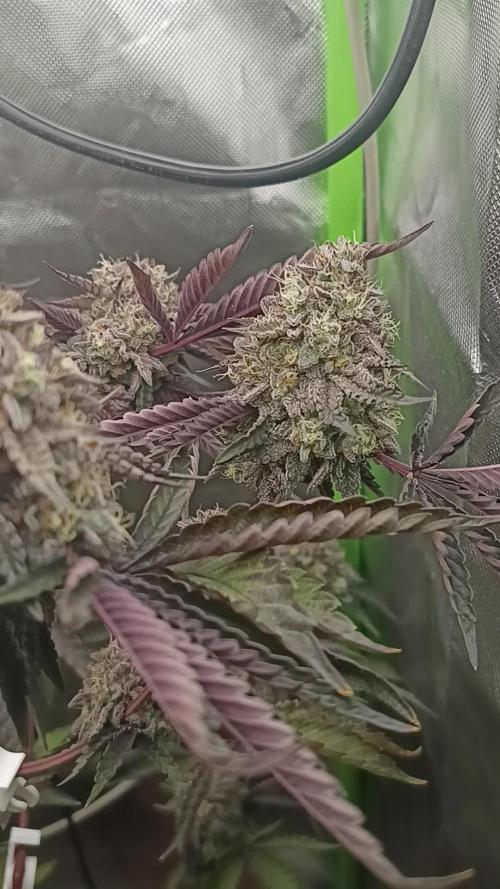
Buds are getting to heavy, i supported the main stem and a side-stem with two rods. The guy who gave me this plant, had to do the same with the mother-plant.
Leaves are very colorfull, purple and redish. Buds look awesome, you can spot trychomes with bare eyes.
I did some improvement to the closet/box. Air Ventilation is even more quiet now. An i have a cupboard in the box to store tools and other stuff.
I gave nutrition (Hesi Bloom) for the last time and will start flushing within the next days.



@Ultraviolet_
Follow
We become aware at such times of man's wonderful ability to bring seemingly unrelated elements into harmonic balance, and receive a glimpse into a world where everything exists in conscious sympathetic attunement to everything else. When we listen to a piece of music that seems to strike a beautiful chord somewhere inside us, or view a painting that simply glows with harmonic awareness well executed, we probably do not spare much time to contemplate the wonderfully intricate combination of vibrations that our sensors make it possible for us to perceive. We tend to appreciate the relationship between the parts of something by an awareness of the harmony or dissonance of the whole. This ability enables us to say "what a beautiful house!" instead of "analysis has proven that this collection of building materials exhibits certain elements of harmonic proportion." While this ability to instinctively appreciate the beauty of true harmony has an important role to play in evolution, a more analytical understanding of the laws involved can be most useful. This is especially so if we wish to create works of art where each part exists in true harmony, not only with the other part of that particular whole, but with the universe within which the creator and the created exist.
Everything vibrates. From the most dense matter to the most subtle cosmic rays, everything which our senses allow our thoughts to become aware of, can be specified in terms of wavelength or frequency of vibration. These two terms define the same thing, but from different points of view.
The following are the approximate wavelengths of various energy carriers:
Cosmic rays 0.000,000,001 mm
Gamma rays 0.000,000,1 mm
X rays 0.000,500 mm
Ultraviolet rays 0.003 mm
Visible light 0.006 mm
Infrared 0.01 mm
Sound waves 1 meter
Radio waves 300 meters
Violet light 400 nm to 450 nm
Blue light 450 nm to 500 nm
Green light 500 nm to 570 nm
Yellow light 570 nm to 590 nm
Orange light 590 nm to 610 nm
Red light 610 to 700 nm
1 nanometer (nm) = 0.000,000,1 cm = 1/10,000,000 cm
If a guitar string is plucked and we hear a sound, it is not too difficult for the human mind to associate this sound with the vibration of the guitar string. With color it is quite different. It is difficult for us to conceive that the color of a substance is not an inherent property of the substance itself, but an indication picked up by our senses of that substance's ability to absorb or reflect the light which happens to be shining on it at that moment. Neither the matter nor the light is colored. What happens is that the brain learns to differentiate between the frequencies reflected or transmitted by the substance the eyes are focused on. The same thing happens with sound. When we say "Oh! Listen, they're playing my favorite song," what we really mean is: "My brain has stored within it a particular pattern of frequencies. I have compared the new information being received with this stored pattern and have deduced the answer that the two patterns are similar within certain specified tolerances." The 'pleasure' involved could have something to do with our running the pre-recorded pattern at the same time, in 'sympathy' with the new pattern as it is received.
The word sympathy describes very well our ability to appreciate color and sound. It also describes the reason behind certain elements of harmony. For instance, if a substance vibrating at 100 cycles per second (tone 1) is in the proximity of another substance vibrating at 200 cycles per second (tone 2), we could perceive, if we had the right equipment, a certain sympathetic relationship between the two.
We will see from this that there is a uniform doubling of the first tone seen in the second. At various points along the waves, the two are the same in amplitude. At other points, they are at opposite poles to each other. This doubled frequency has more points of similarity to the original than any other frequency except the original itself. If the equipment we had available for measuring these two frequencies was a soundboard amplifier and a pair of ears, then we would hear what would sound to us like one tone. If we had the opportunity to hear one at a time, we would hear that although they sound the same, one is higher in pitch than the other. This characteristic of 'the same but different in pitch', musicians have called the octave. Any two tones produced where one has exactly doubled the frequency of the other is called an octave. Speaking in ratios, an octave would appear then as the ratio 2:1 or 1:2, depending on whether we are talking of an octave up or down.
A single note produced by almost any instrument will contain more than one wavelength or frequency. It will have a dominant frequency, the wavelength of which we would call the note's 'fundamental' or 1st harmonic. It will also have a varying number of upper harmonics, gradually fading in intensity into infinity or silence.
Natural harmonics always have the same pattern of intervals between them. The interval between the 1st and 2nd harmonic is a perfect octave; between the 2nd and 3rd a perfect fifth; between the 3rd and 4th a perfect 4th; and so on, the intervals becoming smaller and smaller until they lose any relationship with the western 12 tone scale as it exists at the moment. Just as an octave has certain elements of sympathy with its fundamental, so some intervals have been noted to be more perfectly in sympathy with the fundamental than others. The ratio of the 'perfect 5th' or interval of 7 semitones, as it occurs in the harmonic series, is 3:2 or 2:3, while that of the 'perfect fourth" is 4:3 or 3:4. All the tones in the western 12 tone scale can be expressed in terms of the ratio between the upper tone and its fundamental. This would seem to be an ideal way of generating a scale from any given fundamental and several attempts have been made to do this, the Pythagorean system being probably the most well known. Although when working with a single tone instrument playing on its own, the Pythagorean formula works wonderfully well, if we had several instruments tuned this way together and asked them to play almost any western music, we would find that at times they sounded quite out of tune to each other.
The lack of flexibility of the various scale systems based on the harmonic series has led to what is known as the 'tempered' scale. This uses as its primary unit of interval the ratio of the octave or 2:1. It then proceeds to divide the interval between any fundamental and its upper octave into 12 smaller intervals by applying the ratio: two to the one-twelfth power, to one (21/12:1). This equals 1.059463094, so by multiplying any frequency by this number, we will obtain the tempered semitone next up from our fundamental. We will also find that any tone twelve semitones up from any other tone, in a scale generated in this way, will have exactly double the frequency.
If we took the note middle C on a piano and halved the wavelength, we would have the note C one octave above. If we halved this, we would have the C above, and so on. However, within about 6 octaves, we would find that although a 'sound' was being produced, no human ear could perceive it. If we kept on going, halving and producing upper octaves of our fundamental C, we would proceed through the infrared band, into the visible light spectrum. If we happened to be outside during the day, we would, for one octave only, see the note C with our eyes. The next octave above would already be in the ultraviolet band, and outside the eye's sensitivity range. If we can think of color as being an indication of a substance's vibratory rate or wavelength, we may begin to see a relationship that could exist between the color and sound spectrums.
The logical extension of what has so far been said is that there exists a scale in the color spectrum that corresponds exactly to the scale in the sound spectrum, each color tone being an octave of the equivalent note in the sound range.
This is not the end of the story but only the beginning. If we can for the moment accept that any wavelength in one band has upper and lower octave stretching out to infinity, then the next question is 'fine, but what shall we use as our fundamental? A particular color? A particular sound frequency?' The musicians among us will probably say 'A 440'. This means that the note A should vibrate at 440 Hertz, or 440 times per second. They would tell us that this is standard pitch has been adopted by most orchestras around the world; pianos are tuned to it, instruments are constructed to formulas based on it, and so to them it would probably seem the most appropriate place to begin. Some of these musicians may know of the battle that is still raging with regards to this being the standard, but few would know why A = 440 Hz was chosen except that it worked when it was set to be a suitable compromise between the many different pitches in use at the time.
432 Hz is said to be mathematically consistent with the patterns of the universe. Studies reveal that 432 Hz tuning vibrates with the universe’s golden mean PHI and unifies the properties of light, time, space, matter, gravity, and magnetism with biology, the DNA code, and consciousness. When our atoms and DNA start to resonate in harmony with the spiraling pattern of nature, our sense of connection to nature is said to be magnified.
Another interesting factor to consider is that the A=432 Hz tuning correlates with the color spectrum, while the A=440 Hz is off. Audiophiles have also stated that A = 432 Hz music seems to be non-local and can fill an entire room, whereas A=440 Hz can be perceived as directional or linear in sound propagation.
Once you adopt the idea that sound (or vibration in general) can have an equalizing and harmonizing effect (as well as a disturbing effect), the science of harmony can be applied to bring greater harmony into one's life or tune to specific energies. There is a form of absolute and relative harmony. Absolute harmony can, for example, be determined by the tuning of an instrument. The ancients tuned their instruments at an A of 432 Hz instead of 440 Hz - and for a good reason. There are plenty of music examples on the internet that you can listen to in order to establish the difference for yourself.
Attuning the instrument to 432 Hz results in a more relaxing sound, while 440 Hz slightly tenses up the body. This is because 440 Hz is out of tune with both macro and micro cosmos. On the contrary, 432 Hz is in tune. To give an example of how this is manifested microcosmically: our breath (0,3 Hz) and our pulse (1,2 Hz) relate to the frequency of the lower octave of an A of 432 Hz (108 Hz) as 1:360 and 1:90.
It is interesting to note that 432 Hz was the standard pitch of many old instruments and that it was only recently (19th and 20th century) the standard pitch was increased. This was done in order to be able to play for bigger audiences. Bigger audiences (more bodies) absorb more of the lower frequencies, so the higher pitch was more likely to “cut through”. One of the oldest instruments of the world is the bell ensemble of Yi Zeng (dated 423 BC), tuned to a standard F4 of 345 Hz, which gives an A= 432 Hz. The frequency of 345 Hz is that of the platonic year! Similarly, many old organs are tuned in A=432 as well; for example, St. Peter’s Capella Gregoriana, St. Peter’s Capella Giulia, S. Maria Maggiore in Rome.
Maria Renold’s book “Intervals Scales Tones and the Concert Pitch C=128 Hz” claims conclusive evidence that 440 Hz and raising concert pitch above scientific “C” Prime=128 Hz (Concert A=432 Hz) disassociates the connection of consciousness to the body and creates anti-social conditions in humanity.
The difference between concert pitch A=440 Hz and Concert A=432 Hz is only 8 cycles per second, but it is a perceptible difference of awareness in the human consciousness experience of the dream we share called existence.


@Uk420time
Follow
Coming along nicely .. introduced pk slowly and seems to be doing a really nice kob along with the boost .. how long left you recon guys ?? 3 or 4 weeks ? ... Happy growing grhomies 🤟❤️


@DaddyPrime2
Follow
5/5/2024
Pistils pistils pistils
5/8 these plants are fucking exploding! Super exciting to see them like this. Pistils everywhere and they’re just STACKING! don’t even see budlets yet, just pistils. The structure of these plants is beautiful. They handle training fairly well. I topped one and super cropped it and did a bit of lst. I was feeling impatient so I decided to see what happened if I pushed the one a little harder and left the other to grow naturally.