The Grow Awards 2026 🏆 







Likes
24
Share
@SkunkyDog420
Follow
Hallo zusammen 🤙. So das war es für die erste Super Skunk die andere kommt am Montag unters Messer 🔪🤙

Processing
Likes
8
Share
@Stick
Follow
She has a delicious candy/sweet perfume! Bud structure is really nice, tight nodes and dense buds, I love this {unknown} strain! 😍


Likes
16
Share
@Danger90946
Follow
Hello friends, so after almost 6 weeks of flower her end has come. Pistils were mostly all brown and curl in trichomes where almost all milky, I think topping it made it finished so much faster and it's something I will not do again with this strain. However the harvest was incredible just for this one plant. As you can see total wet was over 400 grams with some branches so I'm guessing maybe about 300 grams of just wet bud. Will come back to update dry weight as well as taste and effect on her.
10/28/2021 Day 85- Finally harvested the other two plants and WOW the smell is super strong and frosty buds everywhere. So after adding this wet weight to the first I came up with a total of 1260 grams wet weight. Will dry for about ten days and will update total dry weight.

Likes
14
Share
@LokalGrenz
Follow
Still just water and some fish shit
Jan. 1 Happy New Year welp to start new year off drop my very cheap PH meter in the bucket water and now the readings are off and I probably watered them today with wrong pH water Sour diesel looks cool didn’t water today soil was still moist but the amnesia haze be


Processing
Likes
58
Share
@1plant_closetgrow
Follow
- Only watered one time this week, 4L of just plain pH'd water. I rotate water with nutrients, and plain water
- Broke a branch, shirt fell on it. Just taped back up, branch still alive 👍
- Worried my buds aren't fattening up. Hoping she plumps up the next couple weeks.
- Almost seems like not much growth from last week
- Plant seems healthy and happy
- Pistils starting to turn dark orangey

Processing
Likes
13
Share
@Hawkbo
Follow
Pics were taken Monday on day 42, video taken Tuesday on day 42. Not much to report just starting to swell up a little bit.

Likes
10
Share
@LittleBigTrees
Follow
Not much to say, the sun hasn't been out much growth is slow. I might pot her up into a 20ltr pot soon
Likes
15
Share
@Homestickycannabis
Follow
This past week seen some fattening of buds. Pretty much all vertical growth has stoped . Now she is focusing on putting weight on. This plant has been a absolute joy to grow to date. I've only encountered a small deff early on and that's it. What dose surprise me is the tricomes she's putting on. I have to bed honest, this is one of the most frosty plants I've grown. Sweet Seeds says it should be mature around the 60 day mark , so far it seems right on track with that mark.

Likes
39
Share
@J_diaz420
Follow
Realmente muy feliz con lo obtenido, 307g en 0.8me me parece genial, estas flores tienen un aroma genial entre el típico haze mezclado con cacao, un efecto muy agradable y confortable, rica al fumar y muy poco picante gracias al lavado de raíces con flawles finish 👌👨🌾🏻
Totalmente recomendable esta genética de royalqueenseeds muy agradecido por la oportunidad 👍👌👨🌾🏻


Likes
11
Share
@GREENPHOENIX6262
Follow
*Week 6 of flowering 10/01*
Critical +2.0 - Apple Fritter
Both plants are nearing harvest and have maxed out at a height of 48 inches.
Buds have developed heavy trichomes and are giving off a bright and vibrant smell.
85% of both plants have grown in their orange hairs and have a bright green and orange tint,
Today will be the last nutrient feed, I will be using the "Lotus Carboflush" starting tomorrow (10/02) to remove the salt build up until harvest which will be next week (10/09)
* 10/8 - Cut down*
Both are heavy on top - Covered in trichomes - smells deep (Citrus)
Dry trimming in two weeks - aiming for 14 day cure.
*Day 2 Dry Hang Video uploaded 10/09*
*10/15 - Harvest should be completed by the end of this week - 10/20*

Likes
12
Share
@PizzaBoy
Follow
Starting the week healthy after a week of recovering from nuit burn.
Strong growth continues and added a 3000W LED in the middle.
Lights as far up as possible and raised the reflective curtain to capture the escaping light.
The tallest tops do not appreciate the speed two of the fans. Lowered to speed one and added an oscillating fan to move air below the canopy.

Likes
11
Share
@GREENPHOENIX6262
Follow
*Week 3 Flower - 09/10*
Blimburn Apple Fritter - Seedsman Genetics Critical+2.0
Healthy - 0 signs on of deficiencies
Most fan leaves have been stripped; - Lighter defoliation - Aggressive LST on main colas
*Week 3 Flower Mid-week update 09/13*
Approximately 3 inch increase in Height on both plants - Critical+2.0 - Seedsman Genetics - Blumburn Apple Fritter
1 Gallon increase on water feed (Nutes included)
Budsite density has increased.
Light defoliation
*End of week recap 09/16* (Week 3 Flower)
BlimBurn - Apple Fritter - 47 Inches - Flowering processing accordingly - 0 deficiencies
Seedsman Genetics - Critical+2.0 - 46 Inches - Flowering processing accordingly - 0 deficiencies
Increased water feed (2.5 gallons every day +Nutes)
*SEE UPDATE END OF WEEK VIDEO RECAP*
Likes
5
Share
@Ganjagrandaddy
Follow
Day 42:Well its halfway though the flowering cycle at least now and I thought with the genetic mix of her parents that she would be a full 11 week sativa cycle. Seems I may be wrong!!!!. She is beginning to colour up nicely now as though she is headin for the finish line. By far the the most ripe of the 9 strains which is surprising as she was younger and had 2 weeks catching up to do before the flip. She is even looking more advanced than the fast flowering Tester run in here now. The Gz mother was completely done by week 9 so maybe they will follow her rather than the longer Gelato41 time. She smells very fruit sweet with a slight hint of a diesel/gas. She is really oily to touch now and even low down where the larf would normally be a little pointless , she has put out medium sized buds too. . I am very happy with her whole cycle so far and she has not been slouch at all. Seeing her overtake the race and showing off is a win for me and the Birth of GanjaGrandaddyGenetics ,GGG seeds. lol Have 2 strains of my own at harvest nearly now and the Hulklato I featured in the last update has given out a very good 6 oz with around 1oz of that being larf and small buds. Not too bad for a first seed popped. let's see if this little lady can come close to her cousin. The NFT system has made the grow the easiest "hands off " growing i have done. Only needing to top up the res and leave it till it needed it again has been a lazy affair but to see an old school system like this work so well compared to the many others I have since used , has been a surprise. I dont know why NFT dropped off the radar but for anyone who is new to growing , it is a perfect , easy to set up and use medium.
Good luck on all your grows. catch you at the next update.
Likes
5
Share
@Sorrnaparszarei
Follow
Whats is wrong with my plants?
I don't know
If you know please advise
Likes
33
Share
@Weird_Jimmy
Follow
Cream Auto Summary
Wk 1: Germination, game plan, equipment, and prepping the room.
Wk 2: Germination progress, fertigation, and a new light.
Wk 3: Two phenotypes.
Wk 4: Woe and wonder, nutrients, and water source.
Wk 5: Growing like a weed, and max power.
Wk 6: Soaking up rays and consuming the nutrients. Algae remediation and proactive pest control.
Wk 7: Will the size difference begin to fall in line with the predictions, and rearranging the wind.
Wk 8: Time slows down, as buds build and plants are thirsty.
Wk 9: A cone shaped bush, and trichome hunting season begins.
Wk10: Playing the guessing game and learning is doing.
Wk11: Escaping from Distancing.
Wk12:Trichome Hunting and Changes in diet.
Wk13:Lessons
Wk14:When will it be the ‘right’ time?
Wk15: This is the right time.
Wk16: Harvest time and Summary.
Final Weights:
Cream 1gallon 157g (5.5oz); Cream 3gallon 299g (10.5oz); Combined 456g (16oz) ((Individual plant weight logs in pix))
New names for the Jars, 1 Cream for the 1 gallon plants buds and 2 Cream for the 3 gallon plants buds.
👉The 1 gallon plant was harvested the 3rd day of the week, It had only a couple of white pistols on each bud and wasn’t producing anymore fresh calixs. There was still very few amber trichomes, but the majority were definitely milky. Very frosty sugar leaves, and overall the buds are mega frosty and remind me of the Gorilla Glue I grew. However the buds are more airy. I started trimming from the top, and worked my way down. I recorded the wet weight for each bud and placed it on a clip with a number that corresponded to the order it was removed. I do this to monitor the % of weight loss due to moisture loss and aim for 20-25%. I did a partial dry trim and left all the frosty sugar leaves to be dry trimmed before going into jars. It had minimal actually larfy buds. I trimmed those not part of the main cola group for each branch and placed them on the rack for drying. The process went fairly easy and I might have spent 3hrs total. The sweet smell of sweet creamy citrus and the overwhelming funky stank was very fun.
👉After 2 1/2 days I placed the buds in paper bags, each cola in its own bag. The main cola was too long so reluctantly I cut it down so it would fit. After another 2 days I placed in jars, some with hygrometers and moisture packs. The overnight humidity in the jars was on average 52%. I added some damp paper towels hung off the lids to restore a bit of the humidity. This worked well and the humidity is now average 62%. I added moisture packs to some of the jars. The jar aroma is sweet cream orange zest and funky stank.
👉I had expected to harvest the one gallon plant during week 16. Given the way the 3 gallon was going, I figured the 3 gallon had another week or so. I assumed that because it had been so slow to develop in all of its phases. After I had harvested the 1 gallon I finally had a chance to really inspect the 3 gallon really closely. I couldn’t inspect it as closely as I had been the 1 gallon because it was further back in the tent and the 1 gallon hindered access. I didn’t think it was a big deal. I hadn’t rotated the 3gallon for two weeks I think. So during my close inspection, I was rotating the plant and it actually took me a while to notice…a dried up tip of a cola. This cola had been sitting on the far side. It hadn’t been against the tent wall. As soon as I saw it it was like a slap in the face…its what I feared would happen to this plant since the buds were so fat and dense….botrytis. Budrot. Nasty, grey fuzziness. My heart sunk as my fears were realized. How many more buds would be affected? Will it be like my Critical Purple and all the best big buds have this hidden scourge? I immediately inspected a few of the bigger buds. I didn’t see any. But there are over 20 colas. The only way to know for sure is to harvest. I didn’t have time to harvest the whole plant right then, so I had to wait for the next evening after work.
👉I took off work a little early to get a head start. The buds were full of sugar leaves still a lot of fan leaves so lots of trimming to do. It took a total of 6 hours from start to finish. I started doing a partial wet trim leaving the smaller frosty sugar leaves to be trimmed dry. I experimented with full wet trim on some of the smaller buds that ended up on the drying net and not left on the branch. I needed the buds to dry slow enough not to taste like hay, and fast enough the botrytis gremlin wouldn’t pay a visit. A close thorough wet trim seemed to look like it could be optimum for these buds. On the 7th branch I started giving the buds a meticulous wet trim. I took the liberty to enjoy some of my Tangerine Dream from a year ago. I listened to Physical Graffiti, Animals, Frank Marino Live, Foxtrot, and some dead air when the album ended and I needed to pick another one. I scrutinized each bud closely for any signs of the evil spores. But I saw none, such a relief after each buds inspection to see nothing but happiness.
👉I had 28 total branch end colas. Most were chunky pine cones. I recorded each branch in the order it was removed. I started at the bottom and labeled them alphabetically. 4 of the branches were smaller near the top in the middle of the canopy and one branch had the bud-rot. I trimmed the buds off the branches but left the bud group forming the cola intact. I put small larfy buds on a separate rack from the good buds trimmed of the branches, I didn’t weigh the larf, and had 72g of good chunky branch buds. The colas when dried to approx 22% weighed in at 227g. The total in the jars is 299g. Very happy! The chunky colas were slow to dry on the interior. I took special care to monitor the buds, not let them get too dry and would spread the buds open a bit to prevent wet spots that could turn into botrytis. When they got a little dry to the touch I would place them in paper bags. That slowed the drying down and allowed the moisture to equalize on the bud. I would weigh the buds and calculate the % of weigh left to help determine how dry they were. When they were below 25% of its wet weight I placed them in jars with many of them getting a hygrometer to monitor the humidity in the jars. I had to take them back out of the jars after one day and back into paper bags because the humidity climbed as high as 80% in some fo the jars. This meant the interiors were still moist. The bigger the buds the longer they needed to stay in the paper bags. The final weights on the buds were after they were dry enough to be at 62% or lower humidity in the jars wish was still around 20% of the wet weight. The jar aroma is not very strong. The aroma is a light sweet orange zest. It should improve over time. The buds are dense and sticky. Not all the colas got their own jars unless they were big enough. Some of the colas I separated from the branches and placed in smaller jars, even combining some of them. The intact colas got the large jars and some were combined in those as well.
👉I have one of those Trim-trays with the screen in the bottom with a tray underneath to catch keif. I trimmed off fans leaves and leaves with no fuzziness on them. I trim the fuzzy leaves over the tray. I did this for both plants. When doing the 3 gallon plants trimming I also snipped up some of the larf and small buds into small pieces to add to the pile. I let the trim sit in the tray till it was crispy dry. I then used my hands to grind the trim into smaller bits. I used a plastic card to scrape the pile back and forth across the screen. I continued to grind up the trim with my hands and alternately scrape the screen and sift the pile. It was hard to tell how much I had got till I used the plastic card to scrap the catch tray. I was pleasantly surprised to see a nice pile form. I made 4 pucks.
👉The bud is cured and stable humidity in jars. I’m doing the typical jar burping and inspection daily for another few days. I have tested both plants and am extremely pleased! Both have a sweet creamy orange zest like aroma (but not like an orange creamsicle). The 1gallon, now called 1Cream, is the strongest jar aroma. When hit on the bong both have a sweet creamy smooth after taste, and again the 1Cream is the strongest flavor. Both are very sticky when pinching off a bit for the bong, and the 1 gallon is the stickiest. Both pass the one hit test with flying colors! Hard to tell the difference between the two as far as the high goes, creeper buzz, with a nice uplifting energy, settling into couch lock and sleep-inducing trail-off. Perfect for night time use. I’m surprised at how nice it is already. The typical 6 week cure review will be updated in the review. If its anything like the other plants Ive grown so far 6 months is when it really hits its stride and is at its best flavor and effect.
👉Methodology Summation: I am really happy with the fruits of my labor. Its not perfect, and I believe I have learned a lot of knowledge and insight. All my grows so far have been in 3 gallon cloth pots with coco coir mixed with 30% total volume of expanded clay pebbles for hydro. The one gallon plant got bigger than I expected it could. I believe that’s due to frequent fertigation I the coco/cloth pot. The problems of being in an undersized pot were somewhat mitigated but not eliminated. The 3 gallon was also showing some of the issues of an undersized container but not as severe as the one gallon. Knowing this will help if I choose to grow in a smaller pot again. Obviously the draw backs to the under sized pots is the issues show up during flower when the plant is at its biggest. Maybe next time I wont exacerbate the issues by chasing my tail. But the drawbacks are not enough to say its bad news to grow good big buds in undersized pots. There is a drawback to frequent fertigation method, the amount of time spent tending to the plant. Two times a day, every day. That is actually the minimum recommended. If I could have automated it I would have done 3 times a day. I am curious what my results might be if I was able to fertigate 3xs a day. I chose this method so I would be spending a lot of time tending my plants anyway, and with coco I avoid the pitfalls of over watering soil when you’re an overzealous gardener.
👉Growing Summary: The 3gallon was actually the second seed to germinate. The first seed petered out, and the 1 gallon was put in four days after the 3gallon had germinated. The 3 gallon was slow to straighten and open its cotyledons up. The cotyledons had a yellow tinge to part of them. It was slow grow for the rest of the grow when compared to the 1 gallon plant which started flowering 12 days before the 3 gallon and seemingly was always almost 2 weeks ahead of the 3 gallon. The trunks of both plants became very stout. I was wondering if somehow I had been given mismatched seed pack, but in the end I think they are the same strain due to the similarities such as aroma and high. The leaves were identical. Both had fat stout trunks, and both had super sturdy branches. I didn’t use one support for the 3 gallon plant, a first for me, and the buds were very dense and heavy. I put some on the 1 gallon plant but that was for its protection from me since it was at the front of the tent. Both plants also smelled similar, sweet caramel cream when sniffed up close. But different in the natural canopy both made around its queen cola, and in the structure of the flowers. Its been very fun and interesting watching these plants grow and seeing two phenotypes of the same strain!😻

Likes
Comments
Share
@Kadash368
Follow
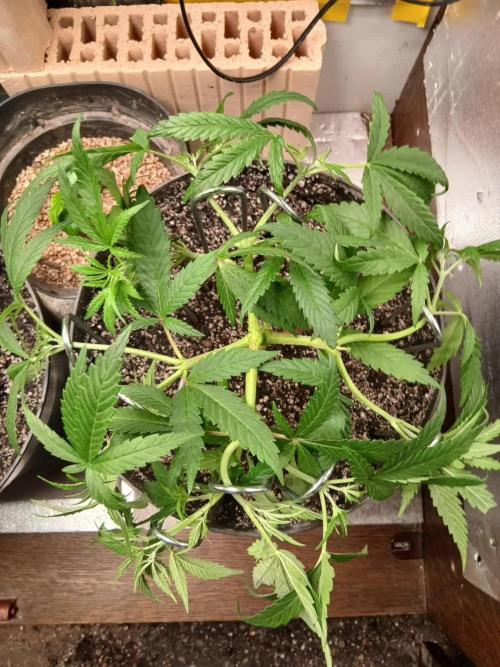
Changed into big box and bigger pots. Lets grow them 3 to 4 more weeks and then send them into flowering. Yupiduuu 🍆🌲🌞🍇
Likes
3
Share
@Rinna
Follow
Unfortunately, the Blue am and dynamighty (also due to their long flowering periods) didn't make it. Told my roommate to cut the plants when I saw that video and those pics but it was far to late already..
