


Likes
Comments
Share


@braxat420
Follow
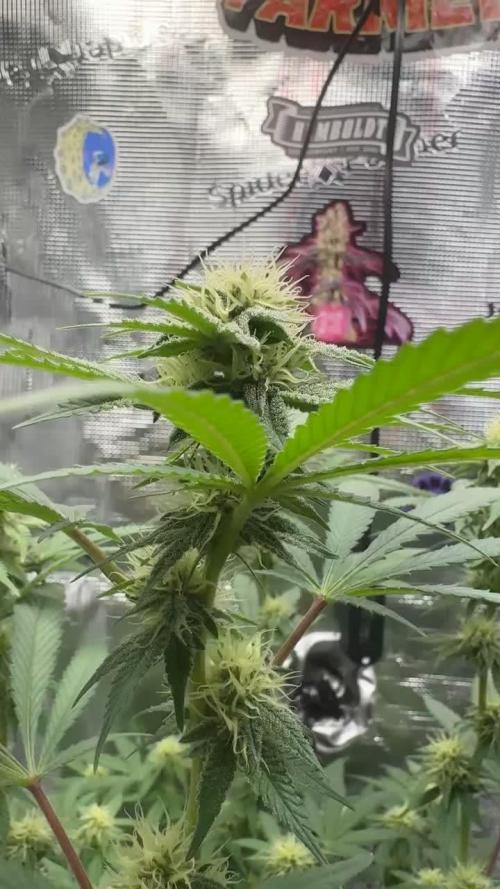
First time trying a main-line. I left four growth points so I wouldn't have to top again. Makes sense to me, but I'm not sure if that's proper or not. Looks great today, though.

Likes
25
Share


@GODSGIFT_2005_JM
Follow
🍼Greenhouse Feeding BioGrow & Bio Bloom
⛺️MARSHYDRO
The ⛺️ has a small door 🚪 on the sides which is useful for mid section groom room work. 🤩
☀️ by VIPARSPECTRA (models: P2000 & XS 2000)

Likes
4
Share

@Mxrcel09
Follow
So my light broke down and only operates on 40%. Spiderfarmer Support not really helpful. They tried to give me 30€ in points back for a broken light that is not even 1 year old. Still trying to get a refund or anything from Support. Really Bad support so far


Likes
11
Share


@DimJesus
Follow
Saludos 🙌 completando la séptima semana y comienzo de floración 🙏
Cambié el fotoperiodo el día 2/04 y la planta dió una buena crecida desde entonces. Comenzó a oler un poco más también pero todavía sin señales de pistillos, ansioso para verlos.
Buenos humos 🍃

Likes
81
Share


@m0use
Follow
SPONSORED DIARY===SPONSORED DIARY===SPONSORED DIARY
TRANSPLANT #2 THIS WEEK!!!!
This week was a great one, lots of sun and gave the plants their 2nd transplant of the cycle. only one left to go in a few weeks, the plan was to do 3gal but I feel it would be best to go upto 4gal a 1extra gallon will not be all that much extra root space to expand into. Will have to check if they even make them in 4. I have a feeling its only 1,2,3.
Root wise they are looking similar but not identical. I would say the Dynomyco treated plant has a thicker rootball and more of them. but not by a massive amount. More white on the Dynomyco treated plant as well. added in some more Acti-Sol into the transplant medium. same mix as before. Then watered in with some LAB Serum. should do the plants well. I did not add in anymore of the MIIM microbial mass product as I thought it might alter the results of the grow. so we will see how they do now with out it. I'm really liking how well the plants are bushing up. I might have to take some clones and try them indoors as well. I think I prefer to grow more indica leaning strain for their growth habits.
SPONSORED DIARY===SPONSORED DIARY===SPONSORED DIARY
This is my diary entry into the Dynomyco Show Us What You Got Contest!
#DynomycoShowUsWhatYouGot!
@DynomycoShowUsWhatYouGot!
@Dynomyco
Big Shoutout to @Dynomyco for picking me in their contest. Happy to be involved and as a user of Dynomyco I am curious to see this side by side with my own eyes. I will be honest I am a little skeptical it will show any major differences. but we will see what happens. Some disclaimers, I am still using LABS serum I made, This is also beneficial to the root mass however it's a bacteria based product and not fungal or mycorrhizae like Dynomyco.
https://growdiaries.com/giveaways/DYNOMYCO_Show_Us_What_You_Got
Likes
4
Share


@Cogollo_eu
Follow
**Encontrarás la traducción a español al final de la descripción**
From/Desde: 19/01/19 || To/Hasta: 25/01/19
From day/Desde día: 49 || To day/Hasta día: 56
----WEEK SUMMARY----
20/01/19: Photos 1 & 2
21/01/19: Photos 3 to 11
22/01/19: Photos 12 to 19
23/01/19: Video 20
- This video was taken with lights off and iPhone flashlight, so you can see very well the trully color here
As you can see in the photos and the video, these little Babys are growing very poblated and equitative. The low structure, an how it goes up is awesome, i don't have much experience growing (Changing that atm), but i will take the risk to say that this structure on an auto plant is wonderfull.
Next week i will add a handmade bottle for generate a bit of CO2, that is going to be the last addition to the tent.
----IRRIGATION CALENDAR----
21/01/19 (Day)
I prepared a solution with 3l water and (Final Solution, Rhino Skin, Sensizym, Bud Factor X, Big Bud, Bud Candy, B52, Nirvana & Bloombastic) @ 1.6 E.C. PH6.4
~750ml for each BlueBerry Mazar
23/01/19 (Day)
I prepared a solution with 3l water and (Silica Power, Final Solution, Fast Food, Auto Stimulator, Pro Active, Bud Candy, Big Bud, Bud Factor X, B52 & Bloombastic) @ 1.8 E.C. PH6.4
~750ml for each BlueBerry Mazar
25/01/19 (Night)
I prepared a solution with 3l water and (Pro Active, Rhino Skin, Sensizym, Bud Factor X, Big Bud, Bud Candy, Nirvana, Overdrive & Bloombastic) @ 1.8 E.C. PH6.4
~750ml for each BlueBerry Mazar
*****ESPAÑOL*****
----SUMARIO SEMANAL----
20/01/19: Fotos 1 y 2
21/01/19: Fotos 3 a 11
22/01/19: Fotos 12 a 19
23/01/19: Vídeo 20
- Este vídeo está tomado con la luminaria apagada y la luz de flash del iPone encendida, por lo que se ve muy bien el color "real" de las plantas
Como podéis ver en las imágenes y el vídeo, estas pequeñas están creciendo muy pobladas de cogollos y muy equitativamente. La estructura inferior, y como crece es increíble, no tengo demasiada experiencia cultivando (lo estoy cambiando a día de hoy), pero me arriesgaría a decir que ese tipo de estructura en una planta auto es maravillosa.
La semana que viene agregaré una botella casera de CO2 que será la última adición que haré al armario.
----CALENDARIO DE RIEGO----
21/01/19 (Day)
Preparo una solución con 3l de agua y (Final Solution, Rhino Skin, Sensizym, Bud Factor X, Big Bud, Bud Candy, B52, Nirvana y Bloombastic) @ 1.6 E.C. PH6.4
~750ml para cada BlueBerry Mazar
23/01/19 (Day)
Preparo una solución con 3l de agua y (Silica Power, Final Solution, Fast Food, Auto Stimulator, Pro Active, Bud Candy, Big Bud, Bud Factor X, B52 y Bloombastic) @ 1.8 E.C. PH6.4
~750ml para cada BlueBerry Mazar
25/01/19 (Night)
Preparo una solución con 3l de agua y (Pro Active, Rhino Skin, Sensizym, Bud Factor X, Big Bud, Bud Candy, Nirvana, Overdrive y Bloombastic) @ 1.8 E.C. PH6.4
~750ml para cada BlueBerry Mazar
Likes
15
Share


@Geili_Seili_fireinfireout
Follow
Ich liiiiebe diesen cut😋👌🔥🔥💚
Jetzt zereisst sie sich komplett stinken wie schweiß oldschool kush aber erst seit woche 5-6 ca. Aber seitdem gibt sie nuuur mehr gas😜😅😅
Likes
57
Share


@ATLien415
Follow
🙏 Big thanks to Plagron and Zamnesia for putting on the Eternity Grow Cup 2025. This kind of platform means a lot to the community. The chance to push our grows, test out new techniques, and connect with other cultivators from all over has been inspiring. Appreciate the love and effort that went into making this event happen! Hope everyone enjoyed looking over my shoulder on this grow and best of luck to all participants!
REVIEW - Runtz (fem., photo.) from Zamnesia: ⬛⬛⬛⬛⬛⬛⬛⬛⬜⬜
The seeds from Zamnesia germinated rapidly, rooted strongly, went wild in veg, and produced an ample amount of high-quality medicinal flower. The diary speaks for itself on that front so this space will be more of a phenotype review. The plants were labelled A, B, and C from left to right respectively in photos. A and B were the 'clasicaly-appearing' sativa-esque leaves while C was the more 'indica-appearing' phenotype. Although A and B appear the same qualitatively, they did produce substantially different amounts of flower (despite their DLI being near max out for the entire tent footprint without supplementing CO2, so I do not think just being in the middle attributed to this). Past their different yields, A and B also have vastly different profiles. A is a classic gelato/ice cream cooler/Z terps, and my personal favorite of the plants (wish I had taken a clone of this one instead). B is the most on point for what I think of with Runtz, classic Z terps but with a slight tropical/rotten/sweetness to it. C had the misfortune of being ready to chop a little earlier than the other girls so her profile is mostly just spicey kush now. I did observe intersex flower sites but given the entire context of the diary and how the plants performed, I have to assume it was user error. No pollination observed in any of the flowers, as zero additional intersex sites occurred. The distinction between A, B and C is what I would expect from a typical F1 cannabis seed. I do not enjoy growing from seed much but these girls were manageable. Add to that the relative stability of the genetics for a Runtz recreation, and well, these are good quality beans for a great price. Not only is Zamnesia responsive and available, their confidence speaks volumes. How many vendors would have an in-house Runtz, knowing how much of a genetic-gravity-well it is in, and be confident enough to let ~200 randos grow it and show it?
REVIEW - Green Sensation from Plagron: ⬛⬛⬛⬛⬛⬛⬛⬛⬜⬜
I enjoyed using the green sensation, the NPK values on it make it versatile in application and a power-house in flower. I can't say I noticed anything better or dramatically improved, although comparing to Heavy 16 and asking for a marked improvement is big ask in my opinion. What I was able to do was seamlessly integrate the Green Sensation into my current routine. The additive stayed homogenous, was easily introduced into solutions with no adverse impact to the water contents or pH. Most importantly, the plants enjoyed the additive and it did accomplish the main goal of being able to wane off your primary line. In this respect, by using Green Sensation I was able to save resources by lowering my Heavy 16 inputs across the board approximately 50% and supplementing with Plagron's Green Sensation.


Processing
Likes
141
Share


@Eyeduno
Follow
Week 5 of flower the tallest plant the pisltols are starting to turn already, wish I would have stripped the underneath abit more now

Likes
12
Share


@cookingwithninja
Follow
day 42 images are in last week, I can not count XD. bridal is stacking a lot of weight and is constantly shifting/leaning every morning, good things. I would chop any day but I will wait it out. water, tiny bit of humic and folvic to reduce chloromine, chlorine- air stones
day 45 took a few nugs off on day 42, dried for 3 days. Tried bridal and blackberry. As a heavy recreational, thc is up there! bridal felt like having a blindfold over your eyes somewhat sativa uplift but heavy weight feelings. Very good. Lasted as good as 30%'s. Dr. Thunder was also very nice, nug was smaller so mixed with blackberry to have a small j. Also feels very good indica. Both trials were chopped on week 6 day 1. Very pleased with the results. I was worried bridal was more sativa; which charasteristica I am not looking for. So I believe this is a very good heavy hitter run with 4 plants. I can chop any day, but I am waiting for pink paradise to finish seeds.
day45 took top nugs from bridal party, blackberry oreo bigstuff and dr. thunder. No touching pink paradise!!
day 46 can chop anytime just waiting on pink paradise seeds to finish, bridal party leaning more
day 47 bridal leaning hard from weight.
day 48 stacking, day 48 video


Likes
23
Share


@danieljeremiah2911
Follow
Exciting week the plants are all out of germination and into their veg growth stage. This means we get to begin the exciting work of building our soil. When the plants veg growth reaches the tips of the pots, this indicates the roots also have and your plant is then ready for more room. We have a fantastic grow shop in town that is great about soil classes and teaching you some great essentials. We plan on utilizing this resource and will keep you updated with the progress of the soil build. Stay tuned for compost tea as well ;)
Stopped by the grow shop to get the run down on the soil build. Because building your own soil creates hot soil, it needs to sit for 6-8 weeks. This obviously won't work for our purposes on this grow. After some deliberation we decided to go with a pre built soil that has already sat and composted. We are going to go with Build A Soil because they have done tons of research into their super soils. We want to do a super soil so that we don't have to top dress or add in any nutrients, we want the grow to be as natural as possible. After looking at Build A Soil's options we are leaning toward the L.O.S. OLY Recipe. This recipe uses 33% OLY Mountain fish compost. We want each plant to be able to finish out in the pots that we switch them into from their nursery pots. I recently found a new grow bag that we are going to try out for this next grow. It is a bag so it has a much larger circumference than the grow pots. It also has a lining on the sides of the grow bag so that it doesn't dry out from the sides like normal grow bags. This is our ideal growing situation because we are trying to simulate earth. When a plant is in the ground in the earth it doesn't dry out from the sides, we don't want our plants to either. The bags are very large (15 gal) but we don't want to fill to the top, in case we need to top dress more soil in the future. We use one cubic foot bag of soil per plant per container. This change will happen tomorrow at the turn of the week. Starting week two of Veg growth we will be in the containers that we finish in. This means minimal transplant stress and much less room for human error effecting my medicine.


Likes
29
Share


@GreenHouseLab
Follow
Amazing structured plant, little to no training all dense buds from this cross of Sugar Cane x Velvet Breath.


Likes
14
Share


@Gc_Dank_Aus
Follow
I love growing this strain, smells delicious the whole way through. 10/10

Likes
25
Share


@Master_weeda
Follow
Bonjour à tous les padawans et maîtres jedis
Jour105 arrosage avec 2 litres d'eau ph6.3
Jour107 arrosage avec 2 litres d'eau ph6.3
Jour110 arrosage avec 2 litres d'eau ph6.3

Processing
Likes
27
Share


@Piquillo
Follow
Seeds look healthy and have been planted in small cups after being successfully germinated. I'll pick two out of three.
I'm still calibrating this setup, but so far it can easily maintain 25 - 26° C when lights on and around 20° C off.
-----------------------------------------------------------------------------
RUNTZ (ZAMNESIA SEEDS) FEMINIZED DATA SHEET
Brand Zamnesia Seeds
Genetics 50% Indica / 50% Sativa
Parents Gelato x Zkittlez
Flowering Time 8-9 weeks
THC 27%
CBD <1%
Yield (Indoor) 450-500 gr/m²
Yield (Outdoor) 400-450 gr/plant
Height (Indoor) 130cm
Height (Outdoor) 180cm
Available as Feminized seeds
Flowering Type Photoperiod
Sex Feminized
Likes
10
Share


@YAKDADDYDWC
Follow
I found seed foeming and bananas so i decided to cut my losses before it got out of hand im just glad they got to where the are now first time grow first time using dwc and i fucked this shit up for a first timer you beauty
Likes
244
Share


@DogDoctorOfficial
Follow
And the time for Le Madame Freak Le Chick to come down as arrived!!! This was a wild ride , super emotional and repleted with amazing views, i totally advise everyone to try and grow this wild card , she is a treat and a blessing in our lives
As always thank you all for stopping by , for the love and for it all, i fell blessed to have you all with me for one more love journey, and a different one form the rest i did so far <3 <3 <3 Thank you Thank you Thank you , you guys are great and have been amazing , thank you for everything <3<3<3
#aptus #aptusplanttech #aptusgang #aptusfamily #aptustrueplantscience #inbalancewithnature #trueplantscience #dogdoctorofficial #growerslove
With true love comes happiness , Always believe in your self and always do things expecting nothing and with an open heart , be a giver and the universe will give back to you in ways you could not even imagine so <3 <3 <3
<3 <3 <3 Growers love to you all <3 <3 <3
Here are the words from this peace of art from nature creator Shapeshifter's @ HI-ELEVATION GENETICS <3 <3 <3
"FREQUENTLY ASKED QUESTIONS
Q. How did you create/breed Freakshow?
A. Methodical selection, line breeding, and culling is the short answer. Read our About page for more details.
Q. Is it an indoor or outdoor type?
A. Everything I've ever worked has been outdoors, including of course Freakshow. It has been our experience that outdoor (or sun grown, as it's recently being referred to) cultivars seem to perform extremely well under artificial conditions. This is true of seed starts or clones made from seed starts. The opposite is not always true; indoor clones often give an outdoor grower headaches because they don't always make the transition smoothly. This is due to light spectrum, temperature, and/or photoperiod changes. Yes, Freakshow will do exceedingly well indoors, and will thrive and mature just fine in a wide variety of natural environments as well, so it's definitely both and I think might even prove to be more resilient to those sorts of transitions.
Q. What are the potency and terpenoid levels?
A. Average 18-20% THCa, THC; negligible CBD, CBN with terps variable, averaging 2.5-3.5, primarily limonene and pinene, but this is variable, there was a lot of diversity in terp combinations and compositions in all the prior generations, it's just something that was left "as is" for now. The different parallel lines that we are developing can be directed in a few different pathways flavorwise.
Q. Why are the seeds white?
A. Why is the sky blue? No, the mature seeds are shrouded by a rice paper thin membrane which has coloring and mottling on it, but it's so fragile that it disintegrates in the process of shucking. Stripped of the outer layer the seeds are very pale, nearly white. It came as no surprise that this plant would have abnormal seeds.
Q. Is it a GMO?
A. Wow...? Well, it's seriously "modified" and the modifications are definitely genetic, and it is an organism. (Genuinely Modified Organically!) Uh, no. No radiation, no recombinant DNA, no gene splicing or editing, no TALEN or CRISPR! These biotechnologies don't belong in the food and medicine plant industries. Sadly, in the near future it will become commonplace and widespread in cannabis and other medicinal plants as it is already is with food crops and ornamentals. I'll avoid discussion on this topic for now, but we hope some people enjoy consuming Frankenbud!
Q. What's the floral period length?
A. 8-9 wks, finishes early Oct. at most latitudes and elevations.
Q. Is it a big producer?
A. Freakshow will produce nice, fat, dense colas (see gallery) with remarkable trichome coverage, and you can expect yields according to your veg. time, root space, and general knowledge and expertise as a gardener. The same set of variables apply to expected outcomes regarding cannabinoid levels and terpene profiles.
Q.What is the lineage?
A. (Bigbud x Skunk#1) x (Big Sur Holy Weed x Banana Kush). NLD("Sativa") dominant, but the afghanica influence is apparent. I'm pretty sure that Freakshow contains some Trainwreck and some Maui Wowie based on some research I did on the origins of the Pineapple Express. Interestingly Big Sur Holyweed, OG Kush, Banana, Trainwreck, and Maui Wowie are all of unclear origins. We have to remember that these are all just names and that they don't really mean much. The exact heritage of any cultivar today is impossible to determine accurately. Also, considering the amount of continuous shameless hybridization that has occurred in the last 40 yrs., any modern kind could easily contain over 40 kinds. In the case of Freakshow, it's much more limited because the ancestry is largely older "Sativas" that didn't go through as much outcrossing. In the 70s in Santa Cruz, Haze was a favorite among surfers for the pure energy and I still have (greatly improved) stock of it around, simply because even when I made hybrids with it I always kept the original in pure form for obvious reasons.
Q. What is the psychoactive effect like?
A. Like the flavors, many people have commented that the "buzz" is somewhat different than other mainstream types out there. It's not entirely out of the scope of imagination that given that this strain has new alleles in so many other respects, that it could also contain new, unique cannabinoids, as well as new and unique terpenoids, some of which may not even be among the standard 16 or so that the average lab is testing for. Aside from the up, cerebral, energetic boost, some report a mild time/space warp effect. Creativity and idea induction should be mentioned, for sure. Freakshow has the pure energy effect and greatly alters perception to the positive side, so definitely destroys depression. Appetite suppression is a side effect, but the enjoyment of food is enhanced. I personally will attest to all of the above. We all have different receptor profiles, so these are just generalizations. Couch unlock.
Q. Is it pest and mildew resistant?
A. Indeed it is. On many occasions in the last few years, it has been observed that when pest and mildew issues were affecting other plants adjacent to in the vicinity of Freakshow plants, for unknown reasons the freaks remained entirely unaffected. This includes 0botritis, PM, various mites and insects, soil fungus, etc. We haven't heard any complaints along those lines so far, so if anyone has any problems, especially with a rigorous IPM regimen in place, we would like to hear about it. And if anyone can attest to the extreme level of resistance it seems to have we'd love to hear about that as well.
Q. Does it contain web-leaf genetics?
A. I thought I better clarify this because there are a few people thinking that because of an article "Growing Marijuana that Doesn't look like Marijuana" that mentions that I had worked web-leaf types years ago and had eventually turned that into Freakshow. This is incorrect and I'm needing to get ahold of the writer to have him change it. When I read the piece and saw the mistake I figured it didn't matter that much, that the actual method of breeding could just remain a "trade secret". Recently, I noticed online that a posting, "Freakshow only exists because of duckfoot" by Curious Cannabis Connoisseur, where he explains how I developed Freakshow using Duckfoot. Let me explain, about 20 yrs. ago a friend gave me a jar of seeds labeled "BC Bigbud" and I sprouted flats of hundreds to look for oddities and had found one web-leaf pheno which we named Webster. It was a female so I bred it to a normal leaf male and began selecting and stabilizing a line of Webster. About 5 or 6 generations later I had nailed it to 100% webs and had also stabilized it for a deep purple color and a nice "gingerbread" terp profile. I was busy working other lines at that point so I put Webster in the library. Also, I was having a hell of a time getting a pheno of it that flowered to my satisfaction. (it seemed to finish with a limited number of calyxes). I knew I would have to outcross it to something with a big tasty bud and restabilize it for web-leaf, and I no longer had the original BC Bigbud. I still have the Webster seeds, and trust me the thought has crossed my mind to make the cross with Freakshow, but why? Why mess around crossing things just to create something even weirder? I have heard that the "Duckfoot" also doesn't bud up well so maybe there's a correlation there. Anyway, people can do what they want to and I will too, but crossing Freakshow with some low-THC crap like ABC is in my opinion idiotic. I worked extremely hard stabilizing and perfecting a beautiful new subspecies and I believe it should be kept pure. I won't go on a rant here about the rampant crossing and the lack of line-breeding in the cannabis world in the last several decades, or where this will eventually lead us, but I will say that it's not in a good direction. Bottom line....Freakshow has no web-leaf genes, it was made using top-grade tropical narrow-leaf drug (NLD) cultivars.
Q.Why is Freakshow patented?
A. Although I and most others (including all the folks at HSC) believe in and subscribe to the concept of "open sourcing" because sharing in cannabis genetics was always the cultural norm, it was decided that Freakshow should be protected (1) because it is a novel and unique, not a preexisting strain (or even subspecies), (2) To keep the greedy corporate big boys from exploiting it, (3) To maintain control of the genetic refinement of it in all future generations. We really can't wait to share it with the entire collective world of cannabis enthusiasts and invite experimental breeding for personal use and curiosity."
source https://freakshowcannabis.com
