


Likes
Comments
Share


@Blaze_With_Haze
Follow
All babies growing up very fast. Very happy so far. Started to use lowdose Advanced Nutrients fertilizer.

Likes
8
Share


@Hightable420
Follow
Beautiful Pheno. Stacked with trichs! Definitely huge appeal! With a slight sour worm/super c terp profile.


Likes
1
Share


@Ferenc
Follow
Day 36 : I did LST again. I set the lamp approx 26cm away. 600 W LED, 20 hours on 4 hours off the same with ventilation humidity approx 60 percent. Ferlizitaion will continue the same way Monday Wednesday and Friday BioBizz family and Tuesday Thursday and Saturday bat gunao and Epson salt. Water intake 100 ml per day per plant.
Day 39: Plants are really nice! Sour Ora ge and Lemon Zkittle started stretching crazily. Critical Orange Punch has nice flowers on it and keeps growing. Sour Stomper started flowering as well.
Day 41: Sour Orange, Lemon Zkittle, Critical Orange Punch stretched a lot this week all have pre flowers and Critical Orange Punch has pistils out as well. COP and LZK have some brown spots. Dour Stomper will be very small plant but cute.


Likes
7
Share


@Stacy_smokez
Follow
Currently trying this run a different way using herbs now I will come back with how many grams yielded from one plant. Overall this grow journey was a process and I can’t wait to explore more. 144g of dried flower and 90g of trimmings

Likes
12
Share


@SSKNFbyHAZE
Follow
** COST **
TO RUN
- Used previous ⛺️ setup : 0.00USD
- Monthly electricity : 36.73USD <-- other ladies sharing ⛺️
- 1 Gallon Fabric pot : 0.10USD
- Bonsai wire : Apx. 0.03USD
- Reused soil from last run : 0.00USD
FOR NUTRIENTS
- Jadam Microbial Solution : 0.00USD
- Fermented Plant Juice : 0.00USD
APPLYING
- JMS : 30ml / 1 Litter
- FPJ : 30ml / 1 litter
TOTAL COST : 36.91USD
Throughout the week, I give compost tea, and fermented plant juice once each ^^
These 2 plants have almost same birthdays, but there are in really different stage of flowering.
I am guessing drought shock had their growth stage all messed up ^^;
Hope you guys have a wonderful day today ^^v
*** Please Like, comment & share ***
Highly appreciated -----/-----<@


Likes
161
Share


@FrontRowAG_BrianG
Follow
By now, everyone knows I use the whole lineup of FRONT ROW AG Nutrients.
They do not sponsor me and neither does anyone else…and I like it that way.
The last 2 weeks I have hammered them with the Bloom. I followed their nutrient schedule and then raised the EC to around 2.4 by adding straight bloom. All nutrients were then PH’d to 5.5-5.6. This week and next nutrients will be on normal feed off of Front row’s feed chart. Then flush.
This week was amazing. The single plant that was lagging behind has caught up to the rest in the room. Probably 2-3 weeks left on the whole room.
This week, til finish, temps will be lowered to 77 during the day and 65 at night. I feel this is very important to get a good crust of trichromes on the plants. It will work!
Thanks to everyone who has been sticking around. I know I do a longer veg than most and I hope I’ve kept things interesting. See you next week guys and girls!

Likes
4
Share


@FuturJuice
Follow
I sliced my thumb open so this weeks report will be short.
We had budlets show up and have come in strong. All 7 colas are firm and strong. I was able to apply some tie downs to allow more light in to the bottom canopy.
No issues to report other than some small colored tips that I’ll keep my eye on. The environment is pretty solid. No issues there to report.
In case you didn’t know, we are approaching the most crucial weeks of flowering, weeks 4-6. From my research, this is a very crucial time for cannabis plants.
Hopefully my thumb will have healed up next week. This is what I get for planting a tree on Earth day while stoned!
Likes
4
Share
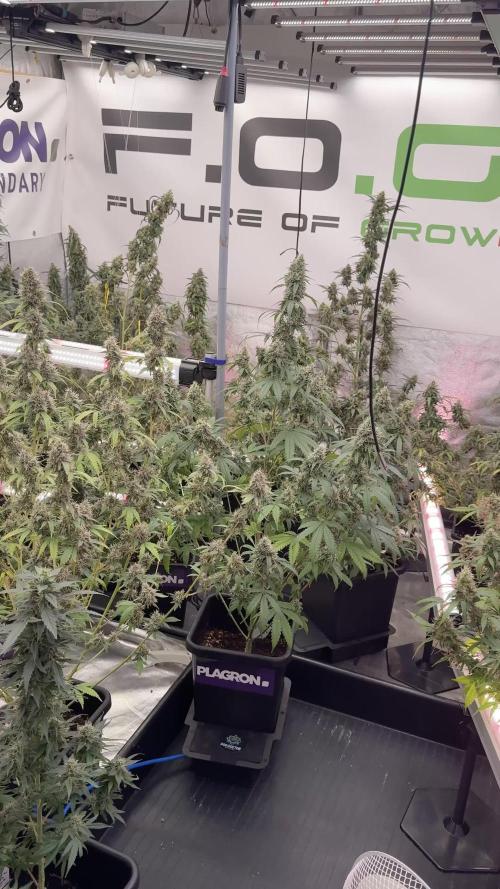

@DogDoctorOfficial
Follow
🥒 Project Blue Tent – Week 8
Pickle Lemon Haze F1 – Pheno B (Folder 14B)
Hello everyone, and welcome back to another chapter of Project Blue Tent! 💙🌱
If you're discovering this diary for the first time, welcome aboard!
Project Blue Tent follows four individual plants from seed all the way through harvest, with each phenotype receiving her own dedicated diary.
All four sisters share the same tent, lighting, irrigation, nutrition, environmental conditions and overall training strategy.
The idea is simple:
Keep the variables as consistent as possible and let the genetics tell the story.
And this week...
The story is getting very interesting.
Because all four girls have entered flowering with absolutely no intention of slowing down.
Today we're giving the spotlight to Pickle Lemon Haze F1 – Plant B.
And once again...
She's shining. 💙🌱
────────────────────────
🌸 Week Eight – Flower Has Arrived
The Blue Tent has officially entered the next chapter.
After seven full weeks of vegetation, we're now running 12/12, and the response from the plants has been immediate.
Plant B is now sitting around 81 cm, compared with approximately 60 cm when we finished the vegetative phase.
That's a serious amount of growth in a very short period.
And what's particularly impressive is that the plants aren't simply stretching upward.
They're developing everywhere.
The branches are extending.
New growth is appearing rapidly.
Flowering sites are becoming more obvious every day.
And the first real signs of bud development are now beautifully visible throughout Plant B's structure.
This is the point where all those weeks of preparation start becoming meaningful.
The SCROG gave us the structure.
The defoliation opened the canopy.
The training created the framework.
And now...
Flowering is filling that framework.
────────────────────────
🌿 Pickle Lemon Haze F1 – Plant B
Plant B continues to be one of those girls that makes me stop and look twice.
Her foliage is lush, vibrant and beautifully green, and the overall health of the plant is exactly where I want it to be.
The developing flowers are progressing quickly, with fresh pistils and new growth appearing throughout the canopy.
And despite the speed at which she's developing, she's still maintaining a remarkably even structure.
That's something I really appreciate about this phenotype.
She has always been a cooperative plant.
She responds well to training.
She builds strong lateral growth.
And even now, with flowering underway and the stretch accelerating, she's still giving us a canopy that is relatively easy to manage.
At least...
As easy as four extremely vigorous plants can be. 😂
────────────────────────
💥 Super Cropping – Keeping the Canopy Under Control
The biggest challenge right now isn't getting these girls to grow.
They've already made that part very clear.
The challenge is managing how quickly they're growing.
We're continuing to use super cropping on selected branches as another tool for managing the most vigorous vertical growth.
The idea is to reduce the dominance of certain shoots, redistribute growth and encourage stronger branching points as the plants continue developing.
And these girls are making me work for it.
I'll carefully work a branch down...
Come back later...
And somehow it's already standing back up again.
😂🌱
They're determined.
But that's actually what makes this stage so interesting.
We're not trying to stop their natural growth.
We're trying to work with it.
The canopy is already very even, and we're simply making small interventions where necessary to keep the most aggressive growth from getting too far ahead.
Whether we'll successfully keep everybody compact throughout the stretch?
Well...
Let's see.
They certainly haven't read that part of the plan.
────────────────────────
🌸 Bud Formation – Things Are Moving Quickly
One of the most exciting changes this week is the speed of flower development.
We're only at the beginning of flowering, yet Plant B is already showing beautiful formation throughout the canopy.
The sites we've spent weeks creating and positioning are now beginning to transform.
Pistils are appearing.
Clusters are becoming more defined.
And every day there's another little sign that tells me:
We're properly in flower now.
This is one of those moments where you can finally see the purpose behind all the earlier work.
The individual branches aren't just branches anymore.
They're becoming future flowers.
And Plant B has plenty of them.
────────────────────────
🌱 Seven Weeks of Vegetation – Was It Too Much?
Looking at Plant B now, I'm still wondering whether I gave these girls too much vegetative time.
Seven weeks of vegetation is considerably longer than I normally run.
Usually, I'd flip earlier.
But the extra time gave us something valuable:
A very established canopy.
Strong branches.
A developed root system.
And a structure capable of supporting a lot of flowering growth.
The downside is becoming very obvious now.
These plants have an incredible amount of momentum.
They grew from roughly 60 cm to around 81 cm incredibly quickly, and they're still moving.
So there is definitely a little bit of:
"What have I created?" 😂
happening in the grow room right now.
But worrying about it isn't going to make the plants grow slower.
We've prepared them.
We've trained them.
We've opened the canopy.
We're managing the stretch.
Now we watch.
And we see where these girls want to take us.
────────────────────────
💡 Strong Light From the Beginning
The transition into flowering also means we're starting with approximately 800 PPFD across the canopy.
I want these girls to have strong light available from the beginning of flower rather than slowly creeping toward higher intensity.
They're already extremely vigorous, so the idea is to give them the photons they need while closely observing how the canopy responds.
The challenge is balancing that strong light with the environmental conditions and the very significant stretch we're already seeing.
I'm particularly interested in seeing whether the combination of strong light and continued canopy management can help keep the plants from becoming excessively elongated.
Because if there's one thing Plant B has demonstrated this week...
It's that she has absolutely no shortage of energy.
────────────────────────
🌡️ Blue Tent Environment
The room continues to run with remarkably consistent conditions across all four sisters.
This week's recorded averages were:
• 🌡️ Day Temperature: 27°C
• 🌙 Night Temperature: 27°C
• 💧 Relative Humidity: 67%
• 🥥 Substrate Temperature: 24°C
• 💦 Nutrient Solution: 19.1°C
• ⚗️ pH: 5.81
• ⚡ EC: 2.09 mS/cm
• 💨 CO₂: approximately 666 ppm
• 💡 Light Schedule: 12/12
• 💧 Irrigation: approximately 1.4 L/plant/24h
• ? Pot Size: 8 L
• 📏 Plant Height: approximately 81 cm
One thing that continues to stand out is the relatively small difference between day and night temperatures.
We're sitting around 27°C for both.
That can contribute to continued stretching, and considering how quickly these girls are already growing, it's something I'm keeping firmly in mind.
But for now, Plant B is responding beautifully.
Healthy foliage.
Strong development.
Rapid flower formation.
And no obvious signs that she's unhappy with her environment.
────────────────────────
🥥 Feeding – Supporting the Transition
The flowering nutrition is now established.
Current feeding:
• Plagron Hydro A — 2 ml/L
• Plagron Hydro B — 2 ml/L
• Plagron Hydro Roots — 1 ml/L
• Plagron Power Buds — 1 ml/L
• pH Plus — 0.03 ml/L
• pH Min — 0.03 ml/L
Current EC:
2.09 mS/cm
pH:
5.81
The plants are consuming aggressively and developing extremely quickly, so the nutritional strategy is now supporting that transition without making unnecessary changes simply for the sake of changing something.
Plant B's colour is exactly what I want to see.
That beautiful, lush green foliage is telling me that she's handling the current program very well.
And when I look at the flowering sites developing throughout the canopy...
I'm certainly not seeing a plant asking me to interfere.
So for now:
We stay consistent.
Observe.
Measure.
Adjust only when necessary.
────────────────────────
💧 The Drip & Drainage System – One Continuous Loop
The automatic irrigation and drainage setup has become one of my favourite parts of this project.
Plant B is now receiving approximately 1.4 litres of nutrient solution every 24 hours through the drip irrigation system.
The process is beautifully simple.
The drippers deliver the nutrient solution directly to the coco.
The solution passes through the substrate and feeds the root zone.
The resulting runoff drains into the collection trays underneath the grow bags.
From there, the drainage pipe carries the water toward the pump.
The pump removes the collected runoff and returns it toward the reservoir, creating a recirculating irrigation and drainage loop.
Water goes in.
The plants use what they need.
Runoff is collected.
The pump moves it away.
And the system continues its cycle.
It's a remarkably elegant setup when everything is working properly.
And right now...
It is working wonderfully.
The plants are growing rapidly, their water demand is increasing, and the system is keeping irrigation consistent without requiring me to manually water four increasingly thirsty plants every day.
That consistency is especially valuable in a project where we're deliberately trying to keep the four sisters under comparable conditions.
It's another variable we can keep controlled while we watch the genetics express themselves.
────────────────────────
🕸️ Managing the Canopy During the Stretch
The SCROG has already done its main job.
Now we're using the structure we've created to manage flowering growth.
The canopy remains impressively even.
There are no huge dominant towers completely taking over the room.
Instead, the flowering sites are distributed across the surface we've spent weeks building.
But the stretch is happening quickly.
So we're continuing to watch the taller shoots and selectively using training and super cropping where necessary.
This isn't about constantly manipulating the plant.
It's about making small corrections before a branch becomes a major problem.
A little intervention now can be much easier than trying to fix an overly dominant branch later.
And Plant B has responded very well so far.
She's stretching...
But she's stretching into a structure.
That's exactly what I wanted.
────────────────────────
🌿 Plant B's Personality Is Still There
This is one of my favourite things about Project Blue Tent.
From above, the four sisters can look almost identical.
Same tent.
Same lights.
Same irrigation.
Same nutrients.
Same environment.
And yet...
Spend enough time with them and their personalities start becoming obvious.
Plant B remains one of the more naturally cooperative phenotypes.
She's vigorous, but her structure remains usable.
She's growing rapidly, but the canopy hasn't become chaotic.
She's producing flowering sites quickly, while maintaining that beautiful green foliage we've been watching since vegetation.
And now she's showing another characteristic:
She doesn't seem particularly interested in slowing down.
😂🌱
Which, honestly, is a pretty good problem to have.
────────────────────────
🌸 From Canopy to Flowers
There is something incredibly satisfying about looking at Plant B now and remembering what she looked like only a few weeks ago.
Back then, we were talking about:
Topping.
SCROG.
Empty squares.
Branch positioning.
Defoliation.
Canopy management.
Now we're talking about:
Flowering sites.
Pistils.
Stretch.
Bud formation.
And eventually...
Bulk.
That's the transition we've been working toward.
The plant has moved from building the machine to using the machine.
The canopy is the foundation.
Now the flowers get to take over the story.
────────────────────────
👀 Looking Ahead
The next couple of weeks should be fascinating.
All four sisters are moving incredibly quickly, and Plant B is right there with them.
We'll continue managing the canopy as needed.
We'll keep an eye on the stretch.
Super cropping will remain one of the tools available when individual branches get too ambitious.
The irrigation system will continue providing its consistent cycle.
The flowering nutrition will continue supporting development.
And the environmental conditions will remain under close observation.
Most importantly...
We don't need to panic about the speed.
Yes, they're growing fast.
Yes, I may have kept them in vegetation longer than usual.
Yes, the warm nights aren't exactly helping us keep the stretch compact.
But the plants are healthy.
The canopy is remarkably even.
The flowers are forming beautifully.
And Plant B is looking absolutely fantastic.
So...
Let's see where this goes.
🌸💙
────────────────────────
💙 Thank You
A huge thank you to Zamnesia for making Project Blue Tent possible and for giving us the opportunity to explore these Pickle Lemon Haze F1 genetics phenotype by phenotype.
A heartfelt thank you to Plagron for the Premium Growbags and Hydro nutrient line supporting these girls throughout their journey and now through the beginning of flowering.
A special thank you to Zamnesia for the Phytonaut LED lighting helping us create such a strong, even canopy and now providing the intensity we're using during the transition into flower.
And a massive thank you to Mars Hydro for the automatic drip irrigation and drainage system.
Watching the drippers, coco, runoff collection, drainage lines, pump and reservoir work together has been incredibly satisfying.
The system has become an important part of keeping the entire room consistent.
Thank you as well to GrowDiaries for providing a place where growers from around the world can document their journeys, exchange experiences and learn together.
And finally...
Thank you to everyone following Project Blue Tent. 💙
Plant B has officially entered flowering.
She's stretching.
She's building flowers.
She's producing lush, beautiful growth.
And she's making it very clear that seven weeks of vegetation gave her plenty of momentum.
😂🌱
For now, the canopy remains beautifully even.
The flowers are developing quickly.
The super cropping is helping us manage the most ambitious branches.
The irrigation system is doing its job.
The nutrition is supporting the transition.
And Plant B...
Well...
She's simply shining.
Four sisters.
One environment.
One experiment.
And four plants that somehow manage to make every week more interesting.
Let's see what the next chapter brings.
Until next week...
Growers Love, happy growing, and take care everyone! 🌱💙
Likes
Comments
Share

@lolasher
Follow
Sie lebt jetzt noch zwei Tage, dann wird geerntet. Immer noch überhaupt kein Anzeichen von Schimmel, nahezu keine Ungeziefer, brutale Buds und ein Geruch, den die Nachbarn 5 Häuser weiter bei gutem Wind noch wahrnehmen 😎
Die Strawberry Gorilla war ein drei Jahre alter Samen, den ich in meinem Growkeller gefunden habe. Ohne Erwartungshaltung. Das sowas im Norden dabei rauskommt… krass.
Also ich weiß jetzt schon, was für Pflanzen nächstes Jahr draußen stehen.
Die Trichome sind alle Milchig, wenige Bernstein. Selbst auf den unteren Buds. Oben hat es sich die letzten zwei Wochen nicht wirklich verändert. Jetzt kann man auch nicht mehr von vorzeitiger- oder Noternte reden. Leider habe ich die Smartphone Lupe verloren und habe ich nur meine zwanzig Jahre alte Retrolupe, weswegen es keine Trichomfotos gibt.
Bin wirklich begeistert.
Likes
150
Share


@RussianGrower
Follow
I am glad to welcome you again from Russia, my friends from different parts of the world. I thank everyone who follows my progress or subscribes to my diary. Your support and attention motivates me to do better and more beautiful. In my tent came 14 week Neville Haze Auto. This plant is great for commercial secret cultivation in the room, as it has almost no smell. Maybe I will grow this cannabis variety again on a large scale. But it requires a lot of patience and work in terms of trimming and LST training. Since I still have marijuana and a bit of Afghan contraband hashish, I decided to give my girls an extra week of life. My girls ' puberty is coming to an end, but has not yet reached its peak, as there are still light hairs. The smell of those girls doesn't bother me at all. So let them live another week, and I will smoke the works of Afghan planters. Soon I'm planning a new diary. Until next time, good luck!


Likes
8
Share


@Fast_Buds7272736
Follow
🌿 Week 11 – Harvest! (Day 77)
Harvest time for my Tropicana Cookies Auto — 77 days from seed to chop.
Instead of giving her 24–48 hours of darkness, I decided to harvest right in the middle of her light cycle to preserve maximum THC and terpene content while the resin was at its peak. Trichomes were mostly cloudy with a few amber — exactly where I wanted them.
The buds came out dense and sticky with a deep citrus aroma and colorful hues. Final wet weight: 300g, expecting around 60–75g dry after a slow cure.
She’s currently drying on mesh racks in a dark, ventilated space with ~21°C and 55–60% RH. I’ll jar her up once the stems snap clean.
This was a compact but resin-heavy pheno — rich in terpenes and easy to grow. Really happy with how she turned out.
Thanks for following the grow — time to cure and enjoy the results! 🔥🌱
Likes
84
Share


@Hempire
Follow
Im doing a bit of defoliation, moreover the leaves that covering the buds, i cut some small branches on the bot of the plants, to keep energy for the distal parts of the branches.
Every 2 day approximately, to no stress a lot the plants, I pinch the apex of MD1, MD2 and BB1, that my secondary branches go up, until the height of the apex central.
Nutriments :
2,0 mL/L of rhizotonic, 2,5 mL/L of cannazym every watering.
2,0 mL/L of terra vega every 2 or 3 watering in case of they need (N) until the final of the strecht (first 2 weeks of bloom).
I will put 5L every watering (pots of 18L) and I will analysed the drain of every plants to check pH and the fertilizer amount.
Im really proud of theses plants, they are strong, resistant (the trunks are huuuge, moreover the Moby dick from Dinafem) and so healthy !! The MD 3 has reacted really really good with the topping ! Im impressed and quite sure do topping next time ;)
I hope they will give me the best of themselves !!!! Lets wait the final of the strecht 😉

Likes
2
Share


@Green_Peace
Follow
Got back from 2 weeks holiday and immediately lollipopped and defoliated all 4 plants heavly. Will wait a few days for them to recover from the battering I gave them before flipping to 12/12.
This plant is at the back of the 4 in the timelapse.
Likes
7
Share

@Pierrougarou21
Follow
Salut les Growmies.
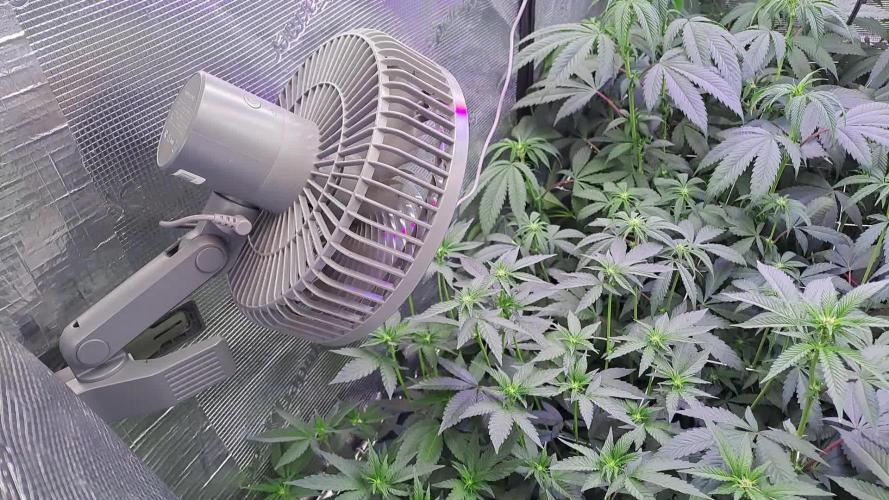
l installation du filet semaine dernière à 80 cm c est bien passé.
Le stretch est juste fou. Je me pose des questions :comment je vais reussir a gerer cette culture ou j'ai été dans l'obligation d'attendre pour lancer la floraison suite à des péripéties familiales. Mais bon je suis quand même pressé de voir le résultat de ce run qui va être très compliqué à gérer
09/01 je viens de lancer les boutures dans ma nouvelle mini serre avec lumière intégrée
11/01 Dernier jours de la deuxième semaine de floraison. la Grape Frappé #3 est juste magnifique
Likes
6
Share


@Rinna
Follow
It was a ride! My first ever indoor grow and I’m very pleased with how I filled up the tent, with autoflowers. The buds are looking dense so I’m guessing around 100 grams in dry buds 👌🏻

Likes
5
Share


@GrowDr
Follow
I Pruned all the lower herming sections and lowered the far red % as well.
Lots of trichomes, which is always awesome. Smell is amazing
Processing
Likes
21
Share


@LittleBigTrees
Follow
I've cut down on grow at this point as the soil seems to have a lot.
I'll feed for another week then think about Flushing.
The kalimist will keep getting fed bloom and grow as its only been flowering for about 3 weeks due to taking longer to force flower.
Likes
5
Share


@Ybjokes
Follow
Well its the middle of the week and I haven't added any nutes until of yesterday. I woke up the next day and they enjoyed the nutes. Saw a big difference in both the plants. I'm a first time grower so any advice will help. I'm just wondering when to put them into flower.

Likes
49
Share


@masterofsmeagol
Follow
Sorry I couldn't get better pictures but I'll try again tomorrow. This strain certainly deserves it. Very low leaf to bud ratio on this plant. Dark pink or orange stigmas retracted into the buds as they finished and one pheno had the densest nugs I've ever grown. This year realky showed me the difference of quality seeds compared to "local" clones. After a rainstorm on the large fluffier pheno I found a "trapped" bumblebee inside one of the massive colas. I had to help it out. It was literally "stuck" due to the resin. This strain had the most pleasant aroma that stuck with the finished product. Due to the small amount of leaf to bud ratio this plant was a breeze to trim. That being said I still don't have it ALL manicured up but I'm working on it. All plants seemed fairly pest resistant as well. If you enjoy indica strains (90/10) with short flowering times than this should certainly be on your "to grow list." Having these plants totally finish before October was very helpful. According to many local growers (both patients and commercial growers) this was "the worst year for growing cannabis in memory." I've had the best year I've had in decades (probably ever) both quality and quantity wise.
