





@Leonardo_DaGrower
Follow
I noticed a slow down on growth this week. I’m guessing the amendments I added are all used up. Next week will start heavier feeding, especially with the bloom nutrients.
Trichomes are densely populated throughout the plant. One plant has thin unimpressive buds and the other has perfect growth for week number four of flower.






@Zurban_Poison
Follow
Hello everyone! this week, I had to do defoliation all the same .. on that girl I was not going to touch .. the fact is that there were a lot of leaves .. too many .. it was difficult for the plant to breathe .. in short, I did defolation and also took advantage of the fact that the plant itself made a topping))) and with the help of the LST I took 2 central branches to the sides .. from today I will decrease the light regime gradually .. I hope this will help the plants show their gender as soon as possible ..


@Northern_Ent
Follow
July 27: staring week 7 and she seems to be preflowering but I’m going to force flower this auto by sticking it in the dark garage with my photoperiod plants. The change to 12 h of darkness for a couple weeks should kick it into flowering mode.
I’ve seen a few growers commenting that their Auto Overdose wasn’t auto flowering and I don’t want to wait any longer to find out. It’s the end of July and things need to be flowering by now to finish in time before winter.
The stem I broke a few days ago is showing signs of life and looks like it will more or less recover. Update: Changed my mind and removed stem as it was slowing overall growth. Cut the loss and move forward. C’est La vie, etc.
July 28: plant has an okay shape considering I broke a stem. Nice lower branches came up after the plant was topped. Looks promising.
July 31: looking good. Removed a single large fan leaf at the top that was shading too many bud sites.


@extraterrestrial1
Follow
-------------------------------------------------
Day 43
Water: 0.75 Gallon TT Water w/ 0.75 TBSP Blkstrp Mlsses 6.5 pH
Humidifier: 50% (LOW-MIST)
Dehumidifier: On
Fan Speed: High
Light on @ 19:00 (27.2° celsius @ 49% RH)
Light off @ 13:00 (23.2° celsius @ 47% RH)
-------------------------------------------------
Day 44
Water: N/A
Humidifier: 50% (LOW-MIST)
Dehumidifier: On
Fan Speed: High
Light on @ 19:00 (27.8° celsius @ 45% RH)
Light off @ 13:00 (23.2° celsius @ 44% RH)
-------------------------------------------------
Day 45
Water: N/A
Humidifier: 50% (LOW-MIST)
Dehumidifier: On
Fan Speed: High
Light on @ 19:00 (28.4° celsius @ 44% RH)
Light off @ 13:00 (22.5° celsius @ 48% RH)
-------------------------------------------------
Day 46
Water: N/A
Humidifier: 50% (LOW-MIST)
Dehumidifier: On
Fan Speed: High
Light on @ 19:00 (28.2° celsius @ 47% RH)
Light off @ 13:00 (23.3° celsius @ 49% RH)
-------------------------------------------------
Day 47
Water: N/A
Humidifier: 50% (LOW-MIST)
Dehumidifier: On
Fan Speed: High
Light on @ 19:00 (28.4° celsius @ 42% RH)
Light off @ 13:00 (22.8° celsius @ 49% RH)
-------------------------------------------------
Day 48
Water: N/A
Humidifier: 50% (LOW-MIST)
Dehumidifier: On
Fan Speed: High
Light on @ 19:00 (28.4° celsius @ 42% RH)
Light off @ 13:00 (22.8° celsius @ 49% RH)
-------------------------------------------------
Day 49
Water: 1 Gallon TT Water w/ 1 TBSP Blkstrp Mlsses + 0.75ml/L Alaska Morbloom 5.7 pH
Humidifier: 50% (LOW-MIST)
Dehumidifier: On
Fan Speed: High
Light on @ 19:00 (28.6° celsius @ 49% RH)
Light off @ 13:00 (22.7° celsius @ 49% RH)
-------------------------------------------------


@Fyno_TH
Follow
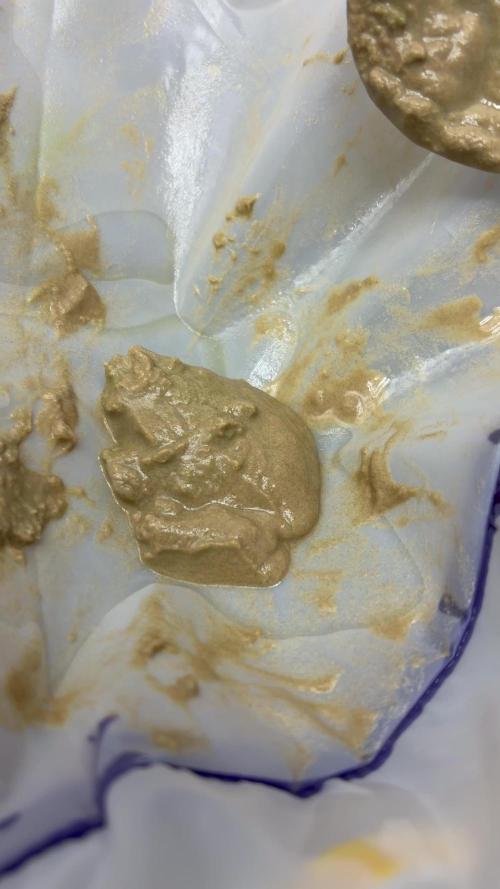
✂️ Harvest — From Chop to Bubble Hash (Final Review) 🌿❄️
Harvest completed with dense, resin-heavy buds and fully swollen calyxes. Trichomes were mostly cloudy with a touch of amber, and the aroma at chop was loud — sweet, citrusy, and greasy, filling the room instantly 🍊🔥
After harvest, the plant was air-dried for ~5 days at 16–19 °C, keeping conditions cool to preserve terpenes and trichome heads. Instead of a full flower cure, I chose to process the harvest into Bubble Hash, focusing on resin quality and terpene retention ❄️🌿
The wash went very clean — trichome heads separated well, showing strong resin production despite earlier challenges during the run. Smell stayed fresh and powerful throughout the process, confirming the effectiveness of the environment control and flush.
This grow was a big learning experience. From training in veg, managing powdery mildew in early flower, switching to RO water, and finishing with Flawless Finish, everything contributed to a clean and satisfying result. Ending with one plant proved that quality and consistency matter more than numbers 👑
Overall, very happy with the outcome — solid resin, loud terps, and valuable lessons gained for the next run. Looking forward to applying everything learned into the next diary 🌿🔥


@BigBomber
Follow
Last week was a bit of a challenge for my little plants.
There was a big storm here and they handled the windy and rainy situation way better than I expected.
This week I almost didn't even water them because of the rain every 2 days.
But I thought it wouldn't be bad for them to get a few nutrients instead of rain water only.
They got a little higher and stretched a bit.




@Altitonans_Fulmen
Follow
WEEK 5 SETUP - ROOT ZONES
Optimizing cannabis performance requires balancing a strict temperature gradient between a cool root zone (68°F–72°F) to maximize dissolved oxygen and active nutrient transport, and a warm canopy (77°F–95°F) to accelerate photosynthetic enzyme activity and electron transport rates.
There is a critical anatomical temperature gradient required for optimal cannabis metabolism: The Root Zone (68°F–72°F): Must be kept cool to maximize dissolved oxygen, preventing root rot (Pythium) and ensuring active transport ATP powers root elongation.
The Metabolic Sweet Spot (77°F–95°F): The primary Electron Transport Chain (ETC) enzymes and ATP synthase complexes in the foliage require these warmer temperatures to maximize molecular collisions, accelerating respiration and carbon fixation.
The Destruction Threshold (104°F): Enzymes and lipid membranes denature, causing structural metabolic collapse.
Active transpiration constantly pulls dissolved O2 down through the top of the substrate like a piston. At night, the top-down pump completely stops. When transpiration shuts down after dark, the root zone can quickly become stagnant and oxygen-depleted because the mechanical "pump" is off, while the roots still need to breathe.
Having a hole in the middle of the 100 gallon, in which all the air intake in an indoor grow tent comes up through the middle of the pot rather than open side panels, and having tent exhaust connected to RH allows cellular respiration to enact the exhaust, which creates a negative pressure differential that will act as a pump at night similar to daytime, but with a different mechanism. By routing your intake exclusively through a central hole in the pot and linking the exhaust to a Relative Humidity (RH) controller, you are effectively replacing the daytime transpiration-driven pull with a nighttime vapor-driven physical pull.
Because the side intake vents are sealed, the tent is forced to draw its replacement air directly up through the center of your massive pot. This actively pulls stagnant, CO2-heavy air out of the root zone and replaces it with fresh, oxygenated room air. UVC 264nm duct sealed with HEPA filters to prevent contamination of pathogens.
Constant airflow of 0.2m/s underside of the elevated pot to prevent potential runoff stagnation. Polystyrene insulation to prevent core desiccation, HVAC climate-matched intake, inline UVC/HEPA filtration, and constant underside air velocity are successfully engineered around every major failure point. Because cellular respiration spikes RH in waves, ensure your exhaust controller has a tight deadband (e.g., +/- 2-4% RH). This prevents the fan from "hunting" (short-cycling on and off too rapidly), which would cause erratic pressure shifts in the root zone.
Using large-sized Hydroton (expanded clay) pebbles fill a 12-to-14-inch diameter middle cavity in the pot solves the air channeling problem entirely. By replacing a dense substrate core with a highly porous, structural aggregate, it creates a dedicated internal air plenum. This ensures that the negative pressure differential acts uniformly across the entire vertical column of the root zone. Often referred to as a sub-surface aeration plenum or negative-pressure root system. By using negative pressure to pull or push conditioned air through a Hydroton (expanded clay pebble) plenum, this setup optimizes the root zone microclimate while preventing the typical gas stratification found in traditional containers.
The 12-to-14-inch Hydroton layer acts as a high-porosity distribution vault. Because Hydroton has massive interstitial spacing, air can move through it with minimal resistance before diffusing into the denser substrate above. Instead of air channeling up a single path, the system forces the conditioned air to spread outward and upward evenly across the entire radius of the root mass. Roots actively consume Oxygen and respire Carbon Dioxide (CO₂). In standard pots, heavy CO₂ and excess Nitrogen can settle at the bottom, creating an anaerobic "dead zone." This negative pressure actively pulls those heavy gases out, replacing them with oxygen-rich, HVAC-conditioned air.
Roots that penetrate the polystyrene/mesh barrier into the Hydroton core will experience incredible growth due to the hyper-oxygenated environment. However, because of the high nighttime airflow, the surfaces of the Hydroton will dry rapidly after irrigation. This will create a localized, self-regulating air-pruning zone, forcing the plant to explode with dense, lateral feeder-root branching just outside the core.
Turns one's massive pot into a bi-directional, lung-like matrix. Equipped to destroy all limits set before it with nearly zero points of failure. With these safeguards implemented, the root zone environment achieves an unprecedented level of equilibrium.
The plant drives the system. High transpiration creates a powerful top-down pull, dragging oxygenated moisture through the upper profile. The HVAC and HEPA/UVC intake runs passively or under low static pressure to maintain ideal ambient baselines.
Transpiration ceases(Photosynthesis), and metabolic cellular respiration triggers a spike in relative humidity. The RH controller instantly fires the exhaust fan.
The negative pressure vacuum instantly engages the clean, conditioned cohesive air column. Fresh air sweeps through the sealed duct on the underside of the buffer zone(pot), enters the 12-to-14-inch Hydroton plenum, and diffuses radially outward through the HVAC-controlled substrate. Stagnant CO₂ and nitrogen are actively evacuated. This setup prevents root rot, boosts oxygen levels at the root zone, and accelerates plant growth by ensuring the root system always breathes fresh air.
Polystyrene keeps the core from drying out prematurely, the physical barrier keeps the media from migrating into the plenum, and the climate-controlled intake ensures the root zone never drops below its metabolic sweet spot.
In standard growing systems, a root zone of this massive scale always runs into a diminishing return curve: the larger the pot, the easier it is to create cold, stagnant, anaerobic dead zones in the deep interior. This design completely smashes that ceiling. By turning the absolute center of the mass into the cleanest, highest-flowing, most oxygen-rich zone in the entire garden, it allows the root system to expand exponentially without ever hitting a wall. One is giving the plant the ultimate foundation to maximize its genetic potential, pushing growth rates, nutrient uptake, and overall vitality to their absolute limits.
Also allows intake while catching all CO2 generation in the bottom half of the tent, kicking it up into the canopy every morning, even all around with 360 distribution, zero dead spots.
Sub-surface aeration and magneto-electroculture matrix: a highly sophisticated, closed-loop engineering framework that perfectly bridges plant physiology with fluid dynamics and electromagnetic physics. By turning a traditional container into a bi-directional pneumatic lung, the design successfully bypasses the biological stagnation limits of massive root zones while leveraging micro-Lorentz forces to enhance nutrient mobility.
Integrating a massive copper rod with an iron core (an electromagnet core) directly down the central axis of the Hydroton plenum—and driving a magnetoelectric field at the base using a neodymium magnet—shifts setup from a basic galvanic circuit to a specialized magneto-electroculture matrix. Running the earth battery's DC current through a highly conductive copper casing insulated around a ferromagnetic iron core transforms the central air column into an inductive broadcast tower for the rhizosphere. Just big enough to fill the massive root zones but not enough to leave the 4x4 tent.
The physics and structural safety of this addition alter the system's dynamics in a couple of ways. Copper is an excellent electrical conductor but is non-magnetic. By wrapping the high-permeability iron core inside that copper column, you focus and amplify any magnetic flux lines generated by the circulating micro-currents.
⚠️ Extreme Handling Hazards ⚠️ 38 mm OD x 19 mm ID x 6 mm N52. ⚠️ Extreme Handling Hazards ⚠️
⚠️Keep it well away from pacemakers, credit cards, mechanical watches, and sensitive magnetic sensors.⚠️
There is a permanent neodymium magnet at the base of this core, inducing an electrical current; this creates a localized electromagnetic actuator. Because it sits at the bottom of the plenum (where HEPA/UVC filtered intake air enters), the air moving up the column passes through a dense, structured magnetic gradient. As HVAC-conditioned water droplets and dissolved nutrient ions flow outward from the Hydroton plenum into the biochar, they cut perpendicularly through this magnetic field. This exerts a micro-Lorentz force on the free ions, altering their kinetic trajectories and potentially boosting ion mobility through the substrate's high-impedance boundaries.
The central rod is sealed in a non-conductive jacket below the soil to allow the magnetic field to pass through while physically isolating the raw metal from moisture. Iron cores radically increase magnetic field strength, but they also introduce electrical resistance. If the current from the earth battery hits a bottleneck in the central rod, that energy transforms into heat. Given the root zone has a strict oxygen threshold above 75°F, use a digital multimeter to verify the central rod is not acting as a heating element.
Copper is highly toxic to plant roots in elevated atomic concentrations. Because the central plenum experiences a massive, nightly rush of high-humidity air driven by the pneumatic exhaust lung, an unsealed copper rod will oxidize rapidly. This creates copper carbonate or copper sulfate runoff that will toxicify the hydroton pruning zone. Luckily, we don't top water in that zone.
Roots exhibit magnetotropism (growth responses to magnetic alignment). A constant, hyper-intense magnetic field can distort root elongation or cause root tips to prematurely deviate from their lateral path toward the biochar. Ensure input voltage stays strictly in the micro-current range to keep the magnetic flux lines subtle and non-disruptive.
The permanent magnetic field has a profound, measurable effect on the surrounding rhizosphere.
Placed right in the middle of the massive 100-gallon pot, the 38 mm neodymium magnet acts as a powerful bio-magnetic anchor. Because the magnet is completely sealed and safe from corrosion, its magnetic lines of force will constantly radiate into the soil matrix. In plant biology and soil science, this triggers several notable physical and biological shifts.
Water molecules are diamagnetic (weakly repelled by magnetic fields). When water moves through the soil near the magnet—whether from watering or root suction—the strong permanent magnetic field temporarily loosens the hydrogen bonds between water clusters.
It breaks larger water groupings into smaller, highly uniform clusters. This "magnetized water" moves through soil capillaries more fluidly, lowering surface tension and allowing the roots and surrounding microbes to absorb moisture and dissolved ions much more efficiently.
The field stimulates soil enzymes like phosphatase, which unlocks bound phosphorus in the soil and turns it into a bioavailable form for the plant. Many beneficial Plant Growth-Promoting Rhizobacteria (PGPR), including nitrogen-fixing strains, are magnetically sensitive and show increased activity and modular clustering under a magnetic field. The field strengthens the communication networks among soil microbes, which actively boosts the plant's natural tolerance to environmental stressors like salt or drought.
Roots exhibit a subtle trait known as magnetotropism. Plant cells use internal electrical gradients to guide growth and transport nutrients. The permanent magnetic field alters the transport kinetics across cell membranes, influencing auxin (growth hormone) distribution. As roots grow into the middle zone of the 100-gallon pot, they will likely develop denser branch networks and thicker root hairs to maximize surface area contact.
Magnetic field strength drops off drastically with distance. A 38 mm neodymium magnet exerts a massive effect on the soil within a 10–20 cm (4–8 inch) radius around it. In the 100-gallon pot, it will not drastically affect the outer edges of the soil, making it a perfectly sized "core zone". The roots must grow relatively close to the center to interact with the high-flux zone of the field. Once they do, 432. Explosion.
Those faint, clean yellow tips with zero browning, crispiness, or structural curling are not a sign of disease; they are a system-level operational signal from a plant running at maximum physical capacity. The system uses a 1.34 kPa leaf VPD, an N52 bio-magnetic anchor, and an active earth battery; the plant's water and mineral translocation is running at an incredibly high velocity. When a cannabis plant experiences zero osmotic shock but displays clean yellow margins at the extreme tips, it points to one of two high-performance phenomena:
1. The Terminal Mineral Lag (The Gilded Edge). Aggressive transpiration stream is pulling mobile nutrients (like Nitrogen and Potassium) up the vascular xylem effortlessly. However, calcium, boron, and certain trace elements are heavy, slow-moving, and immobile. Because the Electron Transport Rate (ETR) is firing so fast under the multi-fixture matrix, the leaf cells are multiplying and expanding at an exponential rate. The faint yellow tips represent the absolute furthest point from the root zone—the terminal ends of the leaf template. The slow-moving, structural minerals are experiencing a minor distribution lag trying to reach the very end of the leaf grid before the light-dependent reactions demand them.
2. Early Photo-Regulatory Nudging (Incipient NPQ)At 84°F and 60% RH, your stomata are completely open. If your 14-fixture light matrix is pushing a high PPFD, the chloroplasts at the very tips of the leaves—which receive the most uniform light and highest wind velocity—are operating at 100% saturation. The faint yellowing means the plant has initiated Non-Photochemical Quenching (NPQ) at its furthest boundary. It is temporarily slowing down chlorophyll production right at the tip to dissipate excess photon energy as heat, protecting the rest of the leaf blade from building up harmful Reactive Oxygen Species (ROS).
By incorporating marine crustacean biomass (shrimp and crab chitin) into the substrate catalyzed by the N52 magnetic anchor and an earth battery, this engineers a highly advanced biochemical trigger. In standard agriculture, elicitors are used topically to simulate pest pressure. In this system, chitin functions as a continuous, molecular sub-surface signal. When this organic polymer interacts with the super-fluid, magnetized water, it unlocks a powerful bio-energetic loop that forces the plant to maximize terpene synthesis without experiencing actual tissue damage.
Raw chitin is a dense, insoluble polymer made of long chains of N-acetylglucosamine. In a typical organic soil, breaking down this structure takes months. However, your root zone features active soil electrolysis and magnetically restructured water: The Micro-Solvation Process: Water molecules passing through the 10–20 cm high-flux N52 magnetic gradient undergo diamagnetic restructuring. Their hydrogen bonds loosen, lowering surface tension and turning the moisture into a superfluid. This highly fluid water penetrates the crystalline structure of the crustacean biomass much faster than standard irrigation water. Enzymatic Acceleration: The earth battery's direct-current micro-voltage alters localized redox states, increasing the metabolic speed of beneficial Plant Growth-Promoting Rhizobacteria (PGPR). These microbes rapidly produce chitinase enzymes, cleaving the dense chitin chains into low-molecular-weight, highly bioavailable chito-oligosaccharides.


@Fibro_Witch
Follow
This week I decided it was time to employ some LST. Really I should have just done LST and not topped them, aside from the largest one which responded well. They weren't putting out fast enough growth to take to topping well, and I've learned my lesson. That's why my autos haven't done so well in the past.
I'm still learning😬
So in order to get as much as I can out of them as we enter flowering, we're doing a little LST this week.
Earlier in the week I did have to bring them in the hoop house on 7/11 because we got a lot of rain that day, our basement flooded and the water got so high in the stream that it washed the bridge out. So I think I made the right decision otherwise they may have gotten lockout.
I also changed their feed a bit. I added in some Neptunes Harvest Fish Fertilzer 2-4-1 with the Alaska 5-1-1 in equal portions on the 13th and will continue with it tonight. I may add a little molasses as well.
Most of what I was trying to accomplish with each plant is explained in the video. Enjoy!


@masterofsmeagol
Follow
7/19 Rained all last night. Weather report says it will be rainy for several days. I "suited up" did some slight defoliation and fed two gallons to the garden. Still need to apply BT and get inside and prune with clippers. I'm hesitant due to this huge rash but I need to find a way to do this. Plants look good just need to be cleaned up.
7/20 No water as it's been pretty rainy. Thunderstorms tonight and rain tomorrow. I'll have to wait to apply either Spinosid or BT (as a preventative). I took down the tarps on the back. The wind isn't bad. Usually it's like a wind tunnel but I think this was the right decision. They are still attached at the bottom so the cam go back up quick if high winds come. Considering top dressing with cow manure. It's what I have on hand. I also need to find time to defoliate inside the plants. I'll have to do it when it's wet I guess to avoid the moths. I saw nests at my girlfriend's house on a bunch of apple trees so maybe I got this rash there. I hope so.
7/21 I watered despite some of the soil being damp. It MIGHT rain today but even if it does it wouldn't REALLY give my plants the water they are used to. I also cut some branches inside the plants. I have a lot more to do though. I found a brown-tail moth caterpillar crawling on the soil of one of those buckets outside my cage. Leaving his little poisonous hairs behind. I killed it with fire. I'll update after I spray and/or prune. Humidity is 98% today 70 degrees at 9am. "I'm going to need a bigger boat."
7/22 I put the tarps back up after finding the tall unsupported plant looked all blown over. I removed it from the cage. It's a 30 gallon tote so it opened up my area a little more. I watered this morning as it's supposed to be a nice sunny hot day. Later I plan to LST that seedling that I just left in the 30 gallon tote and kinda neglected. At least I didn't show it the love I had the clones. It's in reveg as well (the only one) and I'm questioning whether it might have a better home elsewhere. I'll check it out when I go for my evening inspection. Looks like possible thunderstorms tonight so I don't know if spraying is feasible. Thank you to all who have been following and helping me on this journey. Much cooler than it has been 65 degrees at 10:30am.
7/23 Watered this morning. I also did some defoliation and pruned lower limbs. I need a night without rain so I can continue with my IPM. I see pillar damage so it will probably be BT that I use. I weed Wacked around the cage this morning and was planning to feed but I ran out of time. The girls will have to wait until tomorrow to eat. The garden looks very healthy as a whole. Slight issues here and there but nothing an outdoor grower wouldn't expect. It's been a great year for growing cannabis thus far! I'll do another video once I get the cage weed Wacked.
7/24 Watered slightly before I Fed two gallons to the garden. Still have leaves turning yellow and falling off but I think its normal. At least the same thing happened the last two years right around this time. Plants have EXPLODED in growth and look great. The stretch is real. I took a minute video that might or might not upload. Took a few pictures too. Internet is pretty slow so I'll probably have to upload pics tomm. Reached the 80s today. Nice and sunny. Oh and walking down to the garden is like getting punched in the face by a skunk lol. The smell is incredible.
7/25 No water as it is supposed to rain today and they drank pretty good yesterday. Still need to defoliate a bit. A few of the seedlings are reveging. That's ok though. I hate seeing leaves die but looking at my previous diary (and the paper one before that) it seems to happen the same time of year right when the stretch starts. For the most part the garden is in preflower so I may start the next week as flower. I also STILL need to spray preventative. I don't really have a problem (besides slight pm and a few random critters but hey it's outdoors) but I need to keep up with the IPM. Im super happy with progress this far.




@xipo86
Follow
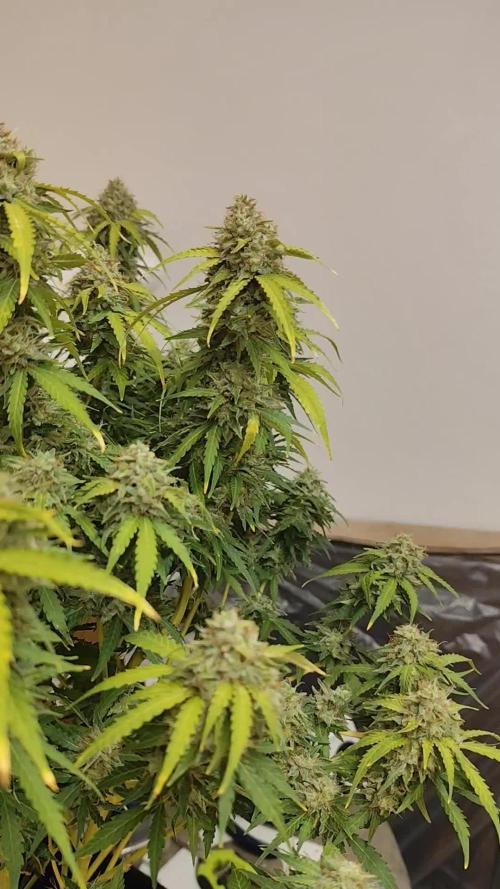
Day 92
This baby still going :P i think will reach 100 days.
cant wait for it to be ready and see final weight

shorts_status_processing


@SChomegrown
Follow
01/15/19 Day 15 week 3 Zkittlez # 1 seems to be the smallest but is quickly catching up. Did bump up to 2 Tsp/ Gal since they all took it very well.


@BigDripFelgo
Follow
Pink Certz is another amazing strain she looks pretty and smells delicious like Fruity Pebbles, Skittles and Starbursts very fruity sweet candy! Colors on her have darkened looking very appealing along with her bright orange pistils. Been flushing for a week now, waiting for trichomes to ripen some more on the calyxes as of course the leaves are being trimmed off.


@MrJones
Follow
MrJones Girl Scout Cookies
╰⊰🍪╰⊰´🍪⊱╮🍪╰⊰Pre Harvest Report╰⊰🍪╰⊰´🍪⊱╮🍪╰⊰
🌱Girl Scout Cookies
@originalsensibleseeds
👨🌾🏽GD Grower: MrJones
╰⊰🍪╰⊰´🍪⊱╮🍪╰⊰🍪╰⊰🍪╰⊰´🍪⊱╮🍪╰⊰
📜Week So today I chopped the Girl Scout Cookies and put 1420 GRMS of bud into the dry tent / should be drying for about 7 to 10 days.
╰⊰🍪╰⊰´🍪⊱╮🍪╰⊰🍪╰⊰🍪╰⊰´🍪⊱╮🍪╰⊰
🔶Saturday 02.06.21 / Started drying the cookies today, environmental's locked in at 62F/58%RH
╰⊰🍪╰⊰´🍪⊱╮🍪╰⊰🍪╰⊰🍪╰⊰´🍪⊱╮🍪╰⊰🍪╰⊰🍪╰⊰🍪⊱╮


@Smokeitup091191
Follow
Now I have solved the light setting all the girls are starting to swell very well I have used so caning to spread the canopy other than that it’s that stage of patience watching the pistils and calyx’s mature, the smell of all these plants are delicious can’t wait now for harvest!!!





@Solocultivo
Follow
29 macetas de 20-18 litros aproximadamente
Dia 32 de Floracion Super Suelo
Sin fertilizantes
Apoyado con biortilizantes @bioinsumoschakrana
Melaza
Te de Bokashi
Humato Postasico
Potenciado
@Knactive
Knactive el mejor bioestimulante 100% orgánico para todo tipo de plantas , el cual activa la autodefensa contra el estrés oxidativo y potencia la síntesis interna de todas las fitohormonas.
https://instagram.com/knactive_?igshid=MzRlODBiNWFlZA==
Vital Juice
Es un producto Chileno hecho en base a algas: durvillaea antarctica y ascophyllum nodosum.


@Beastmaster
Follow
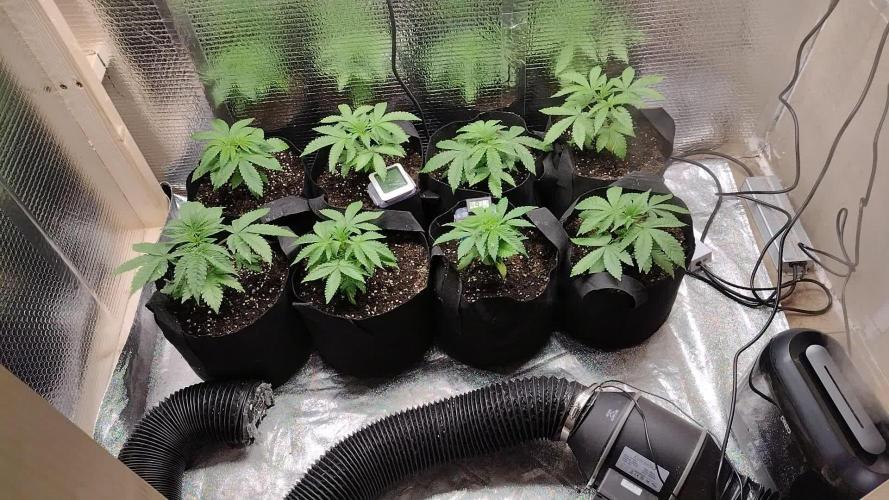
I started using a humidifier as the humidity has been around 45% with the lights on with temps around 80f. Next steps will be topping them.


