The Grow Awards 2026 🏆 








Likes
Comments
Share
@Snaqq
Follow
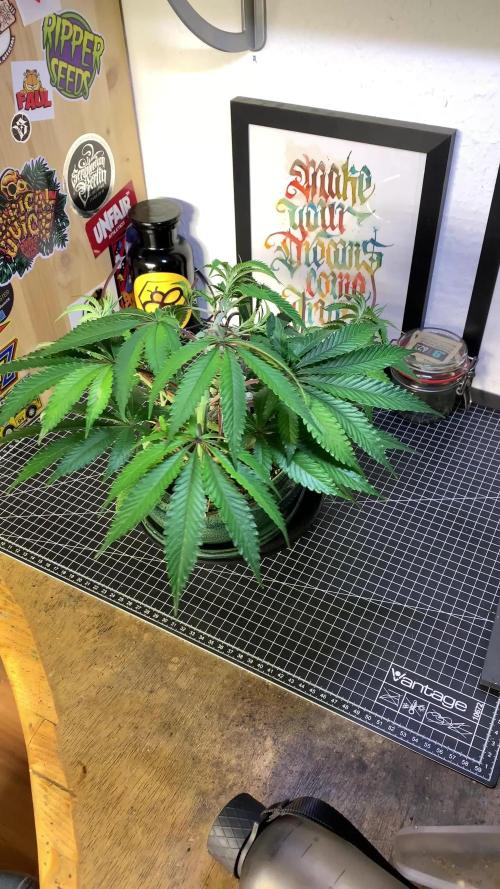
Because of a short vacation, I couldn't water the plant adequately. Unfortunately, it was a bit underwatered when I returned.
06.10.24: 2700 ml
07.10.24: 2200 ml
08.10.24: 2500 ml, Some more LST. Bend the four side branches more to the side and leveled the two tops.
09.10.24: 2000 ml
10.10.24: 2000 ml, Soft defo from the bottom to get easier access when watering.
11.10.24: 2000 ml
12.10.24: 2500 ml, I might need to lollipop, defoliate and more LST the plant soon.

Likes
1
Share
@Hashsmokinslasher
Follow
Most of them are displaying male characteristics unfortunately. Got the two females and the three that haven't developed sex organs mainling in my greenhouse as of may 26th.
Haven't put a grow light on them yet but I should be able to set that up this week
Likes
35
Share
@bioaccessory
Follow
Hello colleagues! ✋😃
Flowering is in full swing, and the left plant, which was slightly lagging behind, finally stopped, almost resting against the lamp. As bro correctly noted in the comment, the plants turned out to be quite large (once again I regret that I did not have time to test them outdoors).
The buds are starting to form, I hope that the final part of the cycle will pass approx.
Thank you for stopping by, and be healthy! 🙏
To be continued... 😶

Likes
12
Share
@StonedandSteady
Follow
AutoBlueberry breed by #DivineSeeds #DivineSeedsSquad #DivineSeedsBreedingCompany Origin:Afghani/Thai
Type:50% Indica/ 40% Sativa/ 10% Ruderalis
Flowering:56 days
THC:22%
Harvest:400-550 g/m2
Height:110-150 cm
Thier Growing under the #Growatt600w and in my #TopoLite 24×24×48 Grow Tent! I'm also using #TNBNaturals #TheEnhancer Co2 Despersal Canister and using thier Ph⬆️⬇️ for my Decolinated Tap Water!
Green and Growing Up Great! She's leaving her 2nd week of Veg and Stretching out into her 3rd week! She's Growing in my special blend of ProMix potting mix, a 1/2 bag of Earthworm castings and 2 light handfuls of Diatomaceous Earth mixed Up well for before transplanted! Diatomaceous Earth: Diatomaceous earth is made from the fossilized remains of tiny, aquatic organisms called diatoms. Their skeletons are made of a natural substance called silica. WHAT IS DIATOMACEOUS EARTH?
In a nutshell, DE comes from the fossilised remains of small marine organisms called diatoms. Over a 30 million year period, these hard-shelled algae collected on the bottom of bodies of water, eventually forming into a type of sedimentary rock. Fast forwarding, it wasn’t until around 1836 that a German peasant Peter Kasten discovered the ivory-coloured, powdery substance while drilling a well in northern Germany. Ever since, the usefulness of DE for multiple purposes, including industrial and horticultural applications, has been well-reported. Just sprinkle some diatomaceous earth on top of your soil and watch mother nature's secret weapon work its magic.CONDITIONS THE SOIL
When it comes to growing cannabis, everyone strives to provide the best soil to grow the best plants—but there’s always a way to make it even better. Making the soil a better medium is called soil conditioning, which is exactly what diatomaceous earth does. It works by improving the retention of moisture in your potting soil, holding a large amount of fluid and drying at a rate that’s much slower. This natural soil additive also helps to retain nutrients and allows for better oxygenation of the substrate. NATURALLY CONTROLS PESTS
DE is an all-natural, safe-to-use substance that doesn’t harm the cannabis plant with toxic chemicals. The nature of diatomaceous earth makes it useful against most types of insect infestation you might be experiencing; and unlike chemical insecticides, insects can’t develop a resistance to the effects of DE. So once they’re gone, they’re gone for good. DE is an abrasive. and when used as an insecticide, it gradually scrapes away an insect’s exoskeleton, absorbs the fluids, and dehydrates insects and other critters to eventual death. IMPROVES PLANT STABILITY
When using DE in your soil, it can be especially beneficial as it frees up nutrients so that they are made available to the plants as needed. This works via the silica content of DE being absorbed into the plant tissue, which helps improve the plant’s ability to respond and receive more nutrients as DE activates. This in turn results in greater yields and better stability under small pH fluctuations!
https://divineseeds.net/
https://instagram.com/divine.seeds?igshid=osxe2v7en33v https://divineseeds.net/
Thanks Again to All my Friends, Family's, Teams, Sponsors, Followers and Subscribers!!! Your Genetics are Merry Magnificent, Mega Marvelous and Mighty Medical! Love um!!! I really Can't stress enough how Thankful and Grateful I am of All of you and what you've Shared with Us! Means the World!!! It's definitely a Pleasure being able to Grow with these Phenomenal Grow Lights! Please Enjoy! BudBrothers4-Life! Cheers Famz!!! Much Props and Much Topz!💯🔥 #Osree #GrowStarStore #Growatt #TNBNaturals #TNBTeam #GrowYourOwn #Bliss
https://instagram.com/as420.ca?igshid=1f116alw054wp
The Grow Bags: https://www.as420

Likes
12
Share
@2Stones1Bird
Follow
Checkout my Instagram @smallbudz to see the Small budget grow setup for indoor use, low watt, low heat, low noise, step by step.
25/10/2019 - First feed I gave her 0.25ml on 250ml of water of Biobizz-Grow, with 6.5ph.
26/10/2019 - Leafs looking a bit crooked, and some pale spot lets hope its not fungus. (gave her 100ml of just PH 6.5 water)
27/10/2019 - Feeding day, gave her 250ml water with 0.25ml Biobizz Grow, 6.4PH (changed feeding to once every 2 days with a plain water interval)
28/10/2019 - Started LST
30/10/2019 - Feeding day, gave her 250ml water with 0.25ml of each Biobizz - Grow,Bloom and Max, 6.3PH, added carbon filter and it raised the temps to 29c
31/10/2019 - A tad too much of nuts, little burn tip. (Sensi Seeds warned me but I still goofed it)

Likes
10
Share
@TeesTrees
Follow
Day 57 - The plant looks great, healthy! The buds are looks great also.
Day 58 - The plant is looking great i just watered her today looks like she might have a bit of water shock. I gave the plant some PH controlled water but i didn't take into account the soil so the whole thing didn't make a difference.
Day 59 - The plant looks amazing. Defoliated her a little more today.I'm noticing the smell more prominently now as well; Also we done some seriouse decore change today so the whole place looks like a bud box we got the other plants from my diaries featuring in a the video.
Day 60 - She is well and growing.
Day 61 - Was to busy running around didnt take a pic its a shame but its okay.
Day 62 - The buds are forming nicely plant is stretching out for the last time. The plant is also dry and will need watering tomorrow. I raised the light today as she is very tall now and was nearly touching the light.
Day 63 - The plant got fed PH 5 water, so she looks a bit droopy from water shock but; she will spring back to life like she normally does. Looks like the plant is doing well though.

Likes
23
Share
@Vincent11
Follow
Hi all.
Hope you enjoyed your week.
This week my Gorilla glue Autoflower did well I can say.
Got a bit off nute burn on day 36 after watering on day 34.
But thankfully my Beautiful and Strong plant make true quickly after flushing her with 15 L off PH-6water.
And she's gone from strength to strength every day after that little nute burn.
Buds sites forming nicely, trichomes started growing and with an explosion.
Stayed nice and green.
Overall very happy 😃.
Look at the Pictures and decide yourself guys.
Good luck growing and Relaxing 😎.
Have a great week everyone.


Likes
6
Share
@GreenForce
Follow
Very happy with harvest , in more three weeks I will give my feedback about terpenes , etc.

Processing
Likes
39
Share
@CanuckVetGrwr
Follow
The last week there has been a few hiccups. I over watered the gal a bit so the branches were drooping, a few days of almost 40 degrees so some heat stress didn't help but they still grew close to 5" though!!
They have really filled out after I gave them a small pruning on day 44, and with the few hiccups they have come back healthy. I.e to.much water so let them dry out, and cut my it in half the volume which seems to be working better.
I used a magnifying glass app to see when I'll get some signs of flower they are obviously not there yet but for a free app awesome pics.
Pretty happy with how they are growing, no issues with bugs or critters. I'm using a few herbs as a natural bug repellent which seems to be working but have a neem oil spray bottle ready incase.
Thanks for stopping by and looking.
Happy growing!

Likes
50
Share
@D33jW
Follow
🌸 Runtz - Week 1 of Flowering 🌸
🌿 Genetics: Gelato x Zkittlez
⏳ Flowering time: 8–9 weeks
🔥 THC: Around 27%
🌈 Effects: A balanced mix of euphoric uplift and deep relaxation, perfect for both creative moments and evening chill.
🍬 Aroma and flavor: Sweet, fruity candy notes with tropical and creamy undertones.
This plant has completely stolen my heart! ❤️ The structure is absolutely stunning
- beautifully forming flowers and an abundance of side branches make this one truly special.
The way it's shaping up already has me excited for the weeks ahead!
The first week of flowering went perfectly under great conditions,
and I couldn’t be happier with how she looks at this stage.
At the start of the week, I performed lollipopping to ensure that lower branches,
where less light reaches, don’t take away energy from the top canopy.
Now, she can focus all her strength on producing some buds!
Grow Conditions (FLO Week 1):
🌞 Light schedule: 12/12
🌱 PPFD: 750 µmol/m²/s
💧 VPD: ~1.2 kPa
Let’s see what week 2 brings! 🚀🔥

Likes
15
Share
@UDUDUDUDU
Follow
da secret of why plants need ventilation is two things.
one da air moves da plants cells allowing them to stretch.
two da air helps maintain a plants electromagnetic charge.


Likes
35
Share
@Hiroots420
Follow
20/05/2021
Las plantas comienzan a superar el estrés causado por el trasplante!
Espero tener una semana mas de vegetativo de cara a que mejore el estado de estrés y luego se van a florar!
23/05/2021
Viene todo muy bien, sigo acomodando ramas en el scrog! esperamos terminar los Citizen para pasar a florar lo antes posible.

Likes
23
Share
@SativaSteve88
Follow
Both shot up in size over the past week or two, ones at 113cm other now at 130cm, tallest has been bent over and tied down to hopefully stop the growth, coming along well now and can't wait for the next few weeks to pass, First ever grow only done LST on 1 plant let the other grow naturally but put a few ties on it this week to get more light exposure as it seems way behind the other and there is only actually about 2 days in them, what are peoples thoughts on how its looking? Thanks
Likes
37
Share
@GODSGIFT_2005_JM
Follow
For LIQUIDS & NUTES ******GREEN BUZZ NUTRIENTS***** organic.
Also i’m using their LIVING SOIL CULTURE in powder form!
MARSHYDRO ⛺️ has large openings on the sides which is useful for mid section groom room work. 🤩
☀️ MARSHYDRO FC 3000 LED 300W
💨MARSHYDRO 6” in-line EXTRACTOR with speed-variation knob, comes complete with ducting and carbon filter.

Likes
15
Share
@tsf_homegrow
Follow
🇩🇪
Die letzten Tage waren wir etwas aus der Spur. Sie hing etwas durch da ich nicht optimal gegossen hatte. Ich hab einen kleinen Teil der Wurzeln weiter frei gelegt und sie weiter und Form gehalten. Entscheiden das oben am Haupttrieb noch 4 weitere Seiten Trieben entstehen dürfen. Und dann wird es langsam auch Zeit sich Gedanken zu mache sie in die Blüte zu schicken. Aber ein paar Wochen darf sie noch wachsen. Happy growing💛✌️
🇬🇧
We've been a bit off track the last few days. She was drooping a little because I hadn't been watering her properly. I've exposed a small section of the roots and kept her in shape. I've decided to allow four more side shoots to develop at the top of the main stem. And then it will slowly be time to start thinking about putting her into flowering mode. But she can continue to grow for a few more weeks. Happy growing! 💛✌️

Likes
8
Share
@YungSmoke
Follow
Week 8. P Biddy.
She's got the least foliage out of the 4 but the buds have come along nicely. Few of the big fan leaves and upper / newer leaves are showing signs of (I think) N deficiency; yellowing quicker than expected and getting crispy / papery.
Top fed with some all mix and a healthy dose of biogrow and hoping it's the right call.

Likes
11
Share
@phelice
Follow
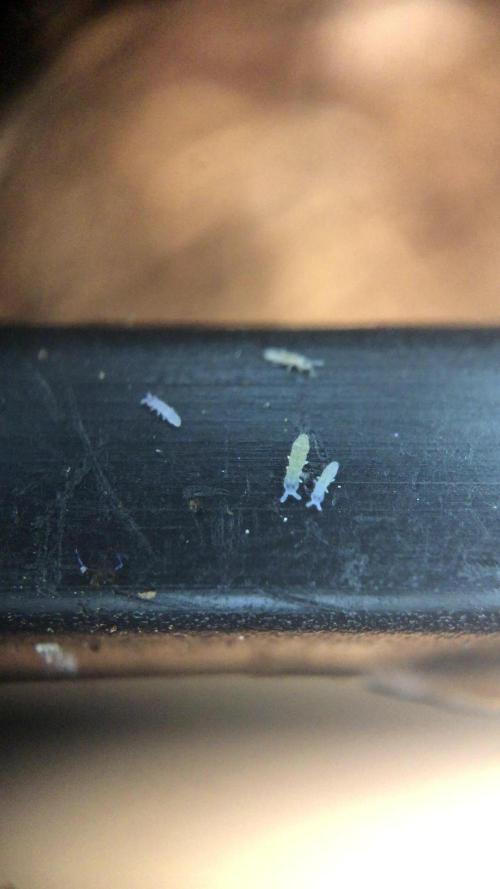
Week 8 and growth continues to be muted. Due to the poor soil, I'm only slightly scratching the strain's potential.
I've attached a video of the insects that were in the soil, along with the fungus gnats.
Today, the ladies were trimmed a bit at the bottom.
-----------------------------------------------------------------------------------------------------------------------------------------------
woche 8 und weiterhin verhaltener wuchs. aufgrund der schlechten erde kratze ich natürlich nur leicht am potential des strains.
ich habe mal ein video der insekten beigefügt die neben trauermücken in der erde inklusive waren.
heute wurden die damen untenrum etwas freigeschnitten.
Likes
111
Share
@Salokin
Follow
Hi Growmies,
So far she is doing what she is supposed to. She popped her head out within two days and since then she has been growing nicely. I have switched on a little fan to make sure she gets sturdy enough. I have also transplanted her into her final net pot and nested her in a bed of Speedgrow green mini cubes and soaked her for 15 min in a 500 ppm ph balanced RO water.
I would love to upload some videos, however this seems to be getting increasingly challenging on this website.
Here is the code that’ll give you 20% in Zamnesia‘s online store, just input ZAMMIGD2023 at checkout.
Likes
8
Share
@Franz1234567
Follow
We are in week five. I was a little embarrassed because my girls reacted to the stress by shrinking. Now the situation is perhaps consolidated and we are gaining weight. They will be such tiny beauties, I really hope.
pH still unstable (5-6), EC of rainwater supplemented with a mix of organic fertilizers to a value of min. 1.2-1.6
The girls look healthy so I cuted some leafs but only so much, as the all tops have good position for light source.