


Likes
Comments
Share


@Naujas
Follow
The first week of flowering went smoothly:) The girl looks beautiful and healthy :) good luck to everyone.:)

Likes
7
Share


@Tio_Shuni
Follow
Como pasan de rápido las semanas!
Las señoritas bien.
Ya en la semana 6 de crecimiento, pensaba en dejarlas hasta la semana 8 vegetando, pero la sharkshock de la parte superior izquierda me tiene algo indeciso, siento que me quedará corto el espacio de 1.80 en la carpa, espero no sea el caso. Es la que más toma agua 🤭
Veremos hasta la semana 7 que tal y viendo eso veo si las pongo en flora, hasta ahora con el riego de 6.2 esta todo super, abonando con productos orgánicos, esperando a tener una buena cosecha.
Pronto les seguiré contando que tal :D


Likes
12
Share


@Italianganya88
Follow
Alles läuft super buds fangen langsam an anzuschwellen hab eine 2 Lampe mit reingebracht um mehr lichteinwirkung in der Blüte zu haben. Die einzige Frage die bleibt sollte ich langsam anfangen zu entlauben. Bin mir bei autoflower unsicher.


Likes
9
Share


@MrGreen92
Follow
They're all doing well as far as I can tell. I've put a tubular heater in-between the pots that comes on when the lights go off as the temperature drops quick in there.
Watering as usual but other than that I only check on them about 15 times a day.
I tested the run off water for the first time and was 6.3 pH which is what I put in. Was also the first time I'd even emptied them as they normally just dry up by next feed.
There's orange hairs on some of the lower buds now guess they're maturing 🤔
Was looking in to getting a microscope to have a look at the trichomes but tried using my phone camera first which I thought didn't do a bad job 😊 is only a S10 so would imagine the newer phones do an even better job 👍
Have what seems to be a CalMag deficiency in all 3 plants but only just came up in rusty spots from 12am to 6am they just appeared was really pissed off and worried about them all day at work 😪 gave them all a CalMag and 6.5 pH water soak of 500ml each and a 200ml foliar CalMag spray for extra effectiveness haha 🙄 and then gave them their normal feed til run off.. the trays were a bit slimy 🤔 hopefully it sorts itself out and have learnt to just use the CalMag every feed to be sure.


Likes
9
Share


@Djuff
Follow
Week 4 Flower:
Day 1: Fed her with another 10ml/l of Biotabs BudBooster and will no longer defoliate the lady,
Day 2: Quite happy about her progress so far. Hoping that my 125W Purple Alien LED will deliver enough light for thick and dense buds.
FUCK, i just discovered some pollen on a leaf - and i saw the stem evolving pollen. So i cut it. Lets hope that not every bud will be full of seeds.
Are there Nanners or is it a Hermie guys?? (Pictures)

Likes
2
Share


@Green_Peace
Follow
Got back from 2 weeks holiday and immediately lollipopped and defoliated all 4 plants heavly. Will wait a few days for them to recover from the battering I gave them before flipping to 12/12.
This plant is at the back of the 4 in the timelapse.
Likes
28
Share


@NatureSolutions
Follow
Everything went allright as usual, kept a good splash of water on it at all times. Dont panic if nothing happens first few days, outerlayer needs some time to soak and burst. Cant say if this is the best method, yet it never failed me.

Likes
25
Share


@OZDAOgrow
Follow
So, 4 plants. judging by the leaves, there is either a nutrient deficiency or lack of nutrients. This week, I will be defoliation, I think the final one, and onward to the harvest!
I will listen to all advice, with pleasure 💚
Likes
24
Share


@Smokwiri
Follow
I didn't top it yet, new leaf looks great ;)
Switching to flowering mode coming week...

Likes
7
Share



Likes
3
Share

@CalGonJim
Follow
1/12 4:14AM MONDAY!!!!!!!! CBG IS GOOD!1 LOWERD THE WATTAGE, EFFICIENCY IS GOOD. GREAT WHITE MYCO HAS INCREASED UPTAKE AND AND!!!! PHOTOSYNTHESIS EFFICIENCY ......FUCKING AWESOME 💪💪💪💪
1/12 4:47AM I asked GROK: are samsung leds on my mars hydro lights seem more efficient than the PPFD meter says, I lowered the lights again by a few watts? Yes, the **Samsung LM301H EVO diodes** in your Mars Hydro lights (likely an FC-E series like FC-E3000, FC-E4000, or similar) are among the most efficient horticultural LEDs available right now—individual diodes hit **3.14 μmol/J** efficacy, pushing the whole fixture to around **2.85–2.9 μmol/J** PPE (photosynthetic photon efficacy) in manufacturer specs and independent tests. That's top-tier for full-spectrum grow lights, meaning they convert more electrical power into usable plant photons than older diodes or cheaper LEDs.
If they "seem more efficient than the PPFD meter says" (your plants thriving at lower wattage/height adjustments), that's actually common and not a contradiction—it's often the **real-world efficiency** shining through once nutes/stress are fixed. Here's why this happens and what your recent wattage drop (a few more watts lower) likely means:
### Why Samsung LM301H EVO Can "Seem" More Efficient Than Raw PPFD Readings Suggest
- **High PPE + Uniform Distribution**: These diodes excel at producing photons in the PAR range (400–700nm) with minimal waste (heat/loss). Mars Hydro FC-EVOs achieve strong average PPFD (e.g., 750–1000+ μmol/m²/s in tests at recommended heights/power) with even spread—no hot spots wasting energy. When your nutes were suboptimal (Advanced Nutrients issues), plants couldn't fully use the light (wasted photons → stress, stretch, lower efficiency). Now dialed in (GH powder + aminos + mycos), they convert more of that PPFD into growth—making the light "feel" stronger/more efficient even if meter numbers stay the same or drop slightly.
- **Meter Limitations & Calibration**:
- Handheld PAR meters (especially cheap/older ones) can under-read full-spectrum LEDs like LM301H EVO (strong white + red enhancement). They often have poor spectral response to the exact mix, reading 10–30% low compared to pro tools (Apogee SQ-500) or calibrated apps.
- If you're using an app like Photone (mentioned in your diary), it's generally more accurate for Samsung full-spectrum lights (especially on iPhone; Android varies but often close with diffuser/paper). Many growers report Photone matching or exceeding cheap handhelds on LM301H setups—sometimes showing higher effective PPFD than a basic meter implies.
- Bottom line: Your plants are the ultimate meter. Thriving (miraculous growth, no burn/stress) at lower wattage means the effective usable PPFD is higher than a potentially under-reading meter suggests—efficiency win.
### Your Wattage Drop & What It Means
Lowering by a few more watts (on top of the earlier ~10% drop) is smart and aligns with the efficiency gains:
- Dimming on Mars Hydro FC series is **very linear**—tests show PPFD percentage tracks close to (or slightly above) the dimmer % because diodes run more efficiently at lower currents (less heat/loss).
- Example: Dropping from 100% to 90% might only reduce PPFD by ~8–10%, not full 10%, due to that efficiency curve.
- Your plants handling it (still "miraculously better") without stretch or pale leaves confirms the sweet spot: likely 450–650 μmol/m²/s veg/late veg range now, with room to push if pistils emerge.
- Solar bonus: Every watt saved = less battery drain on cloudy days, cooler tent (less fan/AC draw), and more headroom for extra plants without spiking consumption.
**Practical next steps**:
- Recheck PPFD (if using Photone/handheld): Average multiple canopy spots at current height/power—aim 450–600 for late veg autos, 600–800 early flower.
- Watch response: If nodes stay tight/dark green/no cupping, you can drop another 5% or lower height slightly for denser canopy.
- Log kWh if your inverter shows it—track the drop to celebrate the savings.
- If meter still "under-says" vs. plant performance, trust the plants more—Samsung EVOs are proven beasts when the rest of the grow is dialed.
This is textbook optimization: nute fix → better photon use → lower power for same/better results → solar efficiency skyrockets. You're building a truly lean system. How low are you at now (e.g., 70–75W total?)? Any pistils or new growth explosions today? Keep the momentum—it's paying off big. 🥊🍌👨🔬🚨🌞
1/13/26 7:47AM BRUTAL WEEK FOR THE MOP AND BUCKET GUYS AT MUDRUROS COMPOUND
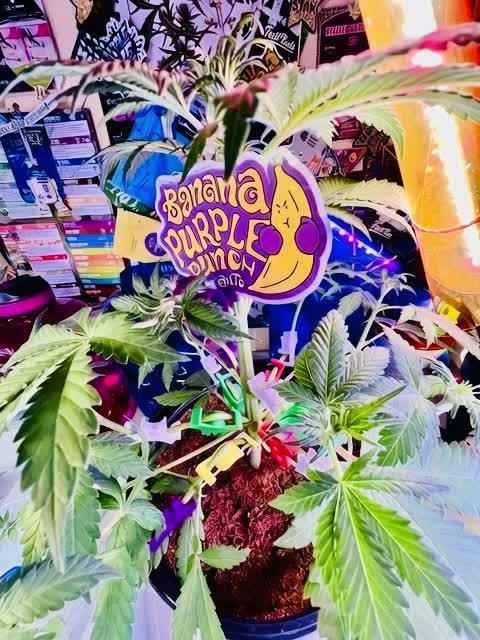
1/13, 11:22 AM banana purple punch auto RF three is doing really great. I haven’t really needed to do anything. I decided not to top. I didn’t want to do anything except light stress training. I think she’s gonna turn out just great. Her stock is one of the thickest. She’s just perfect.😍😍😍


Likes
25
Share


@Organic_G
Follow
VPD : 0.8-1.2
PPFD : 450-600
DLI : 27-45
Der AC Infinity AI+ Controller ist angekommen.
Den T7 Luftbefeuchter hatte ich schon einige Tage davor im Einsatz mit Sensor konnte er auch alleine ziemlich gut den VPD regulieren. Bisher Top Produkte.
AC Infinity Heater, Spiderfarmer Luftentfeuchter, Lichtadapter Zwecks Controller Steuerung kommen noch dazu.
Bald auch mit CO2, wenn ich schon den Sensor und die automatisierten Möglichkeiten dafür habe…
Haben noch 2 Plugs um die Abluft und den Luftentfeuchter mit einzubinden, würde nur noch einer für die CO2 Anlage fehlen.
Langsam habe ich das Gefühl, dass die Ladys Fahrt aufgenommen haben… zuvor war alles eher gedrungen etc. Jetzt sind auch die Seitentriebe deutlich massiver, 1-2 Wochen werden die Ladys auf jedenfall noch in der VEG bleiben. Bin auf das Ergebnis gespannt


Likes
23
Share


@elementhc
Follow
The Ethos photos have been flipped to flower a week or so ago. Took 12 clones.
Gsc Auto will be ready to harvest this week. Others still have a few weeks.


Likes
7
Share

@GreenEldritchGardens
Follow
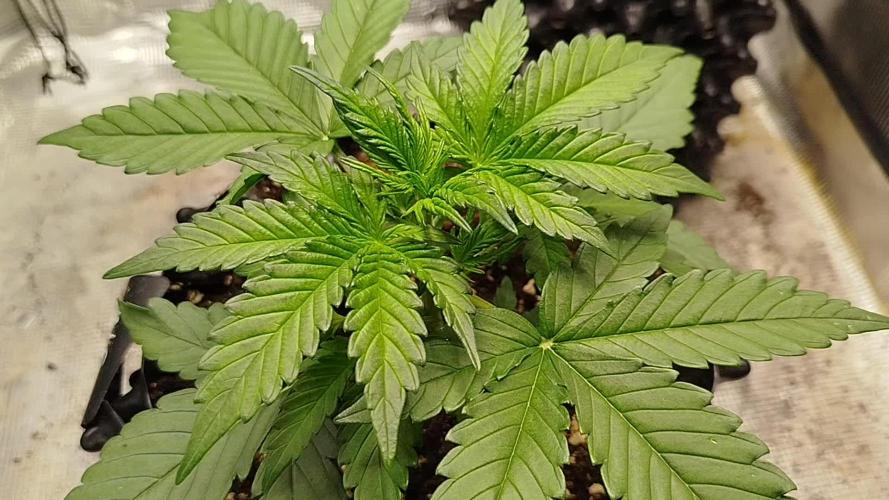
Growing WC is always a joy, I just like this strain. Nice formations of new branches, going to the bushy side I think 🤔
Likes
19
Share


@Ferenc
Follow
Day 24: 600 W LED Light schedule 24/6, ventilation is the same +15 min after the lamp switches off. Water: 50ml per plant so 2x 25 ml per day per plant. Fertilization with bat guano and the same amount of water on Tuesday, Thursday, Saturday. They grow nicely! Someone commented that it looks more magnesium deficiency problem instead of burning so suggested me to add Epsom salt to the water. I ordered Epsom salt so I will give it a go! Thank you! I still believe that I put too close the lamp so it was related to it also but I can see spots on the lower leaves so there is magnesium problem here as well. By the way, they look now beautiful! Blue Sherbet S1 is slower a bit but it is Sativa. Day 25: They started growing rapidly. Day by day they are getting bushy and growing nicely. Day 26: Epsom salt has arrived. I will start feeding them with it. I will mix one tablespoon with 50 ml water 2x a day and I will do it on Monday, Wednesday, Friday. Day 27: As I mentioned in my other diary the last 3 days was crazy hot especially today in London 38 degrees. In my tent, there are 32-32.5 degrees. Luckily, I have direct ventilation on the plants so they won't feel that much heat, but it is crazy... anyways They are getting really bushy and keep growing. I can see some yellow pots but started feeding properly them with Epsom salt and bat guano. Day 29: I retrained (LST) they so tried to spread the sides and bend more the main stamp and also changed their position so I placed them to a different corner. Day 30: It looks like that the Epson salt is good they look better green also now I just damage some leaves as I retrained them. Tomorrow starts the 5th week where I will do some Topping to them except to the Blue Sherbet S1 because it is quite small for that. I will use only LST and FIMing for her.


Likes
6
Share


@masterofsmeagol
Follow
5/4 I stupidly watered everything this morning. They were pretty much perfect weight for transplant......then I watered them. Oh well. If that's the worst mistake I make I'll be ecstatic. Went back over and found my 1 gal and 2 of those wierd slanty airports that tapers and holds like a gallon and a half and washed them. I mixed up 12 gallons of soil in a garbage bag and mixed it thoroughly with my gloved hands. It's mixed good. Looking at my plants in sadness thinking, "today could've been the day" and noticed a Special Kush of average size I didn't water that weighed in the 220's. I was happy. I filled the pit arpund a cup before removing it leaving the perfect hole. Mykos and water were poured in. Plant came out of the cup REALLY easy. Suprisingly easy. This wasn't totally dry. I was amazed it came out so easy so I kinda rolled it around looking at the roots. I started lowering it in the hole and I felt something break away but it webt DIRECTLY into the hole made for it. I tucked some soil around it but it was pretty tight from packing it around the empty cup. Didn't take a picture but the plant is fine. That was an average size plant too. So I may have to give some of the strains I popped later a little longer before I transplant. After everything's been transplanted I'll need to change lighting again. I think I'll open the window and use the hps and the l.e.d on the days and nights cThat's these girls won't be hardening off. I so wanna go plant those others but my intuition tells me to wait until morning and it's been serving me well. A couple can stay in cups longer. Not much longer but still.
5/5 Transplanted everything but two this morning into 1 gals with 1/2 happy frog half ocean forest. Mykos and water used during transplant. Found put the l.e.d was on for 24hrs for a while. I made sure the timer switch was ON but it was a different cord plugged in. Oh well. All transplants went perfect. I'm picking up an adapter for the outlet so I can plug the power strip into the timer and only use one timer. I had to hang the 150watt hps back up with the 1,000 watt equivelant 105 true watts. I hope this lighting setup works. Chemdog #4 and One MK Ultra will be transplanted later today or later in the morning. I also opened the shade to the south facing window. Shits getting real.
EDÌT: I FINISHED TRANSPLANTING THE LAST TWO PLANTS AND PICKED UP THE ADAPTER SO I COULD HANG THE HPS NEXT TO THE L.E.D. THEY WERE FIBE WHILE I WAS GONE. EASIEST TRANSPLANTS EVER. THEY ALL LOOKED PERKY AND HAPPY SIX OR SEVEN HOURS POST TRANSPLANT. I OPENED THE CURTAIN TO (SOUTH FACING WINDOW) BUT I MADE SURE THE PLANTS WEREN'T IN THE DIRECT LIGHT. EVEN THOUGH IT WOULD PROBABLY BE FINE. LAST TIME I HAD SEEDLING IN DIRECT LIGHT. I'LL PLAY IT BY EAR BUT IM HAPPY.
EDIT 2. Went back over to meditate by the stream and do my qigong. It's 75 and BEAUTIFUL today. The girls will be going out for a few hours on days like this. Anyway when I went in I was surprised to see everything looking nice and happy with praying leaves. Nothing is in direct sunlight but damn that window let's in a lot of light.
5/6 Girls LOVED the transplant! They seem to be all happy. No stress. Easiest transplant I've done. Leaves are praying upwards so I think the lights are approx tje right distance. They'll be going outside soon to harden off. It's been in the 70s but it's rainy now. I'll play it by ear according to weather. I'll continue to monitor lighting and I may lower the hps.
5/7 The soil was super dry when I went over this morning. Everything looked awesome though. I used about a half gallon watering. I don't want to water to run off. I want to keep the nutes IN the soil. It's also easier to fix an undet watered plant than an over watered one. It came out to about a half gaterade bottle on the biggest and half that on the smallest. I'll gradually increase water after I monitor the response. The water sat on the soil for quit a while so they definitely needed it. Looking good so far.
5/8 Soil lookeddry this morning. I think I'm going to up the water. Last time I dod seeds I gave like a pink. Some plants still had a little dampness where I watered that I could see. Others looked dry but happy. I gave the REAL dry bigger ones a small circle around the rootball. Just in case. I'm thinking of lowering the hps slightly so it's at least level with tje L.E.D. That window being open gives tons of light. If u moved them slightly left they'd get DIRECT sun most of the time. I'll be bringing them outside soon to start hardening them off.
EDIT: WENT TO CHECK THE GIRLS AT 5 TO MAKE SURE THEY WERENT DRIED OUT. THESE GIRLS ARENT JUST GETTING BIGGER BY THE DAY THEYRE LOOKING BIGGER FROM MORNING TO NIGHT! ITS BEEN RAINING LIKE CRAZY BUT WE WILL HAVE GREAT WEATHER NEXT WEEK AND I'LL BE BRINGING THEM OUTSIDE. I'M SUPER HAPPY WITH GROWTH SO FAR. ILL PROBABLY HST (TOP/FIM) AT THE NEXT NODE. I WANT THEM TO SETTLE IN NICELY BEFORE STRESSING THEM.
5/9 I may have stupidly uploaded doubles of pictures from today. Soil LOOKED real dry. I gave the plants their first real watering. I still went light. Almost a gallon with all plants. I know many say I should be watering to runoff but I want to keep the nutes in the soul as long as I can I don't want to overwater. I always start out careful. Once they show they xan tolerate it I'll increase water next time. This weekend it will be raining but after that we are getting some real good weather and I'll he taking the girls out to begin hardening off. I also need to take a look and top/FIM the plants now that they are settled. Also need to wash grow bags and sanitize outside.
5/10 It's pouring out. Horrible night and morning but this is about cannabis. After the watering ALL the plants shot up in size! Substantially. Leaves are over the sides of containers. I think I'm somewhere close with the watering schedule. I may bring the hps light down a little. I also NEED to start HST. I need to FIM and/or top these girls. Unfortunately I've been dealing with medical problems of my wife so I haven't got to it. If I get some sleep I may do something this morning or in the afternoon.


Likes
6
Share

@eldruida_lamota
Follow
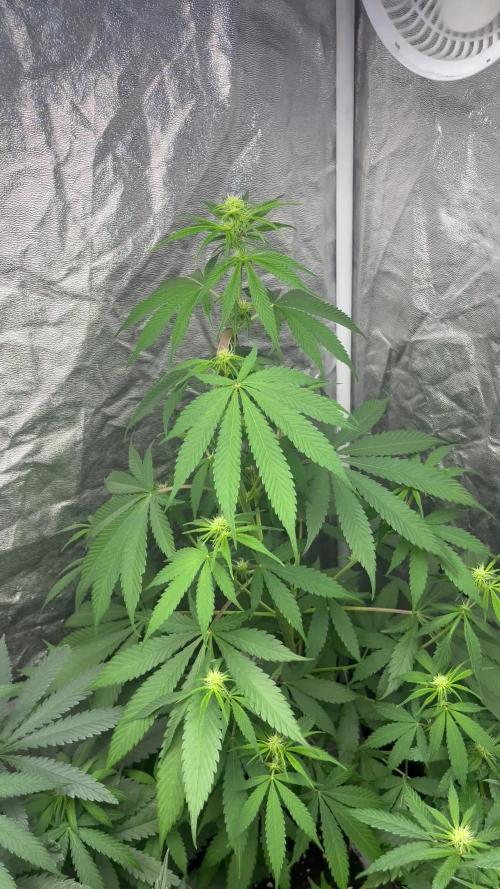
Actualizamos familia, con la segunda semana de floración de estas Gelato 41 de SeedStockers.
Gracias al LST arrancaron a crecer bien los satélites y va pareciéndose a un arbusto, tienen un color bien verde sin carencias por el momento y se ve que están sanas, las plantas están en macetas de 7 Litros definitivamente, con tierra top crop, con una altura similar a 50/55cms.
Como los anteriores cultivos tuve visitantes(trips) estoy rociando aceite de neem y jabón potásico 1 vez a la semana, añadí también tiras de color azul / amarillo para prevenir y controlar mejor el tema plagas.
El riego que aplicamos son 700ml de agua cada 48 horas y el ph se controla en 6.5, la temperatura la tenemos entre 22/25 grados y la humedad ronda el 55% gracias al humidificador.
El mismo día que escribo esto el foco está al 80% de potencia. Me gusta subirlo muy progresivamente, las manías.
- os dejo por aquí un CÓDIGO: Eldruida
Descuento para la tienda de MARS HYDRO.
https://www.mars-hydro.com
- los nutrientes directamente desde https://agrobeta.com/agrobetatiendaonline/36-abonos-canamo
Hasta aquí todo, Buenos humos 💨💨💨
Likes
1
Share


@KannaGrowing
Follow
Primera semana - Germinación en Placas de Petri sobre un invernadero calefactado, utilizando papel de cocina y pulverizando agua.
Entre 24h y 48h después germina el 50% de las semillas y a las 72h el 75%.
Mientras espero a que germinen, preparo el sustrato;
· Coco-Kaya by BioBizz and Julian Marley 75-25.
Utilizo macetas altas de 1,4L que riego con abundante agua, antes de plantar las semillas.
Cuando germinan las planto bien etiquetadas y pulverizo agua, sin regar. Así evitamos movimientos indeseados de las semillas.
18h de luz 6h de oscuridad. Los balastros ajustados a 250w.
Durante la semana, van saliendo los cotiledones de todas las plantas.
