


Likes
Comments
Share


@Elpicor
Follow
Start 25/10/2024
Harvest Day 74 - 06/01/2025
92 cm jet fuel was the taller
No flush, flawless finish 2 ml a week an half before harvest then just watering with pH 8.
Smelling exactly as described in Sweet Seeds site, a fruits explosion, special thanks! They sent me a lot of free stuff Thanks!
Also thanks to Grow Diaries as my best professor ever...and obviously all of you sharing your magic experience, see ya next two weeks maybe

Likes
4
Share

@Growzzbud
Follow
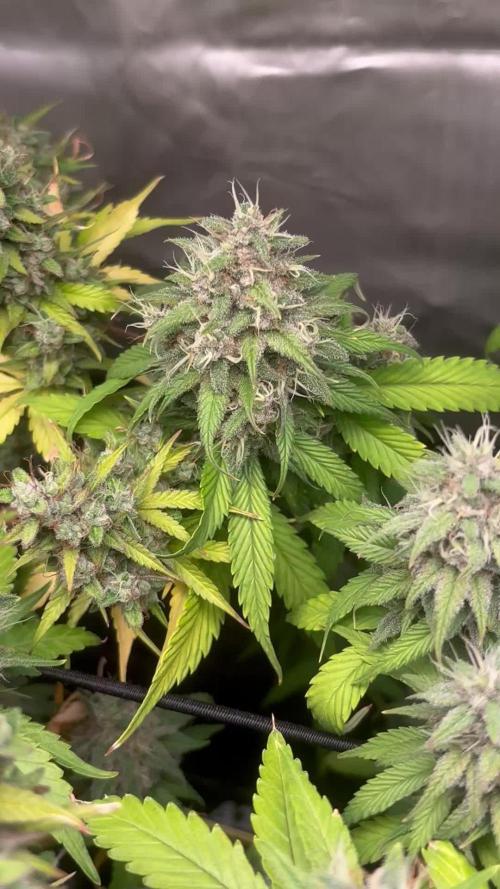
Tras unas semanas de desconexión volvemos a la carga, las flores me parecen preciosas y la revegetacion ha sido todo un éxito. He notado que este round ha producido muchísima resina y los cogollos son súper densos, quizás no ha producido a vista muchos gramos pero a ver que tal
Likes
27
Share


@ButterfliesLittleFarm
Follow
Hello Diary.
The second week of flowering is behind me. There’s already a real jungle in the box, and as I announced last week, I did my first defoliation this week. I removed all the leaves from the lower branches and thus allowed her better airflow since there are three plants in the box. Two Haze Berry Auto and one Fat Banana Auto.
As you can see in the pictures, the plants are really beautiful, with a bunch of flowers that fill up and develop nicely.
Watering is every third day, when each plant in the box receives approximately 2.5 liters of water. I started adding CalMg preventively, 1.5 ml / lit and I continue with BioBizz, I will add it by feeling so we will see how the plants will react to that.
Here's what the week looked like:
23/10/2020 - Day 29.
Watering. This time I only added CalMg without BioBizz. p.H I regulated to 6.4 and the temperature of the water I water with is always around 20 degrees.
Temp / Humidity on the farm - 26.5 degrees and 51% humidity.
24/10/2020 - Day 30.
Defoliation. As I wrote earlier, I cleaned the leaves on the lower branches and allowed better airflow and easier watering.
26/10/2020 - Day 32.
Watering. I always prepare about 8 liters of water with which I water all three plants. This time I added both CalMg and BioBizz. p.H. - 6.4
Temp / Humidity on the farm - 25.4 degrees and 44% humidity.
29/10/2020 - Day 35.
Photographing and watering. I took photos for this week just in the box. I think I will only take photos on a black background for the last two weeks of flowering so as not to disturb them too much.
I then watered the plants only with water with regulated p.H at 6.4.
That's all for this week, so far everything is great and I hope it will continue that way. See you soon.

Likes
5
Share

@Ninjabuds
Follow
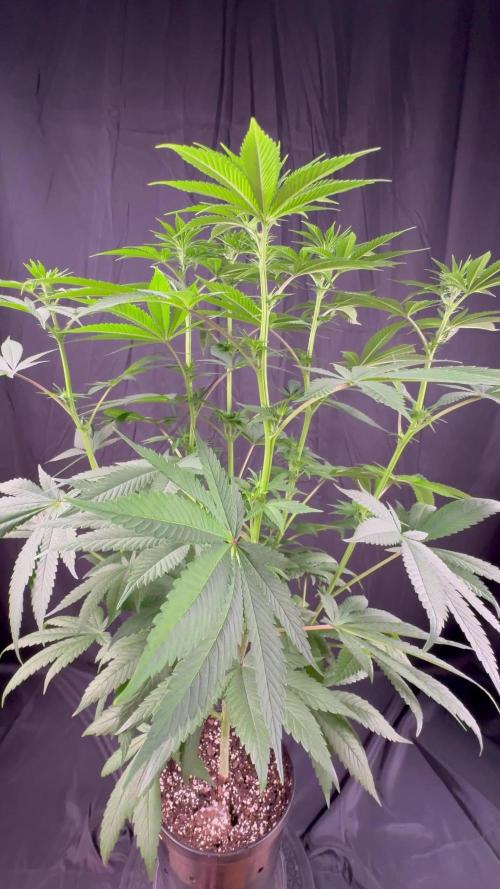
El dorado og has some old school genetics to is and they are starting to shine. It’s really starting to stack up the stems real nicely. The plant reaks like skunk. I bet it turns out really nice
All of the plants have really taken off. Usually I have a couple plants that are much smaller but all of these plants are getting huge. Seeing I got a new eluefah uap1500 the other day and I have my 2 fastbuds plants under that now I have my spider farmer light free. So I popped up another 2x2 and moved 3 of the 10 plants into the 2x2 and left the 7 other in the 2x4.


Likes
Comments
Share

@Growfather1
Follow
Hello everyone.
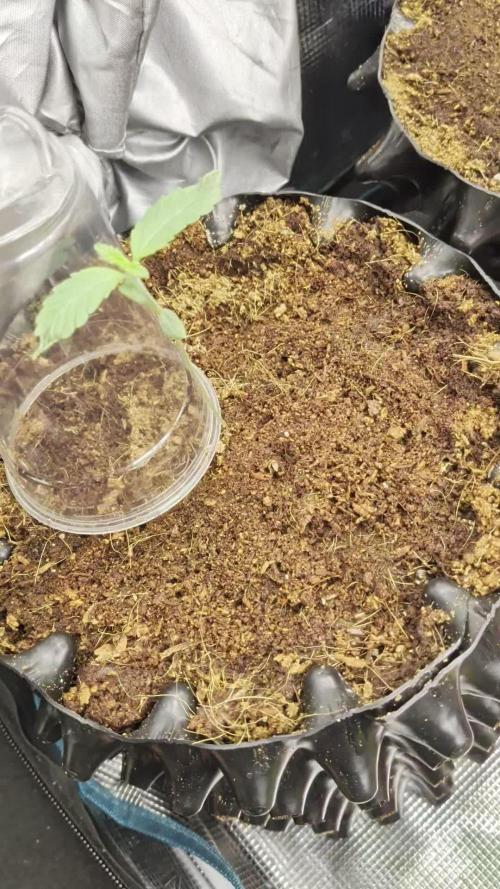
Another week with Gorilla Glue NR4.
Currently, I'm running a 24-hour light regime. Humidity is stable around 65%, and the temperature ranges between 21 and 26 degrees Celsius.
The light is currently quite high, so two of the three plants are stretching, even though it's at 100% brightness.
For feeding, I am gradually raising the minerals and just gave her 4 ml of Canna Rhizotonic per liter of water.
Thank you for stopping by and have yourself a great weekend.
Best regards,
Growfather

Likes
2
Share


@Ultraviolet_
Follow
Topped once, turned off IR @ nights, slowed vertical growth back down, and took off both of the very lowest internodes on each plant.
Eisenia fetida
Stratiolaelaps scimitus
Armadillidium vulgare
Red wigglers (Eisenia fetida) are highly beneficial. They are considered an ideal choice for "no-till" or container-based organic growing because they live in the upper layers of soil, feeding on organic mulch rather than the plant's root system. Red wigglers accelerate the breakdown of organic amendments and produce high-quality, nutrient-dense worm castings directly in the root zone. Clover is another exceptional component of an organic rhizosphere, offering a sustainable, self-sustaining alternative to synthetic nitrogen fertilizers produced via the energy-intensive Haber-Bosch process. By forming a symbiotic relationship with Rhizobia bacteria, clover converts atmospheric nitrogen N2 into ammonium NH4, providing a steady, slow-release nutrient source that enhances soil health and reduces environmental impacts. Red clover offers superior nitrogen fixation and biomass production compared to white or yellow clover, making it the premier choice for maximum soil vitality, particularly for improving soil structure and providing a high-volume nitrogen credit for subsequent crops.
If it is fully functional and efficient soil, the rhizophagy cycle is superior long-term than any synthetic delivery when it comes to preventing deficiencies, not because it's "better," per se. The medium will require a very high CEC to make it to harvest without re-fertilization. The rhizosphere acts as a dynamic, interactive exchange where plants and soil microbes trade resources based on immediate needs. When a plant lacks a specific nutrient, it changes its physiology and releases specialized chemical cocktails—root exudates—into the surrounding soil. These exudates, which include sugars, amino acids, and organic acids, serve as a "shopping list" to attract specific microorganisms, which in turn return higher levels of desired nutrients. There is nothing in comparison when using synthetic delivery, which can cause plants to stop producing exudates, effectively "starving" the beneficial soil life, over time turning the soil barren and void of microbial life. Responsible use, applying the right amount at the right time, can minimize these negative effects. Relying solely on synthetic fertilizers without replenishing organic matter is what typically leads to exhausted soil. The use of synthetic fertilizers can utilize the Cation Exchange Capacity (CEC) of the soil, but without a robust rhizosphere and active microorganisms, the efficiency of this process is significantly reduced. This makes synthetic growing more difficult to prevent deficiencies overall compared to an efficient organic living soil with a robust rhizophagy cycle, as there is no "one size, fits all" when it comes to different nutrient profiles of strains/genetics, making it trickier to "guess" and prevent creeping deficiencies.
CEC does not contribute towards EC. Add more CEC using biochar, problem solved. If you keep pH between 6.3 and 6.7, hydrogen is exudated to cycle the medium's CEC for its needs. Keeping the pH between 6.3 and 6.7 creates an environment where plants release H+ to displace positively charged nutrients (like Ca2+, Mg2+, K+ held on soil particles or within artificial media this cycle through nutrients via the medium's Cation Exchange Capacity (CEC)
Microorganisms generate a stable potential of approximately 0.5 V EC. The rhizosphere creates its own food, similarly to chelation, using 1000's of varying combinations to create its own food.
Start to finish, just add water. Eventually, more materials will need to be added at the beginning of each new grow, but very attainable to go from seed to harvest without ever fertilizing.
ATP is important when it comes to biomass accumulation. Cellular root respiration and cellular respiration are essentially the same biological process, the breakdown of glucose to create usable energy (ATP) in the presence of oxygen, just taking place in different parts of the plant. Synthetic (salt-based) grows have significantly lower levels of total rhizosphere respiration, often referred to as root-zone activity, compared to organic living soil grows. While the plant roots themselves may respire in both systems, the surrounding soil ecosystem in a living soil setup is vastly more active, teeming with bacteria, fungi, and beneficial microorganisms.
2 pools of ATP, it won't double in growth buuuut, but improving root respiration by ensuring high oxygen in the soil is crucial. Good aeration ensures roots can fully utilize glucose to generate the ATP necessary for nutrient uptake, leading to healthier and more productive plants, even if growth isn't exactly doubled. The ATP created using root respiration is dedicated to rootzone growth; the ATP created using regular cellular respiration in a synthetic system would have to dedicate a lot of ATP to the roots when there is little or no root respiration. It's true that there is less of an initial ATP cost in breakdown when nutrients are already in their final form (synthetic), but you lose a solid chunk of ATP when the entire plant is reliant on cellular respiration alone; a large portion of ATP is dedicated to root zones for "forced" nutrient uptake rather than traded. Making it overall less efficient, even if the initial cost of breakdown is higher. Not sure if I butchered that but one can hope It makes sense.
Oxygen is of critical importance when growing in living soil compared to synthetic soil because it supports the metabolic needs of the microbial, fungal, and insect ecosystem, rather than just the root respiration required by the plant itself. While synthetic grows can survive in lower-oxygen environments with precise mineral feeding, living soil systems rely on aerobic microbes to decompose organic matter (microbial mineralization) to create plant-available nutrients, which is an oxygen-intensive process. While a specific fair percentage is difficult to guess, my experience points to a massive, compound difference between the two methods and the amount of oxygen required. All the ATP spared is used on more biomass, not only that, but the extra root respiration can achieve a much higher CO2 compensation point naturally than you could with synthetic and atmospheric CO2 alone.
As a plant grows faster and increases in size, its demand for nutrients to support that growth increases, requiring a higher rate of nutrient uptake. As plants enter phases of rapid vegetative/floral growth, their metabolic demand for nutrients increases exponentially. Without a robust buffer zone—whether in the soil (cation exchange capacity) or in a hydroponic reservoir—deficiencies will occur rapidly because the instantaneous demand for specific nutrients can quickly exceed the rate of supply.
A growing body of evidence suggests that organic living soil provides superior long-term soil health and environmental benefits compared to synthetic fertilizers, which are often criticized for promoting a cycle of dependency and degradation. While synthetic fertilizers offer short-term convenience and high yields, they often come at the expense of long-term soil health, sustainability, and increased corporate control over growers/ farmers. Organic living soil, while slower and requiring more care to establish, creates a sustainable, resilient, and, ultimately, more fertile environment.
We don't really grow; we facilitate energy conversions, and energy is just numbers. Because the universe works the same way today as it did yesterday, there is a single, fundamental mathematical quantity that remains constant. We call this quantity energy. You cannot put "energy" under a microscope. You observe matter and forces (like heat, motion, or light), but energy is just a scalar number calculated to help predict how these things will change and interact. When an object falls, or when a battery powers your phone, matter shifts and changes form. Through it all, the universe ensures the "total score" of the numbers remains exactly the same.
Once all water is removed, approximately 95% to 97% of a plant’s dry matter consists of carbon, oxygen, and hydrogen. These three elements form the structural backbone of all plants. NPK & all the rest 3-5%.
Indigenous Amazonians created, or at least significantly enhanced, the fertile, dark soil known as Terra Preta de Índio (Portuguese for "Indian Black Earth") by incorporating biochar and other organic materials into the soil. This anthropogenic (human-made) soil technique, which dates back roughly 2,500 to 8,000 years, allowed ancient civilizations to flourish in regions with naturally poor, acidic, and nutrient-poor tropical soils.

Likes
8
Share


@pegas
Follow
Ya se ven algunos tricomas de color ámbar en la planta con menos ramas asi que le quedan un par de dias creo, la otra tomara una semana, lucen y huelen muy bien.
Likes
11
Share


@Willy_Balls
Follow
24.02.24 - 1.03.24
Red hot cookies performing stunnigly as always. This is a true beauty and a wonderful plant. Very healthy and sturdy. Yesterday I already noticed some distinct candy mandarine aroma with some chocolate cookies mixed in. Lets hownshe develop those lovely colours ans smell.
One of the older plants is already fed 7 times a day. Thats a record for me. In around 9l of coco.
Likes
16
Share


@HowtoBubatz
Follow
I defoliated the Plant for the first time and adjusted the LST to the growth of the plant.
I found the first white pistils shooting out from the plant which shows me she is ready to go into flower.
Until now i am very happy with the progress, still no issues :)


Likes
119
Share


@DogDoctorOfficial
Follow
Greetings, my esteemed fellow cultivators and botanical enthusiasts! Welcome to the eagerly anticipated Week 12/6 Flower Report for the botanical diva herself, Jealousy, in the Zamnesia Power Buds competition. The journey through the flowering phase has been nothing short of a captivating symphony, and our verdant empress continues to reign supreme in her green kingdom.
As we delve into this crucial stage of flowering, the grow room has transformed into a sanctuary of green opulence. Jealousy, in her perpetual prayer pose, seems to be conducting a botanical orchestra, where each leaf, each bud, plays a harmonious role in the grand crescendo of growth. It's like witnessing the culmination of a green saga, where every petal is a testament to the resilience and beauty of our botanical queen.
The lush, vibrant greenery that envelops Jealousy is a visual feast for the eyes. It's like a living tapestry woven with threads of health, vitality, and sheer botanical exuberance. Every leaf, with its intricate veins and emerald hues, tells a story of photosynthetic prowess and a plant thriving in optimal conditions.
The bud formation has reached a state of sublime perfection. The plumpness and resinous richness of each bud are like treasures waiting to be discovered. It's as if each calyx and trichome is a botanical jewel, sparkling in the radiance of the grow lights. The turbocharged pace of their development is a testament to the genetic prowess of our green empress and the meticulous care she has received throughout this journey.
In response to Jealousy's voracious appetite for nutrients, I've raised the TDS to 900 ppm. She's embracing this increase with open leaves, signaling her hunger for more. It's like providing a gourmet feast to our botanical royalty, ensuring that she receives the royal treatment in the form of essential nutrients.
And now, let's talk about the aromas that waft through the grow room. The olfactory symphony that Jealousy is producing is nothing short of breathtaking. Each whiff carries promises of the floral abundance that awaits us. But fear not, my fellow growers, as I'll save the full aromatic experience for a dedicated report.
Before we conclude this week's odyssey, let's extend our heartfelt thanks and shout-outs to the indispensable contributors to our green adventure. A grand salute to Zamnesia for providing the seeds that birthed this botanical marvel, to Plagron for the nutrients that have fueled her journey, to Grow Diaries for being the platform on which we tell our horticultural tales, and to the incredible community for sharing in the collective knowledge that enriches our green endeavors.
To my fellow contestants and growers, may your grow rooms be filled with the same botanical splendor that graces mine. Here's to a week of perpetual prayer, opulent buds, and the anticipation of a harvest that will be the crown jewel of our shared green kingdom. Stay green, stay inspired, and keep cultivating those dreams!
As always, thank you all for stopping by, for the love and for it all. This journey of mine would just not be the same without you guys. The love and support are very much appreciated, and I feel honored and blessed with you all in my life !!!
With true love comes happiness. Always believe in yourself and always do things expecting nothing in return, with an open heart. Be a giver, and the universe will respond in ways you can’t even dream of .
Friendly reminder: all you see here is pure research and for educational purposes only.
Genetics - Jelousy @Zamnesia
Nutrients @Plagron
Light - @viparspectra P2000
Room size - 3x3 - 0,9x0,9

Likes
32
Share


@Hawkbo
Follow
Everything is movin along some will be coming down this week a few need a little longer. I'll get some pics up a little later today.
This one is on the last couple flush sessions before the chop. Will come down this weekend probly.
Likes
16
Share


@Archieballs
Follow
Ultimate #1 10 cm
Ultimate #2 12 cm
Ultimate #3 9 cm
We are conducting a light experiment with these 3 #3 is solely under the Phlizon 600 watt LED
Ultimate #1 is solely under the Mars Hydo TS 1000
Ultimate #2 is in the middle so getting most of the light from Mars Hydro and a bit from Phlizon
Our belief is the #1 will have the biggest and most dense buds and that #3 will be the shortest and fluffiest buds. So sit back and and enjoy the ride let’s see what they do. These are in a 2x4 tent with Crè soil using solely BioBizz nutrients. All three seeds were direct from DutchPassion.

Likes
9
Share


@AgentOrange
Follow
To be quite honest considering I have planted early and haven’t provided any food or nutrients the smell is incredible and there starting to flower nicely.
All in all happy with this experiment just the Spanish sun and water.
Likes
6
Share


@Fyno_TH
Follow
🌸 Flowering Week 4 (Oct 23–29) — From Stretch to Stack!
Week 4 hit different 🌿🔥 — the early-flower stretch is done, and now the girls are putting all their energy into stacking dense buds. Each cola is forming shape, pistils bright and fresh, and the first layer of trichomes starting to glisten under the Spider Farmer G3000 💡.
The air inside the tent feels balanced now — clean after the PM fight, RH stable at 45–50 %, temps steady around 26–28 °C. The dehumidifier and airflow combo are working perfectly 🌬️💧.
Feed mix (per L):
• Corex 1 ml
• Mira 0.5 ml (pH adjust)
• Florex 2 ml
• Aurora 1 ml
• Bud Candy 2 ml
• Terpinator 5 ml/gal (~1.3 ml/L)
• Oxyroot 1.5 ml
• Athena IPM (foliar every 3–4 days)
💧 15–18 L each with 10–20 % runoff
⚗️ PPM 1760 | EC 3.5+ | pH 6.0
🌸 Flowering Week 4 (Oct 23–29) — From Stretch to Stack!
Week 4 hit different 🌿🔥 — the early-flower stretch is done, and now the girls are putting all their energy into stacking dense buds. Each cola is forming shape, pistils bright and fresh, and the first layer of trichomes starting to glisten under the Spider Farmer G3000 💡.
The air inside the tent feels balanced now — clean after the PM fight, RH stable at 45–50 %, temps steady around 26–28 °C. The dehumidifier and airflow combo are working perfectly 🌬️💧.
Feed mix (per L):
• Corex 1 ml
• Mira 0.5 ml (pH adjust)
• Florex 2 ml
• Aurora 1 ml
• Bud Candy 2 ml
• Terpinator 5 ml/gal (~1.3 ml/L)
• Oxyroot 1.5 ml
• Athena IPM (foliar every 3–4 days)
💧 15–18 L each with 10–20 % runoff
⚗️ PPM 1760 | EC 3.5+ | pH 6.0

Likes
110
Share


@Green_Man_420
Follow
Day 43, The start of Week 7 the cold weather is here 👎🏻 moved the lights to 20/4 for a couple days until I can get a tube heater.
Happy with how these girls are looking. Moving on in the flower stage. Not a lot to report really. Watered last night with just plain water.
Day 46, Happy with how they are progressing. Buds are starting to form nicely, they have a very sweet smell. Water and feed tomorrow. Tube heater and ink bird all set up and working just fine. ✌️
Day 48, couple bud shots from the girls.
Once again thank you to James @ RQS for supplying these seeds for me to grow. And a huge thank you to everyone who has stopped by and shared the love ✌️
Below is a link to RQS if you feel you would like to grow this strain.
⭐️⭐️⭐️https://www.royalqueenseeds.com/uk/f1-hybrid-cannabis-seeds/621-medusa-f1.html⭐️⭐️⭐️
Have a great week and if you have time pop in to check on the updates ✌️✌️
Likes
52
Share


@Roberts
Follow
FBT2403 had a massive growth spurt over the last week. She is showing her first preflowering pistils. She is look healthy, and strong now. Everything is glong good. She will be ready for a solution change very soon to blooming nutrition. Thank you Agrogardens, Medic Grow, and Fast Buds. 🤜🏻🤛🏻🌱🌱🌱
Thank you grow diaries community for the 👇likes👇, follows, comments, and subscriptions on my YouTube channel👇. ❄️🌱🍻
Happy Growing 🌱🌱🌱
https://youtube.com/channel/UCAhN7yRzWLpcaRHhMIQ7X4g
If anyone needs to purchase fastbuds here is a link for my affiliate program
https://myfastbuds.com/?a_aid=60910eaff2419
Likes
4
Share


@AustinRon
Follow
LJ 2Q24 Flower Week 6
Start of Week:
- [Sun Aug 4, 2024, LJ 2Q24 36:F:6:1]
- Plant Heights: [ 25, in]
End of Week:
- [Sat Aug 10, 2024 LJ 2Q24 42:F:6:7]
- Plant Heights: [ 26, in]
EC: 2.4. # Until Week 10
__
Sun Aug 4, 2024
LJ 2Q24 36:F:6:1
Add 7.5 ml of Dr. Zymes to 1 PT of Last Two Plants Feed (Ran out last night)
THIS CHART FOR WEEKS 7 -
DEHU Water, Reducing Lush Green (N), Eliminating Root Anchor
+ PSP, 1 Drop Beauvaria Bassiana Soluble
__
Mon Aug 5, 2024
LJ 2Q24 37:F:6:2
RLA Week 6 +BioAg TM-7
Nik wonders if it might actually be a molybdenum deficiency w/ Lemon Jeffery.
__
Tue Aug 6, 2024
LJ 2Q24 38:F:6:3


Environmental:
- LightIntensityAvg: [ 836, µMol/m2/s]
- TempAvg: [ 78.4, °F]
- RHAvg: [ 65.7 , %]
- VPDAvg: [ 0.90 , kPa]
- EC: [ 2.4, mS]
Note:
- Nik @TheRootedLeaf mentioned Molybendum as an ESSENTIAL µNutrient participating in Nitrogen Reduction.
- The BioAg TM-7 contains Mb, Apply @ 1 tsp/gal

__
Wed Aug 7, 2024
LJ 2Q24 39:F:6:4
__
Thu Aug 8, 2024
LJ 2Q24 40:F:6:5
Note:
- We really need at least 2 Fertigations/day, @2000 & @0130
- We’ll water to saturation each event (10% Pot Volume, 440 ml/plant/event)
- We need 440 * 2 * 7: 6.16 Liters,Need 1.62 Liters, Will mix 1.75
- Need to increase daily total from 1.5 to 2 Gallons
- 1.1 L/Plant/Day
- 440 ml/plant/event * 2
Per Event
- Estimate Minimal Runoff
- Pot Size 4.4 Liters
- Saturation: 440 ml
- 0% Runoff
1.75 Gal, 5700 ml, 814 ml
- [x] Light Defoliation (as needed/lowers)
Feed Chart for 1.75 Gallons
Apply 440 ml/plant @ 2000 & @ 0130
- [x] Mixed! 2024-08-08T16:03:01-0500


__
Fri Aug 9, 2024
LJ 2Q24 41:F:6:6
- [ ] Collect Dehu Water
- [ ] Water 440/plant @ 2000
- [ ] Water 440/plant @ 0130
880 ml/plant/day * 7 : 6160 ml, 1.62 Gal
__
Sat Aug 10, 2024
LJ 2Q24 42:F:6:7

Likes
Comments
Share

