


Likes
Comments
Share


@UDUDUDUDU
Follow
I moved my AKs down on the shelve.
Up high, higher temperatures, more humidity.
I had to move them since they were almost touching the bulbz

Likes
1
Share


@Ttone25
Follow
Starting to really fill out smell is 6/10 so far very sweet some pine as well
Likes
5
Share


@Johngrowbr
Follow
They start to creat a very different type of buds, it’s looks so amazing and smells good

Likes
6
Share


@Cultivandomedicinanatural
Follow
En esta ocasión tenemos algunas plantas más grandes que otras, tenemos las red hot cookies miden 17 y 20 cm. Las tropicanas 15 y 20 cm y la purple punch og 16 cm.
Vamos a hacer una agua con concentración de 1.35 para las grandes y de 1.2 para las que son un poco más pequeñas.
Seguimos con un ph de 5.8 y se va notando ya la corrección de las carencias iniciales.

Processing
Likes
28
Share


@GaiaGreenGiant
Follow
Goodbye week one and hello week two of flower! No real concerns at this point, she seems to be moving along just fine and starting to stretch a little more every day. Had to raise fan, temp minder and humidity controller censor. Can hardly tell her leaves were stripped last week but won’t pull anymore till she done her stretch. Environment has been exceptionally stable throughout the grow thanks to my new LEDs and humidity controller. Just have to focus on watering 💦 Cheers 🍻
Day 14 flower - They perked right up after that watering. Still running humidity at 60-65%. Can’t wait for another week to go by so I can give it it’s final defoliation. Cheers 🍻

Likes
8
Share


Likes
43
Share


@GODSGIFT_2005_JM
Follow
🍼Greenhouse Feeding BioGrow & Bio Enhancer
⛺️MARSHYDRO
The ⛺️ has a small door 🚪 on the sides which is useful for mid section groom room work. 🤩
☀️ MARSHYDRO FC 3000 LED 300W
☀️Also special thanks to VIPERSPECTRA P2000 (200W) & XS2000(240w) LED growlights
🌱 FastBuds 420

Likes
36
Share

@CCSAUTOGROW
Follow
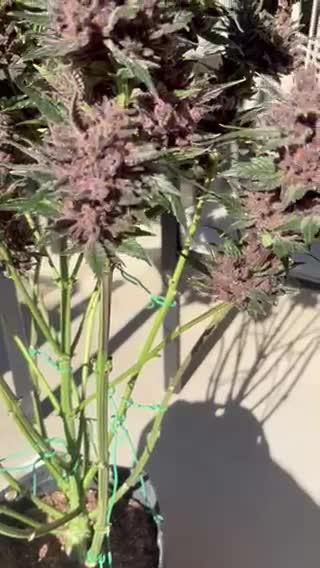
Harvest day for Grand Daddy Purple Auto! I did a wet trim & that really exposed her bud structure & Wow she is just a beauty! Definitely a great genetic. Her buds are heavy, dense and frosty. Purple beast! Hope my pictures do her justice. Super happy with one!!!! I'll update again after drying.😁😎😋

Likes
45
Share


@KrautFabrik
Follow
Day 60: flush 💦
Pictures are taken on day 62 📸
---------------------------------------------
She is doing great 😂i got nothing to say🤷♂️😂
It seems like the nematodes are killing the fungus gnats larvae. Most get killed by the fly paper and no new ones are coming 😁👍
Happy growing 🍌🌱

Likes
4
Share

@FourTwenty_Plants
Follow
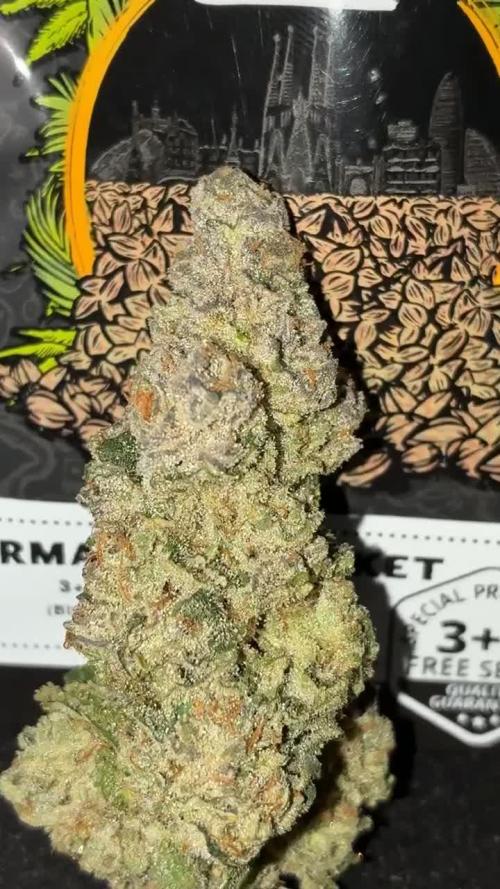
Im happy and shes the best I have ever grown without a doubt.
Will prob update this diary or start a new 1 as soon as I get the 1st clone out of the revegging plant :)

Likes
7
Share


@Granddaddy_Terp
Follow
This cultivar has been an absolute pleasure to grow. Her buds are looking beautiful and frosty and her terps have really gained some complexity over the final two weeks. The density of this flower is phenomenal! Even the lower buds on this plant are incredibly dense. I decided to harvest her on the morning of her 59th day of flower. I will post the yield and smoke report in a few weeks! Thanks for following my grow!

Likes
29
Share

@Hempface86
Follow
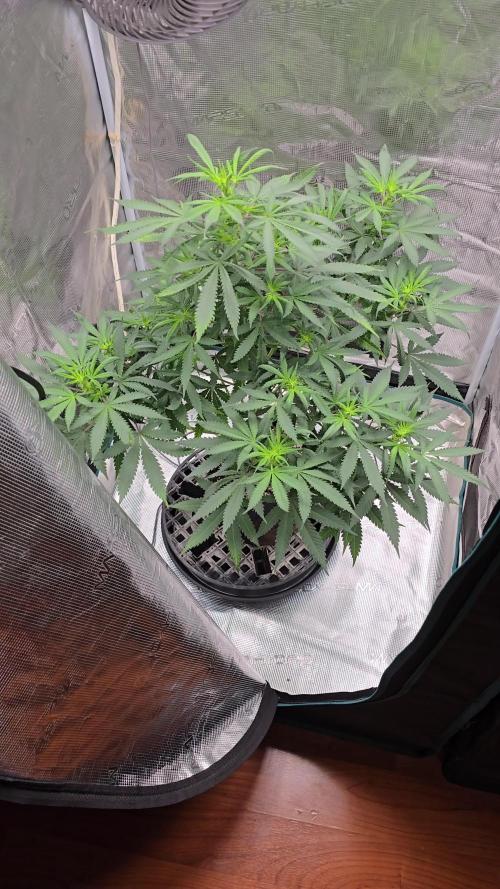
Well, this is not an auto that is for sure... I have her on 12 on 12 off and that has sugar flower.. hopefully, everything works out considering how small the pot is.I don't think she was ever meant to get this big.. But i've also had pretty big plants in one gallon containers.. everybody on here uses five gallon seven gallon.Some even ten gallon... Dirt to weed ratio, if I use the ten gallon theoretically, I should be able to grow atleast at 4 pound plant 🤣 as I average a quarter pound per one gallon .. anyway, I don't know what's going on with this. I'm hoping it's purple haze.. i'm hoping it didn't get swapped around.Somehow with some bs strain . Time will tell .. hope all is well... God bless and happy growing everyone ✌️
Likes
1
Share


@maxpain
Follow
Got about 30g dry bud didnt smoke yet still curing smells nice bud look real nice when I trimmed them ...

Likes
1
Share

@BalconyBoy
Follow
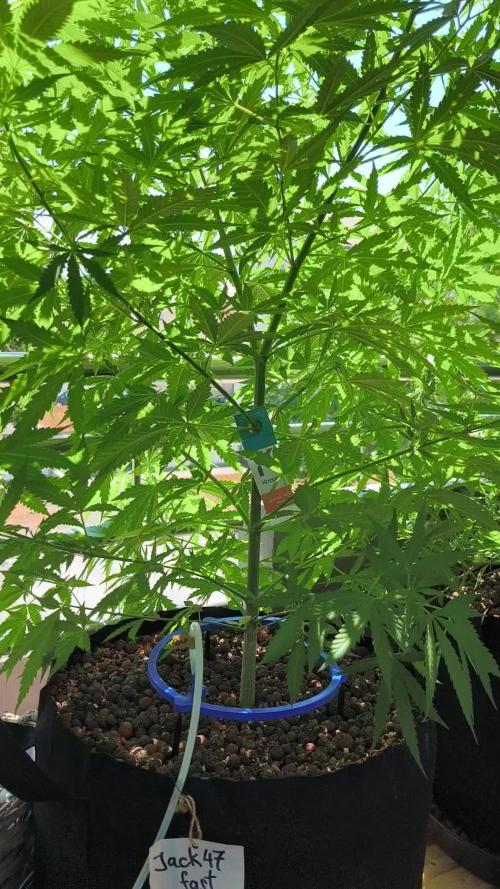
13.07.26 an den Triebspitzen zeigt sich im Gegensatz zu Blueberry Pie noch nicht der Ansatz zum Übergang in die Blütephase.
2025 habe ich Ende Juli den Blütedünger ausgebracht, ich denke heuer werde ich das etwas früher tun und mich im Laufe der Woche daran machen.
Auch die großen Pflanzen haben letzte Woche Tüten mit Raubmilben gegen Thrips bekommen und trotz eigentlich zu niedriger Luftfeuchtigkeit, sehe ich weder neue Fraßstellen noch Thripse.
Die automatische Bewässerung liefert aktuell 3x je 2 Minuten Wasser, was 3x2x700ml = 4.2l entspricht
2x2 Minuten (2.8l) waren bei den Temperaturen nicht genug.
Danke fürs vorbei schauen und angenehme Woche euch allen!
Likes
17
Share


@420DeepGrow
Follow
Gracias al equipo de Seedsman Marshydro XpertNutrients y Trolmaster sin ellos esto no sería posible.
💐🍁 Tangerine Snow F1 Fast:
Esta gran cepa es un cruce de cuatro vías 75% sativa de (Boost x Tangelo) con (Lavender x Power Plant). Este híbrido Fast F1 proviene de la genética Cali y cuenta con excelentes terpenos cítricos, alta producción de resina para extractos, altos niveles de THC, muy buenos rendimientos y excelente resistencia al moho. Tangerine Snow F1 Fast se puede cultivar tanto en interior como en exterior. Los tiempos de floración en interiores son de entre 8 y 10 semanas, mientras que el tiempo de cosecha en las latitudes del norte es en septiembre, mientras que en el hemisferio sur los productores cosecharán durante marzo. Las regiones climáticas recomendadas son cálidas, secas, húmedas y cálidas. Se trata de plantas altas, semiramificadas, que superan los 200cm y que presentan un alto vigor con muy buena uniformidad. Al igual que muchas otras variedades con fuerte dominancia sativa, Tangerine Snow F1 Fast ofrece una excelente resistencia al moho, así como a las plagas y enfermedades de las plantas. La combinación de terpenos cítricos y mucha resina la convierten en una cepa de muy buen extracto, cuyo método de "lavado" produce muy buenos rendimientos de hachís. El perfil de terpenos cítricos recuerda a las mandarinas y mandarinas y también tiene notas dulces. La producción de THC ha sido verificada en laboratorio en un fuerte 24%, mientras que el CBD es bajo. El efecto es edificante y energizante, perfecto para usar durante el día y las primeras horas de la noche.
🌻🚀 Consigue aqui tus semillas:
💡TS-3000 + TS-1000: se usaran dos de las lámparas de la serie TS de Marshydro, para cubrir todas las necesidades de las plantas durante el ciclo de cultivo, uso las dos lámparas en floracion para llegar a toda la carpa de 1.50 x 1.50 x 1.80.
https://marshydro.eu/products/mars-hydro-ts-3000-led-grow-light/
🏠 : Marshydro 1.50 x 1.50 x 1.80, carpa 100% estanca con ventanas laterales para llegar a todos los lugares durante el grow
https://marshydro.eu/products/diy-150x150x200cm-grow-tent-kit
🌬️💨 Marshydro 6inch + filtro carbon para evitar olores indeseables.
https://marshydro.eu/products/ifresh-smart-6inch-filter-kits/
💻 Trolmaster Tent-X TCS-1 como controlador de luz, optimiza tu cultivo con la última tecnología del mercado, desde donde puedes controlar todos los parametros.
https://www.trolmaster.com/Products/Details/TCS-1
🍣🍦🌴 Xpert Nutrients es una empresa especializada en la producción y comercialización de fertilizantes líquidos y tierras, que garantizan excelentes cosechas y un crecimiento activo para sus plantas durante todas las fases de cultivo.
Consigue aqui tus Nutrientes:
https://xpertnutrients.com/es/shop/
📆 Semana 6:
Buena semana, ha habido sol agradable y buenas temperaturas, empieza q tomar fuerza.
Se puede apreciar su aroma tangie.
Mantengo las dosis de nutrientes a 1/3 de lo recomendada por el fabricante al estar en suelo virgen ☘️🌲🌳.
Likes
8
Share


@SkunkyDog420
Follow
Hallo zusammen 🤙.
Sie wächst sehr schön und macht keine Probleme.
Rabattcode für den BIOTABS-Webshop https://biotabs.nl/en/shop/ GDBT420, damit erhalten Sie 15 Prozent
Likes
4
Share

@Black_Widow
Follow
Привет садоводы !!!
началась новая неделя и сегодня я поменял раствор на новый у подруги гидропоники
тот цветок ,что в земле я полил последний раз Ripen и теперь промывка чистой водой
растения чувствуют себя хорошо и активно кушают
вот такие дела в саду😊

Likes
16
Share


@DaddyPrime2
Follow
5/26 this plant is super fucking frosty and is starting to chunk up a bit.

Likes
17
Share


@Frostynugz420
Follow
1.I had 3 pop 18 hours right away from floating in the water.
2. 2 were in a paper towel that did nothing so far after 18 hours.
3. Placed paper towel seeds in water for a few hours to see if we can get them popped.
4. 2 seeds are germed and ready to go, have been planted. One in fox farms happy frog and one in a riot rooter as an experiment. We shall see who comes about first.
Doing 12-16 hours of light.
5. After 48 hours, all 5 have popped and 2 of them are already breaking the soil with their first 2 leaves. Let's go!
6. Day 3 - 72 hours later - 2 of the seeds have sprouted their first 2 leaves and are above the soil! *excitement ensues*
7. Day 3 (continued) UH OH! I just realized my paper towel doesn't have a seed in it. I checked on the floor and found it, the taproot has gone back inside the seed, I'm worried I may have killed it. I planted it in the Root Riot anyway and I'm hoping for the best. :/
8. Day 3 (continued) continuing 18-6 light.

Processing
Likes
10
Share


@Cannibalgardens
Follow
Dam the cold weather was crazy but we made it threw it we had frost for a few days .. I put the ladies I to the garage and was happy to say they thrived with Windsor light . Unfortunately 😞 my youngest son pulled the dinamed CBD out and she died rip . But we move on and she will live on in memory with the #bluecheese .. dinafem has. A great strain going here she smells so good ..

Likes
2
Share


@Growingbuds
Follow
Week 10- 10/7 to 10/13
Two of them are enlarging all buds and looks nice , rest of them development are slow ,ate the end i assume I will harvest with 2 weeks later, some sinal of overfeeding I think I try to correct w irrigation 2 day just with water add just a little of calMag , let's see if in 1 month general I start to flush , bloombastic now is my hope. To put those buds fat and sweet.
