The Grow Awards 2026 🏆 





Likes
Comments
Share
@Ninjabuds
Follow
Man, it must really suck to see that skunk apple plant doing so poorly. It barely grew at all, and those four points on it are supposed to make it look cool, but they're super tiny. It's looking more like a skinny stalk with a few weak branches.
Processing
Likes
6
Share
@Mr_nugs_lover_David
Follow
Looks so beautiful and smells even better, so in love with this strain, has surprised me a lot, I would love to grow her again, very nice plant, maybe not the best in yield but quality is assured. 🤤💎🌱

Likes
17
Share
@JohnnyBarrel
Follow
Week 17
Nothing really moved this week. It’s something like between low tide and high tide: not my favorite moment … waiting for blossoms and flowers 🙄🙏.
Good point is that every plants are healthy ( except a parasite problem on Psicodelicia) and well
prepared for flowering.
For now it’s bad weather outside: 20 degrees max, with lot of wind and rain (cf video). The green house is the best option despite of less exposure.
Morning soon I moved the plants outside to sprayed them with potassium soap (natural insecticide). I cleaned the grow space inside the greenhouse (didn’t touch spiderwebs…good insecticide too).
I removed the automatic watering and get a few liters of rain water during this days.
Watering 1L every 3 days
-Calmag + Cannazym + Alga mic + Root booster
-Flora Series: preflowering quantities.
Daylight 14h30: 6h50/21h20
Sleepy Joe is still the queen of this summer session, using a large place with the long side branches. Zero problems but I did some preventative treatment against predators.

Likes
106
Share
@Med_in_Tropic
Follow
Still no sign of flowering.
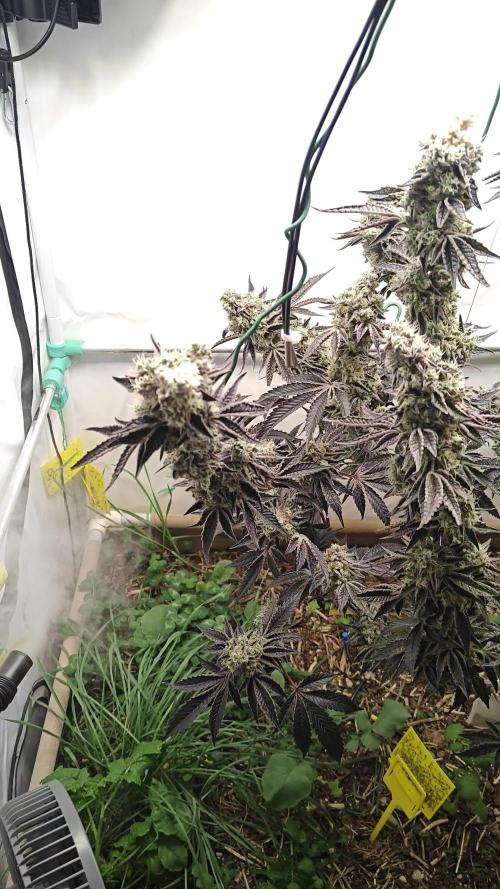
Transplanted Novarine plant 2 into a 50-liters container. The spot is under a big shorea plant. Shorea is a South East Asian medicinal tree. This is minimum light spot in my yard. Hope she would flower. I choose plant 2 because I think plant 1 will stretch even further.
Plant 1 was also moved to a shaded spot under an tree jasmin. This Millingtonia, Indian cork tree. I have sweet flowers all year round. People told me that dried tree jasmine flower mixed well with weed and is good for people with ashma and sinus. Kind of useless since why would asthmatic people even smoke?
Plant 3 is my back up until I come up with a way to put her into flowers.
Clone are doing nicely. And I am growing 3 clones from plant 1 and only one clone from plant 2. I’ll be donating the rest to friends with weight and blood sugar issues. By year end, I probable keep only one or two clones. One clone from bigger branch is growing just fine without any benefit form lighted grow box.
Feeding plants with mid-level dose of cow manure tea and earth worm casting tea to keep leaves healthy. They should have been given a light dose of fertilizer. However, the flowering purslane are also eating and feeding soil microbes.
Got my paws on triancontanol and brassinolide. Perhaps these will jolt Novarine THCV into flowering. Triacontanol won't dissolve in neither water nor alcohol. And it is emulsified with polysobate.
Mixing of Triacontanol
Triacontanol does not dissolve in polysorbate. It is rather emulsified. Means that it need to be melt and there need to be water added.
My steps,
1) heated 70 grams of polysorbate in a big heat resistance glass cup. I used a beaker. Mix in 5 grams of triacontanol. And it does not melt.
2) Put in 100 cc of water and put in microwave. After the mix is boiled, triacontanol melt. There is foam. So a bigger cup and a spillage plate would prevent problem with my better half.
3) After heated, the mix is better. Then I added hot water from to make total 250 CC of solution. Then, the mix is clear.
4) Label the dose with pencil. This works better than labeling with ink.
I use 5 cc at a time for my entire garden. 250 CC would last me 50 doses. No need to buy so much. This is cheap. Let’s see next week how effective they are.



Processing
Likes
10
Share
@BodyByVio
Follow
This week I Supercrop all the plants and spred them out over both lights. One more week of Veg and they are ready to explode
Check me out on Instagram @growmorestressless
Likes
29
Share
@BudXs
Follow
A desigber strain well worth the price. Grows magically outdoors with little to no care. Astroboy didnt get em, so its a win. Thanks for following, see these genetics shine under my indoor diaries.

Likes
34
Share
@Canna96
Follow
Hey now, I hope everyone is having a great week. The Glueberry OG Auto is in week 9 and she is just now starting to stack some buds. I am still feeding Silica, Cal Mag, and Veg Nutes, as well as some PK booster. I am done with training and only defoliate a leaf or two here or there it is blocking too much light from a flower site but pretty much I am just letting her do her thing.
I currently have the Spectrum X running at 100% power and have upped the time on the UV/IR bars to 90 minutes just prior to lights off. I am super happy with this light so far, she puts out impressive PAR, and runs fairly cool. The only thing I would change is to have individual timers for the different spectrums.
Not much to do this week other than keep the reservoir full and in the correct PH range. The tomatoes outside are absolutely loving the runoff from these autos, as that is all they have had to drink since they were about 3 weeks old.
Thanks for stopping by, Stay Safe and Blaze On!!! 💪
Website: https://medicgrow.com/
https://growdiaries.com/grower/medicgrowled
Likes
22
Share
@bypado_farm
Follow
Day 49:
Watered each plant with 1L with nuts
1568 ppm, 3345 us/cm, 3.3 EC (purple punch, strawberry banana, wedding Cheesecake)
1573 ppm, 3346 us/cm, 3.3 EC
It wasn't me who did the feeding
(gorilla cookies)
2 different feedings for the 10 plants
Day 51:
Watered each plant with 1L with nuts
1562 ppm, 3325 us/cm, 3.3 EC (purple punch, strawberry banana, wedding Cheesecake)
1514 ppm, 3293 us/cm, 3.2 EC
It wasn't me who did the feeding
(gorilla cookies)
2 different feedings for the 10 plants
Day 53:
Watered each plant with 1L with nuts
1632 ppm, 3472 us/cm, 3.4 EC (purple punch, strawberry banana, wedding Cheesecake)
??? ppm, ??? us/cm, ??? EC
It wasn't me who did the feeding
(gorilla cookies)
2 different feedings for the 10 plants
Day 55:
Watered each plant with 1L with nuts
1655 ppm, 3521 us/cm, 3.5 EC (purple punch, strawberry banana, wedding Cheesecake)
2142 ppm, 4557 us/cm, 4.5 EC ?
It wasn't me who did the feeding
(gorilla cookies)
2 different feedings for the 10 plants

Likes
13
Share
@Lfuego22
Follow
During this week I will did some fan leaf removal, at the end of the week I will do a full system flush
Flushing in 2 day when RO comes
Good week. Flushed and added full tilt to the system @ 3tsp a gallon total 15 tsp
Likes
6
Share
@frankterpenes
Follow
D35- PX, the lady double in height this week with lot of stretching.
The fimming gave me 3 tops, hopefully they will stretch still to get nice height and good spacing from bud to bud.
I like how she is growing and Im happy with that I didnt break her like the first I grew. The budsites are multiplicating and the lady seems to be healthy.
D35 AHO- The lady is outside to give her some natural light, I will let her grow outside for the entire grow from now.
She seems to love the sun, She was at 13,5' before I bend the main to let some chance to the side branches to get some height.
She is growing nicely too and budlets forming everywhere.
From now I think the output will be slighty lower thn the Px cuz she is smaller, but lets hope Im wrong and they will do great both of them.
If you see something wrong on pics, please tell me, im here to learn
Likes
15
Share
@IsseyBukkake
Follow
We've made it to week 3! (10/12/20)
I'm very happy with how the girls are going, they have definitely put in a HUGE amount of work over the past 7 days.
Plants 3 & 8 are very similar(extremely fat leaves & extra bushy)
Plants 1 & 5 are similar (smaller phenos reacting to nutes slightly differently)
& Plants 2, 4, 6 & 7 seem to be a cross between the previously mentioned phenos(not too small and not too big/bushy & reacting to nutes fine)
Feel free to compare Week 1, 2 & 3 to see the differences.
Nutes are staying the same this week, although I will be spacing feedings out a little bit further(18 hours-ish), as well as feeding straight PH'd water once a fortnight.
I am contemplating hooking my simple drip-to-waste irrigation system up, although the girls are pretty close to the medium still and the halos sit 5-10cm above the medium, meaning fan leaves would be drooping onto the wet halos, so I'll give it another week and see how they're doing :)
Update 11/12/20 - day 22
The girls have beefed up quite a bit over the last 24 hours, I'm really looking forward to seeing a stretch soon :)
No feeding today & will water plain ph'd water tomorrow.
Update 12/12/20 - day 23
Gave the girls straight ph'd water today with little run off.
Veg growth is really starting to boom now, looking forward to seeing where this grow goes!
I'm gladly accepting any tips or tricks, as I'm still only a beginner to indoors.
Update 13/12/20 - day 24
Girls are looking great today, not much to report.
They didn't get a feed or watering today as the medium was still wet after a pure watering yesterday.
Update 14/12/20 - day 25
There's been a big increase in growth over the past 24 hours.
All the girls besides the 2 smaller phenos look 100% happy, the smaller ones have looked a little weird since day 1(Weird as in colour of the fan leaves look deficient of something, but I'm not sure what.
The girls will be getting a full feeding today.
There's still no signs of sex but they are feminised seeds.
Update 15/12/20 - day 26
Girls are looking happy today.
Temps are back to normal after a heat wave in my city(its only going to get hotter from here on out).
No feeding/watering today, pots are heavy/wet enough.
Started using iphone for photos now, my only lens for my DSLR is useless for most grow related photos.
I will upgrade my lens before next grow.
I received my new silenced fan today! I couldnt be any happier :)
It is a silenced Sigilventus SE-A150J, which I have set-up with a brand new Can-lite carbon filter.
I went from a rocket loud eBay fan to a completely silent inline EC fan :D
I hope the girls like the silence!
Update 16/12/20 - day 27
The girls are continuing to boom! and I'm over the moon about it :D
I gave them a full feeding today.
I have seen white pistils coming out of calyx's on most of the girls, so i'm hoping they start to flower soon.
I'm having weird issues with my humidity, it seems to be fine at 40-50% for 70% of the day, but the remaing 30% of the day it goes up to 60-65%.
Temps stay the same in the 5x5 tent, I have ducted air-con in the house which is on most of the day.
Thanks for viewing! :)

Likes
9
Share
@Breezybombaf
Follow
Seeing pistols today on 28 so I had to get photos! These girls are looking great. I have cut back on watering and they're looking much better imo. A few burnt tips but I'm not too worried. My ph was almost 7 a week ago so I go a ph pen for my water and did some watering at 6ph and now going with 6.3 to slowly bring her down. These girls are looking super bushy, green, and hardy imo and they're more appealing to me than the Orginal Afghan Kush Auto from Fastbuds grown side by side. Both look so gorgeous that Im feeling truly blessed to garden my own medicine.
Thanks for dropping by! Any tips and comments are always welcome 🙏


Likes
2
Share
@Saintvicious
Follow
Looks like a lot of top sights. Afraid stretching too much. Hopefully it fills in.


Likes
1
Share
@HASHLAMOTA
Follow
esta es la primera semana con fertilizantes.
también es primera vez que uso advanced nutrients.
estoy regando con poca agua ya que se demora mucho en absorber por las bajas temperaturas que hay en esta época del año.
comenzamos con LST los últimos dias de la semana 3
le eché un par de gotas de limón para dejar el PH un poco mas bajo.
cualquier consejo se agradece. ✌️
Likes
35
Share
@valiotoro
Follow
Hello everyone 😎
Week 5 of flower for the Gorilla Cookies auto from Fast Buds 💥🍪
She grew fast with a beautiful green color,for the nutrient 4ml/L terra bloom & 1ml/L power buds & Green sensation 1ml/L from Plagron
Spider Farmer SE-7000 70%
Have a nice day 😋
Likes
2
Share
@fabialien
Follow
Lunes 19 de Agosto 2024
Van un poco lentas estas vértigo de Paradise seeds, aunque lentas van bien, veamos que tal explotan conforme pasa el tiempo, ire quitando la cinta que puse en la maceta air grow por el molesto fungus gnat, ya erradicado. A un no se nutren.

Likes
12
Share
@DrShotzUK
Follow
Week 4 a very healthy plant, not as tall as I imagined in a 15 litre pot so hope it still produces half deecent yield
Also have a banana purple punch on the go but it’s not as healthy as this and another I have
DRSHOTZUK

