


Likes
Comments
Share


@zera1337
Follow
Week 4:
I somehow managed to overwater 2 of my cuties. Having a humidifier + the fan not being properly positionend kinda lead to this. However, they are now looking stronger again and back on track.

Likes
4
Share


@brosef_b_baggin
Follow
Added some potassium sulfate and they seemed to bounce back but now they want calcium and I’m pretty sure the potassium I put in is antagonistic to calcium. I might harvest early to prevent any trichome degradation due to photosynthesis being halted, trichomes are looking milky too.
Likes
40
Share


@iLoveGoodWeed
Follow
Week 10 - she stop stretching finally and the high is 93cm and I can see that the buds are stretching instead which is good. Looking forward to see how fat she will be, I think another. 3-4 weeks and flush time.


Likes
5
Share


@sinfantas
Follow
Primera semana de floracion
recuperan su color verde
agrego estimulador de floracion de bac , y mantengo grow de bacpara continuar alimentandolas en este proceso de cambio de luces e ire quitando las dosis hasta solo enfocar en florecer con toda la fuerza disculpen mi falta de fotos las perdi todas
Likes
1
Share


@Ultraviolet_
Follow
Turned off IR @ nights
Red wigglers (Eisenia fetida) are highly beneficial. They are considered an ideal choice for "no-till" or container-based organic growing because they live in the upper layers of soil, feeding on organic mulch rather than the plant's root system. Red wigglers accelerate the breakdown of organic amendments and produce high-quality, nutrient-dense worm castings directly in the root zone. Clover is another exceptional component of an organic rhizosphere, offering a sustainable, self-sustaining alternative to synthetic nitrogen fertilizers produced via the energy-intensive Haber-Bosch process. By forming a symbiotic relationship with Rhizobia bacteria, clover converts atmospheric nitrogen N2 into ammonium NH4, providing a steady, slow-release nutrient source that enhances soil health and reduces environmental impacts. Red clover offers superior nitrogen fixation and biomass production compared to white or yellow clover, making it the premier choice for maximum soil vitality, particularly for improving soil structure and providing a high-volume nitrogen credit for subsequent crops.
If it is fully functional and efficient soil, the rhizophagy cycle is far superior long-term than any synthetic delivery when it comes to preventing deficiencies, not because it's "better," per se. The medium will require a very high CEC to make it to harvest without re-fertilization. The rhizosphere acts as a dynamic, interactive exchange where plants and soil microbes trade resources based on immediate needs. When a plant lacks a specific nutrient, it changes its physiology and releases specialized chemical cocktails—root exudates—into the surrounding soil. These exudates, which include sugars, amino acids, and organic acids, serve as a "shopping list" to attract specific microorganisms, which in turn return higher levels of desired nutrients. There is nothing in comparison to synthetic delivery, which causes plants to stop producing exudates, effectively "starving" the beneficial soil life, over time turning the soil barren and void of microbial life. Responsible use, applying the right amount at the right time, can minimize these negative effects. Relying solely on synthetic fertilizers without replenishing organic matter is what typically leads to exhausted soil. The use of synthetic fertilizers can utilize the Cation Exchange Capacity (CEC) of the soil, but without a robust rhizosphere and active microorganisms, the efficiency of this process is significantly reduced. This makes synthetic growing more difficult to prevent deficiencies overall compared to an efficient organic living soil with a robust rhizophagy cycle, as there is no "one size, fits all" when it comes to different nutrient profiles of strains/genetics, making it trickier to "guess" and prevent creeping deficiencies.
CEC does not contribute towards EC. Add more CEC using biochar, problem solved. If you keep pH between 6.3 and 6.7, hydrogen is exudated to cycle the medium's CEC for its needs. Keeping the pH between 6.3 and 6.7 creates an environment where plants release H+ to displace positively charged nutrients (like Ca2+, Mg2+, K+ held on soil particles or within artificial media this cycle through nutrients via the medium's Cation Exchange Capacity (CEC)
Microorganisms generate a stable potential of approximately 0.5 V EC. The rhizosphere creates its own food, similarly to chelation, using 1000's of varying combinations to create its own food.
Start to finish, just add water. Eventually, more materials will need to be added at the beginning of each new grow, but very attainable to go from seed to harvest without ever fertilizing, regenerative cultivation.
ATP is king above all else when it comes to biomass accumulation. Cellular root respiration and cellular respiration are essentially the same biological process, the breakdown of glucose to create usable energy (ATP) in the presence of oxygen, just taking place in different parts of the plant. Synthetic (salt-based) grows have significantly lower levels of total rhizosphere respiration, often referred to as root-zone activity, compared to organic living soil grows. While the plant roots themselves may respire in both systems, the surrounding soil ecosystem in a living soil setup is vastly more active, teeming with bacteria, fungi, and beneficial microorganisms.
2 pools of ATP, it won't double in growth buuuut, but improving root respiration by ensuring high oxygen in the soil is crucial. Good aeration ensures roots can fully utilize glucose to generate the ATP necessary for nutrient uptake, leading to healthier and more productive plants, even if growth isn't exactly doubled. The ATP created using root respiration is dedicated to rootzone growth; the ATP created using regular cellular respiration in a synthetic system would have to dedicate a lot of ATP to the roots when there is little or no root respiration. It's true that there is less of an initial ATP cost in breakdown when nutrients are already in their final form (synthetic), but you lose a solid chunk of ATP when the entire plant is reliant on cellular respiration alone; a large portion of ATP is dedicated to root zones for "forced" (active) nutrient uptake. Making it overall less efficient, even if the initial cost of breakdown is higher. If that makes sense. Oxygen is of critical importance when growing in living soil compared to synthetic methods because it supports the metabolic needs of the microbial, fungal, and insect ecosystem, rather than just the root respiration required by the plant itself. While synthetic grows can survive in lower-oxygen environments with precise mineral feeding, living soil systems rely on aerobic microbes to decompose organic matter (microbial mineralization) to create plant-available nutrients, which is an oxygen-intensive process. While a specific fair percentage is difficult to guess, my experience points to a massive, compound difference between the two methods and the amount of oxygen required. All the ATP spared is used on more biomass, not only that, but the extra root respiration can achieve a much higher CO2 compensation point naturally than you could with synthetic and atmospheric CO2 alone.
As a plant grows faster and increases in size, its demand for nutrients to support that growth increases, requiring a higher rate of nutrient uptake. As plants enter phases of rapid vegetative/floral growth, their metabolic demand for nutrients increases exponentially. Without a robust buffer zone—whether in the soil (cation exchange capacity) or in a hydroponic reservoir—deficiencies will occur rapidly because the instantaneous demand for specific nutrients can quickly exceed the rate of supply.
A growing body of evidence suggests that organic living soil provides superior long-term soil health and environmental benefits compared to synthetic fertilizers, which are often criticized for promoting a cycle of dependency and degradation. While synthetic fertilizers offer short-term convenience and high yields, they often come at the expense of long-term soil health, sustainability, and increased corporate control over growers/ farmers. Organic living soil, while slower and requiring more care to establish, creates a sustainable, resilient, and, ultimately, more fertile environment.
We don't grow; we facilitate energy conversions.
Once all water is removed, approximately 95% to 97% of a plant’s dry matter consists of carbon, oxygen, and hydrogen. These three elements form the structural backbone of all plants. Corporate interest sells you the other 3-5% NPK & all the rest in RATIOS! Why not throw the 3-5% in a pot, and focus your energy on the other 95-97%?
Indigenous Amazonians created, or at least significantly enhanced, the fertile, dark soil known as Terra Preta de Índio (Portuguese for "Indian Black Earth") by incorporating biochar and other organic materials into the soil. This anthropogenic (human-made) soil technique, which dates back roughly 2,500 to 8,000 years, allowed ancient civilizations to flourish in regions with naturally poor, acidic, and nutrient-poor tropical soils.

Likes
2
Share


@cafer
Follow
My plants are growing healthily and have already entered the flowering period.

Likes
269
Share


@JohnnyBlaz3
Follow
Day 129
Flower 67
Remaining 10?!?
WOW! lol they keep plumping up. most have slowed down but some of the colas are still noticeably growing.
The plant on the right is quite a bit different then the other two. much shorter and has different looking colas. much more rounded. Also this plant has lots of white hairs on the main colas. Is this a sign they are still growing? how come the other 2 only have a few white hairs and this one is loaded. another distinction is that this plant hasn't really started fading yet. it has a few purple leaves but doesnt have the fade like the other 2? weird? why this plant so different.
I'm quite nervous still but its all good, its just because its foreign to me. most the trichs are clear but theres a growing number of milky ones and the odd amber one. this is for the top colas i've been watching.
I'm stoked to see the harvest. theres 24 yo yos in there holding up these massive colas!
The flush should be any day now. I'm still confused as to know when i'm a week out and to start the flush?!? I understand harvest is when mostly milky with a few clear and amber. I cant believe the crystals on these ladies. its absolutely insane! also sticky as all hell, amazing!
I'm very excited, the big day is coming up very quick
Thanks again for following along and helping to make this grow what it is, let finish strong! 👌👊👊
Likes
68
Share


@greenAF
Follow
Installed my new CO2 generator yesterday, closed loop system so won't attract bugs like the other. Also have an exhale bag hanging up top of tent.
After talking to a few of you guys decided to drop light down to 18-19in @ 80%
So getting ready to wrap up week 6, may be one more update before we move on.
Plant 1 (Left from front view of tent)
Seem to be doing great, had to flush and adjust feed was getting minor def's. Soil seems a bit of a mess when I flushed, most likely from me feeding way to early and too much. So I kind of expected that, so it backs up the hypothesis that I actually know whats goning on for the most part . lol. I stabilized it.
Plant 2 (Right from front view of tent)
Stopped LST on this one last week, I overfed it way to early, and probably got too much light early on too so its lagging behind a little, but hanging on. Picked up some nute burn, flushed out and stabilized everything and adjusted feed sched. Seems to be hanging on strong though just a smaller slower guy.
Overall nothing drastic, except MORE FLOWERS!!!, which is good.
Thanks to a few of you guys I know understand monitoring EC and PH much more indepth and will continue to monitor throughout and from now on. I didn't want to take on too much learning and get overwhelmed. Figured I would do it when I had to and had an issue. Well I did, and now understand. So that should be a great help moving forward. Shout out to @Creepy_Steve @HappyWeeds specifically, but literally everyone I have spoken to here has been great, and more helpful than you can hope for. I have learned so much in so little time. THANKYOU!
😎

Likes
14
Share

@PhinolaGreen
Follow
Woche 16
Sie wachsen beide weiter drauf los, sie haben sich gut erholt und mal sehen, wann die fertig werden 😊 Die Lampe läuft aktuell auf 75% was 120 Watt entspricht. Sie kriegen alle 12 Stunden ca 500ml Wasser. Ich habe mir Hesilicio von Hesi bestellt. Ich wollte eigentlich umsteigen auf Mineralisch aber ich habe festgestellt, dass ich noch voll viel von dem Biobizz habe. Wäre doch schade drum, den einfach stehen zu lassen. Deswegen werde ich den wohl noch aufbrauchen und dann umsteigen auf Hesi. Ich habe schon alles hier und dachte mir, ich mache schon mal bisschen Hesilicio von Hesi rein und SuperVit von RQS. Die werden auch bei den neuen Ladys dann mit dran kommen.
Ich habe aktuell Zeit mich um die Ladys zu kümmern und muss noch bisschen was nachholen. 😄


Likes
2
Share

@The_Doctor_Green
Follow
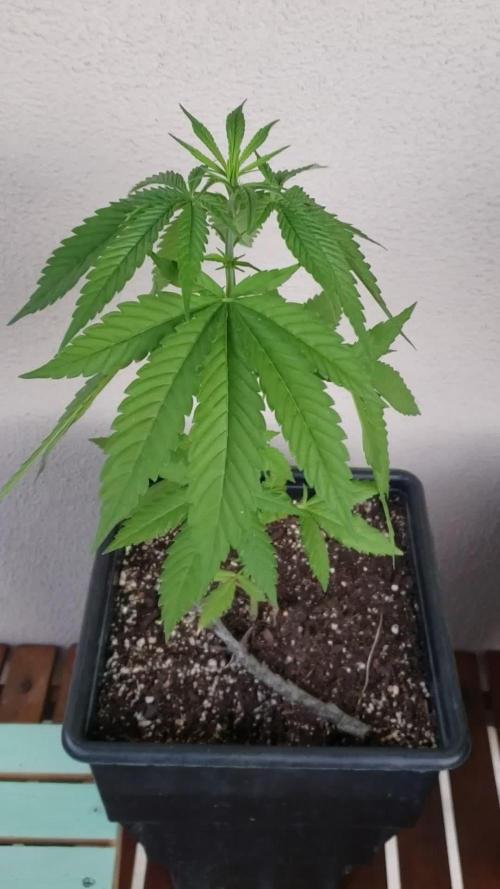
Hola a todos!!!!
Espero que anden bien!!..
Esta gorilla cookies viene creciendo bien y fuerte, ya empieza a largar un poco de olor, me ha sorprendido bastante 🤩💪.
Esta semana solo regué con top veg 2ml x litro de agua.
El resto de los días solo lo hice con agua.
Likes
38
Share


@ScouseCityLX
Follow
Another great week of bud growth and terpenes production. Think I'll be finished half was through week 9, or at the end of week 9. So far no signs of any hermaphrodite traits. Wish I started flower with a little less light intensity, as I feel that's caused the buds near the top to slightly fox tail, as the ones lower down look abit of a better shape, although smaller.

Likes
24
Share


@SMELLYBUDZ
Follow
Defoliation and supercrop a day before 24 hours of darkness. 12/12 following. Flip @ wee6 day1 from seed
Likes
9
Share


@PlumpPelican
Follow
Beginning of second week flowering and plants are shooting up.
Added a second ScrOG net and directed all the branches to get more of an even canopy and so the branches aren’t growing on top of each other.
I did one last defoliation to remove any shoots/stems/leaves that are struggling for light.

Likes
11
Share


@Ferelite
Follow
Week 4 Bloom
31/08 - Mass defoliation day, #1 was suffering from the amount of leafs it had, #2 was not as bad, has filled its own structure out nicely and outgrown #1.
Flushed and changed water. Upped the liquid potash. Added a tiny bit of CMX due to #2 showing a slight magnesium deficiency. Switched from PSI to cyco silica due to running out of PSI.
Humidity and temperatures have been near perfect, 28-38% RH and 20-25 degrees celsius, extra exhaust ventilation helped a lot.


Likes
62
Share


@RockoCalenberg
Follow
Blütetag 52 | Tag 112 gesamt
Klima – Frühling im Anmarsch
Draußen zeigt sich der Frühling deutlicher. Mehr Licht, mildere Tage, mehr Bewegung in der Luft.
Im Zelt ist dieser Umschwung spürbar. Die Pflanzen trinken mehr, der Dryback läuft zügiger durch, das Substrat trocknet gleichmäßiger ab. Der Rhythmus wirkt insgesamt ausgeglichener als noch vor einigen Wochen. Die Kurven verlaufen ruhiger, die VPD liegt häufiger im gewünschten Bereich.
Wir sind klar in der Endphase. Der Stoffwechsel arbeitet aktiv, kleine Schwankungen zeigen sich sofort – insgesamt aber ein ruhiger und stimmiger Verlauf.
🌿 Pflanzenstatus
White Gushers 33
Sie reagiert feiner auf Veränderungen, bleibt aber insgesamt stabil.
Die Blattverfärbungen nehmen weiter zu – deutliche Herbststimmung. Energie wird sichtbar aus dem Blattwerk gezogen und konsequent in die Blüten verlagert.
Das Stacking läuft weiter. Die Buds gewinnen an Volumen, wirken kompakter und schwerer. Die Oberfläche erscheint dichter, geschlossener, reifer.
Trichomstatus:
Überwiegend milchige Köpfe, nur noch vereinzelte klare. Kaum Amber. Sie bewegt sich klar in Richtung Erntefenster.
Triangle Sherbet Kush
Auch sie zeigt nun deutlichere Herbsttöne im Blattbild. Optisch etwas gelassener, aber klar in der Endphase angekommen.
Die Blütenstruktur wirkt sehr kompakt und sauber aufgebaut, extrem frostig. Minimal hinter der White im Reifegrad – jedoch im gleichen Zielkorridor.
Trichomstatus:
Milchig dominiert auch hier, mit leicht höherem Anteil klarer Köpfe als bei der WG 33. Eindeutig in der späten Reifephase.
🌸 Blüten & Duftbild
Die Buds gewinnen weiter an Struktur und Geschlossenheit.
Die Verdichtung ist sichtbar, die Form wirkt ausgereifter als noch vor einer Woche.
Aromatisch entwickelt sich das Profil weiter.
Die Frucht bleibt präsent, wird jedoch zunehmend von einer würzigeren Tiefe begleitet.
Die Komplexität nimmt zu, ebenso die Intensität.
Das Zusammenspiel der Noten wirkt runder, dichter und vielschichtiger.
Beim Öffnen des Zeltes steht der Duft klar im Raum – nicht lauter, sondern konzentrierter.
💧 Nährstoffe
Unverändert gefahren:
CalMag: 1,5 ml/L
Bloom: 1 ml/L
Keine Anpassungen.
Keine Experimente.
Konstanz bis zum Schluss.
🐞 IPM / Biologischer Pflanzenschutz
Keine neuen Maßnahmen.
Das bestehende System läuft weiter ohne zusätzliche Eingriffe.
Schimmel ist bislang kein Thema.
Aufmerksamkeit bleibt – Überreaktion nicht nötig.
🔎 Ausblick
Wir sind auf der Zielgeraden.
Noch wenige Tage – realistisch im Bereich von 7–10 Tagen, abhängig von der weiteren Trichomentwicklung.
Jetzt heißt es:
Klima stabil halten.
Nicht unnötig eingreifen.
Den Lauf sauber ins Finale führen.
🔎 Wochenfazit
Die Zeichen stehen klar auf Reife.
Herbstfarben im Blatt, milchige Trichome, fortschreitende Verdichtung.
Wir sind auf der Zielgeraden –
aber noch nicht an der Ziellinie.
Noch ein paar Tage Geduld.
Dann fällt der Vorhang.
— Rocko 🌿🔥💚
Flower Day 52 | Day 112 Overall
Climate – Spring Moving In
Outside, spring is becoming more noticeable. More light, milder days, more movement in the air.
That shift is clearly reflected inside the tent. The plants are drinking more, the dryback cycle moves faster, and the substrate dries more evenly. Overall, the rhythm feels more balanced compared to a few weeks ago. The curves look calmer, VPD stays in the target range more consistently.
We’re clearly in the final phase now. Metabolism is active, and even small fluctuations show up in the leaf expression — but overall the run feels steady and composed.
🌿 Plant Status
White Gushers 33
She reacts a bit more sensitively to changes, yet remains stable overall.
Leaf fade is progressing — clear autumn tones setting in. Energy is visibly being redirected from the foliage into the flowers.
Stacking continues. The buds are gaining volume, becoming denser and heavier. The surface looks tighter, more mature, more consolidated.
Trichome status:
Mostly cloudy heads with only a few remaining clear ones. Hardly any amber. She is clearly approaching the harvest window.
Triangle Sherbet Kush
She is now showing stronger autumn coloration as well. Slightly calmer in overall appearance, but unmistakably in late flower.
The bud structure is very compact and clean, extremely frosty. Slightly behind the White in maturity — yet within the same finishing corridor.
Trichome status:
Cloudy dominant here as well, with a slightly higher percentage of clear heads compared to WG33. Clearly in the late ripening phase.
🌸 Flowers & Aroma Profile
The buds continue gaining structure and density.
Their formation appears tighter and more developed than a week ago.
Aromatically, the profile keeps evolving.
The fruity notes remain present, but are increasingly supported by a deeper, warmer spice layer.
Complexity is increasing, and so is intensity.
The overall expression feels more layered, more concentrated, more mature.
When opening the tent, the aroma doesn’t feel louder — it feels fuller.
💧 Nutrients
Unchanged:
CalMag: 1.5 ml/L
Bloom: 1 ml/L
No adjustments.
No experiments.
Consistency through the finish.
🐞 IPM / Biological Pest Management
No new measures.
The existing system continues running without additional intervention.
No mold issues so far.
Awareness remains — overreaction does not.
🔎 Outlook
We are on the home stretch.
Likely within 7–10 days, depending on how trichome development continues.
Now it’s about:
Keeping the climate steady.
Avoiding unnecessary interference.
Guiding the run cleanly into the finale.
🔎 Weekly Conclusion
The signs are clear: ripening is advancing.
Autumn tones in the leaves, cloudy trichomes, increasing density.
We are on the home stretch —
but not at the finish line yet.
A few more days of patience.
Then the curtain falls.
— Rocko 🌿🔥💚

Likes
5
Share


@The420Century
Follow
She's ready to get flushed.
I've put her in my second tent to leave her in total darkness for 2 days before I'll hang her to dry. This helps the plant to break down the chlorophyll.

Likes
8
Share


@zombikush81
Follow
hello to all I share with pleasure this fantastic variety, excellent structure, grows very vigorous. as regards lengthening in the first weeks not more than 50% of its size. this week I will make the last thinning. thanks to all the friends who follow me. make it grow

Likes
13
Share


@YOUNGSTERBR
Follow
semana evolutiva, acertando os fatores que faltavam, mantendo o VPD, coloquei a Tela de SCROG para segurar o topo que já tinha ultrapassado a borda do vaso, os demais ramos continuo puxando para a borda, até agora nenhum Pistilo, fechando 4 semanas muito bem, sem estresse e com diferentes intensidades de técnicas em cada Auto, to fazendo meus próprios testes, coloquei as Auto do vaso mais largo para Green House que eu fiz, para posicionar os vasos do Indoor na posição final e adicionar a tela de SCROG, as Auto Outdoor adoraram a casa nova! seguimos..