


@Sieben
Follow
After 2nd defoiling the buds have their air and space back , shot a vid , but was too done for better pics after cutting session ^^ .
And sadly one of the both Gran Jefa got hermaphrodite and so had to go... :(
Will give the Lemon Orange more space at least.
Left Gran Jefa, right back Fullgas , right Front and mid Lemon Orange.


@bassik
Follow
Plants are starting to be full of flowers but one thing I do not explain is why the plant in the middle has a main bud that is actually quite thin.




@Kushycat
Follow
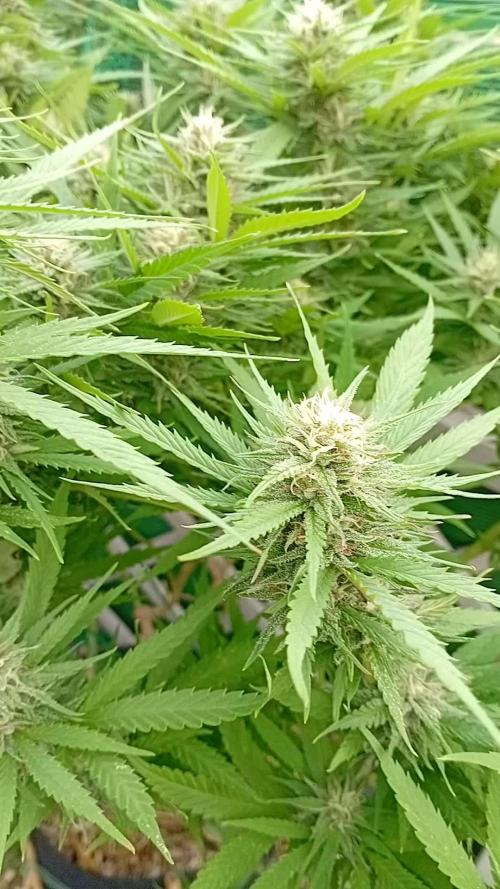
I skipped a week of flowering because I was often late with my updates. The plant is really picking up steam again, and the flowers are getting bigger. Just take a look at the pictures and video. 😄


@Skinnytalls420
Follow
Day 23-18/05/22 all looking good I think a few are showing early signs of flowering





@Davesflavours
Follow
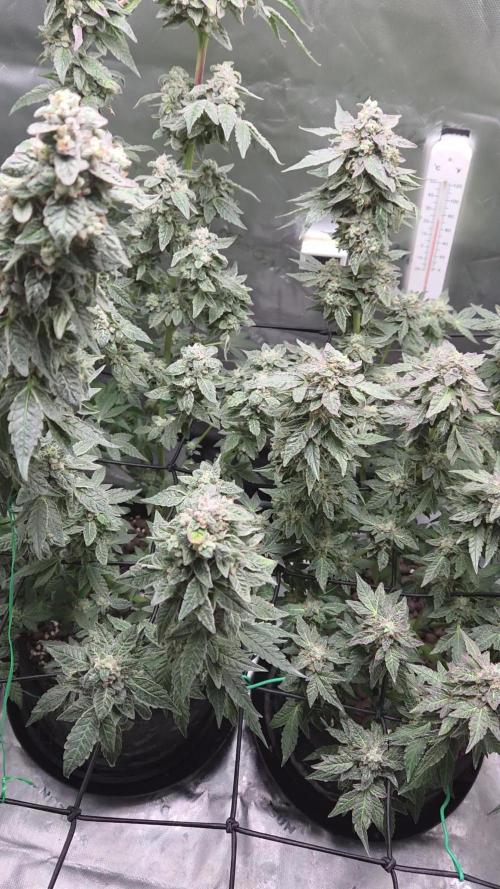
Last week before the flush
This video was actually taken at the end of the week, im pretty sure the plant on the right is very ready for harvest but the trichomes on the left plant don't have as much amber ones as I'd like.
But im going to flush anyway and hope for the best
Thanks for stopping by ✌️





@diversiv0
Follow
Week 5 – A Warmer Home, Steady Growth & a Curious Apex
Day 28 since sprouting | Royal Queen Seeds – Epsilon F1 Auto
This has been a week of important changes for Dionisio, especially regarding environmental control. After several weeks of struggling with low temperatures, I’ve finally managed to stabilize the grow tent conditions.
🌱 Plant Development
Dionisio has reached approximately 13 cm in height, growing from around 9 cm at the end of last week.
The main stem is getting noticeably thicker and stronger, internodal spacing remains compact, and several lateral branches are developing actively. The overall structure is becoming bushier, with plenty of new growth emerging from multiple nodes.
The mature fan leaves remain predominantly green, although the newest growth has a rather unusual appearance, which I’ll explain below.
🌡️ Temperature & Humidity – Major Upgrade
On November 5, I installed a Spider Farmer 540W grow tent heater (SF-Heater-03) to address the persistent low temperatures inside my Mars Hydro 60 × 60 × 140 cm tent, located inside an outdoor greenhouse.
Previously, temperatures had dropped as low as 11.3°C, with weekly averages around 16°C.
The heater is now running in thermostatic mode, set to 20°C at power level 2.
Initial Govee monitoring showed a significant improvement:
* Average overnight temperature: approximately 20.5°C
* Recorded temperature range after stabilization: 20.1–21.1°C
* Average overnight relative humidity: approximately 45%
* Lowest recorded humidity: approximately 42%
While the heater has dramatically improved temperature stability, relative humidity has dropped considerably. This appears to be partly due to the increase in air temperature, although changes in absolute humidity were also observed.
I’ve switched off the dehumidifier and set the Mars Hydro inline extractor to run continuously at minimum speed, maintaining a small passive air intake.
I also adjusted the Govee calibration against the Mars Hydro sensor, applying a −1.0°C temperature offset and a +2.5 percentage-point humidity correction. Since the probes are positioned differently, these adjustments remain approximate.
💡 Lighting
On November 6, I increased the Mars Hydro TS1000 from 50% to approximately 65%, raising the fixture to 42 cm above the canopy.
The photoperiod remains 18/6, with lights running from 18:00 to 12:00.
The aim is to provide more light during vegetative development while avoiding abrupt increases, especially given the unusual appearance of the newest leaves.
💧 Watering & Nutrients
On November 5, Dionisio received her first light feeding with BioBizz Bio·Grow.
* Watering volume: 900 ml
* Bio·Grow: less than 1 ml in total
* Estimated concentration: approximately 0.8 ml/L
* Substrate: BioBizz Light Mix
* Container: 12L Air-Pot
The concentration was intentionally kept low for this first feeding. No additional nutrients were used.
🔍 An Unusual Apex – Community Opinions Welcome!
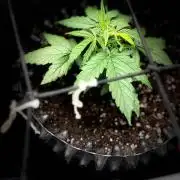
One thing I’ve been noticing throughout this grow is the unusual morphology of the newest leaves.
The main apex produces very narrow, elongated, upright leaves, with some twisting and curling. Several lateral growth tips show similar characteristics, while the older fan leaves look relatively normal.
The newest growth is also noticeably lighter green, with occasional yellowish areas.
Interestingly, Dionisio has displayed some of these characteristics since early development, so I’m wondering whether this could be a genetic trait of the Epsilon F1, a developmental abnormality, or a response to the environmental stress experienced during the first few weeks.
Despite this, the plant continues to grow, producing new nodes and lateral branches.
I’ve decided to postpone defoliation for now and observe how the next leaves develop under more stable conditions.
I’d really appreciate some feedback from the GrowDiaries community:
Has anyone seen this kind of narrow, upright, twisted growth on an Epsilon F1 or another autoflower?
Does it look like a possible genetic mutation, environmental stress, a nutrient-related issue, or something worth checking for pests?
I’m particularly curious because the older leaves seem relatively normal, while the unusual growth is concentrated around the main apex and younger shoots.
Any observations or similar experiences would be very welcome!
🌿 Overall
I’m pleased with the structural development this week. Dionisio is becoming stronger, with a thicker central stem, compact internodes, and increasingly active lateral growth.
The biggest achievement has been improving temperature stability after a challenging few weeks.
My priorities now are maintaining consistent environmental conditions, observing the response to the increased lighting, and understanding the unusual apical growth.
Let’s see what Week 6 brings!
shorts_status_processing


@RickJames_Mcdank
Follow
She is doing better now with the Nitrogen she looks much better but she is a heavy Nitrogen feeder. And the Plagron Start Up is doing really good its like steroids for ht eplant. Next week monday I will start to flip the switch to 12/12.


@Mr_Fuki
Follow
SO there are one of last weeks.
Only 1 meal they have now. and only to sunday.
Last defoliation and GO ON!


@Yolka
Follow
Everything is going great. A little stimulants and water - this recipe for soil I like very much, let's see what happens next. The purple coloring is filling the buds


@KivzBudz
Follow
In the end I’m very happy how this first Grow went. Tomorrow I’m gonna finish the other half and update some pictures. Curing begins now, can’t wait to smell and taste the full cured terpens! 😋🌱



@PapaTerps
Follow
ZkyzcraperZ - N.Y.Ceeds
Day 62
🚿 She has been watered with 2L of RO tap water, mixed with the defined nutrients and then finally pH'd to 6.5👌🏻This week, I increased her bloom nutrients and reduced the BioGrow nutrients as she is just about to finish up her stretch 👍🏻
🌸 She has also stretched really well and her flower sites have been developed to a point where they are now clearly defined on the plant, she has a really nice structure with good internodal spacing and strong stems! Over the next few days she will finish up her stretch phase and then switch her focus over to bulking her flower 🙌🏻
✂️ No work on her just yet, as she is still in stretch, but in a few days, I will defoliate and lollipop her, with a goal to improve light penetration and airflow and to remove any budsites that are too far from the light 👍🏻


@Lordviper28
Follow
These lady's have formed very nice buds even have a few show purple 😍 this strain has been very good can't wait to see war other color pop off right it's the start of 6th week flower
shorts_status_processing


@Ganjagrandaddy
Follow
Day 35:
Another week passes for these ladies who have been stacking up the buds and turning some nice pistils out to add to their bulk and appearance.
FFT#1 Has kept her small stature status but has some very nice smelling sweet buds to play with . I have been under watering these girls I think so have upped their moisture levels a little. They have responded fairly well and look a little more perky for it.
FFT#5 is continuing to impress and putting out some beautiful fat looking colas full of oil when gently squeezed. She is a thirsty girl and absorbs so much of the water very quickly. Her base and stems are very thick and hardy now so she still has a lot of load bearing to do hopefully .
FFT#7 Is still out there in front for overall production of buds and mains. Her base is a huge wedge of green and would support my weight I think. lol
Another of the hungry girls that drinks everything i throw at her. All of the FFT testers are so impressive here on GD . I look forward to the harvest which I think will be around day 50 , so not long to go before I can begin to guess who we have in the house ?????.
have fun Growmies. Be safe
Let's see what fun the we can have next week with bud swell approaching.


@MadeInGermany
Follow
Info:
Unfortunately, I had to find out that my account is used for fake pages in social media.
I am only active here on growdiaries.
I am not on facebook instagram twitter etc All accounts except this one are fake.
Harvest day 71
since the time
change to 12/12 hrs.
Hey guys :-)
Finally the time has come .
The lady was harvested.
After the trichomes have been checked (70% milky 30% amber) as always, it was left in complete darkness for 48 hours before it was neatly trimmed by hand.
After trimming, she was put back in the drying tent on nets.
There they are allowed to dry for the next 8-12 days at 62% humidity before they are put into the jar to ferment with 62% boveda packs.
After about 4-6 weeks in the jar I will swap the 62% boveda pack for a 58% boveda pack where it can be ready for another 4-6 weeks to enjoy :-).
As always, the remains of the leaves are used to make Ice o Lator and oil.
Of course, as always, there is a final update during the fermentation process.
Until then, I wish you all a lot of fun with this update.
Stay healthy 🙏🏻 and let it grow 👍.
You can buy this Strain at :
https://www.amsterdamgenetics.com/product/kosher-tangie-kush/
Type:
Kosher Tangie Kush
☝️🏼
Genetics:
Kosher Kush
X
Tangie
👍
Vega lamp:
2 x Todogrow Led
Quantum Board 100 W
💡
Bloom Lamp :
2 x Todogrow Led
Cxb 3590 COB 3500 K 205W
💡💡☝️🏼
Soil :
Canna Coco Professional +
☝️🏼
Fertilizer:
Green House Powder Feeding
☝️🏼🌱
Water:
Osmosis water mixed with normal water (24 hours stale that the chlorine evaporates) to 0.2 EC. Add Cal / Mag to 0.4 Ec Ph with Organic Ph - to 5.5 - 5.8 .


@DogDoctorOfficial
Follow
Hey fellow green thumbs! 🌿💚 The day has finally come—our Auto Northern Dragon Fuel from Super Sativa Seed Club has been harvested! After an exciting journey, we’re thrilled to share the details of this incredible plant’s final stage. Let’s dive into the harvest report!
🌟 Harvest Details:
Day 75: Harvest Day
• Harvest Date: Day 75
• Harvest Method: Our beautiful Auto Northern Dragon Fuel was harvested yesterday. After weeks of careful nurturing, the time was right to bring in this amazing plant. 🌿🌼
• Preparation: Before hanging, we meticulously cleaned the plant, removing all leaves without trichomes to ensure a smooth drying process and to enhance the quality of the final product. 🌿✂️
Current Drying Process:
• Method: The entire plant is now hanging upside down to dry. This method helps maintain moisture levels within the buds, allowing for a slower and more even drying process. 🌿🔄
• Environment:
• Temperature: 18-22°C (65-72°F)
• Humidity: 50-60%
Maintaining these conditions is crucial for achieving a perfect dry and preserving the plant’s aromatic and flavorful profile. 🌡️💧
🌟 Plant and Bud Characteristics:
Auto Northern Dragon Fuel:
• Bud Structure: Dense and sticky, with an impressive trichome coverage. The buds are beautifully formed, showcasing the robust genetics of this strain.
• Aroma: Even in the drying phase, the rich and potent aroma is unmistakable. Expect a delightful scent that hints at the powerful experience to come.
• Trichomes: A thick layer of trichomes covers the buds, promising a potent final product with a great flavor profile. 🌿✨
🌟 Care Tips:
• Drying Process: Patience is key. Allowing the plant to dry slowly will enhance the final quality, preserving both flavor and potency. Ensure good airflow around the hanging plant to prevent mold and mildew. 🌬️💧
• Trimming: Once the drying process is complete (typically 10-14 days), it will be time to trim the buds. This is where we’ll shape the final product and get it ready for curing. ✂️🌿
• Curing: After trimming, curing the buds in jars for at least 2-4 weeks will further enhance the flavor and smoothness. This final step is essential for achieving the best possible smoking experience. 🍁
🌟 Genetics Spotlight:
Auto Northern Dragon Fuel:
• Characteristics: Known for its robust structure and dense buds, this strain has shown remarkable resilience and impressive bud development throughout the grow. The final product promises to be potent and flavorful, thanks to the thick trichome coverage and rich aroma.
• Harvest Expectations: High-quality buds with a strong aroma and potent effects. The slow drying process will ensure the best possible preservation of cannabinoids and terpenes.
🌍🌿 Fun Fact:
Did you know? 🌿✨ Drying the entire plant slowly helps retain more terpenes, which are responsible for the plant’s aroma and flavor. This method also helps preserve the potency and quality of the buds, resulting in a smoother and more enjoyable experience.
For all the in-depth action and detailed explanations, head over to my YouTube channel! 🎥✨ I’m sharing all the tips, tricks, and step-by-step guides to help you get the best results from your grow. This week’s harvest has been particularly exciting, and there’s so much more to explore and learn together!
👉 Join me on YouTube Link in my profile 👈
🌟 Conclusion:
Harvesting Auto Northern Dragon Fuel at Day 75 has been a rewarding experience. With the plant now drying, we’re eagerly awaiting the final product. Stay tuned for updates on the drying, trimming, and curing process, and get ready for a high-quality harvest!
Happy growing, and see you next time! 🌿💚✨
#SuperSativaSeedClub #HarvestReport #NorthernDragonFuel #PlantMagic #GardeningJoy #NatureLovers #PlantPower #InspireGrow #YouTubeJourney
