Likes
Comments
Share
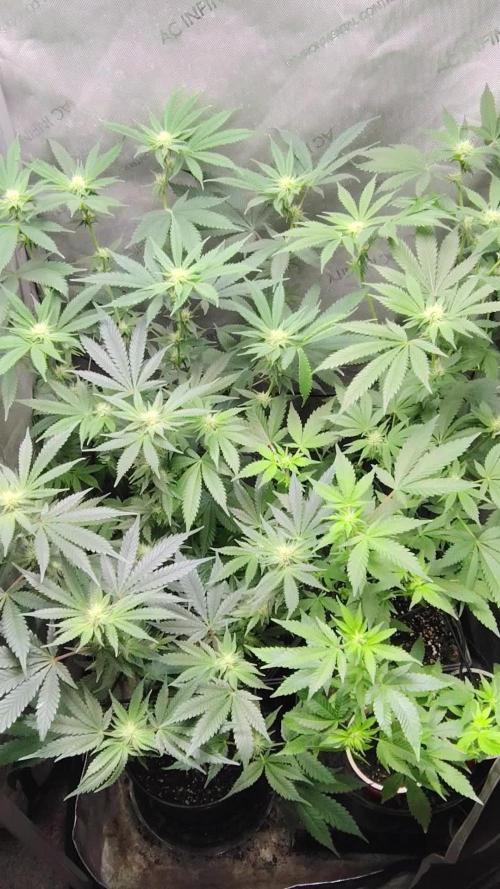
Here our Zookies, as I anticipated, have started off great and are starting to give their best In this diary you will find the plant worked with the techniques in this case the first topping was done, we cleaned everything else creating the Mainfold and we are going to work everything with the main lining. We are at the first topping and we have two mini branches growing. The other one you will find in the diary next worked without the application of techniques that involve cuts to preserve its speed. Comparison is the salt of experience. We have started the Plagron fertilization program, we are in 100% organic configuration, the soil is recycled Promix + 1/3 fresh soil + 10% Perlite + RQS Mycorrhiza Mix (4gr in the mix, 1 gr under the small fiber pot). We are administering // 1 ml/l of Power Roots - 1 ml/l of Pure Zym - 1 ml/l of Sugar Royal - 3 ml/l of Alga Grow I have doubts about the compatibility of Pure Zym with mycorrhizae. If in doubt, ask the experts, do not mix too much at random. https://plagron.com/en The doubts about the compatibility Pure Zym / Mycorrhizae have been dispelled, they can go well together according to Plagron experts. If someone tells you that enzymes eat mycorrhizae, which in principle may seem possible, explain to them that it is not true. https://www.royalqueenseeds.it/growing/452-easy-roots-mix-di-micorrhize.html Try this variety, it is a top strain of the last few years very high level of thc ---- https://www.zamnesia.io/it/11174-zamnesia-seeds-zookies-auto.html Brief description of Zamnesia // The result of the cross between Animal Cookies, GG#4 and ruderalis, this compact variety produces top quality buds, maintaining all the charm of a modern US hybrid. Thanks to the hard work of the Zamnesia genetics team, Zookies Automatic is easy to grow, fast flowering and exceptionally vigorous. Regardless of whether you grow indoors, outdoors or in a greenhouse, if you are looking for a stable autoflowering strain that is quick to harvest, Zookies Automatic is definitely the one for you. Like all Zamnesia autoflowers, Zookies Auto promises rapid harvests of top-quality bud with minimal effort. And she delivers on that promise. After germination, Zookies Automatic plants grow vigorously for around 3–4 weeks. At the end of the pre-flowering phase, plants typically reach a height of between 90–110cm, depending on the size of the pot. You can find the whole world of growing on Zamnesia and more, just check out the site and you will find "all the best that nature has to offer" in various shapes and colours. The new strains are fantastic and the old ones are no exception... p.s. no hermaphrodites so far, can you growers say the same? ---- // www.zamnesia.com
Likes
45
Share
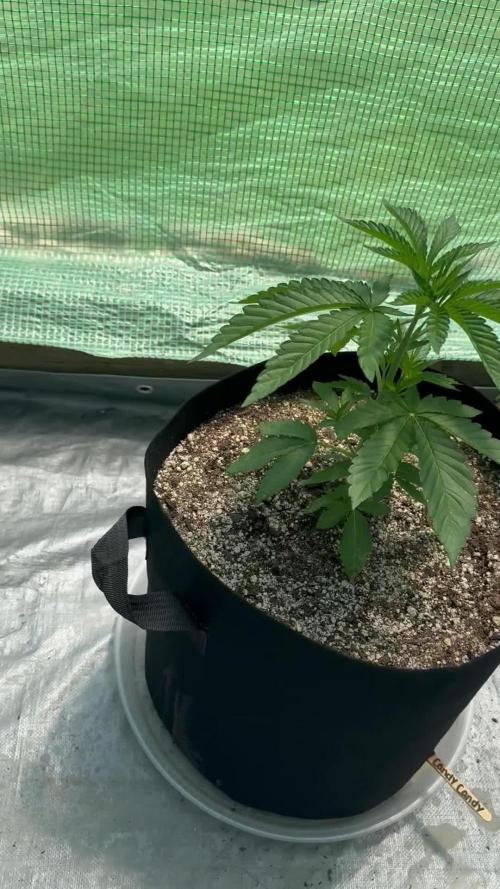
6/26 Rained last night. Might have showers bur the sky is clear. Real good weather coming. I need to transplant those seedlings. Plants are noticeably bigger every day. I see small spits of damage but it's isolated and in a high wind area. I'll address it and watch for nute deficiencies. Also need to transplant those seedlings. At leastcones an auto. 6/27 Rained overnight again. Looks clear today but we did get some rain yesterday. Tomorrow is all sun. I'm planning to transplant those 3 seedlings today. Also noticed some ragged holes so I've got a few pests. Looks like grasshoppers or something. With all the rain could be slugs or pillars I guess. Need to get ipm up amd running. I've got work to do. Found a plant on my gmo in the 30 bag. It got sun burnt and wind burnt but came out of it and they're all doing great. At first this one was a little behind after transplant but so were the other gmo's. Originally, it was one of my best plant prior to transplant outdoors. That one leaf I found during a thorough inspection of the garden. I'm hoping it's not tmv. Plants growing vigorously and better than but I'll keep an eye on it. I also transplanted the 3 seedlings. I added half new 707 in the 50 (prior soil was this same mix from last year) and transplanted one in that. One in a 10 gallon bag and the auto in a 5 gallon bucket. It will be interesting ingredients seeing how they turn out. All transplants went really smooth. 6/28 It's gonna be a hot one today. I haven't watered in over a week due to rain. Wind was whipping this morning! Looked like plants MIGHTVE been drooping but now that I think about it it was probably just the wind. ANYWAY I WATERED TWO AND A HALF GALLONS on the clones. That wind dries the bags out fast. Some still had some heft to them. Lately I've been going by my intuition which has seemed to be on point. All the seedling transplants look good and show no signs of stress. 6/29 The site was down so I couldn't update. Looks like it's gonna rain. It's noontime. This morning i found and killed two inch worms. There's not much damage so I'm wondering whether bt is necessary. Birds sit on the frame and dart I'm and grab them. I'll have to think on it. I also need to decide what I'm going to use for nutes this year. Don't need it yet. GMO's and sherb pie is putting out pistols everywhere. Same with the event horizon. Looks like I may have an early harvest this year. I certainly hope so. Still.....only did half what I did last year but with everything going on its all I can handle. 6/30 Site was down and it doesn't want to pet me upload my pictures 7/1 Trying to keep this updated. Need to spray bt. I'm seeing some damage. Not much but I need to get a handle on it now. Poured yesterday. Super sunny today. Plants seem to be flowering early this year while I still have a 2 seedlings that haven't shown their sex yet (they are fems but still). The clones are beginning to flower it looks like so I may have an early harvest this year. 7/2 WATERED THE GARDEN WITH 4 GALLONS. Spent some time looking over the plants and decided to hold off on the bt seeing as there isn't much damage. I spoke to a few shop owners and after seeing my garden this wad their advice as well. While watering I noticed red ants coming out of the soil of my GMO in the 30 gal. Some of these strains will be early finishers. The only time I've had stigmas like tjis was when I grew mendo breath and that was a super early harvest. Either way things are looking fantastic. The auto seedling finally showed a stigma. One seedling left (they should ALL be females) but I cant tell by the preflower yet. It looks female but I need to see that little white hair emerge to be sure.
Likes
4
Share
Week 6 sticky wasabi. plants growing and bounced back from LST they are growing fast with no problem, a few of them are growing with tight nod spacing and they still loving the 24 housrs of light under 580wats led lighting, THIS FEED they av took 40l between the 14 of them,.. @growerchoice @SHOGUN COCO A 4ml/L 160ml @SHOGUN COCO B 4ml/L. 160ml @SHOGUN ACTIVE BOOST 2ml/L. 40ml @SHOGUN CAL MAG 1ml/L 20ml @SHOGUN ZENZYM 2.5ml/L. 100ml
Likes
3
Share
So the one girl is a week ahead with the other 2 slowly behind as popped later date, will keep diary from the 1 main girl and add the other 2 in with description as go along Entering week 2 for the main girl now with her being potted up shortly 🌱💚 Aptus nutrients are being used which atm seem very easy too follow I cant wait too start getting these girls flying 🤞 The other girls in there are humbolt seed co ice cream cake which are very slow atm and may open a diary for them or throw them in with this diary
Likes
23
Share
@Diips
Follow
As the weeks fly by, our 5 ladies are growing in size! no problems just straight forward from here. all 5 pots have gotten a biotab each, to support them for the rest of the grow. since these should finish around week 10-11. and then they are getting Biotabs bio pk 5-8 weekly. water also ph to 6.5. even tho there have been some variation in the growth from all 5 plants, then ive been able to manage it pretty smoothly with the 2 big ladies in the back of the tent. really streched alot. also no herm from the stress ive been putting all 5 ladies through 🌞 i gave a very small dose of som leftover power roots, that was given to some clones and then i decided to swap the feed with Biotabs PK compost tea. as a small little experiment, i put 12 g in 10 L of water. went smooth with my oversized air pump with 4 airstones 😅✌️.
Likes
1
Share
Remember that, however you are played, or by whom, your soul is in your keeping alone. Even though those who presume to play you be kings or men of power, when you stand before God, you cannot say, 'But I was told by others to do thus,' or that virtue was not convenient at the time. This will not suffice. Remember that. Day:18 84°F and 65% RH (VPD) for the vegetative stage. Approximately 1.15kPa(assuming leaf temperature is about 2°F cooler than the air), which falls right into the ideal vegetative sweet spot (0.8kPa to 1.2kPa). At 1.15kPa, plants can draw water and nutrients efficiently without risking stress or wilting. It keeps the leaf pores (stomata) open, allowing for ideal carbon dioxide intake and maximizing vegetative growth. VPD is determined by the leaf's temperature, not just the ambient air. Because leaves usually run 1° to 3°F cooler than room air under bright grow lights, my actual VPD will be slightly lower, closer to the 1.0kPa mark. As she transitions from vegetative growth to flowering, one can gradually lower the humidity (to around 45–60%) and drop temperatures slightly to prevent disease from settling inside dense buds when they appear. Night:6 At 70°F and 60% relative humidity, Vapor Pressure Deficit (VPD) is 0.86 kPa. This is right on the cusp of whats optimal for the vegetative stage. During the nighttime, plants generally close their stomata and undergo cellular respiration rather than photosynthesis. Transpiration slows to a near stop, making VPD less critical at night than during the day. However, maintaining a nighttime VPD between 0.8 and 1.0 kPa is highly beneficial in that it ensures the air is dry enough to prevent powdery mildew or bud rot, but moist enough to keep the plant from undergoing unnecessary stress. This range keeps the environment comfortable for cellular processes and prevents large atmospheric swings. Keeping it all flowing. (Not pushing them yet, these are photoperiods) The optimal soil (root zone) temperature for cellular root respiration and nutrient uptake in cannabis is between 68F & 72F This narrow range balances biological energy production (cellular respiration) with the dissolved oxygen levels in the soil, maximizing plant growth and health. Warmer soils hold significantly less dissolved oxygen. When soil temperature exceeds 74F oxygen depletion occurs, inhibiting cellular respiration almost entirely, At 68-72F root cells generate optimal adenosine triphosphate (ATP) via respiration to power root-tip elongation and the active transport of water and nutrients. Too Hot (Above 78F) Root respiration increases, demanding more oxygen, while the water's oxygen-carrying capacity drops. This creates a prime environment for anaerobic pathogens and Pythium (root rot). Too Cold (Below 60F) Root metabolism and cellular respiration slow to a crawl. This severely impairs nutrient and water absorption, leading to yellowing, wilting, and phosphorus deficiencies. A lot depends on whether it's automatic or photoperiod; with photoperiod, there is not as much of a need to push "hard" as the real countdown only begins once the flower is initiated. Automatics, on the other hand, the chronological "clock" begins ticking the moment the seed germinates. It is of critical importance that the seedling growth gets off to the races, understanding that early growth is like compound interest, which will pay off come harvest. This reality is why getting autoflowers "off to the races" early on yields such exponential benefits. The "compound interest" is directly related to the surface area of the leaves. Larger, faster-growing seedlings process more light and build bigger root networks early on, which translates into an explosion of vertical and lateral growth during their short vegetative window. The margins for error are so thin with autoflowers; this early-stage momentum depends on several critical practices. Seedlings exposed to increased atmospheric CO2 levels early in life will develop at an increased rate. To effectively "extend" or optimize the capacity of Photosystem II (PSII) for increased photosynthetic efficiency. In standard oxygenic photosynthesis, Photosystem II (PSII) is naturally limited to the red-light spectrum, peaking at 680nm. Extending its light-harvesting capacity past 700nm into the far-red region requires bypassing the natural limits of standard chlorophyll a. Adding 730 nm (far-red) LEDs alongside standard red/blue lights has been shown to increase canopy photosynthesis by 20–30% in several crops by acting synergistically with shorter wavelengths. However, the limitation is that excessive, pure IR/Far-red light (without accompanying red light) can trigger the "shade avoidance response," causing plants to grow tall, weak, and spindly rather than robust. Utilizing infrared light (specifically the 700-750 nm far-red range) is a viable method to boost photosynthetic efficiency. It acts as a bridge to allow PSII to utilize a broader spectrum of light, breaking the traditional 700 nm barrier. UVR8-mediated signaling (often in conjunction with CRY proteins) triggers protective mechanisms that maintain the stability of the photosynthetic apparatus (including LHCII and reaction center proteins), thus ensuring that the efficiency of Photosystem II remains higher in UV-B-exposed plants compared to plants lacking this receptor. ΦPSII indictates the rate of electron transfer from water to plastoquinone, which drives the production of ATP and NADPH. There is a close link between ΦPSII and the true rate of CO2 fixation (Φ*co2). ETR stands for Electron Transport Rate. It measures the speed at which electrons are moved through the thylakoid membranes in a plant's chloroplasts during the light-dependent reactions of photosynthesis. Infrared light (particularly Near-Infrared or NIR) improves cellular energy by interacting directly with the electron transport chain (ETC) in mitochondria. This process boosts adenosine triphosphate production, which acts as a metabolic coefficient multiplier by accelerating enzyme activity dramatically. Extend then multiply. Far-Red photons interact with plant photoreceptors to accelerate the plant’s biological "clock" or trigger a shade-avoidance response. Autoflowers don't use the plant's biological clock, although the IR will initiate a shade avoidance and make them stretchy. You can just add equal measures of 660nm-680nm to negate the shade avoidance effect. Replacing nights' "darkness" with a combination of IR+ and 660nm. Because autoflowers don't require a dark period to flower, many growers just blast them with light. 18/6 24/0. However, this ignores the plant's metabolic rhythms, where daytime photosynthesis (light reactions) must be perfectly balanced with nighttime carbon fixation and assimilation (Calvin cycle) to avoid bottlenecking plant development. Cellular respiration is a 24/7 process, but it can only function while the plant has the free oxidative capacity to do so. A 100% photosynthetically active leaf cannot perform cellular respiration. The viral trend of defoliation of every leaf that isn't "getting enough light" is of great detriment overall, putting 100% of the cellular respiratory "workload" and responsibility on the 0/4/6 hours of darkness in sub-optimal conditions for enzymatic activity. Photosynthesis captures nearly 100% of the initial energy as carbon, while cellular respiration is the process that unlocks 90% of that captured energy into usable ATP so the plant can use it. Respiration is considered roughly 30% to 40% efficient. It captures enough of the potential energy in glucose to synthesize around 30 to 38 ATP molecules per glucose molecule. The remaining 60% to 70% of the energy in the sugar is not captured in ATP; instead, it naturally escapes into the environment as heat, which helps regulate plant temperature. In plants, the primary enzymes of the Electron Transport Chain (ETC) and the ATP synthase complexes are typically adapted to function optimally in warmer temperatures (roughly 25°C to 35°C depending on the specific plant strain). As temperatures rise within this physiological range, molecular collisions increase, speeding up respiration and ATP production. The cannabis plant has a branched respiratory pathway. During heat or cold stress, plants activate Alternative Oxidase (AOX). AOX burns sugars to dissipate energy as heat rather than coupling it to ATP production. This pathway actually functions optimally at elevated temperatures to help protect the cell from the damaging build-up of Reactive Oxygen Species (ROS) during heat stress. Enzyme activity generally scales with heat; there is a strict biological limit. If canopy temperatures in a grow room exceed 40°C, the enzymes and their supporting lipid membranes lose stability. Not saying you need to go crazy, just optimize nights the same as we optimize days. Phosphorus is the driving force behind early seedling development. It acts as the "energy hub" of the plant, directly driving cell division, robust root growth, and the creation of DNA. Without an adequate, easily accessible supply early on, the plant's overall growth potential and final yield can suffer permanently. E=MC2 looks like a simple multiplication problem; it describes a fundamental physical truth: mass and energy are the same thing. The equation doesn't just calculate a value; it reveals that mass is effectively "congealed" energy. Energy is just numbers. Energy isn't a physical "substance" you can hold or touch. It is essentially an abstract, calculated number that we assign to a system to predict how it will change, interact, or move. A numerical label we attach to matter to track how it behaves. Because the universe runs on laws of symmetry (specifically, that the laws of physics don't change over time), a single global number must be conserved. We call that number "energy". We don't grow; we facilitate energy conversion. How well a seedling grows is essentially down to how much knowledge one can acquire to increase the level of conversion to occur. Applying knowledge effectively requires intuition, which comes from hands-on experience. A seasoned stoner learns to read subtle signs—like a slight change in leaf turgor (stiffness), subtle color shifts, or the specific texture of the soil—before a textbook diagnosis can be made. Ultimately, growing is the application of botanical science blended with active observation. Knowledge dictates your potential, but adaptability and attentiveness to the plant's immediate environment determine your results. 1.618 nature mathematically optimizes quantum energy transfer and light absorption efficiency within the photosynthetic machinery, as it naturally dictates energy scaling hierarchies and resonance dynamics. External vibration or electromagnetic wave that perfectly matches a plant's natural frequency directly influences plant growth. Low-frequency sound waves and targeted electromagnetic fields stimulate cellular processes and boost photosynthetic efficiency Does it produce better yields? How long is a piece of string? As long as you cut it. But isssss the juice worth the squeeze? The quantum framework of the IVM seems to think so. Good enough for the quantum firmware, good enough for the DNA software. Genetics are not dictated; they are expressed; the rate of that expression is dictated by the environment in which growth occurs. Quantum Coherence in Photosynthesis occurs When a photon of sunlight strikes a leaf, the energy it carries must travel to a reaction center to be converted into chemical energy. This process operates at nearly 100% efficiency. If the energy moved in a traditional "bunching" or random hopping manner, a large portion of it would be lost as heat. Instead, plants utilize quantum superposition. The energy particle (exciton) doesn't just take one path; it exists in a wave state and explores multiple pathways simultaneously. It essentially "chooses" the most efficient route to the reaction center simultaneously. Research shows that molecular vibrations and the specific network arrangements of chlorophyll molecules (like the naturally evolved Chlorophyll A & B ratios) actively protect against energy overflow, optimizing light capture across different light intensities. Enzymes are the biological catalysts that speed up chemical reactions within a plant's cells, allowing them to grow, metabolize, and repair. Rather than relying solely on the classical kinetic energy of molecules colliding, plants use quantum tunneling. Subatomic particles like electrons and protons (hydrogen ions) can literally "teleport" through energy barriers that they normally wouldn’t have the energy to climb over. This makes vital metabolic reactions happen far faster than classical physics could ever explain. Chloryphyll b has peak absorption at 460nm (Blue) and at 647nm(Red). If we take the blue peak wavelength 460nm and a UV-B, UVR8 peak absorption wavelength 285nm, Tryptophan-285 (W285) Sensing protein. 460/285=1.618 Φ If we take chlorypyhll b's Red absorption peak 647nm and a UV-A of 400nm, we get 647/400=1.618 Φ. "Structure of light". The cryptochrome photoreceptor (CRY) is a UV-A/blue light receptor that shares this dual sensitivity with several other biological structures and functions, including significant sequence similarity and a common evolutionary ancestor with DNA photolyase enzymes. These are light-activated enzymes that use blue/UV-A light to repair DNA damage caused by UV-B radiation in plants. Synergistic. But Shhh, it's a secret. Effective quantum efficiency of photosystem II, often denoted as ΦPSII, represents the proportion of light absorbed by Photosystem II (ΦPSII) that is actually used in photosynthetic electron transport. It is a key indicator of how efficiently a plant is using light for photosynthesis, as opposed to losing it as heat or fluorescence. ΦPSII (effective quantum yield of photosystem II) functions primarily as a "multiplier" (a coefficient of efficiency) rather than an additive factor when estimating the overall photosynthetic electron transport rate (ETR). Multipliers are considered far more beneficial than additions because they generate exponential growth, leverage existing resources to their full potential, and create sustainable, self-multiplying capacity, rather than just incremental, linear increases. This fascinating observation is rooted in the intersection of subatomic geometry, fractal scaling, and quantum dynamics. In specific molecular arrangements—such as in conjugated polymer networks or biomolecular architectures—the Golden Ratio (PHI) naturally dictates energy scaling hierarchies and resonance dynamics. Mathematically tied to the fine-structure constant, which defines the strength of the electromagnetic interaction. The Golden Ratio can be mapped geometrically as the Golden Angle (137.5 degrees) in atomic structures, linking the charge of the electron to fundamental quantum constants like Planck's constant. Electromagnetic. The Golden Angle (137.5): This angle is derived from the Golden Ratio (1.618). It is the smaller of two angles created when a circle is divided such that the ratio of the arcs equals the Golden Ratio.
Likes
22
Share
@Brujha77
Follow
Start 9. Blütewoche Endspurt🥀🥀 Trichome sind langsam alle milchig💪 Denke mal ich werde noch bis nächstes Wochenende warten, dann sollten die beiden es geschafft haben. Bin da wirklich gespannt. Guter Trichombesatz und riecht wirklich komplett nach Zitrus mit Papaya 😍😍 Tag59 Blüte Heute wurde der Tank abgedreht.
Processing
Likes
1
Share
Steady week, all the girls seem to just keep getting bigger and bigger! Defoliated which I forgot to take pictures of however, they literally replaced the foliage in days! I Have a slight worry about one of the GG as she seems to be carrying on vegging with no real signs of flowering, just stretching more each day!? This seems strange as the Stardawgs look like they could be ready for flush in the coming weeks.. I am only a newbie so maybe i'm just been a little paranoid!? Either way She's absolutely massive!! Got the Dawgs out for a little photoshoot!
Likes
64
Share
@Natrona
Follow
Sponsored grow 👉WeedSeedsExpress👈 Week 7 / Flower week 3 2/23-3/1 Week 7 flower week 4 Love Potion is in flower, the buds are puffing out with many white pistols. Trichomes are just starting to form Love Potion got her first defoliation removing fans and any bud sites and more pins added on 2/24. Since I have overfed my gals, this week I am trying to remove excess fertilizer from the planting medium by giving ph 6.5 water only. I am hoping since Love Potion is behind the other gals, I’ve addressed the over feeding issue and she will not show burnt tips and look pretty out her life. Ph 6.5 Temp 65 Thank You @WeedSeedsExpress for the opportunity to grow your strains. Your likes and comments are appreciated. Thanks for stopping by. Growers love 💚🌿 💫Natrona💫
Likes
12
Share
@Chamed33
Follow
Plant is looking great so far I had to flush it 2 days ago to readjust my run off water ph
Likes
2
Share
Hola a todos, esta semana hicimos una buena deformación, en las partes bajas de la planta. Regamos con oro negro de namaste 2ml x litro, en total regamos con 5 litros de fertilizantes y el resto de la semana, solo agua. No se midió ph ni ec .La planta soporto bastante bien el stress por la defoliacion, esperemos siga así. Hasta la próxima amigos!.
Likes
20
Share
Gracias al equipo de Royal Queen Seeds, Marshydro, XpertNutrients y Trolmaster sin ellos esto no sería posible. 💐🍁Punch Pie: Un híbrido monstruoso con un 90% de dominancia índica, ocupa uno de los primeros puestos de la lista de favoritas de Kid Dynamite. La Punch Pie desciende de la Cherry Punch Pie de Tyson 2.0 y contiene la genética de dos índicas galardonadas: la Purple Punch y la Purple Kush. Punch Pie tu paladar se impregnará con ricas notas de pastel de frutos rojos, repostería caramelizada y tierra. Luego, pocos minutos después de la primera calada, sentirás todo el poder de este portento. La Punch Pie proporciona un combo 1-2 que se manifiesta justo en medio de los ojos y derrite todo el cuerpo, dejándote en un estado somnoliento, hambriento y apacible. Produce plantas compactas que alcanzan una altura de 80-110cm en interior y hasta 120-150cm en exterior. Tras 9 semanas de floración, esta señorita robusta crece con fuerza para soportar el peso de sus densas flores, y da cosechas de hasta 600g/m² en interior y 750g por planta en exterior bajo el sol. 💡TS-3000 + TS-1000: se usaran dos de las lámparas de la serie TS de Marshydro, para cubrir todas las necesidades de las plantas durante el ciclo de cultivo, uso las dos lámparas en floracion para llegar a toda la carpa de 1.50 x 1.50 x 1.80. https://marshydro.eu/products/mars-hydro-ts-3000-led-grow-light/ 🏠 : Marshydro 1.50 x 1.50 x 1.80, carpa 100% estanca con ventanas laterales para llegar a todos los lugares durante el grow https://marshydro.eu/products/diy-150x150x200cm-grow-tent-kit 🌬️💨 Marshydro 6inch + filtro carbon para evitar olores indeseables. https://marshydro.eu/products/ifresh-smart-6inch-filter-kits/ 💻 Trolmaster Tent-X TCS-1 como controlador de luz, optimiza tu cultivo con la última tecnología del mercado, desde donde puedes controlar todos los parametros. https://www.trolmaster.com/Products/Details/TCS- 🍣🍦🌴 Xpert Nutrients es una empresa especializada en la producción y comercialización de fertilizantes líquidos y tierras, que garantizan excelentes cosechas y un crecimiento activo para sus plantas durante todas las fases de cultivo. Consigue aqui tus Nutrientes: https://xpertnutrients.com/es/shop/ 📆 Semana 6: Esta semana ha explotado 💣, los cogollos comienzan a tomar densidad y llenarse de resina, me hubiera gustado aplicar algo mas de nutrientes en la fase vegetativa, la próxima vez será.
Likes
39
Share
@Antares
Follow
Plant is doin ok I noticed she's a little bit smaller than other phenotypes, but soon she will grow like a monster as she prepares for flowering stage, so I decided to start LST. As you can imagin guys, is my first LST and you may guess what happened 😢 Yes I broke a branch (with little sprouds) , Will I have serious consequences at harvesting? ****I confess i smoked the broken branch and the leaves (haven't smoke in months!) Man, now I can see this will be some trippy sh^t****
Likes
11
Share
Had to tear out my best looking Deep Purple because it was a male :(. So bummed 🙁 so only have one left so fingers crossed. Two of the fast buds CBD got about one week left. The other on is twice the size and about 3 weeks left. They smell very citrusy 🍋. Grow on!!
Likes
4
Share
This lady looks absolutely gorgeous, she's got big beautiful leaves, I cannot wait to transplant this lady and make her become a beautiful fat bush! Let's do this! I'm very glad to be working with this strain this 2021 outdoor season, this lady has been Transplanted after 34 days since planted to her definitive 30L texpot, let's see how this lady performs!!
Likes
Comments
Share
@Budhunter
Follow
Week 1 flowering - Day 5 of flowering & Day 61 of life Finally flowering here. It’s been 5 days on flowering, still pre flowering but finally the best is coming. Lemon tree is a monster 💪🏼 far the biggest plant in the tend and growing 😅 time to fat up 🔥 I have added bloom fertiz and bud candy to the mix. Let’s go
Likes
9
Share
It's been great.. upgraded their tent, girls are stretching fairly but not excessively. I remove lst tie downs before flowering [experiment] but had to redo to maximize light penetration, previous topping and lst created a lot of bud sites Happy growing guys..
Likes
14
Share
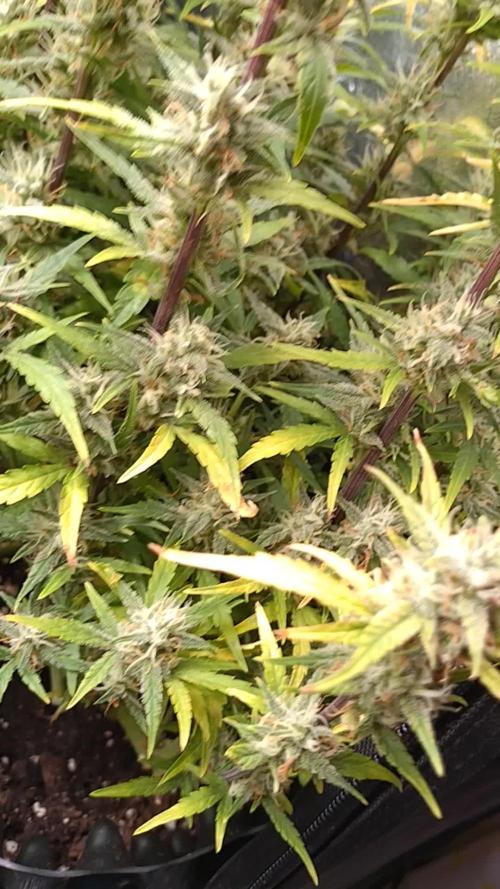
Back to plain water, seeing some foxtailing and I love it. Dense dense nugs are no good for making hash I hear. My s/o and I are super excited to get her harvested and squished but am waiting for the 20% amber to chop. Thanks for the feedback on harvest time indicators. PLEASE COMMENT your go-to method/indicators for harvest time! Would love to see if everyone solely depends on trichombes or other methods such as pistils or leaves. *I am growing 4 plants here, but only tracking one.
Likes
15
Share
Привет друзья, всем тем, кто следит за мной. Вновь обновляю свои дневники. Если вы следите за мной, то знаете, что на протяжение всей прошлой недели я брал клоны от своих растений. Вы можете следить за их развитием в соседнем моём дневнике. После того как я взял достаточное количество клонов, я сломал привычку растений выращивать один центральный стебель. Теперь я дам им немного покоя и буду наблюдать, как их внешний вид восстановиться после жёстких тренировок. Я даю растением небольшое питание, в основном из витаминов, гуминовых кислот и бактерий. Когда мои 50 клонов будут готовы к пересадке, я переставлю материнские растения в палатку поменьше и буду дальше экспериментировать над ними. Если вам интересно следить за приключениями травки в России, подписывайтесь на мои дневники