


Likes
Comments
Share


@FarithAriasFajardo
Follow
Dump de lo que fue esta semana. Seguimos ajustando con lst la estructura que quiero y empezamos a la transición a flora. Esta semana será la última de vegetativo donde trataremos de sacar clones (esquejes) de ambas. Ya que he estado mirando videos y tomando información de cómo hacerlo, creo tener una idea de cómo hacerlo sin fallas en el intento. La próxima semana nos veremos realizando estos esquejes y veremos el avance de esta última semana. Recuerden que todo lo estoy haciendo de forma empírica y sin conocimiento previo. Todo ha sido con apoyo a videos de otros growers e información de distintas páginas. Gracias por estar aquí y compartir conmigo esta primera experiencia!


Likes
7
Share


@Huntablunt
Follow
Hi guys and welcome to Week 7
As you see, the small plant really suffers and I really dont have no clue anymore whats really up. So she needs to go through like this. Signs of overnutrition cant be possible with the ec the drain has. As mentioned the ph was increased, thats why I flushed, but anyways. Compared to the other two she really doesnt seem to like these circumstances.
Next run I really am goint to measure everything three times,lol.......I really dont know what the actual problem is now. Anywys the small plant stretched a bit and gained also a bit of buds. The other two are showing interesting colours. One will turn quite purple, the other seems to develop slight red tones. I am curious when they will really explode and really hope they dont had too much stress with that.

Likes
22
Share


@BigDaddyK
Follow
Short plant , dense , would suit people with reduced height rooms , flavoursome
Processing
Likes
57
Share


@LockDownGrow
Follow
Ok so this week I did a defoliation and a tigh down too the netting , I really was not planning on doing such a big defoliation but the leafs became thick and dense and there was almost no light penitration down too the lower branches of the plant , so she is opened right up now and the humidity and temperature has dropped loads and the air is moving alot better around the leaves and branches , I will not take anything more off her now , I have also added Cal mag too the nutrients for this week only , she is well into pre flower now but the stretch has not yet started so I figured it's no or never too defoliate and tigh them down , this grill really has grown right out this week and is unrecognisable from the plant just a few days ago ,
I am very happy with them so far and being new too all this it's all very exciting ,
Thanks for looking :)
Likes
42
Share


@Brown832
Follow
Hey folks, I have been checking the trichomes, and they have all glazed over white now with some turning Amber.
So I am starting to flush with water. I am hoping for a 2 week flush 😀
Some of the branches are falling over with weight, hopefully a good sign. 😅


Likes
31
Share


@MadeInGermany
Follow
Info:
Unfortunately, I had to find out that my account is used for fake pages in social media.
I am only active here on growdiaries.
I am not on facebook instagram twitter etc All accounts except this one are fake.
Harvest day 67
since time change
to 12/12 hrs.
Hey everyone Finally it was time for the lady to be harvested :-).
The buds smell very tasty and look very good so I'm really excited.
The trichomes are 70% milky and 30% amber.
As always, it came to the darkroom 48 hours before harvest :-).
There it will now remain after harvesting at 62% humidity for 8-12 days before it is put into the jars for fermentation with 62% boveda packs :-).
As usual, the last update will come after the fermentation.
Until then, I wish you all the best and stay healthy 🙏🏻
You can buy this Strain at :
www.Zamnesia.com
Type:
Runtz
☝️🏼
Genetics:
Zkittlez x Gelato
👍
Vega lamp: 2 x Todogrow Led
Quantum Board 100 W
💡
Bloom Lamp : 2 x Todogrow Led
Cxb 3590 COB 3500 K 205 W
💡💡☝️🏼
Soil : Bio Bizz Coco
☝️🏼
Nutrients : Green House Seeds Company Powder Feeding Bio
☝️🏼🌱
Water: Osmosis water mixed with normal water (24 hours stale that the chlorine evaporates) to 0.2 EC. Add Cal / Mag to 0.4 Ec Ph with Organic Ph - to 5.8

Likes
8
Share


@thekilograham
Follow
Nearing the end of this plants growth, I was somewhat busy and wasn’t as tentative to that plant as I normally will be. I did however tuck and hang branches with bigger bud sites to get better air flow and light penetration as well as defoliating the lower small sights slowly over a few days. Each branch is extremely heavy and packed with trichome covered buds.

Likes
2
Share


@TheBudWhisperer
Follow
Initial cuttings entry for this journal on the to-be-pollinated F2s. We’ll be backing out each plant specimen against some F1 pollen in an effort to trait stabilize the best bud of the lot. Still debating on pushing my luck with just the aero-cloner through the whole shortened cycle. If not I’ll have to cobble together some sort of shallow dwc bin from scratch to accommodate them for the long haul. Pollen as soon as we see prevalent pistils.
***Grow notes: 2 cuts from each plant specimen against- #5 potentially a male. All lookn great and perky post-cutting. Let’s hope the F1 pollen is still preserved🤞🤞🤞.
Likes
14
Share


@CHILLING_RACOONS
Follow
Dear Friends, 👨🌾 👩🌾
White russian by Seeds Mafia is growing sooooo strong
27/11 transplanted into 15L smart pot
✅ VEGETATIVE week #5
📅this week goes from 12/12 to 18/12.📅
💡💡💡Viparspectra XS2000 is working at 50% power.
💉🔍Fertilization schedule:🔍💉
14/12 eposom salts 2g/l foliar and 1g/l irrigation
WE ARE BACK!!!
We are back after a little pause.
We take a break because we were too busy to post high quality diaries. In the last diaries we tried to post as good as possible and we have to publish about 6 or 8 diaries (in addition to these that we will publish shortly). We opened also an educational Instagram page, we growed a lot in a short amount of time BUT, Instagram suspended our account and we lost all our posts, I was so sad and disappointed... a lot of work lost in a night....
Now we started a new grow with six awesome strains!!!!!
In this diary you will see our journey with White Russian by our friends Seeds Mafia, sit down and enjoy the show!
We are growing in a 15L Smart Pot with Light Mix soil by BioBizz
White Russian Feminized was obtained by crossing the AK-47 and White Widow varieties, it has a very short flowering period of 55-65 days. It is especially recommended for outdoor cultivation, such as France and Spain, although it may also adapt to indoors and greenhouses. The harvest flavor is relatively intense during the growth and flowering period.
These seeds give excellent plants, both as appearance and effect. The plant has a medium height, it is robust, thick and dense, with flowers full of resin (the crystals occur about 5 weeks after flowering). Having a 22% THC content, White Russian is one of the most popular and potent marijuana varieties.
As a result, this strain has a very strong, intense, lasting and rather mind effect
💸💸💸💸💸 Here you can buy seeds of this top shelf strain: https://seedsmafia.com/en/feminized-cannabis-seeds/white-russian-feminized-.html
_____________________________________________________________________
🔧💡OUR SET UP💡🔧
✔️ 💲💲💲VIPARSPECTRA 🚀🚀🚀🌕🌕
ViparSpectra®️ XS2000 240W Infrared Full Spectrum LED Grow Light:
Excellent ratio between wattage and ppfd, excellent light penetraton, perfect light spectrum (it also has IR 🤩) and it has the best build quality on the market. Until now, built quality is really awesome. You can touch that quality. Materials are really strong, excellent driver and the best leds on the market. Heat dissipation is perfect, the lamp is never too hot and it has a passive dissipator so you will have zero noise. It also has IP65 certification. I like that this lamp is bigger than others, so the 240w of power are well distribuited on the space. Viparspectra has an awesome customer service, and shipping was creazy fast!
This awesome brand also offers 3 years warranty.
This lamp has no rivals.
A special thanks to Emily of Viparspectra ❤️❤️❤️❤️
HERE YOU CAN BUY THIS PROFESSIONAL LIGHT: https://www.viparspectra.com/products/xs-series-xs2000 or https://amzn.to/3dyUoJl
and here you can buy other awesome stuff: https://www.viparspectra.com
✔️ 💲💲💲MARSHYDRO 🚀🚀🚀🌕🌕
📦120X120 GROW TENT: an awesome box, easy and fast to assembly. Made by strong materials, solid zips and it is totally lightproof. The position of holes is optimal and the two lateral windows will make easier the work inside the box. There is also a double end, so you are 100% sure that dirt or liquids will not spill out. You can find it here: https://www.mars-hydro.com/grow-tent/buy-mars-hydro-grow-tent-48x48x80-1680d-4-x-4-size-keeps-all-light-in-top-quality-1680d-canvas-is-tear-proof-and-double-stitched-light-blocking-fast-installation-for-sale
💡TS 600 FULL SPECTRUM 100W LED GROW LIGHT : with this light you will achieve excellent buds, you will not need anything more. This lamp replace a 150w HPS lamp, but, with this Led Light you will smoke bigger, harder and tastier buds because Led have a complete spectrum and a powerful light penetration, so your plants will work as much as possible to make you happy. Psssssss it it extremely cheap and it is only 100w, your bills will never be too high, YOU HAVE NO EXCUSES!! Here if you want this little beast: https://www.mars-hydro.com/led-grow-light/mars-ts-series-led-grow-light/mars-tsw-600-led-full-spectrum-hydroponic-led-grow-light
Thank you Eleen of Marshydro❤️❤️❤️❤️
💣Quantum board - 480w - 4x120w Boards by Zhoangshan Koray Opto-Electronic Ltd.
Samsung LM301B 288 led/board 3000K 0dB noise
+24led/board led Osram 660nm
Efficiency 2.6 umol/J 220 lm/w
Driver: Meanwell HLG-480H-36B
💣Quantum board - 240w - 2x120w Boards by Shenzen Yuanhui Led Ltd.
Samsung LM301H 504 led 3500K 0dB noise
+24led/board led Osram 660nm
Efficiency 2.7 umol/J 220 lm/w
Driver: Meanwell HLG-240H-48B
-ESTRACTION FAN:
Blauberg 125 Turbo Pro Series
Maximum air flow: 430-560 m³ / h 50W 32-44 dBA
-FANS:
A)OSCILLATING FAN D.15cm 2 speeds 20w
B) COMPUTER FAN Sunon DP200A – 230V 20w (Strong, reliable and quiet)
C)Cornawall Electronics Multifan Turbo, three speeds, can be used both on support surfaces and mounted on the wall. High capacity, about 740 m3 / h. High silence and reliability.
💊💉💊FEEDINGS:
We used BioBizz light Mix
TOP CROP:
-DEEPER UNDERGROUND: to stimulate roots system
-TOP VEG: for a excellent growth in the vegetative phase
-GREEN EXPLOSION: to promote creation of bud sites and to allow a faster growth
-MICRO VITA: bacterias for equilibrate the soil and to make the plant healty
-BIG ONE: to stimulate bud sites and to stimulate resin production
-TOP BLOOM: to achieve excellent big and hard buds
-TOP CANDY: to feed the buds with molasses for a tastier smoke and to gain weight
-TOP BUD: to enlarge buds and to gain weight
PLAGRON: PK 13-14 to have big and hard buds and to feed plants with lower effort
ADVANCED NUTRIENTS: Sensi Cal-Mag Extra-> for cal mag deficiency
GROTEK: CAL MAG for cal mag deficiency
HESI: PowerZyme to clean and balance the soil. It feeds the plant cleaning the soil.
GHE: - Final Part (ex Ripen) accelerate the final flowering phase, dissolves minerals in excess
- Flash Clean to flush the plant and to be sure that all excesses are out from plant and pot
These two products improve A LOT the smoke of our babies
-PURPINATOR to stimulate flavonoids and to have a better taste and smell.
____________________________________________________________________________________________
🙏❤️ THANK YOU FOR BEING HERE ❤️🙏
Please leave a comment with your opinions, it is very important to us to have a comparison.
If you like our job, tap the weed button and follow us. It will be really appreciated.🙏
We want to thank again everyone that help us in our project. You support us to support our dream. ❤️
SPREAD THE LOVE OF THIS PLANT ALL AROUND THE WORLD
🌿Thank you again🌿
❤️Sweet hugs❤️
👨🌾CHILLING_RACOONS👩🌾


Likes
3
Share


@bigsmoke42069
Follow
Week 5 of flower 9/6/24
After neglecting to check runoff EC, the reading was 3 and PH 4.7, it's crazy that the plant did not show any signs of damage besides one branch.
After flushing the growing medium with RO water + FloraKleen + H2O2 (PH 6.5), the runoff PH was still to high.
The problem persisted after watering with 50% dilution nutrient solution and still getting low PH readings and high EC.
The solution was to put something underneath the fabric pot, to create a gap for the runoff water to drain freely from the bottom part.
Before, the fabric pot was sitting on the plate and the runoff was draining from 2 little holes in the middle to the drain compartment.
Right after creating the gap and watering, all the readings were corrected.
Fortunately, all salt build up got washed away, and the plant showed no more problems. :)
On day 26 days of flower, the nutrient schedule was changed to fit the fifth week of flower.
Note to self: check PH and EC every 3 waterings.

Likes
5
Share

@Jungle_James_Grows
Follow
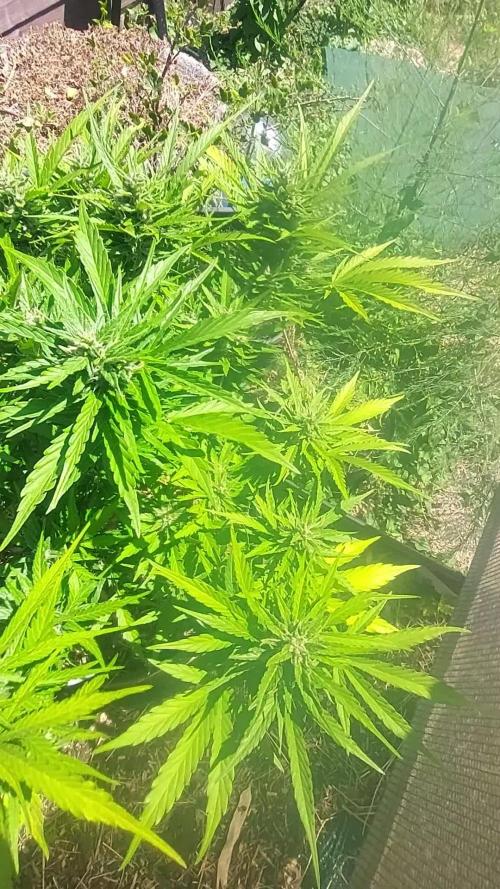
She's putting on some weight now, getting fat and frosty. Her fan leaves are yellowing out, time for a big defoliation and a bit more leaf tucking and give her another lollipop trim of her u der carriage


Likes
44
Share


@RakonGrow
Follow
Note : jegliches Zubehör wird in der GermniationsWoche aufgelistet .
Day 29:
+ PPFD 550 * 20h = DLI 39.6
+ Flaschenwasser mit Canna-Boost 1.5Liter
Die war komplett Trocken ... kaum zu glauben lol
Day 30:
Sie alles recht normal aus . Es entfaltet sich noch .
Day 31:
+ Flaschenwasse 2L EC 0.26 PH 7.3
+ + mit Dünger EC 0.7 PH 5.7
+ Drain 0.25L mit EC 0.9 PH 6.8
Fazit : ich übe noch mit dem Dünger und dem "zuviel" an Urgesteinsmehl :))
Day 32:
Das Wetter ist eine Katastrophe . Draussen ist es 21°C mit 90%rH . Hier drinnen sind es im Zelt 26°C und 67%. Im GrowRoom ,also praktisch meine 1 Zimmer Wohnung mit 2x2m Niesche hat so 25.5°C und 60%rH. Luftentfeuchter läuft , sonst geht hier gar nichts, aber der produziert Abwärme .
Will ich nun kalte Luft von draussen wirds hier mit 77%rH geantwortet aber die Temperaturen gehen runter :)) Lass ich es bleiben und entfeuchte , ich habe eine undichte Hütte was die Luftfeuchtigkeit betrifft , dann steigt die Wärme wieder . ES IST EIN TEUFELSKREIS :)) Aber wie gut das ich weiss das auch die ganzen CSC's und auch die Profis ihre liebe mühe haben die Temp und Luftfeuchtigkeit zu regeln . Und nein , ich werde mir keine Klimanalage einauen die beides regeln kann. Ich wollte nicht ewig viel Geld für das Gras ausgeben :))
Also liebe Brüder und Schwester des gepflegten Ganja komsumes und Produzenten , wir sitzen alle im selben Boot . Und jeder versucht der beste Kaptain zu werden :))
P.S. ich weiss, ein neues Bott wäre gut :) Aber dadurch ändert sich nicht das Meer :))
Day 33 :
Das Spiderfarmer Zelt 70x70x140x200cm ist fertig und Einsatzbereit . Meine kleinen Zwerge ziehen um . Im großen Zelt läßt sich die Luftfeuchtigkeit und Temperatur besser regeln. Klingt komisch , ist es auch :)) Aber Ihr müsst auch nicht in denkbar schlechtester Bausubstanz leben und gärtnern :))
Day 34 :
+ Flaschenwasse 2L EC 0.26 PH 7.3
+ + mit Dünger (Terra Vega 3.8ml/l , Rhizotonic 2.0ml/l , Boost 2.0ml/l , CannaZym 2.5ml/l ) = EC 0.7 PH 6.5
+ + Final PH 6.1
Nach einigen Problemen mit der Abluft und der Umluft und die Luftfeuchtigkeit , versuchen die Zwerge sich jetzt im neuem Zelt zu aklimatisieren . Ich drück die Daumen .
Day 35:
Die Düngung war genau richtig . Meine Luftfeuchtigkeit geht auch . Temperaturen sind etwas hoch . Aber Sie entfaltet sich . Videos gibts heute Nacht.
P.S. Da ich mal wieder zu schusselig bin eine Zeitschaltuhr und das Sanlight DIM System richtig zu nutzen , haben wir ein paar Lichtaussetzer gehabt , somit sind nicht an allen Tagen 20h Licht . In der nächsten Woche kommen 18h * PPFD 750 + 1h sonnenaufgang und + sonnenuntergang wird zu DLI 46.29 was etwas über das Limit von 45.00 geht . Schauen wir was passieren wird :))
Likes
4
Share


@TheSurfBud
Follow
Nice sweet smell... could say what strain it is because its from sweetseeds sweet auto mix 10 pk of the best..
Definitely going to enjoy this one ...
Grow went well and fast 62 days flat...
Likes
5
Share


@CreoWeed
Follow
Hello nice people!
This week number 6 went pretty good... Colas are building up and bringing out gorgeous colours as you can see in the pictures, purple mixed with pink and orange makes this plant the most beautiful I ever grown.
The smell started very softly and it had a kind of pine arome, sublime.
I've started giving her some Bloombastic and will keep doing so for the whole week.
Stretching seems over and she kept a quite compact size, at 62 centimeters.
That's all lads, I cannot wait to update the next weeks of this marvelous plant.
Ah, I also just harvested and rated my other diary, come and have a look if you have done it yet!
Stay tuned and stay high peeps!


Likes
10
Share


@Andre3001
Follow
I received some great tips here. For starters by suggestion I have lowered my day-time temps to between 75-78 degrees and my night-time temps to between 65-68 degrees. I had no intentions of trimming/defoliation anymore. So far she's adjusted well. Ive adjusted to only watering from the bottom instead of top watering.