


Likes
Comments
Share


@Aleks555
Follow
Chimera Cut - Anesia Seeds
124 days of growth and 76 days into flowering, and we’ve finally reached the moment we’ve been waiting for—harvest time! This beauty has exceeded all our expectations with massive buds covered in resin, emitting an intense aroma and showing off an incredible blue hue, exactly like the photo on the seed pack. We couldn’t be happier with the results!
We decided not to weigh the wet buds; we’ll wait until they’re dried to get the final dry weight, but we’re confident it’s going to be impressive.
A massive thank you to Xpert Nutrients for their outstanding support, top-notch service, and, most importantly, their amazing fertilizers that have allowed us to grow such powerful plants year after year. Without a doubt, your products are the key to our success.
An equally huge thanks to Anesia Seeds for providing such incredible genetics. We are beyond satisfied with the results, and we can’t wait to grow more from your amazing seed collection in the near future.
Oh, and we’ve already sampled the smoke—this strain is exceptionally strong and flavorful. From the very first hit, it’s clear you’re smoking something premium, top-shelf quality. Truly a connoisseur’s delight!
Thank you again to Xpert Nutrients and Anesia Seeds for making this journey so rewarding!🏆

Likes
14
Share


@ConspiracyFly
Follow
It is growing sideways :) more leaves are appearing
18 hours - Daytime from 19:00 to 13:00
6 hours - Evening Time 13:00 to 19:00
It was necessary to buy another heating blanket the temperatures dropped a lot around here
I already had a blanket keeping the girl company
Warming Blanket 35x20cm 15W
I put another blanket under the vase
Heating Blanket 55x35cm 30W
(A)
Suggestions:
-You can also buy tent heaters
-And if you prefer, there are also electric towel dryers, they say they work!
(B)
The Analog Timer serves for lighting, ventilation and heating blanket
Note:
- They say that ventilation must be continuous so as not to harm the plant!
😲10 washed worms dropped in the pot let's see if they work well or destroy the roots of the plant


Likes
35
Share


@Veteransgrow710
Follow
Welp i finally got to log on my account lol..so i updated it finally plants are getting big . Bigger than what i thought i could ever grow they are starting to stink alittle bit ..


Likes
2
Share


@herewegrow
Follow
Day 51 - Stour Stomper 1 is looking very frosty, excited for her to start swelling. The runt is just a little behind but still looking great. 4AM1 really chunked up quickly, quite far ahead of 4AM2. Getting pretty stinky in there. Some lower leaf issues but nothing devastating.


Likes
14
Share

@DogDoctorOfficial
Follow
🌿 Amnesia Skunk Auto — Week 10 From Seed (Week 6 Flower)
🔄 Quick Recap — How We Got Here
For anyone just joining us, welcome 🤝
This run has been 12/12 from seed, building structure early and transitioning naturally into flower without interruption. What we are seeing now is the result of consistency over intervention — letting the plant express while guiding environment and inputs with intention.
Last week marked an important moment:
👉 minimal intervention until now…
👉 and then, a necessary defoliation to rebalance the canopy
We’re now entering a phase where the plant is no longer building —
it’s refining, stacking, and expressing fully.
⸻
🌡️ Environment — Dialed for Transpiration & Expression
• Temperature: 26°C
• Humidity: 60%
• CO₂: ~1000 ppm
This combination is not random — it’s intentional.
At this stage, we are pushing leaf surface activity (leaf VPD / EPD balance) to keep:
• stomata open
• transpiration active
• nutrient flow constant
This is why these plants are drinking ~1.8L per day in 14.5L soil.
👉 That’s not just “thirsty” —
that’s a fully active metabolic system.
When a plant drinks like this:
• roots are oxygenated
• nutrients are moving
• photosynthesis is running efficiently
This is exactly what we want in mid-flower.
⸻
💡 Light Strategy — Full Canopy Activation
We are currently running:
• Top lighting
• Inner canopy lighting
• Under-canopy lighting
All LED.
PPFD varies between 800–1500, depending on plant height.
This variation is intentional.
Taller tops receive higher intensity, while lower zones are supported from within and below — ensuring:
• no dead zones
• active lower bud sites
• balanced energy distribution
👉 The result: the entire plant is working, not just the top
Airflow across all layers keeps:
• heat pockets controlled
• humidity consistent
• gas exchange efficient
The room is not just lit —
it’s breathing.
⸻
🌿 Structure & Canopy — Controlled Chaos
These girls are… big.
Not plants — bushes.
Dense, wide, expressive.
Until now, we kept a low-touch approach.
But this week, it was time.
✂️ Defoliation
We removed a significant amount of foliage.
Some will say:
• too much
others:
• not enough
I say: necessary.
What we targeted:
• blocked light paths
• restricted airflow zones
• overlapping leaves with no functional contribution
What we kept:
• active fans driving transpiration
• structurally important leaves
• balanced energy zones
👉 The goal was not to strip —
it was to open the plant.
⸻
⚠️ Observations — Minor LED Stress
During defoliation, we noticed:
• minor bruising / light stress on some branches
Nothing major, but worth noting.
Likely cause:
• proximity to high PPFD zones
At this stage:
• plants are more resilient
• but also more demanding
We’ll monitor closely, but no current signs of impact on flower development.
⸻
❄️ Frost Development — Outstanding
Trichome production is already impressive for this stage.
Why this is happening:
• High metabolic activity (drinking + transpiration)
• Strong, stable environment
• Balanced nutrition
• Full light exposure across the plant
👉 Trichomes are not just genetics —
they are a response to environment + energy availability
What this means:
• strong resin potential
• terpene development on track
• good signs for final quality
⸻
Nutrition — Feeding the Engine
Current feed (~EC 2.0 / pH 6.5):
• Terra Bloom → Core flowering nutrition (PK-driven development)
• Green Sensation → Flower density + metabolic boost
• Sugar Royal → Carbon allocation + terpene precursor support
• Pure Zym → Root zone enzyme activity, breaking down dead matter
• Power Roots → Continued root stimulation (yes, even now — keep the engine alive)
• CalMag Pro → Buffering + stability under LED intensity
⚖️ pH Control
• Down: Lemon Kick
• Up: pH Plus
👉 All inputs aligned and consistent — no chaos in the root zone.
Why this matters now:
At this stage:
• plant demand is high
• transport systems must stay clean
• energy must be directed to flowers
This feeding strategy supports:
• uptake efficiency
• terpene expression
• structural flower development
⸻
🌬️ Airflow & Room Dynamics
With this level of density, airflow becomes non-negotiable.
We are maintaining:
• constant air movement through canopy
• no stagnant zones
• balanced humidity across layers
This was one of the main reasons for defoliation.
👉 Light feeds the plant
👉 Air keeps it alive
⸻
👃 Aroma — Loud Already
For this stage…
these girls are loud.
This early terpene expression usually indicates:
• strong genetic potential
• healthy metabolic state
• proper environmental conditions
⸻
🔮 What to Expect (Week 7 Flower)
We are entering the phase of:
• bud stacking
• density increase
• trichome expansion
What to expect:
• visible swelling of bud sites
• increased resin coverage
• stronger aromas
What not to expect:
• explosive vertical growth (stretch is mostly done)
• major structural changes
Now it’s about refinement, not expansion.
⸻
🤝 Final Words — Gratitude
To everyone here:
• the OGs
• the new growers
• the silent watchers
• the commenters
• the skeptics
• the supporters
• the ones showing love here
• and the ones talking with us across platforms
Thank you.
To GrowDiaries — for giving us this space.
To the community — for keeping it alive.
To the genetics — for the expression.
To the LEDs & tools — for enabling precision.
To Plagron — for consistent nutrition.
And to everyone following this journey:
👉 This is not just a grow
👉 This is a shared process
From grower… to growers 🌱
📡 DELETED @ 1K Please stay tuned.we never quit https://www.youtube.com/@TheDogDoctorOfficial NEW 🙏 Thank you for your patience and continued support.
FOR DISCOUNT CODES AND MORE JUST FOLLOW THE LINK https://website.beacons.ai/dogdoctorofficial
📲 Don’t forget to Subscribe and follow me on Instagram and YouTube @DogDoctorOfficial for exclusive content, real-time updates, and behind-the-scenes magic. We’ve got so much more coming, including transplanting and all the amazing techniques that go along with it. You won’t want to miss it.
GrowDiaries Journal: https://growdiaries.com/grower/dogdoctorofficial
Instagram: https://www.instagram.com/dogdoctorofficial/
YouTube: https://www.youtube.com/@dogdoctorofficial Deleted by Youtube - https://www.youtube.com/@TheDogDoctorOfficial NEW
Vimeo : https://vimeo.com/dogdoctorofficial Under construction stay tuned ⸻
Explore the Gear that Powers My Grow
If you’re curious about the tech I’m using, check out these links:
🔆 Lighting & Environmental Control
• Future of Grow — Advanced LED lighting technology
https://www.futureofgrow.com/
DISCOUNT CODE: DOG20
• Lumiflora — Under-canopy LED lighting
https://lumiflorade.com/
• TrollMaster — Environmental controllers and automation gear (past collaboration)
⸻
Genetics
• Zamnesia Seeds — Genetics used in this project
https://www.zamnesia.com/
⸻
🌱 Soil, Substrates, Boosters & Root Support
• Plagron — Substrates, bio mixes, and supportive products
https://plagron.com/en/
⸻
🎒 Storage, Curing & Preservation
• Grove Bags — Curing and storage solutions
https://grovebags.com/
⸻
📸 Photography Equipment & Tools
(Not sponsors, but part of my creative toolkit)
• Sony A6700
• Sony full-frame macro lens + few more
• Stacking photography workflow - learning
• iPhone (for behind-the-scenes shots)
We’ve got much more coming as we move through the grow cycles. Trust me, you won’t want to miss the next steps, let’s push the boundaries of indoor horticulture together!
As always, this is shared for educational purposes, aiming to spread understanding and appreciation for this plant. Let’s celebrate it responsibly and continue to learn and grow together.
With true love comes happiness. Always believe in yourself, and always do things expecting nothing and with an open heart. Be a giver, and the universe will give back in ways you could never imagine.
💚 Growers love to all 💚
📸 P.S. – The Eye Behind the Lens
All photos in this diary (for now — except for the ones showing the camera, which I took with an iPhone) are taken with a Sony A6700 paired with a Sony full-frame macro lens and a few more.
Photography is part of the story — it’s how we share the fine textures, the glow, and the quiet details that words can’t always capture.
I’ve also started experimenting with photo stacking — a technique where multiple images, each taken at a slightly different focus point, are layered together to create one perfectly sharp image from front to back.
It’s not digital enhancement or AI; it’s pure photography — a way to reveal the plant’s beauty in microscopic depth, from trichome to petal.
You’ll even see a few shots of "ghost me" capturing the shots — camera, lens, setup — because every grow deserves not just to be cultivated, but documented like art.
FOR DISCOUNT CODES AND MORE JUST FOLLOW THE LINK https://website.beacons.ai/dogdoctorofficial
NEW DISCORD - Official Server Invite Link : https://discord.gg/ksjAkA5T74

Likes
3
Share


@Moon_garden
Follow
Pics show 1.5 weeks from last post.
Really wish I could flip her into flower but still can't. I think she is begging to be flipped. So many pre-flowers. Wonder if pre-flowers in Vegg can get pollinated? This thing might get too big before I can flip.
Still growing so fast. Probably because I'm focusing all growth to the mainlined stems. Which are so tall now.
Most all leaves are dark. Going to start backing off the nitrogen (FF Grow Big) Also seeing tip burn, as well as edge burn on the leaves. Definitely over feed. The soil is probably caked with salt by now.
Stress techniques -
- Still super cropping all nodes every other day. See image on how big some of these knots get. All stems are super thick and hefty. Which was a goal of mine.
- Defoliation every other day. Taking leaves and new nodes off. Definitely think doing this almost every day is the worst stress its dealing with.
- Branch squeezing/tie down. Still noticing heavy scaring or buildup where I have it tied down at the base. Will keep it there to keep seeing what happens. All stems/branches around it have hardened. Also noticing red/purple streaks in areas. Wouldn't say it's the healthiest plant but it sure is a sturdy fast growing one.
Likes
9
Share


@Lifesgarden420
Follow
This beautiful lady is getting huge and those nuggets are so dense they are so Frosty she is going to provide some wonderful rosin yeah yeah she's almost ready maybe two more weeks

Likes
2
Share


@NocturnalGardner44
Follow
Continued training and caring for the life in the soil... I'm trying to think of it as growing soil more then growing plants
Likes
20
Share


@Insaniac_0
Follow
8set Mainline & 6/4set Manifold in Auto Pot - Selfie Seeds Sweet Slurry x Sugar Cane (6X4) - Week 13
Flower Week 4 Day 28 to 34 - 4/15 to 4/21
Seeing some purple on the leave and they are really pointing up now... They both look extremely healthy this week. I cant really say enough about the autopot system, the once a week effort is a game changer for me.
Feed this week was an auto pot reservoir feed now at 750ppm total before add-ins. I used 750ppm of Bloom concentrate mix (recipe week 5). However, I also added 1ml/gal of CaliMagic (General Hydroponics 1-0-0) and ph balance this week was for 5.8 where Io plan to maintain it until harvest.
Next week nutes will decrease in Bloom mix again. The signs of trichomes, pistols, and calyx are all about 3 weeks from harvest now, so feed will be 400ppm before add-ins for with 5.8ph before feeding.
Likes
25
Share


@wolfvb
Follow
She responded very well to the toping and now we are going strong into week 4, been a smooth ride so far. Even through the cold days
16.01.26
Smooth week so far
Likes
8
Share


@Theia
Follow
Purple punch has gone nuts she had a lot of supercropping done on her and after 10 days has doubled in height and basically gone mental. Amazing strength in this genetic very vigourous growth and lovely bud sites everywhere.
I'm away in America doing the formula 1 so the updates are from photos and messages sent from my wife back home who is looking after the ladies..
No issues really apart from higher RH then we would like but she has gone in and defoliated a bit and things seem to have settled.
I'm awa until November 1st as I'm doing the Mexico formula 1 after this..
Updates will be a little light on detail I'm afraid and images will be generic from the room..
Thanks growmies.
Stay safe 😷
Grow well 🌿

Likes
2
Share


@Ultraviolet_
Follow
We become aware at such times of man's wonderful ability to bring seemingly unrelated elements into harmonic balance, and receive a glimpse into a world where everything exists in conscious sympathetic attunement to everything else. When we listen to a piece of music that seems to strike a beautiful chord somewhere inside us, or view a painting that simply glows with harmonic awareness well executed, we probably do not spare much time to contemplate the wonderfully intricate combination of vibrations that our sensors make it possible for us to perceive. We tend to appreciate the relationship between the parts of something by an awareness of the harmony or dissonance of the whole. This ability enables us to say "what a beautiful house!" instead of "analysis has proven that this collection of building materials exhibits certain elements of harmonic proportion." While this ability to instinctively appreciate the beauty of true harmony has an important role to play in evolution, a more analytical understanding of the laws involved can be most useful. This is especially so if we wish to create works of art where each part exists in true harmony, not only with the other part of that particular whole, but with the universe within which the creator and the created exist.
Everything vibrates. From the most dense matter to the most subtle cosmic rays, everything which our senses allow our thoughts to become aware of, can be specified in terms of wavelength or frequency of vibration. These two terms define the same thing, but from different points of view.
The following are the approximate wavelengths of various energy carriers:
Cosmic rays 0.000,000,001 mm
Gamma rays 0.000,000,1 mm
X rays 0.000,500 mm
Ultraviolet rays 0.003 mm
Visible light 0.006 mm
Infrared 0.01 mm
Sound waves 1 meter
Radio waves 300 meters
Violet light 400 nm to 450 nm
Blue light 450 nm to 500 nm
Green light 500 nm to 570 nm
Yellow light 570 nm to 590 nm
Orange light 590 nm to 610 nm
Red light 610 to 700 nm
1 nanometer (nm) = 0.000,000,1 cm = 1/10,000,000 cm
If a guitar string is plucked and we hear a sound, it is not too difficult for the human mind to associate this sound with the vibration of the guitar string. With color it is quite different. It is difficult for us to conceive that the color of a substance is not an inherent property of the substance itself, but an indication picked up by our senses of that substance's ability to absorb or reflect the light which happens to be shining on it at that moment. Neither the matter nor the light is colored. What happens is that the brain learns to differentiate between the frequencies reflected or transmitted by the substance the eyes are focused on. The same thing happens with sound. When we say "Oh! Listen, they're playing my favorite song," what we really mean is: "My brain has stored within it a particular pattern of frequencies. I have compared the new information being received with this stored pattern and have deduced the answer that the two patterns are similar within certain specified tolerances." The 'pleasure' involved could have something to do with our running the pre-recorded pattern at the same time, in 'sympathy' with the new pattern as it is received.
The word sympathy describes very well our ability to appreciate color and sound. It also describes the reason behind certain elements of harmony. For instance, if a substance vibrating at 100 cycles per second (tone 1) is in the proximity of another substance vibrating at 200 cycles per second (tone 2), we could perceive, if we had the right equipment, a certain sympathetic relationship between the two.
We will see from this that there is a uniform doubling of the first tone seen in the second. At various points along the waves, the two are the same in amplitude. At other points, they are at opposite poles to each other. This doubled frequency has more points of similarity to the original than any other frequency except the original itself. If the equipment we had available for measuring these two frequencies was a soundboard amplifier and a pair of ears, then we would hear what would sound to us like one tone. If we had the opportunity to hear one at a time, we would hear that although they sound the same, one is higher in pitch than the other. This characteristic of 'the same but different in pitch', musicians have called the octave. Any two tones produced where one has exactly doubled the frequency of the other is called an octave. Speaking in ratios, an octave would appear then as the ratio 2:1 or 1:2, depending on whether we are talking of an octave up or down.
A single note produced by almost any instrument will contain more than one wavelength or frequency. It will have a dominant frequency, the wavelength of which we would call the note's 'fundamental' or 1st harmonic. It will also have a varying number of upper harmonics, gradually fading in intensity into infinity or silence.
Natural harmonics always have the same pattern of intervals between them. The interval between the 1st and 2nd harmonic is a perfect octave; between the 2nd and 3rd a perfect fifth; between the 3rd and 4th a perfect 4th; and so on, the intervals becoming smaller and smaller until they lose any relationship with the western 12 tone scale as it exists at the moment. Just as an octave has certain elements of sympathy with its fundamental, so some intervals have been noted to be more perfectly in sympathy with the fundamental than others. The ratio of the 'perfect 5th' or interval of 7 semitones, as it occurs in the harmonic series, is 3:2 or 2:3, while that of the 'perfect fourth" is 4:3 or 3:4. All the tones in the western 12 tone scale can be expressed in terms of the ratio between the upper tone and its fundamental. This would seem to be an ideal way of generating a scale from any given fundamental and several attempts have been made to do this, the Pythagorean system being probably the most well known. Although when working with a single tone instrument playing on its own, the Pythagorean formula works wonderfully well, if we had several instruments tuned this way together and asked them to play almost any western music, we would find that at times they sounded quite out of tune to each other.
The lack of flexibility of the various scale systems based on the harmonic series has led to what is known as the 'tempered' scale. This uses as its primary unit of interval the ratio of the octave or 2:1. It then proceeds to divide the interval between any fundamental and its upper octave into 12 smaller intervals by applying the ratio: two to the one-twelfth power, to one (21/12:1). This equals 1.059463094, so by multiplying any frequency by this number, we will obtain the tempered semitone next up from our fundamental. We will also find that any tone twelve semitones up from any other tone, in a scale generated in this way, will have exactly double the frequency.
If we took the note middle C on a piano and halved the wavelength, we would have the note C one octave above. If we halved this, we would have the C above, and so on. However, within about 6 octaves, we would find that although a 'sound' was being produced, no human ear could perceive it. If we kept on going, halving and producing upper octaves of our fundamental C, we would proceed through the infrared band, into the visible light spectrum. If we happened to be outside during the day, we would, for one octave only, see the note C with our eyes. The next octave above would already be in the ultraviolet band, and outside the eye's sensitivity range. If we can think of color as being an indication of a substance's vibratory rate or wavelength, we may begin to see a relationship that could exist between the color and sound spectrums.
The logical extension of what has so far been said is that there exists a scale in the color spectrum that corresponds exactly to the scale in the sound spectrum, each color tone being an octave of the equivalent note in the sound range.
This is not the end of the story but only the beginning. If we can for the moment accept that any wavelength in one band has upper and lower octave stretching out to infinity, then the next question is 'fine, but what shall we use as our fundamental? A particular color? A particular sound frequency?' The musicians among us will probably say 'A 440'. This means that the note A should vibrate at 440 Hertz, or 440 times per second. They would tell us that this is standard pitch has been adopted by most orchestras around the world; pianos are tuned to it, instruments are constructed to formulas based on it, and so to them it would probably seem the most appropriate place to begin. Some of these musicians may know of the battle that is still raging with regards to this being the standard, but few would know why A = 440 Hz was chosen except that it worked when it was set to be a suitable compromise between the many different pitches in use at the time.
432 Hz is said to be mathematically consistent with the patterns of the universe. Studies reveal that 432 Hz tuning vibrates with the universe’s golden mean PHI and unifies the properties of light, time, space, matter, gravity, and magnetism with biology, the DNA code, and consciousness. When our atoms and DNA start to resonate in harmony with the spiraling pattern of nature, our sense of connection to nature is said to be magnified.
Another interesting factor to consider is that the A=432 Hz tuning correlates with the color spectrum, while the A=440 Hz is off. Audiophiles have also stated that A = 432 Hz music seems to be non-local and can fill an entire room, whereas A=440 Hz can be perceived as directional or linear in sound propagation.
Once you adopt the idea that sound (or vibration in general) can have an equalizing and harmonizing effect (as well as a disturbing effect), the science of harmony can be applied to bring greater harmony into one's life or tune to specific energies. There is a form of absolute and relative harmony. Absolute harmony can, for example, be determined by the tuning of an instrument. The ancients tuned their instruments at an A of 432 Hz instead of 440 Hz - and for a good reason. There are plenty of music examples on the internet that you can listen to in order to establish the difference for yourself.
Attuning the instrument to 432 Hz results in a more relaxing sound, while 440 Hz slightly tenses up the body. This is because 440 Hz is out of tune with both macro and micro cosmos. On the contrary, 432 Hz is in tune. To give an example of how this is manifested microcosmically: our breath (0,3 Hz) and our pulse (1,2 Hz) relate to the frequency of the lower octave of an A of 432 Hz (108 Hz) as 1:360 and 1:90.
It is interesting to note that 432 Hz was the standard pitch of many old instruments and that it was only recently (19th and 20th century) the standard pitch was increased. This was done in order to be able to play for bigger audiences. Bigger audiences (more bodies) absorb more of the lower frequencies, so the higher pitch was more likely to “cut through”. One of the oldest instruments of the world is the bell ensemble of Yi Zeng (dated 423 BC), tuned to a standard F4 of 345 Hz, which gives an A= 432 Hz. The frequency of 345 Hz is that of the platonic year! Similarly, many old organs are tuned in A=432 as well; for example, St. Peter’s Capella Gregoriana, St. Peter’s Capella Giulia, S. Maria Maggiore in Rome.
Maria Renold’s book “Intervals Scales Tones and the Concert Pitch C=128 Hz” claims conclusive evidence that 440 Hz and raising concert pitch above scientific “C” Prime=128 Hz (Concert A=432 Hz) disassociates the connection of consciousness to the body and creates anti-social conditions in humanity.
The difference between concert pitch A=440 Hz and Concert A=432 Hz is only 8 cycles per second, but it is a perceptible difference of awareness in the human consciousness experience of the dream we share called existence.


Likes
13
Share


@Eldorado_ed
Follow
Everything running smooth no issues and some big changes from last week these are looking good ✌️🏻
Likes
13
Share


@Weedy_Shepherd
Follow
One week left before I chop these girls.. Will flush them then down they go.. Will definitely shout timber while holding the Sega in hand!! Daamn I can't wait to smoke all of you baby's..!😀😀😀 🐕-------
P. S. Just chopped them down and waiting for them to dry up!
Only OG Kush remains as it still needs some more weeks!
Likes
5
Share


Likes
8
Share


@dreamLife
Follow
Las hojas nuevas se ven mas sanas, esperemos que siga así, las raíces se ven en excelentes condiciones. Se realiza poda apical al cuarto nudo.


Likes
3
Share

@Liquido
Follow
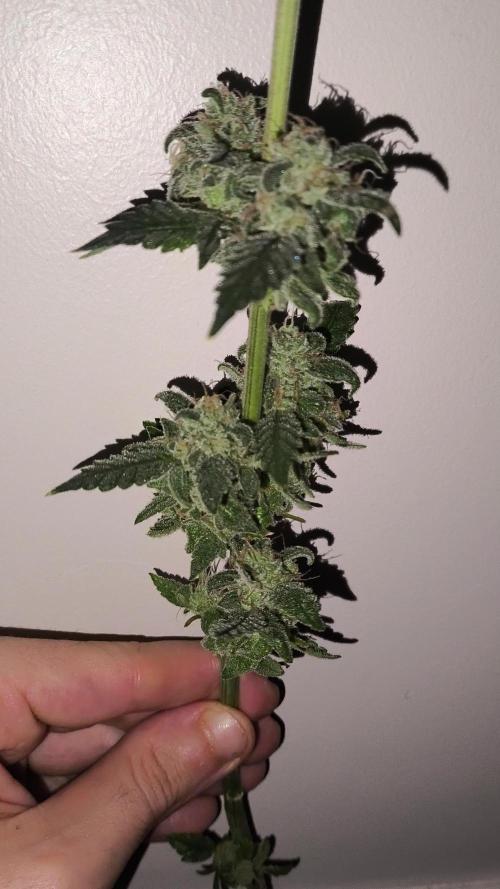
Questa è la prima GMO che raccolgo, cime molto più dense rispetto alla runtz e sembra essere molto più pesante, tra qualche giorno raccoglierò l'altra e poi mancano solo le due più grandi
