


Likes
Comments
Share





Likes
24
Share


@Grnhead
Follow
This was a fantastic plant to grow, and although it doesn't have the strongest resistance to mold, I think that if I were to grow it again I could avoid the issue.
I am starting to figure out how to maximize my grow space! Come check out my next grow when you get a chance!


Likes
12
Share

@Northern_Ent
Follow
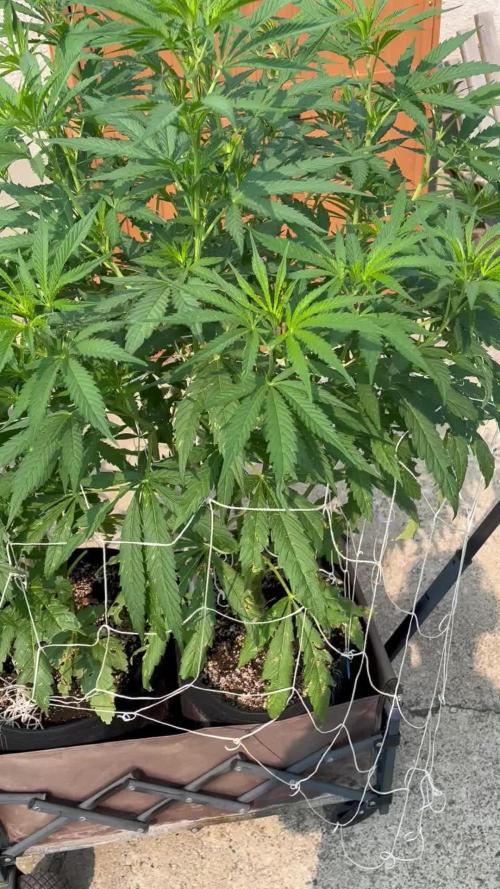
July 25: mostly recovered from the hail storm two weeks ago. Now one week into force flowering and she is stretching. Looks really good.
July 26: watered with compost tea this morning.
July 28: in garage at 7:20 pm to avoid incoming heavy thunderstorm and good chance of hail. Rainiest summer ever here. No 730 nm red light and I will bring out again at 7 am to preserve close to 12 h of darkness.
July 29: added strings and weights to space out the scrog net. Added malted barley, soil, some gypsum (for Ca), and Epsom salts (for Mg) and even a bit of dolomite (for Ca and Mg without sulphate). Key ingredient is the malt which is great for flowering stage.

Likes
6
Share


@GrapevineGrower2
Follow
Ending the fifth week of flower, we are humming right along. Needless to say, weeks 1 to 4 of flower is where the hard work comes into play (pre and post flower top dressings, PPFD light adjustment, defoliation, structure netting, etc.). Now, it's just a matter of ensuring good health until harvest. Towards end of this week five, you can see the canopy of buds gaining in density and weight. I'll continue to gauge whether or not a second netting is needed. The super soil medium was top dressed at the end of week four, so that's it in terms of feeding. The final tea will take place at end of week six. Thereafter, ph'd water until harvest. The estimated harvest window is January 28 (day 56) to February 11 (70 days). Aside from the physical beauty of these girls, the smell is getting stronger by the day. Installing new carbon filter today.
Thanks for stopping by and checking out my journal, it is very much appreciated. I'll provide an update same day same time next week. 😎


Likes
36
Share


@Salokin
Follow
Hi Growmies,
My apologies for the delayed update, but work life balance got a bit out of wack recently. Anyways, water was changed on time and general maintenance took place. Continued with very light defoliation to really guarantee that all the shoots get equal light exposure. She is turning out to be a real beauty and literally no Scr.O.G was necessary due to her natural structure. Buds are already forming very compact and dense to touch, something that’s always a good sign ;) Since this is my first proper DWC grow I am actually quite impressed by the root growth and the resulting nutrient uptake, as well as vigor in plant growth.
Is it btw just me or is this website getting slower, buggier and laggier by the day? Videos won’t upload, weeks don’t reflect, diaries won’t update….

Likes
20
Share


@Ultraviolet
Follow
Paramahansa Yogananda taught us how to heal anxiety and depression with these three powerful affirmations from his book back in 1924:
"I relax and cast aside all mental burdens, allowing god to express through me his perfect love, peace, and wisdom."
"I will, with my own will, which flows from the divine will, be calm and patient under all circumstances."
"I am submerged in eternal light; it permeates every particle of my being. I am living in that light, the divine spirit fills me within and without."
All light stems out from darkness. Darkness can only exist in the absence of light. Where there is light, there are shadows. Shadows require light to exist. A shadow is a reduction of light, not a total absence. "Shadow"—the hidden, unconscious, or repressed aspects of the self—must be acknowledged and integrated into the conscious mind ("the light") to achieve psychological wholeness and prevent destructive outbursts. Rather than erasing the darkness, the goal is to reveal it and bring it into the light, thereby preventing it from consuming the personality. Very few make it through awakening without becoming a monster themselves. Every individual harbors a repressed, uncivilized, or dark side—regardless of how moral or virtuous they believe themselves to be. The belief that this darkness is absent in oneself is a form of dangerous ignorance that leads to "shadow projection," where one denies their own flaws and projects them onto others. "Until you make the unconscious conscious, it will direct your life and you will call it fate," highlighting that confronting this inner darkness is essential for psychological maturity and avoiding personal demise.
All things exist as energy. We are vessels that utilize chemical energy and experience it through emotions. We are biological machines fueled by ATP (adenosine triphosphate). Emotions, e-motion, energy in motion, where you apply your thoughts, words, and action, is where you apply your energy, where focus goes, energy flows.
Everything that was ever invented was first observed. The critical role of observation in the innovation process, where natural phenomena, patterns, or accidents provide the foundational idea for a new creation. Many foundational technologies were derived from direct observation of nature or physical processes.
The Heisenberg observer effect describes how the act of measuring or observing a quantum system inevitably disturbs it, altering its state. The observer effect is often misconstrued to mean that human "consciousness" affects reality; however, in physics, it refers to the physical interaction of measurement tools (detectors) with the system. It is often confused with the, but distinct from, the Heisenberg Uncertainty Principle.
The Heisenberg Uncertainty Principle applied to electromagnetism dictates that the electric (E) and magnetic (H) fields cannot be simultaneously measured with absolute precision, with an uncertainty relation of for a spatial volume. This fundamental limit means electromagnetic waves possess intrinsic quantum, non-classical, and fluctuating natures.
The K radiation and quantum mystery of potassium refers to the fascinating, naturally occurring radioactivity of Potassium-40 (K) and the, until recently, poorly understood, rare quantum decay mechanisms that make it a significant, quiet, and sometimes mysterious participant in both biological and geological processes.
1. The Radiation: Potassium-K40
While potassium is essential for life, a tiny fraction of all natural potassium (0.017%) of all pottasium is the radioactive isotope K40. With a half-life of 1.25 billion years, it is a "primordial" radionuclide (present since the Earth's formation). Because potassium is abundant in the human body (muscles), we are all walking sources of weak radiation, often measured by "banana equivalent dose."
K is unique because it decays via three distinct routes, creating a "triple" radioactive mystery:
Beta Decay (89.6%): Decays into Calcium-40 (Ca), releasing a fast electron (beta particle).
Electron Capture (EC) (10.3%): Decays into Argon-40, emitting a high-energy 1.46 MeV Gamma Ray.
Positron Emission (0.001%): Decays into Argon-40 (Ar), emitting a positron (antimatter).
2. The "Quantum Mysteries"
The mystery of potassium isn't just that it is radioactive; it's how it decays and what that implies for the universe.
A. The Missing Decay Pathway (KDK Experiment).
Until very recently, one specific path—electron capture directly to the ground state of Argon-40—had never been directly measured, making it an "unknown background" in dark matter searches.
The KDK Collaboration (Potassium Decay): Experiments at Oak Ridge National Laboratory (2017-2023) finally measured this, helping scientists refine the age of the Earth and improving precision for detector simulations in particle physics.
B. The "Spin-Forbidden" Long Life K has a surprisingly long half-life (billion years) for a positron emitter.
The quantum reason is that the decay requires a massive change in nuclear spin (from 4 down to 0), a "spin-forbidden" transition that makes the decay highly unlikely, thus slowing it down.
C. The "Mysterious" Heat Source For decades.
Scientists debated whether K was a major radioactive heat source inside the Earth's core. New high-pressure/high-temperature experiments suggest it can dissolve in iron, making it a significant, long-term heat producer in the core of Earth (and Mars), affecting planetary magnetism.
D. Quantum Biology/Biology Mystery. Because K is a major source of internal potassium radiation, there is emerging research regarding its impact on DNA damage, metabolic regulation, and the "bio-photons" emitted by living systems.
E. Ultracold Potassium and Quantum Gases.In laboratories, researchers use potassium (K39, K40, K41) to create "degenerate quantum gases" to study exotic states of matter, such as superfluids, which are used to simulate quantum behavior in solids.
In short, the potassium 40 isotope is a tiny, ancient, quantum-mechanical time bomb, slowly releasing energy from the birth of the solar system, making it essential for geological dating, a nuisance for dark-matter hunters, and a subtle factor in our own biology.


Likes
22
Share


@medicalhydro
Follow
Flush week
Total system power 230w
Dim %10
UV-IR-FR Dim %100
PH:6.0
PPM 285


Likes
Comments
Share


@Card1Cultivations
Follow
April 28 - May 5
This week the nutrients have been completely phased out and they are now just sipping plain TO water ph balanced to 5.8 still. As they start entering into the flushing zone with harvest day quickly approaching.
Daily tricome inspections become the focal point In these final days and or weeks.
I

Likes
Comments
Share

@Growfather1
Follow
Hello everyone!
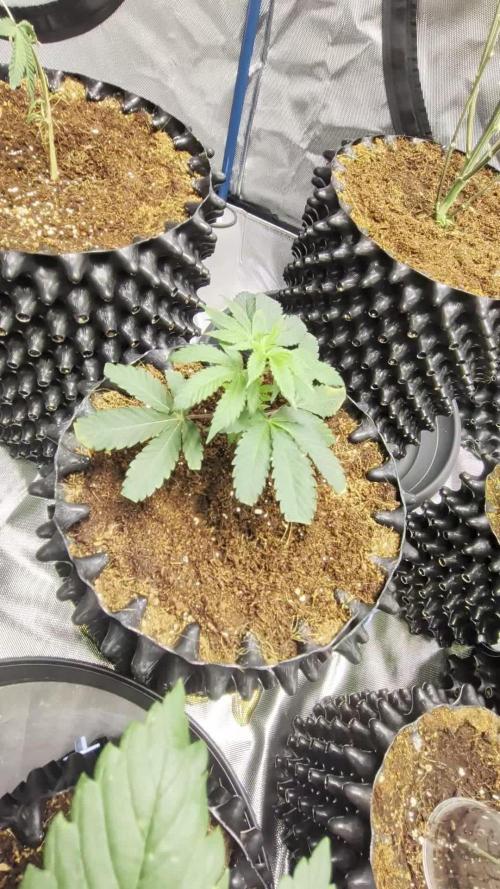
Welcome to the saga of the MAC 1 F1 Hybrid clones, entering week two.
These little ladies are the offspring of my second-largest plant, plucked from the 120 by 120 centimeter tent.
I'm aiming to turn them into flowering superstars, though one of them seems to be on a personal strike.
Conditions are locked in at 65% humidity, a cozy 23-degree max, and 24/7 light.
They graduated yesterday from the flowering canopy to the veg tent, so they are finally getting their own spotlight.
I expect at least one to thrive, while the other is currently practicing her "stay behind" routine.
Thanks for popping in, and may your own green endeavors be fruitful and smell fantastic!
Growfather

Likes
1
Share


@captaincondor
Follow
Finally reached the point of flushing her, she has taken a long time to reach this stage at the end of week 12 . She hasn't received the full 18 hrs on throughout her life cyclye due to space and spending time with photoperiods so I guess this is the reason for her being slow to mature. This strain really is a stinker and the spider farmer carbon filter has not done the job of neutralizing the smell. I have had to replace this with a rhino filter which has solved the issue .
Likes
15
Share


@Rebola
Follow
Close to harvest now, i think 1 more week and they are ready..
Started the flush, only giving nutes to BB she is heat stressed and growing slow.

Likes
6
Share


@Lickey
Follow
Still losing leaves from the bottom. Humidity is high at around 65%. Buds are still developing very fast. Just at 21 days into flowering I’ve bumped the lights up to 100%.


Processing
Likes
1
Share


@nausicaahime
Follow
week 7
first flowering week
when I finally discovered my princess was actually a prince.
12/12
flowermind ferts (6ml + 0.5g)
LST + defoliation
started seeing some thrips again, but just a few, nothing to worry
so, the plant stayed for 4 weeks in the tent, under COB LED 200W.