


Likes
Comments
Share


Likes
61
Share


@Hou_Stone
Follow
✌️👨🚀🍊
C'est partis pour la floraison ! Mes lemon orange se développe excessivement bien, je croise les doigts pour que ça continue en espérant avoir de gros bourgeons savoureux dans 2 mois 🤞🍊
J'ai ajouté environ 25gr de poudre BioBloom par pot de 8L soit environ 3gr/L.
J'arrose chaque pot avec environ 1.5L tout les 5 jours. J'ajoute du biohenhanceur 1 fois sur 2
Intensité de la FC3000: 90%
Ventilation : 2 ventilateur oscillant ( ON 12/24H) + Extracteur pouces mars hydro power : 2/10 (24h/24h)
👋👨🚀🍊
Venez me voir sur instagram ! 🤩
https://www.instagram.com/hou_stone420/


Processing
Likes
2
Share


@BigHorn
Follow
Growth has been steady I'm going to start budding coming week 7. I think I'm going to run out of tent room might be a lil late but it is what it is.

Likes
27
Share


@All_our_small_plants
Follow
Tag 64 sie ist immer noch am Stretchen, aber so langsam entwickeln sich auch ihre Blüten immer mehr. Heute hat sie wieder eine Ordentliche Portion Wasser mit Dünger bekommen, und jeden 2 Tag Wasser ohne.
Tag 69 Heute haben wir angefangen Plagron Green Sensation und Canna PK 13/14 hinzuzugeben und werden langsam mit dem NPK Dünger aufhören. Wir wechseln von dem NPK 10-4-7 zu einem NPK 3,5-6-6 da die Pflanzen nicht mehr so viel Stickstoff brauchen.


Likes
6
Share


@Krautbauern
Follow
She was extremly fast and ready to harvest after 55 days of flowering.
Smells a bit like ripe grapes.
Likes
18
Share


@Bread_n_Buds
Follow
This week I'm presenting the HARVEST of Mimosa Autoflowering #2, a plant grown using the main lining technique but without LST.
The other plant, left to grow straight, harvested the previous week. Go check it out, it's a beautiful plant and has some great photos.
This plant is a real monster—excuse the banal term, but it's true. It's a monster. Just a couple of years ago, I would never have dreamed of growing autoflowers like this. The plant did so well from the start, so much so that I noticed it and moved it from an 11-cm pot to a 20-cm pot. It was given 24-hour light for a while, then the super heat arrived and I gave it a break.
The plant looks perfectly balanced with medium-dense flowers that are beautifully resinous. It's so well-proportioned that it didn't need any support despite the very large flowers. Thanks to the 24-hour light, the plant probably produced a lot of solid buds.
There are solid, large buds everywhere, and the resin is good, but I've seen better in this harvest from the other Mimosa, which, as mentioned, you can find in the previous week.
Pot and Soil - This plant was grown in a 20-liter pot with Plagron BiloLight Mix organic soil.
Lighting - The Zamnesia Phytonaut 480W LED lamp, used from mid-flowering onward, allowed fruiting. We achieved a PPFD (photosynthetically active photon flux density) between 800 and 1200 μmol/m²/s, with cycles of 24, 23, 20, and finally 18 hours.
Z https://www.zamnesia.io/it/14526-led-grow-lamp-phytonaut-480.html (National link in case Google doesn't work)
Growing System: Zamnesia Ecosystem, fan, extractor, and grow box, all made by Zamnesia.
Trichhomes: We let the plant mature longer than usual to bring out its indica characteristics; this time, there are numerous amber trichomes and beautiful red-tipped trichomes.
Feeding: Grown with Plagron Official, a 100% organic base fertilizer, and all recommended additives.
Visit www.plagron.com for grow cycle calculations, product selection, and general information.
All nutrients are available on the Zamnesia website. Also check out the live substrate and the fantastic new Zammi product line.
You can find this excellent strain here:
https://www.zamnesia.io/en/11107-mimosa-auto-zamnesia-seeds-feminized.html
(Google if the link doesn't work; it's a national link)
Terpene // Carophyllene, Myrcene, Limonene
Parents // Clementine x Purple Punch x Ruderalis
Genetics // 70% Indica / 30% Sativa
THC // 20%
Height 100cm
Taste / Aroma // Sweet, Citrus, Fruity
Effect // Relaxing, Euphoric, Happy, Energetic, Clear-headed
Zamnesia Description - Mimosa Auto captures all the vibrant flavor and energizing effects of the original Mimosa, now in a fast and compact autoflowering format. Bred from Clementine, Purple Punch, and ruderalis, this 70% indica / 30% sativa offers the perfect blend of speed, aroma, and clarity. and potency.
From seed to harvest in just 10–11 weeks, Mimosa Auto grows quickly and efficiently, reaching a compact height of 80–100 cm and producing up to 400 g/m² indoors or 300 g/plant outdoors. Despite her small size, she develops dense, resinous buds, laden with a sweet, citrusy aroma reminiscent of fresh orange juice: crisp, refreshing, and uplifting.
With 20% THC, Mimosa Auto offers a clear-headed high that starts off euphoric and then transitions into light physical relaxation. It's ideal for daytime use, to stimulate creativity, or simply to enjoy a mood boost without the heaviness of stronger indicas.
Easy to grow and bursting with sunshine, Mimosa Auto by Zamnesia Seeds is the perfect strain for those seeking speed, quality, and flavor in one package. Whether you're a beginner or an experienced grower, this auto version will satisfy you from start to finish. Day.
"The best that nature has to offer"
www.zamnesia.com

Likes
6
Share


@CanadianFillmore
Follow
Start of week 3 of flowering. Bud site development over the last week was impressive! This girl is starting to smell and is already sticky to the touch. Hopefully this girl will stretch a bit more this week.

Likes
24
Share


@PrairieFrostGrow
Follow
****Week 16 growth – March 20 to 26, 2021 – Week 7 flower ******
We are in flush now until the end😃 Its nice to be past toxicity and deficiency issues and will just watch them finish and swell up.
Flushing agent used this week to assist with getting all the nutrients out.
This girl is still looking awesome and I am hopeful she will flush out more of the nutrients. She is pretty green overall so she was given the flushing agent. Still expecting her to be fire, just not a huge producer👍
Little more detail…..
Mar 20/21, Day 43
- plain watering today
- 4L given to each girl at 26ppm and 6.0pH
- turned the light down more today to 410 watts
Mar 21/21, Day 44
- dry out day
Mar 22/21, Day 45
- finishing agent watering today
- typhoon given today for flush at 2ml/l
- 425ppm and 6.0pH
- 4L for each girl.
- a couple of the girls are a little dark so going to use a flushing agent.
Mar 23/21, Day 46
- plain watering
- watering again after the flushing agent
- 4L for each girl and gave a good runoff
Mar 24/21, Day 47
- dry out day
- fade coming out now
Mar 25/21, Day 48
- plain watering with tap water.
- 280ppm and 6.1pH
- 4L each girl again
Mar 26/21, Day 49
- dry out day
- will be drying out the pots more now before the next waterings.
Through week 7 and heading into week 8. Not a lot of action in the final weeks as far as grower maintenance.......love the end when you can just enjoy😃 Very nice ETS💪🙏
Likes
Comments
Share
@Chrisandweed
Follow
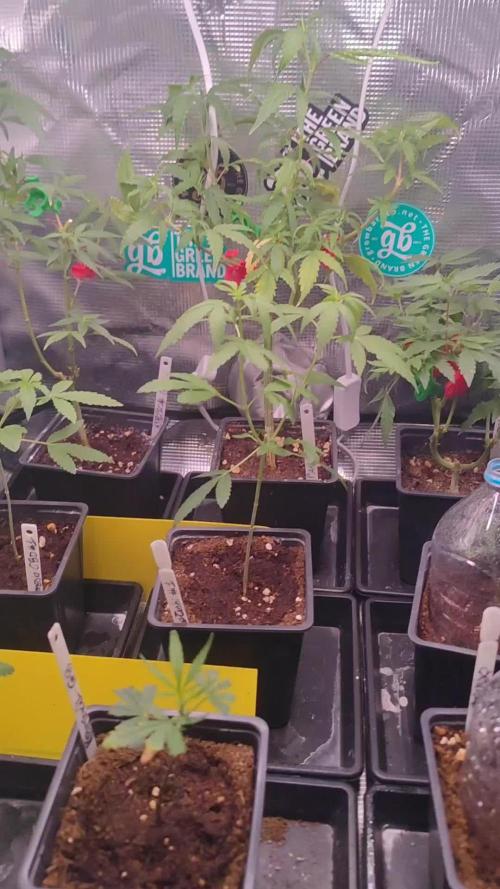
Y empieza el cultivo de los esquejes. De momento están recien metidos al armario pequeño con la luz flojita (dos barras led de 14w) y encuanto se aclimaten todos, los pasaré al armario grande con la luz grande puesta al minimo 300W. La intención es llenar el 1.5x1.5 con los 4 esquejes (3 esquejes y una semilla pero eso). La semilla es de la blue zushi, los esquejes son de la Kritical GB (de GB Strains), Critical (de GB Strains), y la Pakistan Valley Early Harvest de World of Seeds).
El cultivo va a ser organico basado en un supersoil, pero añadire potenciador de raices, enzymas y otros productos de base organica. El único producto mineral que usaré será CalMag para suber la ec del agua a unos 0.2 al principio e ir subiéndola hasta unos 0.4 mas o menos. El agua va a ser literalmente del aire acondicionado, que me tira mas de 8L de agua destilada al dia.
HE DE DECIR QUE EN ESTE DIARIO EL TEMA DE LAS PRIMERAS SEMANAS NO LO ESTOY REGISTRANDO BIEN YA QUE AL SER MEZCLA DE ESQUEJES Y SEMILLA NO QUISE PREOCUPARME MUCHO POR EL TEMA SEMANAS PERO BUENO. ESTA QUE ES ESQUEJE BUENO, DIGAMOS QUE ESTE DIARIO VA A PARTIR CON 2 SEMANAS DE CRECIMIENTO EN LA MACETA DE 1 LITRO ESTA QUE TIENE. YA TRATARÉ A PARTIR DE AQUÍ LLEVARLO MEJOR CONTROLADO.

Processing
Likes
66
Share


@Teamdirtbag3
Follow
Well its been a while. I'm social distancing from this site. 😂😂😂😂
Harvested the three Tangerine Hybrids
Tangerine Slurpee
Tangerine Fart
Tahoe Sour Tangerine
All smell incredible, these tester's will be a welcome addition to my flower stash.
Sour Patch Kids x Sour Fire and Tahoe OGKB x Sour Fire Kush are out to flower now. I hope they don't reveg on me.
And last but not least AJ's cut Sour Diesel is out to flower also. Fingers crossed they stay flowering. 🤗


Likes
31
Share


@Pedrojuan
Follow
Bueno, iniciamos la semana con cambio de solución nutritiva con el nivel por debajo de la argilla en 5 cm para tener aire entre raíz, sustrato y solución nutritiva. Se ven más grandes y lindas, veremos cómo continúa en la semana.
Hoy miré las raíces y se ven muy bien.
Desde ayer algo cambio para mal...😩

Likes
Comments
Share


@KannaGrowing
Follow
Esta semana, poca cosa a añadir, tan solo que continuamos como la semana pasada.
Riegos alternos entre abono y agua, según tabla de fertilización de JUJU Royal by BioBizz.
Hemos aumentado la potencia de extracción para evitar olores.


Likes
Comments
Share


@Back_woods_buds
Follow
Wish the bird the leaf ratio was a little better which it wasn’t too bad but other than that I don’t have any complaints and Would recommend it

Likes
20
Share


@OGJesus
Follow
The last week before I flip them into bloom. I'm seeing a lot of cracks in the leaves I'm hoping that is from the over watering and the ensuing drought that I gave them to stop but we'll see.
I've checked the plants over for bugs and have seen none so we'll see how the coming weeks treat the girls.

Processing
Likes
88
Share


@Fergie
Follow
hey guys so not much happen in last week girls are filling out nicely ,going to repot next week have new 10gallon smart pots coming . still on r/o water with 10ml calmax every gallon . Til next week😀

Processing
Likes
22
Share


@GreenReaper
Follow
Still vegging, no preflower yet. Spreading her out till mid-flower. Hopefully she'll be a big girl. Accidentally snapped a branch in half attempting to supercrop. Taped it up, looking good as new...
Been switching to led when temps from mh are too high...
