


Likes
Comments
Share

@Nickeluring
Follow
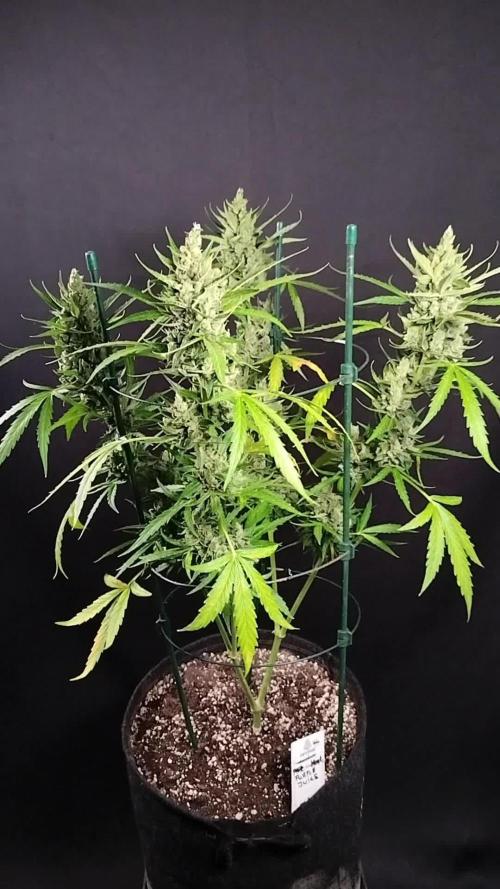
It is still hot here and all my girls are suffering. We´re almost done and I will start checking the trichomes now.
I had to add some support to help keep the heavy buds upright. Both plants are getting beautiful buds that smell amazing.




Processing
Likes
6
Share


Likes
4
Share


@TheGreenGroomer
Follow
Grow Diary Update: Week 4, Day 2 🌱
Everything is going great today! The plants are really starting to take off, and the canopy is coming along nicely with the LST (Low Stress Training) and topping I’ve been doing. I did have to flush the other day because the PPMS were way too high for this stage, but that’s all sorted now—running at 438 PPMS on the way out, so they're much happier now. 😊
Looking at flipping to flower by the end of Week 5, maybe Week 6 at the latest. The plants are getting no more than 500 PPFD right now, typically hanging around the high 400s, which seems to be working well for them at this stage. In a couple of days, I’ll be increasing the light intensity and boosting up my feed to prepare them for the transition to flower. 🌸
Overall, they’re on track and looking strong. Can’t wait to see how they develop over the next couple of weeks! ✌️
Likes
48
Share


@AsNoriu
Follow
Day 78. Girls are my pride and joy !
Everything going well, even supercroped branches are recovered well and hopefully i will push that grow to the end without any hiccups ;)))
One Kalini Asia shows some potency for funky colours !
Maybe will defoliate at the end of this week or at the beginning of next one ...
Hope everything will go smooth ..
Day 82. Happy 420 !!!! And for me it really HAPPY !!! Just check todays video .... My best run, no doubts !!!
Happy Growing !

Likes
7
Share


@Aleks555
Follow
We’ve officially entered week 7 with our FBA 2503 from 42Fast Buds, and the transformation is impressive—our girl is now in full bloom! After a smooth and steady vegetative phase, the flowering stage is progressing beautifully. The decision to experiment with a 12/12 light cycle for this autoflowering strain has proven to be an interesting choice, and so far, the results are encouraging.
The plant stands tall and strong in its 10-liter pot, with a well-structured shape thanks to early LST. The climate remains stable with daytime temperatures reaching up to 30°C and an average range of 27–28°C. Humidity levels are consistently between 60% and 65%, which has supported healthy growth throughout the cycle.
We continue to feed her with Xpert Nutrients, and the impact is clearly visible—dense flowering sites, vibrant foliage, and a healthy overall appearance. The aroma is starting to build, and the buds are forming with great structure and frost.
So far, this grow has been a pleasure, and week 7 marks a crucial point where everything starts coming together. We’re excited to see what the final weeks will bring!
Likes
4
Share


@EmpireGrows
Follow
Now the fun begins 😁😁🔥
Ended off the week with a bang, first week on VEG nutes still getting that Route 66, with a touch of magical & sugar daddy ! Man this girl is soooo resilient I did a little bit of lollipoping as well but it’s really not worth mentioning. 10/10 recommend meph genetics . I’m literally growing “ Charizard “ via the Reddit thread (🙈🔥) doesn’t matter what stress i put her thru she trucks on. Sucks up what ever i give her and loves the abuse. 8 h of dark every Friday 😏 Thanks for stopping by and happy growing ! 🎉🔥

Likes
4
Share


@HighOhioAn
Follow
Rainbow melon has exploded with vibrant green branching. Seems like a new node every day beautiful plant structure going to start low stress training this week.🔥
Likes
11
Share


@TerpyTears
Follow
Hi 😊✌️💚
The FatMonkeyAuto is in the final stages of waiting for 20% brown trichomes and then it's harvest time.
I can only recommend the FatMonkeyAuto. It has good growth and is better for outdoor use or tents over 2m high. Because in a 180cm tent you quickly reach the limits. It smells spicy and fruity and the buds are nice and compact.
Thank you for your time 😊👍
For more just follow and like 💚 Thanks

Likes
48
Share


@Rangaku
Follow
GSC girls looking like fine specimens, great growth the last week . I’ll move them into their forever homes this afternoon.
Likes
30
Share


@DrewbieDoobieNoobie
Follow
Water the ladies with some PH 6.0 CALMAG 5ml/gal and a small shot of KING COLA and EMREALD GODDESS about 1ml/gal in between feedings.
I am using a little heavier feeding this week than last weeks late flower per EH chart. I leaned into it a little more by 2ml extra per gallon I have not seen any nuite burn the whole time so I think they can handle an extra 250ppm its my last feeding I am hoping for some swell up on the colas, I know there is some sacrifice in yield with the 11/13 flower shedule but these bitches smell bad ass. I have to leave the fan and filter on all the time now as soon as I open the tent it wafts through the garage. If a bag of citrus fruit were to slapping sloppies with a brick of Blonde Lebanese is the only way I can describe it. I am going to feed this week and start flushing next week with PH 6 rainwater for the last two to three weeks. The hairs are starting to turn orange and trichomes are getting more cloudy. thanks for liking.

Likes
31
Share


@GrandmasBoy2021
Follow
Week 13,
Week 13 is the final week! Woohoo! I used some ClearEx at the start of the week to help the flushing process. I am beyond happy with the results. The buds are big and dense! Her flowers are nice and crystally and she has a nice strong sweet smell.
Enjoy the little videos :D Let me know if you have any questions. Happy Growing Growmies!
Likes
4
Share


@Bigdaddyblue
Follow
Day 76 (4/22)
Day 77 (4/23)
Day 78 (4/24)
Day 79 (4/25): just fed plain water. 5 more days and this one is coming down assuming all the trichomes are looking right.
Day 80 (4/26)
Day 81 (4/27)
Day 82 (4/28) hung to dry around 10pm.

Likes
25
Share


@ChiefBrody
Follow
Some clones look ready enough (pics) and I don't want the big plant to stay in veg too long. So I've decided to plant the clones and see if they grow well.
Anyway, I'll switch to 12-12 in 3 or 4 weeks.
Applied some biobizz alg-a-mic and acti-vera (very light foliar spray).
Applied nematodes again: other vendor, the previous applications didn't seem to be very efficient.
PS: lights still roughly at same height and intensity (45%)

Likes
5
Share


@Rizza78
Follow
Smooth few days after the defoliations. They seem to be happy. Malted Milk can be very temperamental but I have been catching on to her ways. Still wary with my feedings tho. Want to give all these different nutes and unknown what the results will be? Installed ac units in each room to ensure good temperatures and RH outside the tents. Hoping for another good week!


Likes
8
Share


@XanabaGrows
Follow
So I was very impressed with the yield for my first grow
What did I learn?
so I Learned the importance of LST and staying o top of it, also the importance of not letting the medium dry all the way out because it will cause Ph fluctuations. another mistake I made was that I did not switch the nutes from veg to flower, so they were not getting everything they needed at the times they needed them. The last thing is lighting, I had 1 1000w blurple led light (and that was for a 4by4) and I finally got another 1000w at about week 9 to properly fill out the tent, so I'm excited to see what I can do with both lights and next grow. I also only used GH 3 part nutes and cal mag, it did great, but I'm planning on adding in a few things next grow so stay tuned.
Harvested date: April 18th
Jaring date: April 25th - 28th
Dry yield for each plant:
#1: 100.7g
#2: 93g
#3: 85g
#4: 143g
Follow my grows on IG :
@XanabaGrows
Likes
10
Share


@Gram_Solo
Follow
Tropicanna Banana is all done. 2 weeks in the jars to cure now.
got just over 2 ounce of this plant so not too bad. should be a good daytime smoke.
Likes
84
Share


@Hempire
Follow
Im doing a bit of defoliation, moreover the leaves that covering the buds, i cut some small branches on the bot of the plants, to keep energy for the distal parts of the branches.
Every 2 day approximately, to no stress a lot the plants, I pinch the apex of MD1, MD2 and BB1, that my secondary branches go up, until the height of the apex central.
Nutriments :
2,0 mL/L of rhizotonic, 2,5 mL/L of cannazym every watering.
2,0 mL/L of terra vega every 2 or 3 watering in case of they need (N) until the final of the strecht (first 2 weeks of bloom).
I will put 5L every watering (pots of 18L) and I will analysed the drain of every plants to check pH and the fertilizer amount.
Im really proud of theses plants, they are strong, resistant (the trunks are huuuge, moreover the Moby dick from Dinafem) and so healthy !! The MD 3 has reacted really really good with the topping ! Im impressed and quite sure do topping next time ;)
I hope they will give me the best of themselves !!!! Lets wait the final of the strecht 😉


Likes
12
Share


@NuclearPyro
Follow
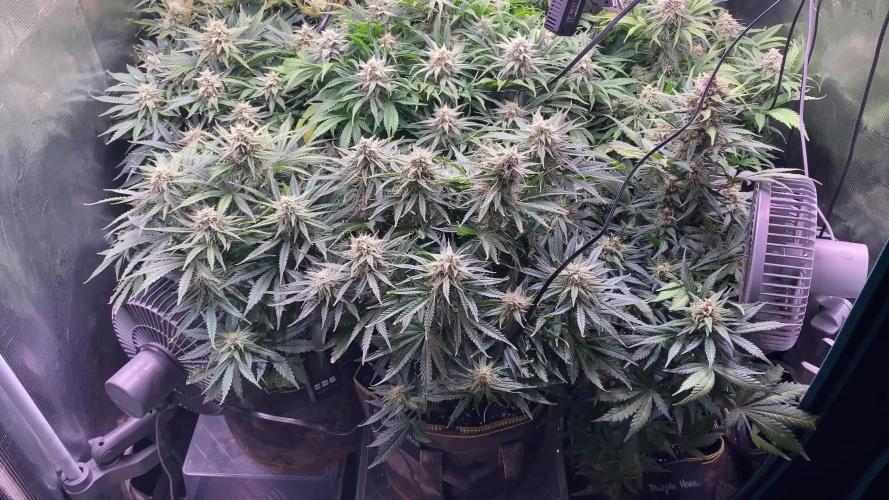
Struggling with RH, tent is too crowded bc I have lots of negative pressure, tent is bowing in hard. The best I can get down to is 50%RH, however I have tons of circulation. Look at video. I put a dehumidifier in the lung room. Rh drops if I open window, but its raining. Too wet outside rn. It went from blizzard (dry) to rain for 7 days now, maybe thats why Im struggling. Need circulation in lung room too. Vents open, still struggle, tent door open, im fine. And I use blackout curtains so no light penetrates the room. It maintain complete darkness 24/7. Plants sleep when i sleep, so never worried about it. My house was built in 1952 post WWll, so no insulation, just straight brick and a solid slab. That means it will hold moisture. Lung room at 35% RH. Rearranged set up. Trichomes...... 70% clear, 20-25%% cloudy, 5% amber
Likes
21
Share


@darb35
Follow
Last week was a short one, decided to chop them on day 80.
Both plants weigh at 800g wet, hoping to get a bit over 100g dry.
They could probably go for another week to get fatter, but I was feeling ready looking at the trichomes.
Hope the dry slow, I can't get RH above 50% so hoping that won't be so bad.
Processing
Likes
52
Share


@CBD_Sweden
Follow
2017-09-11. Kl 12.00. Week 3 starts. I have cleaned the whole room for the new week and gave the girls water and nutes. Added videos and pics. Girl is 10 cm high.
--------------------------------------------------------------------------------------------------------------------
2017-09-12. Kl 10.00. New pic and video.
---------------------------------------------------------------------------
2017-09-13. Kl 22.00. Added new video.
---------------------------------------------------------------------------------------
2017-09-15. KL 10.00. New pics and video. The girl is 14 cm high.
---------------------------------------------------------------------------
2017-09-16. Kl 10.00. The girl is starting to grow little better now and i hope she is picking up the pace. Added new videos.