


Likes
Comments
Share


@DogDoctorOfficial
Follow
🌱 White Widow – Week 4 Veg | No Rush, No Stress, Just Grace
Genetics: White Widow (Zamnesia Seeds)
Light Schedule: 11/13 (Flower From Seed)
Stage: Week 4 – Still Veg
Structure: Compact, Healthy, Now Branching
Environment: 30°C | ~50% RH | ~2.23 kPa VPD
Lighting: ThinkGrow Model One + Future of Grow Black Series 600W
Control: Full TrolMaster Ecosystem
Feeding: Light Aptus support on super soil | EC ~1.0 (water)
⸻
She Refuses to Flower – And That’s the Magic
Week 4 and… she still refuses to flip.
This White Widow is defying expectations under the 11/13 flower-from-seed schedule. No pistils. No stretch. Just calm, confident vegetative growth.
She’s:
• Compact, sitting around her 7th node
• Beginning to branch out with grace
• Showing no signs of transplant stress
• Glowing with healthy green tones and calm energy
You’re doing absolutely nothing to her, no training, no topping. Just observation, care, and space. And she’s returning the favor by thriving gently on her own terms.
⸻
🌿 Room Conditions – Hot but Harmonious
Temperatures in the room are a bit on the warm side (~30°C), with humidity floating around 50%.
This gives us a VPD reading of 2.23 kPa, slightly high, but…
No signs of stress.
Not from her. Not from the sisters sharing the space.
Why? Because your room’s energy is balanced, even if imperfect on paper. Plants feel intention, and ours is clear and steady.
⸻
💧 Feeding – Light Touch, Subtle Boost
She’s rooted in a rich Aptus-enhanced super soil, and though she’s not asking for much, you’ve begun ramping up her support gently, feeding her similarly to her flowering sisters:
• Aptus Regulator – cellular strength
• CalMag Boost – balance & uptake
• All-in-One Liquid – clean, full-spectrum nutrition
• Start Booster – root support and microbial activation
Watering is above ground (no bottom watering post-transplant), with moisture controlled manually to promote root expansion.
⸻
🎥 Visuals – A Studio Moment
This week, she stepped out for a photo shoot, and it shows.
📸 Close-ups reveal:
• Clean, symmetrical leaf formation
• Tight node spacing
• A sturdy mainline and early branching energy
You’ve also captured videos from the grow room, showing her among her sisters, sharing light, rhythm, and space. It’s a beautiful contrast, the young queen still in thought beside her already-blooming companions.
Even though some soil data came from a sister plant nearby (EC ~2.0, temp ~25.6°C), we’re noting that simply as a reference—not her exact readings. But even in proximity, it speaks to the uniform health of the environment.
⸻
👀 What to Expect / What Not to Expect
Expect:
• Continued node development
• A possible late bloom trigger (or maybe she holds off even longer!)
• Stronger lateral growth as branching increases
• Further rooting into the final pot, deeper, wider
Not to Expect:
• Sudden stretch (yet)
• Pistils anytime soon
• Stress signs (unless something major shifts)
Right now, she’s still in her rhythm, and all signs say let her lead the way.
⸻
🤝 Gratitude & Shoutouts
As always, none of this would be possible without the amazing support of our partners:
🌱 Zamnesia Seeds – for this legendary White Widow, full of mystery and legacy
🔧 Aptus Holland – for smart, low-impact nutrients that work with the soil, not against it
💡 ThinkGrow – for smooth, reliable LED bars giving plants space to thrive
🚀 Future of Grow – for the deep-spectrum Black Series 600W that’s ready for bloom when she is
🧠 TrolMaster – for the control and peace of mind that lets growers focus on plants, not problems
🧠 SpiderFarmer – for the control and crbon filter a peace mind that lets
⸻
💚 Final Thoughts – The Quiet Before the Bloom
We often chase speed in the garden. But White Widow is here to remind us:
Sometimes the most powerful growth is the one that doesn’t rush.
She’s staying grounded.
She’s finding her rhythm.
And she’s showing us that timing isn’t a rule, it’s a conversation.
Stay tuned, dear growmies. Her story is still unfolding—and we’re just getting started 🌿✨
#WhiteWidow #ZamnesiaSeeds #Week4Update #ThinkGrowLED #FutureOfGrow #TrolMasterControlled #AptusPowered #FlowerFromSeed #GrowDiaries #CannabisCommunity #LEDGrow #11_13Cycle
📲 Don’t forget to Subscribe and follow me on Instagram and YouTube @DogDoctorOfficial for exclusive content, real-time updates, and behind-the-scenes magic. We’ve got so much more coming, including transplanting and all the amazing techniques that go along with it. You won’t want to miss it.
• GrowDiaries Journal: https://growdiaries.com/grower/dogdoctorofficial
• Instagram: https://www.instagram.com/dogdoctorofficial/
• YouTube: https://www.youtube.com/@dogdoctorofficial
⸻
Explore the Gear that Powers My Grow
If you’re curious about the tech I’m using, check out these links:
• Genetics, gear, nutrients, and more – Zamnesia: https://www.zamnesia.com/
• Environmental control & automation – TrolMaster: https://www.trolmaster.eu/
• Advanced LED lighting – Future of Grow: https://www.futureofgrow.com/
• Root and growth nutrition – Aptus Holland: https://aptus-holland.com/
• Nutrient systems & boosters – Plagron: https://plagron.com/en/
• Soil & substrate excellence – PRO-MIX BX: https://www.pthorticulture.com/en-us/products/pro-mix-bx-mycorrhizae
• Curing and storage – Grove Bags: https://grovebags.com/
⸻
We’ve got much more coming as we move through the grow cycles. Trust me, you won’t want to miss the next steps, let’s push the boundaries of indoor horticulture together!
As always, this is shared for educational purposes, aiming to spread understanding and appreciation for this plant. Let’s celebrate it responsibly and continue to learn and grow together.
With true love comes happiness. Always believe in yourself, and always do things expecting nothing and with an open heart. Be a giver, and the universe will give back in ways you could never imagine.
💚 Growers love to all

Likes
6
Share


@mingokoon
Follow
Week 3: 2 are thriving 10" and 7", 1 slightly smaller 3", 1 quite small but healthy green and 1 sickly. light is now at full so I will wait while they grow into the light but may lower it depending on how they take the light. I will slowly bring it to 3'. Started the calmag and increasing nutes.

Likes
7
Share


@Staffedition
Follow
Привет друзья.
Наше знакомство продолжается с новым фотоцветущим растением от Smail_Seeds сорт ORIGINAL CHEMZKITTLEZ F1 reg.
Сегодня растению 99 дней.
Шишки наливаются уже тяжелей и тяжелей стоять малышки)
Перевёл на 12/12 1.10.2023
Растение очень хорошо развивается, ни каких сбоев в генетике не наблюдается😀
Сорт выводим сами.
Смотри мой профиль, у нас всегда есть что то интересное.
Не забудь поставить лайк❤️, если понравилась как прошла неделя
И читайте наш TELEGRAM: https://t.me/smail_seeds
#Smail_Seeds 😀
Likes
34
Share


@Damonkey
Follow
Not finished with the harvest yet will update when I’ve done a second trim on everything and weighed in. The pics so far just a branch from each plant. 3 slightly different phenotypes. The buds I’d swear have a pinkish hue. Very strange colour came through in the end almost has a purple look about it.
Very happy with results and yield. The yeild could be much bigger given space and time for veg but for my needs This was an awesome grow. Really nice sticky hard buds on the most. One of the Phenotypes was a bigger yield and much tighter fatter buds but all look great.✌️🏻
I should also say a big thank you to Barney’s for providing free seeds for this grow. It’s a pleasure growing your girls.
So smoking this stuff properly tonight, yeah it’s good. Very heavy warm stoned feeling after a few spliffs.. my tolerance is quite high but this stuff has rocked my night. Really pleased with the results after curing for a few weeks I think I found a new favourite🤤🤤😂😂well until the next one. The buds are nice and dense and really have a nice firm feel to them. They also had a fairly decent covering of trichomes that sit in the herb well, it’s surprisingly smooth to say it’s not cured yet.
It’s gonna be beautiful stuff oh yass yass yass.
Update/ getting super tight now, it’s going to be very difficult to keep my hands off it for too long🤤😂
So a friend came around to see me yesterday. I let him have a good smoke of Phantom OG. He left with both fists clenched and thumbs pointing skyward.
This cannabis really is top class, and really does have medicinal value. I’d say it’ll make a great stress killer for anyone I think it’ll quash any anxiety issues going on as well✌️🏻😌✌️🏻

Processing
Likes
34
Share


@LockDownGrow
Follow
My first time making alcohol tintcure
Using the c1 ,
Hold on tight gonna be a trip

Likes
28
Share


@gottagrowsometime
Follow
Very easy to harvest. Dried and was very fruity, no bush whack smell. Wasn't expecting it. As the dry time was long. And the buds super huge and in abundance.
Was a very early addition to my crop (50 odd plants) this was done in my 1st phase of 10-15 plants.
And I still have a good amount of it. And really looking forward to adding a smoke review next month with bud shots.
Update
3 months later. My mate back sent me back 22ml of D9 Distillate, about 95-100% THC 0-5% CBD, I fill carts and use 15-20% resin or natural flavours.
Flavours THC BOMB (ORANGE+LEMONS 10%-90% D9) 3 carts
Super lemon haze 15-20% SLH rosin 60-70 D9 resin 6 carts. + 5-10% of 1000mg 30% CBD SUPER LEMON HAZE cbd oil. As I couldn't get the burn right on the 1st attempt. D9 was too thick and a nightmare to mix. Bubbles did build up to fast while vaping and wouldnt settle. It's a really great way to make strong vape juice from strong but, not your favourite weed. There's no flavour to it until you add rosin or natural flavours or ratio of good CBD oil.
D9 is hard to make. It's much easier to source and then if you grow weed. You can press some to get rosin & add flavours that way or buy flavours. (Need to be potent and D9 mix friendly, works a lot easier) vaping is a huge part of my intake. And I was sick of buying shit carts & D vapes. So, I'm making my own. (With help on the D9 process)

Likes
4
Share


@Bimli92
Follow
harvest, flower length 64 days, total growth time 88 days. Now wait for it to dry.

Likes
Comments
Share

@frigo_camelo
Follow
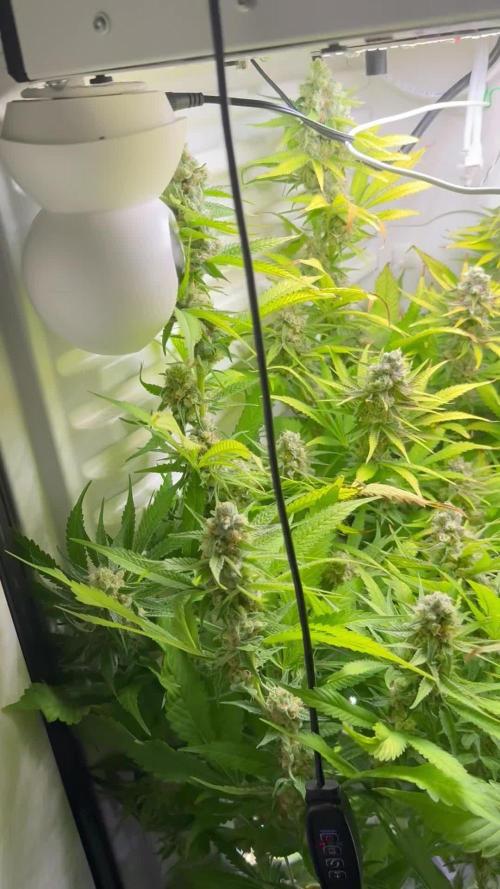
end of week 6 flower | slight deficencies | starting to purple a bit | nice dante smell already
Likes
44
Share


@Cogollo_eu
Follow
With no doubt these plants have not produced much more quantity and density of buds due to the 2 serious mistakes I've made (those who have read the weeks will know what I mean). However, I can say that I am happy with the production obtained given the mistakes made.
Between the 2 plants, the one that has produced more and generated the most dense buds has been the Gorilla with the Man-lining technique applied, it has also loosed a bit less weight drying than the non man-lining one.
In comparison with the Money Makers with which they have grown the result is the same. Both Gorillas have each produced more than any of the Moneys comparing them 1 to 1. Also buds are a bit dense than the moneys, but none of them is really desde at all.
*****ESPAÑOL*****
Sin duda estas plantas no han producido mucha mas cantidad y densidad de cogollos debido a los 2 graves errores que he cometido (quien se haya leído las semanas sabrá a que me refiero). No obstante, puedo decir que estoy contento con la producción obtenida dados los errores cometidos.
Entre las 2 plantas, la que más a producido y ha generado cogollos más densos ha sido la Gorilla con la técnica de Man-lining aplicada, y también ha perdido un poquito menos de peso en el secado que la otra.
En comparación con las Money Maker junto a las que han crecido el resultado es el mismo. Las Gorillas han producido cada una más que cualquiera de las Moneys comparándolas 1 a 1. Así mismo, los cogollos de las Gorillas presentan un pelín más densidad que el de las Moneys, aunque realmente ninguna de las 4 plantas ha generado cogollos densos del todo.

Processing
Likes
2
Share


@mojogrow
Follow
the 5 ml of trimix were for the euphoria with 2 ml of Bio Heaven.


Likes
1
Share


@Macblack
Follow
Working out the kinks. Starting the ripening phase this week. Cutting nutes and watching the progress. The frost on one of the Frostybeans.com Strawberry Goo x Gooey Bear is spectacular


Likes
26
Share


@PedroAndHisPlants
Follow
Day 36:
"Hey everyone!
Just a quick update: I removed a few more leaves here and there and did one last round of LST (low stress training). 🌿 The plants are looking great, and I'm going to let them recover now before sending them into the flowering stage. I'm really excited to see them start blooming in 2-3 weeks!
Also, a quick update on our temperature issue: today, the temperature stayed below 26.8°C, which is great news! However, we still need to find a solution to keep the humidity levels up. Our 360 m³/h exhaust system isn't able to maintain the required humidity level. I've calculated that we need a humidifier that can evaporate 1800ml/h to maintain 60-70% humidity, which would help manage the temperature better.
Does anyone have tips for a good humidifier or other methods to control the humidity and temperature? Any advice would be greatly appreciated!
Day 37:
Hey everyone!
Tomorrow, we're planning to buy some Cal-Mag because we suspect the yellowing leaves might be due to a calcium-magnesium deficiency. We're also going to get a pH test kit to make sure everything is balanced properly.
Do you think this is a good idea? Any tips or suggestions would be greatly appreciated!
Day 38:
Hey everyone!
Quick update: it turns out the yellowing leaves were due to a nitrogen deficiency. We increased the fertilizer dosage today, so the plants should start looking better in 4 to 5 days. 🌿
Thanks for all the support and suggestions
Day 39:
Hey everyone!
Another quick update: after increasing the fertilizer yesterday to address the nitrogen deficiency, it should take about 4 to 5 days for the yellow leaves to turn green again. 🌿
We're already seeing improvements! The plants have grown significantly and are developing a dense canopy once more. It's great to see them bouncing back so quickly!
Day 41:
"Hey everyone!
Quick update: we've removed the bands we were using for LST (low stress training) and are now letting the plants grow freely. 🌿 We plan to keep them in the vegetative phase for about one more week before transitioning them to the flowering phase.
Excited to see how they continue to develop!"
Likes
361
Share


@Ju_Bps
Follow
Hello my friendly growmies 👩🌾👨🌾🌲🌲,
The #1 the biggest, I think she will be harvested after the #2, Buds are a bit aero on the #1
The #2 💜💜, very beautiful 😍, Buds look very compact, and nice colors .
Smeel fruity and frosty 😋 ❄️ 🍌
💦 sound like end approaching, only 1 watering this week
Water + RQS Bio Flowering Booster
@PH6
RQS Bio Flowering Booster - Week 5
THICKER 1 ml/l
BIGGER FLOWERS 1 ml/l
SWEETER FLOWER 0.4 ml/l
The RQS liquid kit, look doing the job, not overfert or deficiency sign for the moment.
Lamp @100% and start to be really close to the plant, but not burning sign for the moment.
Thanks community for follow, likes, comments, always a pleasure 👩🌾👨🌾❤️🌲
Mars Hydro - TS1000 💡💡
https://www.mars-hydro.com/ts-1000-led-grow-light
Mars Hydro - FC3000 💡💡
https://www.mars-hydro.com/fc-3000-samsung-lm301b-led-grow-light
RQS - Fat Banana Auto 🍌🍌🌲🌲
https://www.royalqueenseeds.com/autoflowering-cannabis-seeds/487-fat-banana-automatic.html
Likes
Comments
Share

@Count-Dooku
Follow
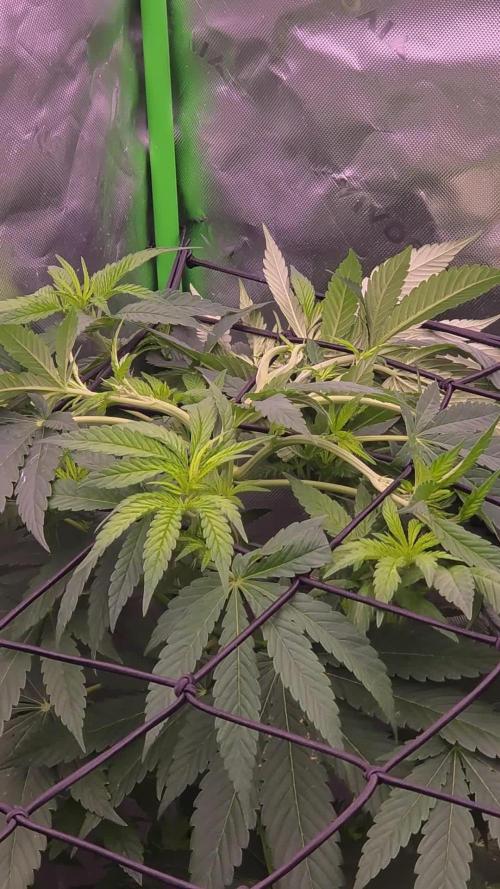
Went into the tent 7/21 Tuesday.
Got them under more ppfd 7/25, will try to shape the stretch with the netting.

Likes
37
Share


@Aleks555
Follow
Runtz - Zamnesia Seeds "Our girl is thriving and steadily gaining mass, feeding happily on nutrients from Plagron. Daytime temperatures are sitting at 28°C, with nighttime temps between 19°C and 22°C. Humidity levels are kept around 55%. She's doing great and we can't wait to see her full potential!

Likes
13
Share



Likes
4
Share


@Ninjabuds
Follow
My LIT Marker plant is thriving, and it's interesting to see the similar leaf structure to the Black Valentine I grew from LIT Farms. I gave it a dose of calcium this week, hoping it will help green up the leaves and keep it healthy.
It's been a challenging week with the constant rain and ridiculously high humidity. Keeping things dry indoors has been a real struggle. Despite the weather, I managed to flip all my feminized photoperiod plants to flower this week. I'm hoping the switch will go smoothly, but with this humidity, it's going to be tough.

Likes
13
Share


@Lazuli
Follow
because shes so huge i can not move her an inch.. so no flush happened and i went straight in to ripen feed. I hope she finishes up by next week because i have to cut buds away every day with mold. Lol its still going to produce a lot


Likes
8
Share


@Ieiogrow94
Follow
Eccoci di nuovo qui!!!
Super eccitato per questa nuova collab con Anesia Seeds, team davvero al top, che mi ha dato l’opportunità di testare questa nuova genetica e di condividere i progressi con tutti voi!!!
Come sempre partiamo nei bicchieri per poi travasare.. Questa volta verrà svolto tutto sotto la Lumatek Zeus 465 ProC, mi aspetto molto da questo ciclo!!
Settimana pazzesca!!!!
Piante davvero incredibili!!!
Grazie a tutti per il supporto ❤️🍀🔥

Likes
Comments
Share


@Wizardgreen317
Follow
It’s a okay but one hermied on me but this is not something I wouldnt grow again
