


Likes
Comments
Share


@BlackForestGrower
Follow
Growing Apple & Bananas was a breeze. The plants showed impressive resistance throughout the entire grow, handling stress and minor fluctuations with ease. They responded especially well to lollipopping — that technique really brought out their best structure and boosted the final yield. Speaking of yield, it was definitely on the higher side, with dense, resinous buds that were a pleasure to trim.
In terms of potency, the effects sit comfortably in the mid-range. It’s not overwhelming, but still delivers a pleasant, balanced high that’s perfect for relaxed afternoons or casual social sessions. What really stands out, though, is the flavor. Apple & Bananas lives up to its name with a sweet, fruity profile that mixes apple-like freshness with tropical banana notes — smooth, tasty, and easy on the lungs.
Overall, this is a great strain for growers looking for reliability, high yields, and a deliciously sweet terpene profile. While it’s not the strongest hitter out there, its combination of flavor, simplicity, and resilience makes Apple & Bananas a solid choice for both beginners and experienced growers alike.

Processing
Likes
33
Share


@Ferenc
Follow
Day 29: LST is done. I set the lamp approx 36 cm away. BlackBerry Kush, LSD-25 started flowering. All of them are OK started growing rapidly. 600W LED, 20 hours on 4 hours off the same with ventilation. Water intake: 75 ml per plant plus triggering, humidity around 60 percent. Fertilization is on Monday, Wednesday, and Friday with BioBizz family, Tuesday, Thursday, Saturday bat guano and Epsom salt.
Day 30: I did LST again. I didn't have enough elastic band yesterday so I bought today and bent them better. I also set the lamp closer approx 34 cm.
Day 31: I did LST yesterday and bent them. They already "lifted up" their heads toward the lamp. As they grow I will keep bending the main stalk and the side ones. I will try to create a spiral form and spread the plants with time.
Day 32: Most of them started flowering except Colorado Cookies. BlackBerry Kush aggressively started floweing. This plant is very strong and aggressive.
Day 35: pre flowers nicely coming along.... Balckbeery Kush and LSD-25 are the quickest. I changed the lamp as it is now really good.... so I placed an other 600W lamp there. I will swap these lamps one week here other week there. I will change that lamp after harvest. End of the week the tallest is BlackBerry Kush with approx 25 cm (I bent them so can't give perfect measurement) and the shortest plant is approx 18 cm.


Likes
2
Share


@waty_slo
Follow
Looking great. Continuing to defoliate and un-shade some bud sites, but with a light touch.
On 2/6 Top dressed: 1/2 cup bokashi, 1/2 cup build a flower, 1/2 cup fresh ground malted barley, 1/4 cup BAS craft blend, 1/4 cup alfalfa meal. Split this between the two containers. The worms are loving it and the soil mites are feasting.


Processing
Likes
34
Share


@Ashbash
Follow
Hey there,
Welcome to another week in the tent.
All plants are proceeding well, only thing is the gelato leaves are very light green in places bordering on yellow. I have added a little exra N nutes to that plant to try and remedy.
Other than that its plain sailing. Very easy going plants. Might just be me, but im sure that the QB has bought out the pistils sooner than the HPS did, but who knows. Light is doing very well, ecstatic with the upgrade.
Tried to upload a vid, but getting site errors, so maybe later it will be up.
Happy Growing.
Likes
2
Share


@ElBrujoTHC_Official
Follow
Terminamos nuestra quinta semana pasando a floración nuestras fotodependientes 🍀💫 empieza la magia

Processing
Likes
11
Share


@GreeneRecluse86
Follow
Another smooth week with the ladies. Nothing really to report.

Likes
19
Share

@adam_pawloski87
Follow
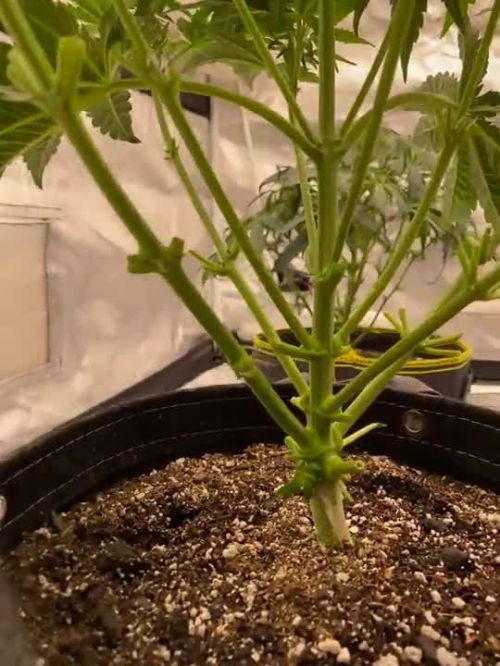
What another great week it’s been , today is Day 39 from seed an the lil ladies have jumped into preflower 😍! Yesterday gave em the trim up of the unders , kinda popsicled you can say to each one, cause we want to focus on them colas ! This week we should see some more great progress, let them caps start stacking ! Can’t wait to see what we do next week ! Hope you all enjoy an have an amazing productive day! Peace love an positive vibes to y’all Cheers 😶🌫️💨💨💨💨💨🤙🏻

Likes
16
Share


@Andres
Follow
she is in her last weeks ... we will see what she offers us ... with very little smell but nice ...
Likes
5
Share


Likes
29
Share


@AvoidantGrower
Follow
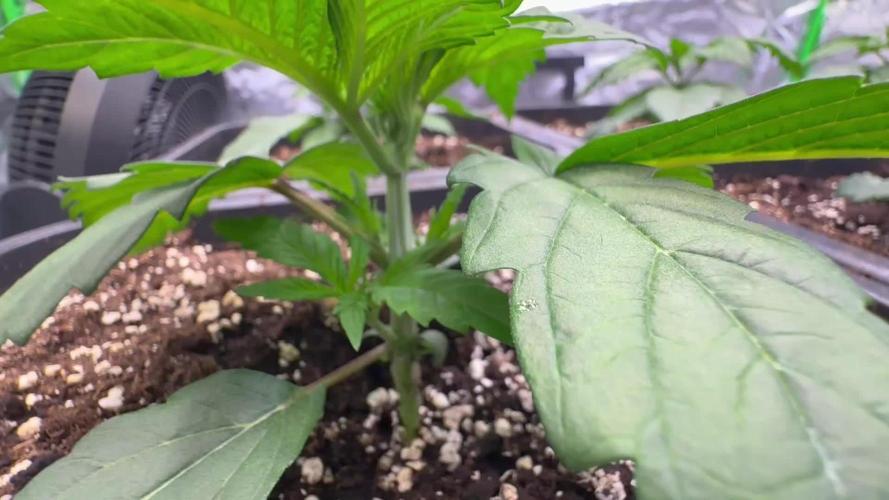
Day 21 - ThunderHaze Auto
This plant looks like it’s coming along just fine; she looks really healthy and all new growth looks free of burns so I’m going to start feeding nutes again this week. If the lower nodes branch out far enough I will begin LST'ing with 6” garden staples.
Technique: Topped on day 18 and seems to have handled it fine.
Light: MarsHydro 300 set at 15" above plant providing about ~28,000 LUX
Watering/Nutrients: plain RO water
Environment: 4x2 Grow Tent. Temps low of 68 - high of 91 with RH of 80%
Soil: ~6 gallons of Foxfarm Ocean Forest w/ 4 extra quarts of perlite added.
If you see anywhere that you think I can improve please drop a comment – thanks for reading

Likes
10
Share


@Gruschel_Muschel
Follow
Purple Punch am 26.12.2024
Tag 28 / 25.01.2025
Die Purple Punch habe ich ein Topping und LST unterzogen, sie hat sich sehr schnell erholt von Topping; eigentlich habe ich keine negative Reaktion bemerkt, das einzige ist wenn ich mit Biobizz dünge, macht die Pflanze einen gewaltigen Wachstumsschub.
Feedback:
Ich habe unterhalb zwei Blätter entfernt, mit dem Entlaubung bin ich sehr vorsichtig. Die Pflanze werde ich gut wachsen lassen, und die große Blätter nach und nach entfernen.
Ich könnte mehr Blätter entfernt, aber in der Vergangenheit habe ich Fehler gemacht.
Ich habe festgestellt das die Pflanzen in Light Mix besser wachsen, einmal Gisse ich die Pflanzen mit Dünger von BioBizz und einmal ohne Dünger. Soweit ich das sehe ist eine Überdüngung ausgeschlossen, gerne nehme ich Ratschläge aus der Community an.
Feedback am 29. Januar 2025
Die Entlaubung von Purple Punch war für meiner Sicht erfolgreich, die Vorgehensweise nach und nach die Entlaubung durchzuführen hat die Pflanze nicht gestresst.
Likes
7
Share


@BudLoveJohn
Follow
Plants sprouted in just three days after planting! First week for the seedlings was me learning to get the humidity and light the right distance. A little bit of stretching but not too big of a deal. Plants fixed themselves


Likes
74
Share


@Mr_Maes
Follow
We are officially in full bloom. The have been enjoying 6-7 hours of sun light per day for about 4 days now, then brought back in under the cobs. The girls are all exploding with growth and stacking what I expect to be huge buds.

Likes
19
Share


Likes
10
Share


@I_Identify_As_A_Dan
Follow
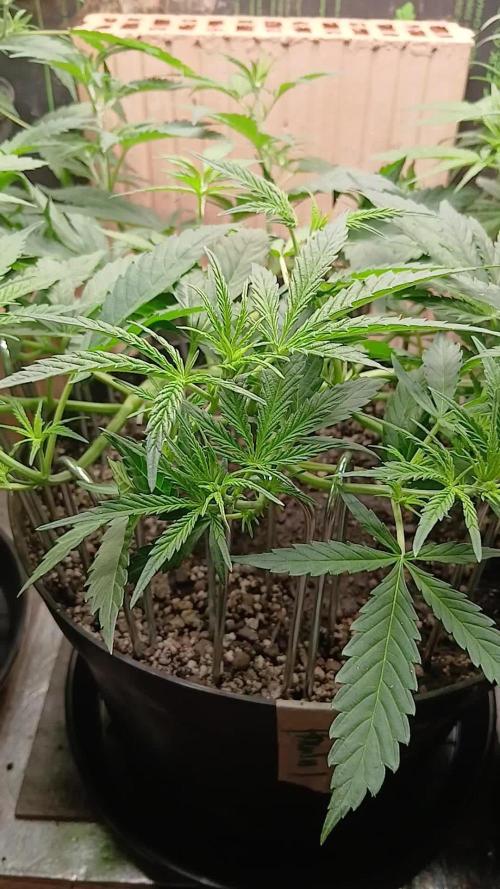
Week 3 of flower for White Widow
Hard not to love this girls structure to be honest...😍
Also showing purple signs from the could nights i think not ideal.
Bottom feeding just over a litre of water a day on her drip tray.


Likes
55
Share


@Ultraviolet
Follow
What's in the soil? What's not in the soil would be an easier question to answer. 16-18 DLI @ the minute. +++ as she grows.
Probably not recommended, but to get to where it needs to be, I need to start now.
Vegetative @1400ppm 0.8–1.2 kPa 80–86°F (26.7–30°C) 65–75%, LST Day 10, Fim'd Day 11
CEC (Cation Exchange Capacity):
This is a measure of a soil's ability to hold and exchange positively charged nutrients, like calcium, magnesium, and potassium. Soils with high CEC (more clay and organic matter) have more negative charges that attract and hold these essential nutrients, preventing them from leaching away.
Biochar is highly efficient at increasing cation exchange capacity (CEC) compared to many other amendments. Biochar's high CEC potential stems from its negatively charged functional groups, and studies show it can increase CEC by over 90%. Amendments like compost also increase CEC but are often more prone to rapid biodegradation, which can make biochar's effect more long-lasting. biochar acts as a long-lasting Cation Exchange Capacity (CEC) enhancer because its porous, carbon-rich structure provides sites for nutrients to bind to, effectively improving nutrient retention in soil without relying on the short-term benefits of fresh organic matter like compost or manure. Biochar's stability means these benefits last much longer than those from traditional organic amendments, making it a sustainable way to improve soil fertility, water retention, and structure over time. Needs to be charged first, similar to Coco, or it will immobilize cations, but at a much higher ratio.
a high cation exchange capacity (CEC) results in a high buffer protection, meaning the soil can better resist changes in pH and nutrient availability. This is because a high CEC soil has more negatively charged sites to hold onto essential positively charged nutrients, like calcium and magnesium, and to buffer against acid ions, such as hydrogen.
EC (Electrical Conductivity):
This measures the amount of soluble salts in the soil. High EC levels indicate a high concentration of dissolved salts and can be a sign of potential salinity issues that can harm plants.
The stored cations associated with a medium's cation exchange capacity (CEC) do not directly contribute to a real-time electrical conductivity (EC) reading. A real-time EC measurement reflects only the concentration of free, dissolved salt ions in the water solution within the medium.
98% of a plants nutrients comes directly from the water solution.
2% come directly from soil particles.
CEC is a mediums storage capacity for cations. These stored cations do not contribute to a mediums EC directly.
Electrical Conductivity (EC) does not measure salt ions adsorbed (stored) onto a Cation Exchange Capacity (CEC) site, as EC measures the conductivity of ions in solution within a soil or water sample, not those held on soil particles.
A medium releases stored cations to water by ion exchange, where a new, more desirable ion from the water solution temporarily displaces the stored cation from the medium's surface, a process also seen in plants absorbing nutrients via mass flow. For example, in water softeners, sodium ions are released from resin beads to bond with the medium's surface, displacing calcium and magnesium ions which then enter the water. This same principle applies when plants take up nutrients from the soil solution: the cations are released from the soil particles into the water in response to a concentration equilibrium, and then moved to the root surface via mass flow.
An example of ion exchange within the context of Cation Exchange Capacity (CEC) is a soil particle with a negative charge attracting and holding positively charged nutrient ions, like potassium (K+) or calcium (Ca2+), and then exchanging them for other positive ions present in the soil solution. For instance, a negatively charged clay particle in soil can hold a K+ ion and later release it to a plant's roots when a different cation, such as calcium (Ca2+), is abundant and replaces the potassium. This process of holding and swapping positively charged ions is fundamental to soil fertility, as it provides plants with essential nutrients.
Negative charges on soil particles: Soil particles, particularly clay and organic matter, have negatively charged surfaces due to their chemical structure.
Attraction of cations: These negative charges attract and hold positively charged ions, or cations, such as:
Potassium (K+)
Calcium (Ca2+)
Magnesium (Mg2+)
Sodium (Na+)
Ammonium (NH4+)
Plant roots excrete hydrogen ions (H+) through the action of proton pumps embedded in the root cell membranes, which use ATP (energy) to actively transport H+ ions from inside the root cell into the surrounding soil. This process lowers the pH of the soil, which helps to make certain mineral nutrients, such as iron, more available for uptake by the plant.
Mechanism of H+ Excretion
Proton Pumps: Root cells contain specialized proteins called proton pumps (H+-ATPases) in their cell membranes.
Active Transport: These proton pumps use energy from ATP to actively move H+ ions from the cytoplasm of the root cell into the soil, against their concentration gradient.
Role in pH Regulation: This active excretion of H+ is a major way plants regulate their internal cytoplasmic pH.
Nutrient Availability: The resulting decrease in soil pH makes certain essential mineral nutrients, like iron, more soluble and available for the root cells to absorb.
Ion Exchange: The H+ ions also displace positively charged mineral cations from the soil particles, making them available for uptake.
Iron Uptake: In response to iron deficiency stress, plants enhance H+ excretion and reductant release to lower the pH and convert Fe3+ to the more available form Fe2+. The altered pH can influence the activity and composition of beneficial microbes in the soil. The H+ gradient created by the proton pumps can also be used for other vital cell functions, such as ATP synthesis and the transport of other solutes. The hydrogen ions (H+) excreted during photosynthesis come from the splitting of water molecules. This splitting, called photolysis, occurs in Photosystem II to replace the electrons used in the light-dependent reactions. The released hydrogen ions are then pumped into the thylakoid lumen, creating a proton gradient that drives ATP synthesis.
Plants release hydrogen ions (H+) from their roots into the soil, a process that occurs in conjunction with nutrient uptake and photosynthesis. These H+ ions compete with mineral cations for the negatively charged sites on soil particles, a phenomenon known as cation exchange. By displacing beneficial mineral cations, the excreted H+ ions make these nutrients available for the plant to absorb, which can also lower the soil pH and indirectly affect its Cation Exchange Capacity (CEC) by altering the pool of exchangeable cations in the soil solution.
Plants use proton (H+) exudation, driven by the H+-ATPase enzyme, to release H+ ions into the soil, creating a more acidic rhizosphere, which enhances nutrient availability and influences nutrient cycling processes. This acidification mobilizes insoluble nutrients like iron (Fe) by breaking them down, while also facilitating the activity of beneficial microbes involved in the nutrient cycle. Therefore, H+ exudation is a critical plant strategy for nutrient acquisition and management, allowing plants to improve their access to essential elements from the soil.
A lack of water splitting during photosynthesis can affect iron uptake because the resulting energy imbalance disrupts the plant's ability to produce ATP and NADPH, which are crucial for overall photosynthetic energy conversion and can trigger a deficiency in iron homeostasis pathways. While photosynthesis uses hydrogen ions produced from water splitting for the Calvin cycle, not to create a hydrogen gas deficiency, the overall process is sensitive to nutrient availability, and iron is essential for chloroplast function.
In photosynthesis, water is split to provide electrons to replace those lost in Photosystem II, which is triggered by light absorption. These electrons then travel along a transport chain to generate ATP (energy currency) and NADPH (reducing power). Carbon Fixation: The generated ATP and NADPH are then used to convert carbon dioxide into carbohydrates in the Calvin cycle. Impaired water splitting (via water in or out) breaks the chain reaction of photosynthesis. This leads to an imbalance in ATP and NADPH levels, which disrupts the Calvin cycle and overall energy production in the plant. Plants require a sufficient supply of essential mineral elements like iron for photosynthesis. Iron is vital for chlorophyll formation and plays a crucial role in electron transport within the chloroplasts. The complex relationship between nutrient status and photosynthesis is evident when iron deficiency can be reverted by depleting other micronutrients like manganese. This highlights how nutrient homeostasis influences photosynthetic function. A lack of adequate energy and reducing power from photosynthesis, which is directly linked to water splitting, can trigger complex adaptive responses in the plant's iron uptake and distribution systems.
Plants possess receptors called transceptors that can directly detect specific nutrient concentrations in the soil or within the plant's tissues. These receptors trigger signaling pathways, sometimes involving calcium influx or changes in protein complex activity, that then influence nutrient uptake by the roots. Plants use this information to make long-term adjustments, such as Increasing root biomass to explore more soil for nutrients. Modifying metabolic pathways to make better use of available resources. Adjusting the rate of nutrient transport into the roots. That's why I keep a high EC. Abundance resonates Abundance.
Likes
6
Share


@Donniedanko93
Follow
Despite her flaws due to my own fault she was giving me a real cheese smell but now the wedding cake comes through and sweetens it up. She smells amazing
Likes
44
Share


@I_and_I
Follow
New light installed, twice as powerful as before but still a cheap light I've yet to learn fully
Like the first batch of seeds to germinate, I again get a strange 'quad' seedling, 4 embryo leaves, then attempts to grow it's first 4 leaves instead of 2 also, growth is severely stunted in both seedlings to start with 4 embryo leaves after seed popped
Likes
8
Share


@YourStonedBuddy
Follow
Week 4 is here!
putting in some over time with the leaf tucking, this girl is very short and bushy! Prepping for her stretch, opening the plant out nicely so light can hit deep down.
She is stretching slowly and throwing pistils everywhere. Im holding fingers she stretches some more
