Likes
Comments
Share
@Arkash
Follow
This was the last week I fed the plants nutrients. For the next two weeks, they’ll get only water. It’s also the final week with the lights at full power.
Likes
41
Share
Everything looking great. I'm adding pk13/14 starting today at 2ml per gallon for the next two weeks. Leaves starting to sugar up, smells piney and amazing.
Likes
47
Share
So, I’m excited. New lights today. Horticultural grow lights quantum boards built for me by growerslights.com I don’t have to time or knowledge to build one but I wanted one. Growerslights builds and tests for you for $50. Money well spent. This light is the shit. Full stop. So bright, so efficient. I’m getting a lot more light for 80w less per hour and that’s on full power. I’m going to start at 1/3 and slide up a little over the next few days. It’s the hlg-650h ok commercial done. I cannot wait to do a full grow under this monster. As far as the current plants. They’ll do their last week and a half under it. I’ll move the mars hydros to a small cloner I got. Flushing now until harvest on the weekend of the 30th-31st
Likes
Comments
Share
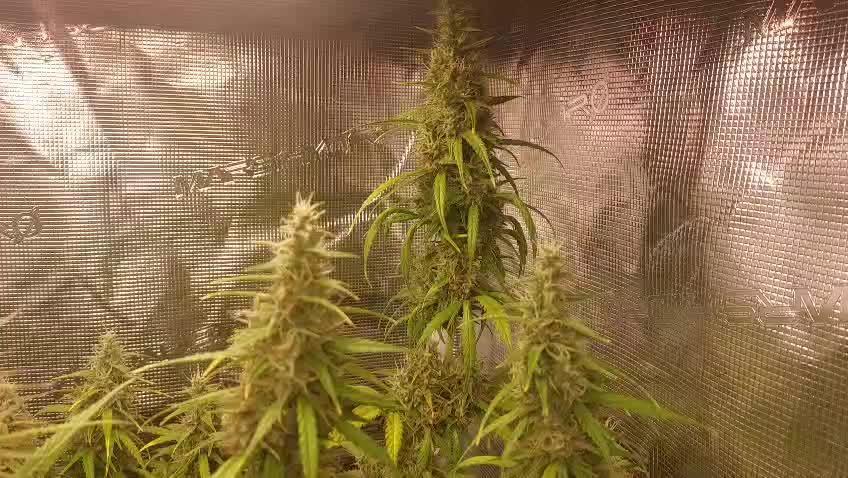
Het gaat goed , niks noemenswaardig. Heb haar in de tweede week getopt, en nu wat grote bladeren verwijderd.
Processing
Likes
3
Share
Likes
27
Share
@Dunk_Junk
Follow
5.5cm of growth from her this week!! Roots are getting more prominent too. Still have no idea what I'm doing 😂
Likes
3
Share
Muy buena cepa, potente, productora y fácil de cultivar. El efecto fue exactamente lo que buscaba; intenté curar la yerba lo mejor que pude para poder preservar los terpenos y así disfrutar aún más. Cepa recomendada😄
Likes
306
Share
@Sparkles
Follow
Brought to u by Mars Hydro SP3000 x2. Grow on Earth. Grow with Mars. All pics day 40. Welcome back. Mid/late flower now. Winding down nutes and teas and will feed to get the buds to ripen. Apex is frosting up nicely and her smell is popping, closest I can get to describing it is like cleaning products from a real fancy hotel…but lots of fan leaves are showing signs of deficiencies and/or lockout cuz she’s root bound really bad. Buds and sugar leaves aren’t affected, so far so good, I hope they stay that way 🤞 Gelato is fattening up real nice and has that distinct pungent aroma but not as strong as apex and not a lot of trichs. I hear this strain starts picking up in week 7+…although she’s root bound too but not as bad (I think). Lights are at 80%…they’re fricken beasts and way too much power for such a short, tiny tent. Next grow will be same strains, bigger final pots and will be in a new tent that is 6” (15cm) taller, every little bit helps :) That’s it for this week. Thanks for stopping by. Stay safe and happy gardening 🌱🌱
Likes
2
Share
Day 50 Flower: So far the last few cold nights have kept any 8 legged pests away: fears averted. A couple Hoverflies have been patrolling. After a quick google search I read they eat aphids so I think we're friends. Night time temps dipped as low as 5c while daytime temps were 22-24c with sunshine 95% of the time. I keep it indoor until 10am when it warms up so that morning photosynthesis isn't inhibited. I am aiming for 100g in 100 days so these last two weeks w may be tougher to keep her happy as temperature is rising into the high 20s(c). The one day i let her sit in the sun at 28c i noticed the top calyxs suffered UV damage and caused minor fox tailing. From then on if temperatures peaked above 26, my procedure is to shade it. I've made more frozen water bottles to circulate in and out of my reservoir every two hours. Root health has improved they are looking pretty good and the water is always kept cold to touch. I haven't used h202 in a few days. She smells more and more everyday! The smell drenches fabric and my darkroom smells for hours after taking her out for the day. Day 52: Temps hit 32c high today. I had to put the plant in the porch shade by 1230 when it peaked over 26c. Circulation fan on full blast keeps her happy and fox tail free (knocks on wood) She's drinking like a sailor close to 5 litres+/- in this heat. When i refresh the reservoir i give her a heavy dose 4ml/L. Then when topping up the reservoir I only use 2ml/L. Day 53: Trichrome inspection with a loupe confirmed its mostly cloudy with over 25% still clear as glass.
Likes
8
Share
@Fubar_420
Follow
So far so good they are starting to slow down on stretching and getting some nice pretty white flowers. The Little girl might still impress after all.
Likes
200
Share
@Ferenc
Follow
Day 79, 28th of November 2020: Hi there! Here we go let's say half way. Plants are pretty these Original Sensible Seeds genetics are fantastic! The 2 OG and the Runtz Gum is very strechy. Black Ghost is pretty shorter bushier plant. Runtz Gum and Do-Si-Dos OG approx the same height Do-Si-Dos OG is taller a bit. Wedding Gelato is really cool little, bushy anf nice buds forming not problem with her all she is quiet. Do-Si-Dos OG has some deficiency and leaf gets dry but nothing very serious..... Fertilization is still the same every second day with the rationand mixture above stated. The lamp is on 11.15 min and off 12.45 min. Last week was 15 min longer light cycle.... So every week 15 min shorter light cycle until the 5th week. So far -45 min. It switches on at 6 am and off at 17.15 pm.
Likes
1
Share
@420Baddie
Follow
She really had a growth spurt! She seems very happy! Hope things keep going smoothly.
Likes
18
Share
@Dunk_Junk
Follow
Stick a fork in her, she's done. Look at the timelapse how she goes yellow very quickly! Shortly after these pics she was harvested. I note she is VERY sticky.
Likes
2
Share
Remember that, however you are played, or by whom, your soul is in your keeping alone. Even though those who presume to play you be kings or men of power, when you stand before God, you cannot say, 'But I was told by others to do thus,' or that virtue was not convenient at the time. This will not suffice. Remember that. Day:18 84°F and 65% RH (VPD) for the vegetative stage. Approximately 1.15kPa(assuming leaf temperature is about 2°F cooler than the air), which falls right into the ideal vegetative sweet spot (0.8kPa to 1.2kPa). At 1.15kPa, plants can draw water and nutrients efficiently without risking stress or wilting. It keeps the leaf pores (stomata) open, allowing for ideal carbon dioxide intake and maximizing vegetative growth. VPD is determined by the leaf's temperature, not just the ambient air. Because leaves usually run 1° to 3°F cooler than room air under bright grow lights, my actual VPD will be slightly lower, closer to the 1.0kPa mark. As she transitions from vegetative growth to flowering, one can gradually lower the humidity (to around 45–60%) and drop temperatures slightly to prevent disease from settling inside dense buds when they appear. Night:6 At 70°F and 60% relative humidity, Vapor Pressure Deficit (VPD) is 0.86 kPa. This is right on the cusp of whats optimal for the vegetative stage. During the nighttime, plants generally close their stomata and undergo cellular respiration rather than photosynthesis. Transpiration slows to a near stop, making VPD less critical at night than during the day. However, maintaining a nighttime VPD between 0.8 and 1.0 kPa is highly beneficial in that it ensures the air is dry enough to prevent powdery mildew or bud rot, but moist enough to keep the plant from undergoing unnecessary stress. This range keeps the environment comfortable for cellular processes and prevents large atmospheric swings. Keeping it all flowing. (Not pushing them yet, these are photoperiods) The optimal soil (root zone) temperature for cellular root respiration and nutrient uptake in cannabis is between 68F & 72F This narrow range balances biological energy production (cellular respiration) with the dissolved oxygen levels in the soil, maximizing plant growth and health. Warmer soils hold significantly less dissolved oxygen. When soil temperature exceeds 74F oxygen depletion occurs, inhibiting cellular respiration almost entirely, At 68-72F root cells generate optimal adenosine triphosphate (ATP) via respiration to power root-tip elongation and the active transport of water and nutrients. Too Hot (Above 78F) Root respiration increases, demanding more oxygen, while the water's oxygen-carrying capacity drops. This creates a prime environment for anaerobic pathogens and Pythium (root rot). Too Cold (Below 60F) Root metabolism and cellular respiration slow to a crawl. This severely impairs nutrient and water absorption, leading to yellowing, wilting, and phosphorus deficiencies. A lot depends on whether it's automatic or photoperiod; with photoperiod, there is not as much of a need to push "hard" as the real countdown only begins once the flower is initiated. Automatics, on the other hand, the chronological "clock" begins ticking the moment the seed germinates. It is of critical importance that the seedling growth gets off to the races, understanding that early growth is like compound interest, which will pay off come harvest. This reality is why getting autoflowers "off to the races" early on yields such exponential benefits. The "compound interest" is directly related to the surface area of the leaves. Larger, faster-growing seedlings process more light and build bigger root networks early on, which translates into an explosion of vertical and lateral growth during their short vegetative window. The margins for error are so thin with autoflowers; this early-stage momentum depends on several critical practices. Seedlings exposed to increased atmospheric CO2 levels early in life will develop at an increased rate. To effectively "extend" or optimize the capacity of Photosystem II (PSII) for increased photosynthetic efficiency. In standard oxygenic photosynthesis, Photosystem II (PSII) is naturally limited to the red-light spectrum, peaking at 680nm. Extending its light-harvesting capacity past 700nm into the far-red region requires bypassing the natural limits of standard chlorophyll a. Adding 730 nm (far-red) LEDs alongside standard red/blue lights has been shown to increase canopy photosynthesis by 20–30% in several crops by acting synergistically with shorter wavelengths. However, the limitation is that excessive, pure IR/Far-red light (without accompanying red light) can trigger the "shade avoidance response," causing plants to grow tall, weak, and spindly rather than robust. Utilizing infrared light (specifically the 700-750 nm far-red range) is a viable method to boost photosynthetic efficiency. It acts as a bridge to allow PSII to utilize a broader spectrum of light, breaking the traditional 700 nm barrier. UVR8-mediated signaling (often in conjunction with CRY proteins) triggers protective mechanisms that maintain the stability of the photosynthetic apparatus (including LHCII and reaction center proteins), thus ensuring that the efficiency of Photosystem II remains higher in UV-B-exposed plants compared to plants lacking this receptor. ΦPSII indictates the rate of electron transfer from water to plastoquinone, which drives the production of ATP and NADPH. There is a close link between ΦPSII and the true rate of CO2 fixation (Φ*co2). ETR stands for Electron Transport Rate. It measures the speed at which electrons are moved through the thylakoid membranes in a plant's chloroplasts during the light-dependent reactions of photosynthesis. Infrared light (particularly Near-Infrared or NIR) improves cellular energy by interacting directly with the electron transport chain (ETC) in mitochondria. This process boosts adenosine triphosphate production, which acts as a metabolic coefficient multiplier by accelerating enzyme activity dramatically. Extend then multiply. Far-Red photons interact with plant photoreceptors to accelerate the plant’s biological "clock" or trigger a shade-avoidance response. Autoflowers don't use the plant's biological clock, although the IR will initiate a shade avoidance and make them stretchy. You can just add equal measures of 660nm-680nm to negate the shade avoidance effect. Replacing nights' "darkness" with a combination of IR+ and 660nm. Because autoflowers don't require a dark period to flower, many growers just blast them with light. 18/6 24/0. However, this ignores the plant's metabolic rhythms, where daytime photosynthesis (light reactions) must be perfectly balanced with nighttime carbon fixation and assimilation (Calvin cycle) to avoid bottlenecking plant development. Cellular respiration is a 24/7 process, but it can only function while the plant has the free oxidative capacity to do so. A 100% photosynthetically active leaf cannot perform cellular respiration. The viral trend of defoliation of every leaf that isn't "getting enough light" is of great detriment overall, putting 100% of the cellular respiratory "workload" and responsibility on the 0/4/6 hours of darkness in sub-optimal conditions for enzymatic activity. Photosynthesis captures nearly 100% of the initial energy as carbon, while cellular respiration is the process that unlocks 90% of that captured energy into usable ATP so the plant can use it. Respiration is considered only roughly 30% to 40% efficient. It captures enough of the potential energy in glucose to synthesize around 30 to 38 ATP molecules per glucose molecule. The remaining 60% to 70% of the energy in the sugar is not captured in ATP; instead, it naturally escapes into the environment as heat, which helps regulate plant temperature. In plants, the primary enzymes of the Electron Transport Chain (ETC) and the ATP synthase complexes are typically adapted to function optimally in warmer temperatures (roughly 77°F to 95°F, depending on the specific plant strain). As temperatures rise within this physiological range, molecular collisions increase, speeding up respiration and ATP production. The cannabis plant has a branched respiratory pathway. During heat or cold stress, plants activate Alternative Oxidase (AOX). AOX burns sugars to dissipate energy as heat rather than coupling it to ATP production. This pathway actually functions optimally at elevated temperatures to help protect the cell from the damaging build-up of Reactive Oxygen Species (ROS) during heat stress. Enzyme activity generally scales with heat; there is a strict biological limit. If canopy temperatures in a grow room exceed 104°F, the enzymes and their supporting lipid membranes lose stability. Not saying you need to go crazy, just optimize nights the same as we optimize days. Phosphorus is the driving force behind early seedling development. It acts as the "energy hub" of the plant, directly driving cell division, robust root growth, and the creation of DNA. Without an adequate, easily accessible supply early on, the plant's overall growth potential and final yield can suffer permanently.
Likes
53
Share
Salutations, fellow cultivators! Week 2 unfolds with the grace of a symphony, and the tale of my Blackberry Auto continues to captivate. The journey is both an art and a science, and every green leaf is a brushstroke on the canvas of cultivation. Our heroine has found her throne – a final 16L AutoPot. What makes AutoPots the crown jewel of cultivation, you ask? These self-watering wonders provide a dynamic, gravity-fed watering system, ensuring the plant receives precisely what it needs when it needs it. It's the epitome of hands-off perfection, allowing the plant to dictate its own hydration destiny. Transplant day is a ritual, a moment where roots meet Mycor Mix magic. This mix, a blend of mycorrhizae species, becomes the plant's ally, expanding the root system and fostering nutrient uptake. It's like giving my Blackberry Auto a superhero sidekick, enhancing her abilities and resilience. The transplantation dance continues with the application of Aptus Holland Mycor Mix on the roots and surroundings. This isn't just a transplant; it's a ritual of care. Mycor Mix establishes a symbiotic relationship, unlocking nutrients and fortifying the soil with beneficial microorganisms. It's a small act with profound effects, ensuring my plant's journey is supported at its very foundation. As the pot receives its royal guest, the soil is adorned with 75g of Aptus All-in-One pellets (NPK). This powerhouse blend provides a balanced nutrient feast, a banquet for optimal growth. The soil is further enriched with Aptus Micro Mix, a harmonious supplement that fine-tunes the nutrient symphony, ensuring every note is in perfect balance. Post-transplant, the ritual concludes with a nourishing bath – my Veg Aptus Recipe. This elixir, carefully concocted, ensures a smooth transition for Blackberry Auto. It's not just water; it's a potion that whispers the promise of health, strength, and vitality. The week embraces low-stress training, a dance where leaves are gently bent to shape the plant's architecture. Blackberry Auto, the prima ballerina, responds with joy. This technique not only encourages lateral growth but also maximizes light exposure, orchestrating a symphony of photosynthesis. As I witness this botanical ballet, I'm reminded that cultivation is a dialogue between caretaker and plant. Together, we embark on a journey where each element, from AutoPot elegance to Mycor Mix finesse, plays a vital role. Stay tuned for the continued saga of Blackberry Auto – a story told leaf by leaf, in every graceful twist and turn. Genetics Blackberry Auto @Fast_Buds Food - @aptusholland @aptus_world As always thank you all for stopping by, for the love and for it all , this journey of mine wold just not be the same without you guys, the love and support is very much appreciated and i fell honored and blessed with you all in my life
Likes
2
Share
Week 4 in the books. She started throwing pistils this week. Cruising along and handling the training like a champ. She's drinking about a cup of water daily and her roots are thriving in the runoff caught in the 2nd cup, which gets dumped before each new watering. Strong structure and starting to get a little smell. She smelled like celery leaves up to this point. I've raised her closer to the light to increase light intensity.
Likes
7
Share
@RBG
Follow
LA is doing lovely, she's was originally the tallest but after folding her like a lawn chair after a big day on the beers her upward growth has slowed right down and she's starting to push outwards like I was anticipating. LA punch is an unreleased genetic from Cali connection. I suggest if you top her to top her once. Relax on the defoilation and let her grow out. She is quiet compact and wants to stay together so you need to try and be forceful to get your way but do be careful. Doesn't like stress in the sense of defoilation and topping early on but handles high PH, high EC and high temperatures so far but obviously not for long otherwise you can seriously stunt your ladies. Light went from 60% to 90% over Week 5 to Week 6, next 2 days she'll be at 100% ready for flowering. 2 set AC infinity bar lights will go in over this week as well as my scrogg net. Nutrients this round Floramax veg1 Floramax organabud Floramax flowering enhancer ( 1/4 ) dose Flairforms roots Sleepz with the fishes ( pythoff ) Cyco platinum series silica Floramax calmag E.c 2.2 Ph 5.9-6 Let's gooo
Likes
22
Share
She had a tough life, I messed up her roots at the beginning and then overwatered, was really stunted and not growing for a while. Finally started growing normally, a bit late but looked fine. I had to hand her over to a friend for the last 4 weeks and she looked strange and buds were quite solid hard and dry.